

Fixing the world … together
Bergen County Interfaith Committee breaks bread and unites over global goals
We seem to live in a polarized world right now.
It’s an unsettling time, and we often look for comfort among people who are the most like us. That’s human, and understandable, but it also shuts us off from people and ideas we don’t already know.
Interfaith work seems to alter that. “By definition, interfaith work is important because we all share certain visions in common,” Rabbi Dr. Wallace Greene of Fair Lawn, an educator and historian, said. “We all want peace. We all want to eliminate the ills that affect society, when it’s hunger, when it’s climate change — there’s more that binds us than separates us.
“Theologically we have different belief systems, and we worship in different ways, but in terms of the world at large, there’s an agreement that we have to work together to improve the world.”
Rabbi Greene’s credits include leading the Hebrew Youth Academy — now the Joseph Kushner Hebrew Academy — when it began the program that now is the Sinai Schools. Sinai works with students with a range of developmental and academic disabilities, tailoring each student’s education; Rabbi Greene oversaw the program as it began and has championed it ever since.
He’s also — among many other accomplishments — been a member of the Interfaith Brotherhood/Sisterhood Committee of Bergen County and worked on the group’s annual breakfast for decades now.
The most recent interfaith breakfast — the group’s 36th — was on Presidents Day, just a few weeks ago. It’s always in a catering hall — with RBCB-inspected kosher food available — but its sponsorship changes every year. This year, the Jewish community sponsored it, and the speaker was a rabbi, Allyson Zacaroff, the American Jewish Committee’s associate director for interreligious affairs.
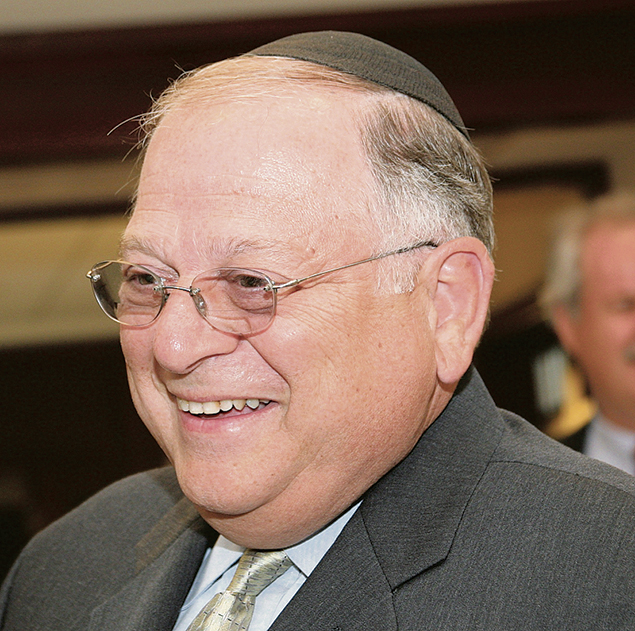
Rabbi Greene talked about the term “tikkun olam” — repairing the world. “It’s a term that might not be familiar to every other faith community” — and in fact it’s used most frequently by Reform Jews — “but it’s something that we all believe in,” he said. It’s taken from Aleinu, the prayer that ends all three daily services. There, we hope someday “l’taken olam b’malchut Shaddai” — to repair the world under God’s sovereignty. In other words, the phrase is old, and so is the concept.
All the social ills that the faith groups represented at the breakfast work together to attempt to fix “are within the framework of tikkun olam,” Rabbi Greene said. “We do not discuss theology. That is why I am able to participate in it.”
The other participants “all are wonderful people, and we have a great deal in common.”
There have been times when the members of the committee have come together to respond to specific events. “There was a bombing in a Sikh temple in Wisconsin in 2012, and all the members of the committee showed up to protest,” Rabbi Greene recalled. At other times, they meet for activities that showcase the culture and traditions of members. “When there’s an iftar” — the break-fast meal that ends each day of Ramadan — “the imam invites everybody to go to his mosque to participate in the meal. People share their festivals, and people show up.”
Rabbi Greene of course is careful about what he eats — unless it has a hechsher, he doesn’t — and he doesn’t go into buildings that hold the religious symbols of other faiths. “I was a speaker at a Bergen County event, and it started to rain, so we all went into the Protestant church next door. There were no images there. So it was no problem.”
Even when he can’t go inside a house of worship, he and the other Jews on the committee have a very friendly relationship with the imam and the Catholic priests, Protestant pastors, and other leaders. “I don’t understand the religious practices of some of the groups, and I’m not really sure what they do, but it doesn’t matter,” Rabbi Greene continued. “I’ve been to the Baha’i Gardens” in Teaneck. “It’s gorgeous.”
What really matters are the issues. “Everybody wants peace on earth,” he said. “Everybody’s concerned about the environment. Everybody’s concerned about nuclear warfare. These are things we share.”
In the last few weeks, the administration has made sweeping changes to environmental law and health protections. It’s reduced deregulation by rescinding the Greenhouse Gas Endangerment Finding, implemented in 2009, that capped dangerous gas emissions. It’s also changed its advice about what vaccinations children should get, and made it harder for adults to get others.
Those are subjects about which the members of the interfaith committee agree. “It boggles the imagination,” Rabbi Greene said. “You have nonscientists debunking scientific findings of pollution and emissions and vaccinations.
“I remember going to school with kids who had polio. When the Salk vaccine came out, it was the greatest thing since sliced bread. No, actually, it was better than sliced bread. So to say that kids don’t have to be inoculated anymore just boggles the mind.
“The group agrees on these issues. And they’re not about religion. They’re not theology or religious practice. They’re not even politics.
“We’re interested in tikkun olam. In bettering the world. We’re interested in what we have in common, not the things that separate us. There are so many things going on in the world — health, starvation, poverty discrimination — and we’re all concerned about all of them.”
The interfaith committee’s 36th breakfast represents a number that resonates with the Jewish community. On the level of popular superstition, it’s 18 times 2; 18 represents chai, life, so 36 is double life. (It’s a convenient amount of money to donate.) And 36 also is the number of lamed vavniks, the anonymous people who, according to Jewish mystics, save the world with their goodness.
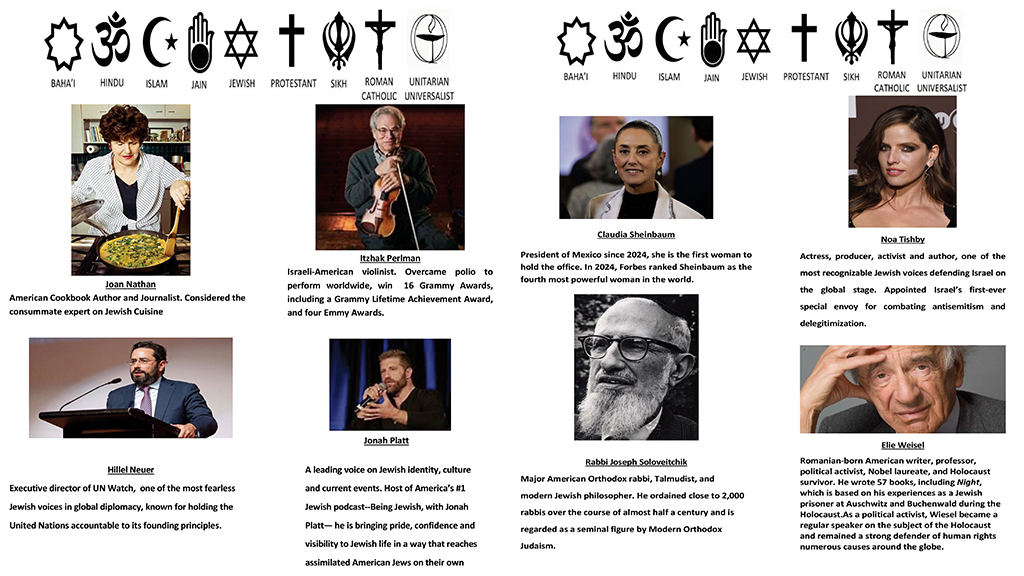
The Jews on the committee came up with 36 people, all either still alive or recently dead, who, they think, could be lamed vavniks. It’s an idiosyncratic, committee-made list — and hard to imagine that any one person could agree with all the choices — but it’s an interesting look at some of the values in today’s American Jewish community.
“They’ve all made contribution to the world, not just the Jewish world,” Rabbi Greene said. “Even though there might be negatives about some of these individuals, in the grand scheme of things, the good probably outweighs the bad. But we don’t know how God works. And it’s a fascinating list.”
The list took much time and effort to produce, and it’s sure to generate conversation about what our values, both personal and communal, represent. He hopes that soon the 10 poster boards that display all 36 people will hang in both the Jewish Federation of Northern New Jersey in Paramus and the Kaplen JCC on the Palisades in Tenafly, Rabbi Greene said.