

‘They feel so free’
Swimmers with multiple sclerosis find strength in the water at the Kaplen JCC
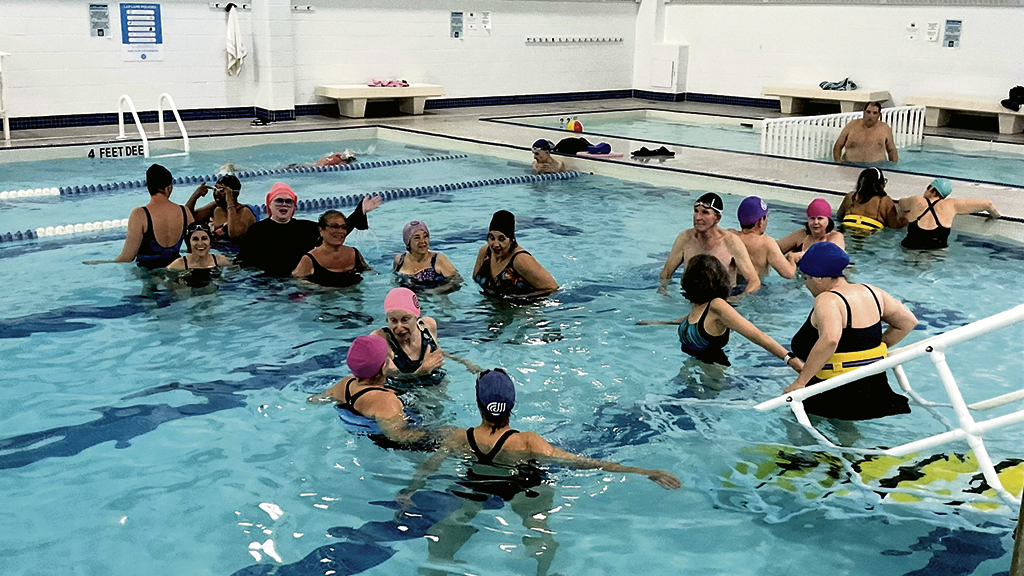
More than 15 participants in MS Swim-In, a free weekly program founded, funded, and sponsored by the Bergen County section of the National Council of Jewish Women, celebrated the program’s 50th anniversary at the Kaplen JCC on the Palisades in Tenafly this week.
MS Swim-In is one of very few water-therapy programs in the United States for people with multiple sclerosis that is run and supported by trained volunteers and offered at no charge to participants.
“There is no question that both the social and exercise aspects of this special community service are rewarding to swimmers and volunteers alike,” Roxanne Reff, the program’s co-chair, said.
Ruth Cowan of Teaneck, who died last year at the age of 100, was a licensed physical therapist and a past president and life member of NCJW. Her contributions to NCJW and programs sponsored by the Bergen County section were significant. A graduate of Syracuse University’s physical therapy program, Ms. Cowan believed in the medicinal value of water therapy.
Back in 1976, in a collaborative effort between the NCJW’s Greater Teaneck section — now it’s the Bergen County section — and the YWCA of Hackensack, Ms. Cowan helped form a water therapy rehabilitation program for patients recovering from radical mastectomies. The program, known as ABC (After Breast Cancer) helped more than 1,500 women and two men return to normal function and improved their ability to cope post-operatively.
“Ruth Cowan understood the therapeutic value of water exercise for those people recovering from breast cancer surgery and those suffering from the debilitating symptoms of MS,” Ava Silverstein of Woodcliff Lake said. Ms. Silverstein is a licensed physical therapist and the program’s clinical supervisor of water exercises. A past president and life member of NCJW, she has been involved with the Swim-In program for more than 25 years.
“In early 1976, we began sending introductory letters, materials, and permission slips to hospitals and MS centers throughout Bergen County to make clinicians aware of our program, to lay out our requirements for participation, and to seek referrals,” Ms. Silverstein said.
Multiple sclerosis is a disease of the central nervous system. Symptoms vary from person to person and can include fatigue, memory difficulties, mobility issues, mood changes, numbness, pain, tingling, and vision impairment. “People with MS don’t get better,” Leta Arad of Fair Lawn said. Ms. Arad, who is Ms. Cowan’s niece, is a member of the MS Swim-In leadership team and has volunteered as a swim buddy for the last 10 years. “Water activity is beneficial for them because their limbs often become weakened,” she said. “The buoyancy of the water permits body movement which might otherwise be difficult,” she said.
When MS Swim-In was founded, it was supported financially by a collaborative effort between the local NCJW section and the NJ Metro chapter of the national MS Society. “The program started in the pool at the Boys Club of Paramus and moved to the Kaplen JCC on the Palisades 25 years ago,” Ina Miller-Silverstein of Teaneck, MS Swim-In’s liaison to NCJW, said. “But in 2020, when the pandemic started, the MS Society no longer was able to contribute to the program. So the MS Swim-In program established its own 501(C)3 to be able to stand on its own as a nonprofit entity.”
For the last 50 years, the MS Swim-In program has been going strong. Ms. Silverstein explained how the process works. “Typically, a swimmer is referred to us by his or her doctor. Once we meet the participants, we determine whether they meet the criteria of the MS Swim-In program. Our evaluation assesses each swimmer’s ability to ambulate. For example, are they able to take five steps down to get into the pool? We evaluate balance, coordination, stamina, and muscle strength.
“The 17 participants in the program come to the pool every Wednesday from September through May with varying degrees of disease severity,” she continued. “Since MS is a progressive disease, our swimmers’ ability may change over time. For those who can no longer use the stairs, we have a hydraulic chair that transports them into the pool.”
Swimmers are never discharged from the program because of a change in status.
“People move easier in the water,” Ms. Silverstein said. “There’s no easy way to completely eliminate gravity, but you can minimize it in the pool. It is restorative for our swimmers. Many tell us they haven’t been able to move like this in years. They feel so free. While that feeling may not last for the rest of the week, for that hour they feel better than they have in a long time.”
Many of the MS Swim-In participants are referred by Dr. MaryAnn Picone, a board-certified neurologist who’s been the medical director of the MS Center at Holy Name Medical Center since 1993.
“Once swimmers join, they are evaluated by a licensed physical therapist and given a weekly swim program tailored to their needs and abilities,” Ms. Silverstein said. “In the pool, each MS swimmer is assigned a buddy for assistance in the water. Some participants want to swim to the deep end with their buddy and stay there. Some remain strictly in the shallow end. There, we work on gait activities, balance, coordination, and strengthening. Others require hands-on mobilization exercises to help them regain motion where an upper or lower extremity has tightened. In the pool, swimmers are fitted with buoyancy belts and they can walk in the water, swim, and exercise. If we see red flags, we refer them back to their physicians.”
There are also volunteers, who are responsible for taking a swimmer in a wheelchair from the gym to and from the locker room to the pool area, helping swimmers dress or undress, or meeting them at the front door of the JCC to escort them to Swim-In.
“Our trained volunteers recognize that each swimmer who joins MS Swim-In comes to the program with his or her own set of expectations and abilities,” Ms. Silverstein said. “It’s important to respond to each person individually so that they are comfortable from the moment they arrive at the JCC. Our volunteers can empathize with their MS buddy, but they can’t really know what the swimmer is experiencing. Thankfully, the MS swimmers can support one another in and out of the pool.”
Ms. Silverstein was Ms. Cowan’s PT assistant at MS Swim-In for several years. “Once Ruth began tapering down her involvement, about 15 years ago, I became the lead physical therapist for the program,” she said.
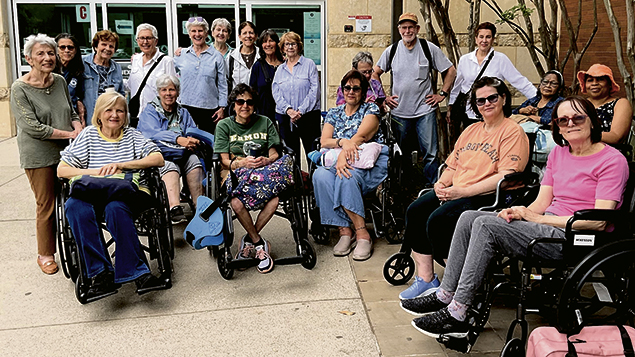
It is the program’s practice to dedicate a wheelchair that will be used by a member of MS Swim-In to a volunteer or a swimmer who passed away,” Ms. Silverstein added.
After Ms. Cowan retired, the MS Swim-In program was chaired by Michael Silverstein, an MS Swim-In volunteer and board president. When Mr. Silverstein stepped down two years ago due to ill health, a leadership team consisting of his wife, Ina Miller-Silverstein, Roxanne Reff, Nina Saslowsky, and Leta Arad was formed. Ms. Miller-Silverstein describes the swimmers and volunteers, so many of whom return from year to year, as more like a family than anything else.
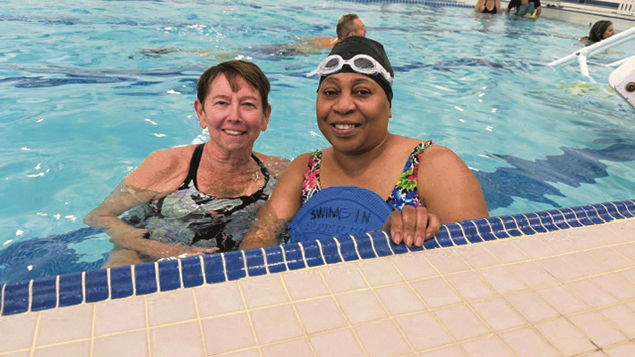
MS Swim-In participants Francine “Francie” Forteau of Hackensack, 60, and Angela “Ang” Silecchia of North Bergen, 62, agree. “I was diagnosed in 1988,” Ms. Silecchia said. “I was 24 years old and I’d lost vision in my right eye. A brain MRI revealed relapsing/remitting MS. Ten years from my diagnosis, I was taking high doses of oral steroids and still working as a children’s wear pattern maker in New York City. I began feeling more debilitated as flare-ups increased.
“Standing was difficult, I was overwhelmed with fatigue, I had bouts of numbness and paralysis in my legs, and I was in so much pain that sometimes I couldn’t even walk across the room. I would drive my car to a bus stop that was easier to get on, but the routine of walking from the Port Authority to work became intolerable.” Ms. Silecchia sees Dr. Picone for treatment at Holy Name. “I stopped working and needed to start on medications that were specifically targeted to treat my symptoms and exacerbations.”
Ms. Silecchia lives with her mother, Frances, who is 93. “I learned about the MS Swim-In program through my neurologist and my late father, Nick, who drove me to my appointments and volunteered to support the men in the MS Swim-In program for 20 years,” she said.
Ms. Silecchia walks; she doesn’t use a cane or a wheelchair.
“I was never afraid to go in the water,” she said. “But there are some people who rely on the belt we wear that serves as a floating device — like a life vest. Our volunteers stay right next to us and, if we’re not comfortable in the deep end, even beyond six feet, we don’t have to venture far. Some of us stay in the low end of the pool and do arm stretch exercises.”
“I have been participating in MS Swim-In for 28 years,” she said. “I look forward to attending every Wednesday and appreciate how loving and giving the volunteers are. They’re my swim family.”
Ms. Silecchia said that there are times when she doesn’t feel physically able to go, but she forces herself because she knows she’ll benefit from it. “It’s easy for me to do things in the water,” she said. “When my dad died, the NCJW MS Swim-In program honored him with a plaque that was placed on the side of one of our wheelchairs.”
Francie Forteau started the MS Swim-In program three years ago. “I had my two daughters later in life,” she said. “My first was born when I was 35, the second when I was 37. I’d been an elementary school teacher in Trinidad and Tobago, but when I turned 40, I decided I wanted to be a nurse, so I enrolled at William Paterson University at night.
“I remember distinctly when I started having symptoms,” she said. “It was my last year of school and we were doing a med-surg unit on, of all things, multiple sclerosis. I said to my classmates, ‘Guys, I think I have MS.’ Everyone thought the stress of school was getting to me, but I had all the classic symptoms.
“I earned my BSN, began working the 11 p.m. to 7 a.m. shift at Englewood Health, and saw my primary care physician to request an MRI. He told me he’d order an X-ray first to determine why I was having pain in my right arm and vertigo. He gave me a steroid shot for the inflammation and it helped, but when I saw the neurologist, he ordered an MRI, a spinal tap, and lab work. The results matched my suspicions. I had progressive/remitting MS.”
Because of the stress at work and not getting enough rest, Ms. Forteau’s condition exacerbated rapidly. She was hospitalized every year until she decided to stop work and apply for long-term disability. “I began treatment with Dr. Picone, who enrolled me in several clinical trials for free,” Ms. Forteau said. “She referred me to the MS Swim-In program.
“I grew up in Trinidad, an island in the Caribbean surrounded by water, but because of my overprotective mother, I never learned to swim,” she said. When she arrived at the Kaplen JCC in Tenafly for her first MS Swim-In class, she was scared. “I stayed in the shallow end,” she said. “I would not leave the stairs for some time, but the swim coaches were wonderful, patiently coaxing me to swim out a little further each week.” It took her a year and a half to make her way to the deep end.
Ms. Forteau’s husband, Donald, supported her as she gave up her job. “I could not physically do it anymore,” she said. “My wish was for my daughters, Donna and Danielle, to get a good education here, and they did. They’ve both graduated from Rutgers University.”
After many accidents, Ms. Forteau stopped driving. “I take the free Bergen County Community Transportation bus to and from the MS Swim-In program,” she said. “Every state in America should have a program like this. Since I started exercising with the program, I have not had an exacerbation or any new plaques. My deficits remain, but no new symptoms.”
Ms. Silecchia attests to the therapeutic and social value of the swim program. “We make friends with one another — we chat outside of the locker room, we chat on the phone, and for a period of time, we were communicating on Zoom about our symptoms, the medications we were on, and our experiences living with MS.
“Ruth Cowan started this wonderful program 50 years ago,” she added. “She did so with all her heart.”
Ms. Silecchia and Ms. Forteau are indebted to all the dedicated volunteers of the MS Swim-In program and the financial support of NCJW’s Bergen County section. “Without them, we wouldn’t have a program,” Ms. Silecchia said.
To join or to volunteer, email Barbara Lightbody at msnewswimmer@gmail.com.