

Dedicating Rabbi David M. Feldman Way
Teaneck honors the spiritual leader, scholar, writer, and thinker who helped calm a town in crisis
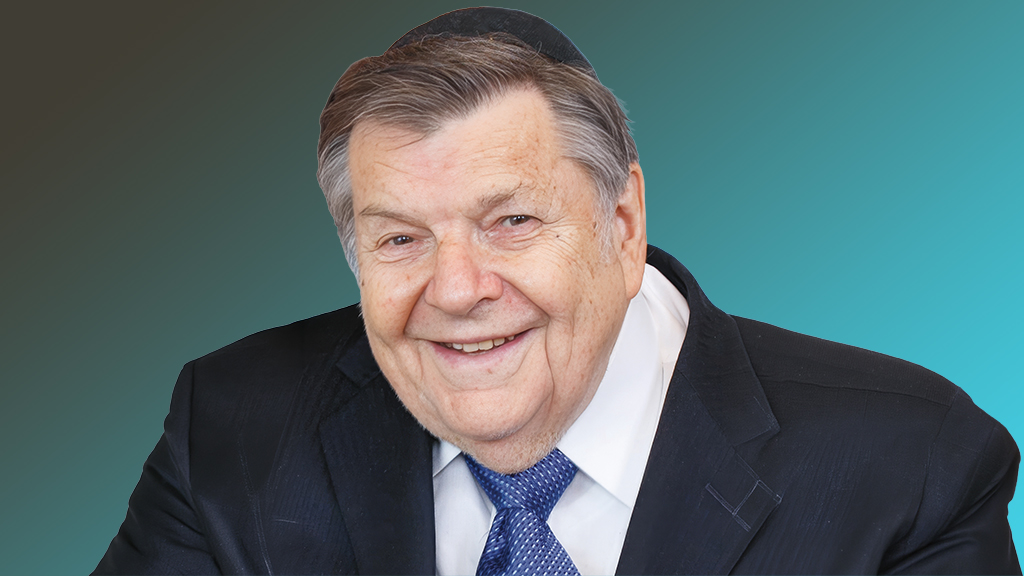
The thing about time is that it moves in only one direction. Relentlessly. Usually it blows sand over the memories of all but the most extraordinary among us and covers them up.
But sometimes that process is stopped. No, not time — that’s beyond our power — but the time-enforced fading of memory. When someone has lived an extraordinary life, people who have been touched by him or her remember.
That’s the case with Rabbi David M. Feldman, the longtime rabbi of the Jewish Center of Teaneck, who was born in Los Angeles in 1929 and died in 2014 at 85.
One Sunday, March 29, after a ceremony inside the Jewish Center that begins at 10 a.m., a sign will be unveiled at the corner of Broad Street and Sterling Place in Teaneck. It will carry that segment of Sterling’s new name, Rabbi David M. Feldman Way.
“David Michael Feldman was a pastoral rabbi, a scholar, a medical ethicist, a serious and authentic Jew, a formal and generous and devoted family man, and the rabbi emeritus of the Jewish Center of Teaneck,” we wrote in his obituary, published in this paper on December 5, 2014.
We went on to trace his life, from his beginnings as a rabbi’s son, the seventh of nine children, born into the new Great Depression. Because Rabbi Feldman came of age at a time when the boundaries between the Orthodox and Conservative worlds were porous, he lived in both those worlds. As we wrote, “Mr. Feldman, as he was then, studied with the greats of his generation, who were at JTS. His teacher Saul Lieberman … had a formative influence on Rabbi Feldman’s scholarship. Louis Finkelstein, Louis Ginzberg, Robert Gordis, Salo Baron — all were great, and all were Rabbi Feldman’s teachers.”
He was a scholar — his books, which became classics, included “Birth Control in Jewish Law,” “The Jewish Family Relationship,” “Health and Medicine in the Jewish Tradition,” and “When There’s Life, There’s Life.” He was a medical ethicist whose work examined and advanced the application of halacha to modern, quickly changing medicine, giving medical ethics a Jewish underpinning.
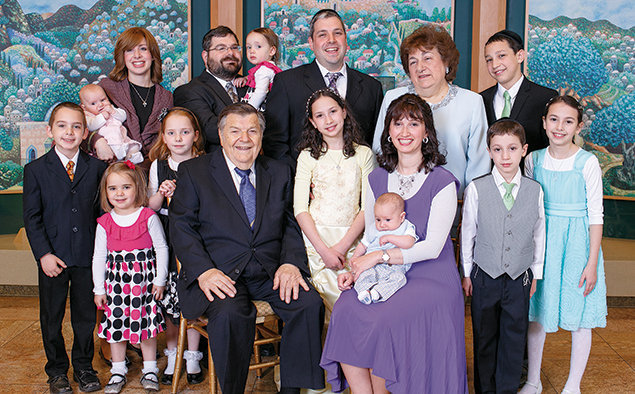
He was a man deeply in love with his wife, Aviva, and a beloved father to his three children, Daniel (now Rabbi Daniel), Jonathan (now Rabbi Jonathan) Rebecca (now Rebecca Feldman Becker), and then a besotted grandfather of many grandchildren.
Rabbi Daniel Fridman now leads the Jewish Center of Teaneck. “I couldn’t be more supportive of naming the street after Rabbi Feldman,” he said. “I think that it’s a wonderful thing.” He believes that its new name — not Street or Place or Road, but Way — is exactly right. “It highlights that it’s not named for a set of discreet actions, but the way in which Rabbi Feldman approached life.
“Rabbi Feldman was a Torah scholar of consequence,” he continued. “His writing was greatly respected by his contemporaries, and it was based on Torah principles about human dignity and the importance of civility and humanity.” Given everything that’s going on in the world right now, “it is providential that we should have the chance to reflect on his legacy now.”
Rabbi Fridman recalled an episode that marred life in Teaneck in 1990, when 16-year-old Phillip Pannell was shot and killed by a police officer, Gary Spath. Mr. Pannell was Black, Mr. Spath was white, the situation was murky, the outcome was terrible, and local tensions were high.
“Rabbi Feldman was very involved in keeping the peace in Teaneck,” Rabbi Fridman said. “There was a tremendous amount of tension. Rabbi Feldman had the ability to transcend. He had the civility, based on his Torah principles and completely consistent with his worldview, to want to be fair-minded and just to all the parties involved. He had the fairness and the compassion and the humanity to really play a role at that time that I don’t know anyone else has played.
“There’s a challenge there for us. There’s plenty that might serve as a cause of division or tension right now, but we still have agency. Rabbi Feldman’s example reminds us that we have a lot of agency in how we choose to handle situations. We can’t control everything, but we can do a lot to make clear that we have every intention of living here with great stability and neighborliness and comity.”
Rabbi Fridman knows many stories of Rabbi Feldman’s deep kindness that he cannot reveal, because the nature of such kindness is that it is private. “Rabbi Feldman would never know about the chesed he did but he saw humanity in everybody,” Rabbi Fridman said. “I think that he would challenge us not to fall into the caricatures that are fed to us by social media, and into the divisiveness, but to remember people’s humanity. That would be very helpful in this moment, when there is so much that could be combustible.”
One of the extraordinary things about Rabbi Feldman is related to this division between the private and the public. “His scholarship was remarkable, but he really felt that if you were going to be in the community rabbinate, you really have to listen,” Rabbi Fridman said. And he did.
“He would have been a world-class professor of Talmud, and I’m sure that had he picked up the phone any day and called any number of institutions he would have had a job there.” Becoming a pulpit rabbi was an active choice, and that choice allowed him to help people quietly, one at a time, with no fanfare but with real kindness and love.
Daniel Feldman is the rabbi of Ohr Saadya in Teaneck, a rosh yeshiva at Rabbi Isaac Elchanan Theological Seminary at Yeshiva University, and a writer like his father. Like Rabbi Fridman, he sees the death of Phillip Pannell and the unrest that followed as pivotal in both Teaneck’s recent history and his father’s story. “My father recognized it as the tragedy that it was for both families” — Mr. Pannell’s and Mr. Spath’s — “and he was involved in trying to comfort both families,” he said. “Nobody else was paying attention to the officer, who was completely shattered, as was his family.
“Just recently, our security guard in shul told us that he had heard from his boss, Jack Terhune,” then the Bergen County sheriff, “how much they appreciate my father’s contribution to keeping the peace during that period.”
His father “was tremendously empathetic, and he also was very wise in his empathy,” Rabbi Feldman continued. “It wasn’t simply an instinct. He was open to things in general that people didn’t necessarily notice. It’s one thing to feel compassion and that you want to reach out people who are suffering. He certainly did. But he also was able to perceive problems that weren’t as obvious, and not necessarily popular. He often reached out to people who had unpopular viewpoints, or weren’t necessary heroic.”
He did not limit his compassion to members of his shul, or to Jews, Rabbi Feldman said. Like Rabbi Fridman, he knows many more stories than he can tell, but there is one public anecdote that he relates with pleasure.
“It was election day in 1980, and like everybody else we knew, he was going to go to vote for Reagan.” Ronald Reagan, the Republican, was running against Jimmy Carter, the Democrat who had served one term and was up for re-election.
“But he got very busy, and by the time he was on his way to vote, he heard on his car radio that Carter already had conceded. Because of that, he decided to vote for Carter. He’d already lost, so let him get one more vote.”
And Rabbi Feldman told one more story. “There was a man whose house had burned down, and what he felt worst about was that he’d had many plaques from the many different organizations that he’d been involved with. They represented his life’s work as a volunteer. So my father found out what the organizations were, and he went out and had one big plaque made that represented all those organizations.”
That is a very creative way to show compassion.
Street namings don’t come out of nowhere. Someone has to advocate for them. The push to get Rabbi David M. Feldman Way came from Benjamin Kelsen. Rabbi Kelsen, a lawyer, writer, speaker, and communal activist who grew up in Teaneck and now lives just houses away from the town line in Bergenfield, brought the matter up with two members of the Teaneck town council, Mayor Mark Schwartz and Deputy Mayor Karen Orgen. All it took was one mention, Rabbi Kelsen said. Rabbi Feldman had been so beloved that it took no political capital to name a street in his memory. “I must have asked them what they thought about naming the street after Rabbi Feldman, and they just went with it.”
The idea came to him because “Daniel Feldman and I have been friends — basically brothers — since we were in fifth grade at Moriah together.” That’s the Moriah School in Englewood; it’s an elementary and middle school. “Then we were at Frisch together.” That Paramus-based institution is a high school. “Then we went to Kerem B’Yavneh together” — that’s in Israel — “and then we were at RIETS together” — that’s YU’s rabbinical school, where both were ordained — “and now we have daughters in each other’s classes.
“Rabbi Feldman” — that’s Rabbi David Feldman — “was incredibly special,” Rabbi Kelsen said. “Rabbi Feldman was the first rabbi I actually met and got to know on a personal level.” He had known rabbis as more distant figures, but Rabbi Feldman was his friend’s father. “I didn’t have any other friends whose fathers were rabbis. Doctors or lawyers, but not rabbis.
“I remember the way he carried himself, the way he spoke, his use of diplomacy. He had such polish. I would see how he talked to people at shul, and people at home, and his breadth of knowledge.
“As we got older and learned more about halacha, I got to see some things he had written, and our conversations became more tachlis-oriented. I was just blown away by what a tremendous person he was.
“One of the things that I was struck by — and that I hadn’t really thought about until after October 7 — was how much of a disconnect — a chasm — there was between the Jewish community and the rest of the town. It had always been there, but never to this extent. And in talking to people, thinking about it, wondering why it happened and what had been different, I saw that basically the community had had more and better outreach in the past. And a lot of it was Rabbi Feldman.
“It’s unfortunate that we don’t have anyone like Rabbi Feldman. I think that we should be looking at how Rabbi Feldman would have handled this situation.”
That was one of the inspirations behind Rabbi Kelsen’s move to get the street named.
The other was “when I said to someone, ‘This is not how Rabbi Feldman would have handled it,’ this person looked at me and said, ‘Who is Rabbi Feldman?’
“So I wanted to do something public, so someone would look at the sign and say, ‘I see that this street is named after Rabbi Feldman. Who is Rabbi Feldman?’”
And then they could find out who he was, and how much good he did in the town he loved, and that loved him back.