

What extraordinary lives
Theodore Bikel’s widow, Aimee, talks about his life, and hers
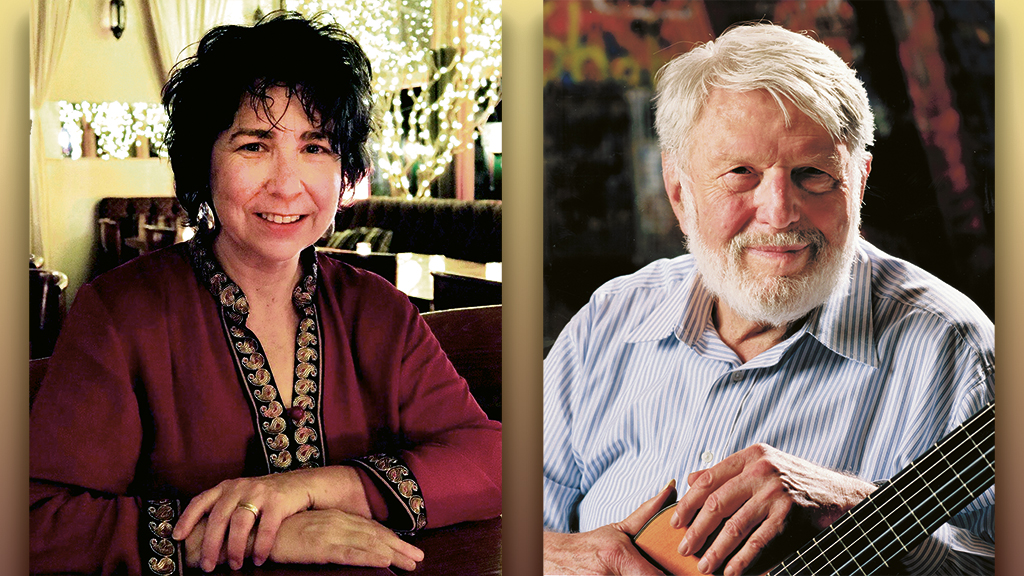
First, let’s deal with the elephant in the story. The question of age.
Aimee Ginsburg Bikel has lived so many lives — in Israel, in India, in the United States — in so many ways — as a reporter, editor, foreign correspondent, public speaker, activist, yogi, life coach, and spiritual advisor, to list just some of them — that it seems that she has to be at least 100 years old. How else could someone have done so much living?
She’s also known not in her own right but as the widow of the great actor, folk singer, activist, and all-around 20th-century public Jew, Theodore Bikel, who also lived a remarkably full life and died in 2015, at 91.
Ms. Bikel was born in 1962. She’s crammed all that living in 64 years.
She’ll speak at the Rabbi Israel S. Dresner Tikkun Olam lecture at Temple Beth Tikvah in Wayne on May 29. (See below.)
Her story started in Cincinnati, where she was born, Ms. Bikel said; her family made aliyah when she was a kid. “My upbringing was as a Labor Zionist,” she said; “my parents were Habonim Drorniks — that became important to me when I met Theo.” She graduated from high school in 1980, lived on a kibbutz for a year, matriculated at the Hebrew University and graduated four years later, and then, from 1985 to 1987, she served in the IDF, working at Galei Zahal, the army’s radio station.
Next, she said, she went to work at the newspaper Maariv, where she won the Ariella Yashiv award for “the journalist who did the most to improve the lives of women in Israel.”
So by the time she moved to India, in 1998, Ms. Bikel already had lived a full life. She made that huge change in her life not to further her career, but “it attracted me spiritually,” she said. “I went there for a visit, and I was just gobsmacked. I fell in love with it immediately.
“I didn’t want to leave — and I didn’t leave. Instead, I raised my two children there.”
For the first few years, Ms. Bikel said, “I was studying Indian philosophy, Indian medicine, the Indian way of life.” To further that study, she spent some time in rural parts of the country.
Soon, her training and instincts as a journalist drew her back to the field. “I started as a columnist in Yedioth Achronot,” she said. “I wrote about life from a spiritual perspective. Soon, though, the newsroom coopted me. I wrote for its magazine, about finance, about transportation, and Bollywood. And then at some point I started freelancing for other papers, and that led to me getting my own column in a very good, important Indian newsmagazine, and I also wrote features there.”
In Israel, Ms. Bikel had written in Hebrew; in India, she began writing in English as well. “It’s different writing in English,” she said. “In Hebrew, every word is able to turn itself around to have multiple meanings. It’s the way the grammar is; you can turn every word around, and every word has all these levels. It’s a very dense language.”
When she started writing in English — which had been her first language — “I felt that it was swimming away from me. It was what it was, and I didn’t know how to pull it close enough to me.
“But now, I find the Hebrew to be too dense. I love the space, the flow-iness of English, the airiness of it. It suits my personality. I find that I can say things that are very powerful quietly. In Hebrew, you can’t really talk quietly. Every letter has a meaning, its own kabbalistic meaning, and that’s very special, but it’s harder for me to write in Hebrew now.”
In 2012, Ms. Bikel visited the United States. “I was back in L.A., visiting family, at a Shabbat meal at mutual friends’ house, and I met Theo. He was from my parents’ generation. I had always heard of him. My father loved listening to his records. I remember that.
“But it wasn’t the same thing for me that it was for other people. For some people, meeting Theo was like meeting God.”
But when Aimee met Theo, “we both immediately knew that we were friends.
“The other people around the table were conservative, and we kept agreeing with each other on everything,” she said. Moreover, “we knew all the same songs. It was wonderful. So we became friends. When I was back in India, we wrote to each other, and we Skyped.
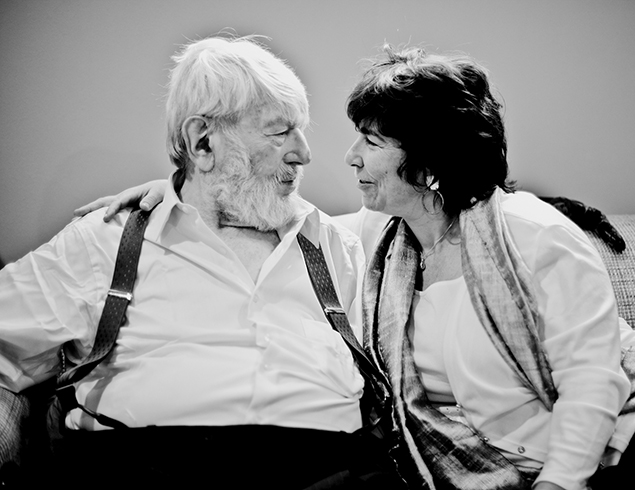
“Very quickly it became clear that this was a love affair.”
Mr. Bikel was 38 years older than she was. “He was already 86, and it seemed clear that if we were going to do something, we should do it right away, and that I should move back to the United States. So after four months, I moved back.”
Had she thought that she’d live the rest of her life in India? “Yes and no,” Ms. Bikel answered. “You are never quite taken 100 percent into the fold. And I missed my family. When you are a foreigner in India, something inside you is always saying ‘I really really am going to live here forever,’ and something else inside you really feels like. You are making a mistake. That this isn’t normal. So even if you love it — and I love it — something in you, in me, was calling out, telling me, ‘This isn’t your place.’”
There wasn’t really a Jewish community there, Ms. Bikel continued. “There were a lot of Israelis there I loved, but they were not really for me. I had an international community, and I loved it. I loved raising my kids there.
“But when I met Theo, I was ready to come back. I don’t know if I would have come back then.” She had lived in India for 15 years, “and that’s a long time,” she said.
Going back to Israel hadn’t been a real option for her, she continued. For one thing, her family by then was mainly in America. “I left because of extreme weariness and heartache about the political situation,” she said. “I had been very active, but that had worn away. Then Rabin was assassinated, and there was the intifada, and people seemed to me moving to the right, without a deep understanding of what that move to the right meant for our future.”
But all that was abstract. “Then I met Theo, and I always tell it that he crooked his finger at me and said ‘come here. Come hither.’ And I did. So I came back to America and we got married very quietly.”
Mr. Bikel would have turned 100 in May of 2024. “That would have been his blessed birthday centennial,” Ms. Bikel said. “I have been on a two-and-a-half-year tour of the country with a show called ‘The Magic of Theodore Bikel.’ I’ve been to between 20 and 30 venues — synagogues, JCCs, Holocaust museums, colleges — with a program that’s a cross between a Ted talk and a one-woman show. I’ve been weaving together stories of his incredible life and career, starting with his escape from Vienna as a child, right after the Anschluss, all the way through to his return to Vienna as an old man to give the Parliament a concert for the 75th anniversary of Kristallnacht.”
“And I weave that story together with Theo’s rich and incredible legacy of tikkun olam.” Of working to help fix a very broken world. “Theo was an icon. He was an iconic actor, a singer, and an iconic labor union leader. He led Actors Equity for many, many years. He was very active fighting against apartheid, against segregation, and against Jim Crow. He was vice president of the American Jewish Congress and of the leaders of the movement to free Soviet Jewry.
“Every time there was a fight for justice, he was there, and he was arrested in that fight more than once. He respected people who were willing to be arrested for justice, and he used every one of his platforms to speak up, even though it cost him.
“He never pandered. He never said what other people wanted him to say.”
Although Mr. Bikel is very well known in much of the Jewish world, Ms. Bikel is sure that he would have been more successful and more famous as a performer in the outside world had he focused less on social justice and more on his career. “He would have, should have been a household name,” she said.
He was “staunchly Zionist,” she said. “There was no bigger Zionist than he was. He fought for Zionism in every possible way. He brought it into the American folk music movement.”
But not only did his Zionism not keep him from seeing Israel’s faults and failures, it made him see them more clearly, and work toward fixing them. “I hate the sentence ‘My country right or wrong,’ he’s say. “It is a cheap and unworthy thing to say. When it is right, it is right. And when it is wrong, it needs to be put right.’
“And he was never afraid.”
Mr. Bikel took some unpopular stances, and “we received so much hate mail,” Ms. Bikel said. “When he passed away, someone wrote on his obituary, ‘Good riddance to the Jew hatred Theodore Bikel.’”
Ms. Bikel has finished her program about her husband. Her talk in Wayne will be “on the importance of speaking up and speaking out,” she said. “This is not a wishy-washy thing. It takes courage and it has costs.
“He used to say that we know what happens when good people remain silent in the ace of injustice. He learned about that in Vienna. All his nice Austrian neighbors all of a sudden were Nazis. When Hitler came to town, they were prepared with Nazi armbands, that they waved on the day of the Anschluss. He would say, ‘Where did all those armbands come from? They sewed them at home, in anticipation.’
“He said that on the morning of the Anschluss, when he went down to the shop to get bread for Mama, they were fine. They were good. They were their normal, polite selves. In the afternoon, they were waving their armbands.
“Theo lived on the main thoroughly. He saw the parade; saw the Nazis in their open limousines. He and his momma and poppa were huddled like mice behind their curtains, watching the parade. The whole strasse where they lived was a long row of beautiful buildings, and as they watched the procession they saw thousands of people hailing and heiling and cheering and blowing into instruments, cheering and cheering and cheering.”
The Bikels got out because Theo’s father, who had fruitlessly tried embassy after embassy, unsuccessfully asking for visas, was able to get three of the 10 that the British Mandate in Palestine gave to the Austrian Jewish community. They went directly to the Zionist committee, and Theo’s father was on that committee, representing Labor Zionists.”
Ms. Bikel talked about all of this and more in the program she just finished. Learn more about her at her website, aimeeginsburgbikel.com.
Who: Aimee Ginsburg Bikel
What: Will speak at the Rabbi Israel S. Dresner Tikkun Olam lecture at Temple Beth Tikvah in Wayne
When: On May 29 at 7 p.m. It’s a Friday night; the evening will include Shabbat services and a festive oneg.
To learn more: Call Janice at (973) 694-1616, email her at jdp222@aol.com, or go to templebethtikvahnj.org/