

From Paris to Newark
Rabbi Anne Laurent talks about what drives her
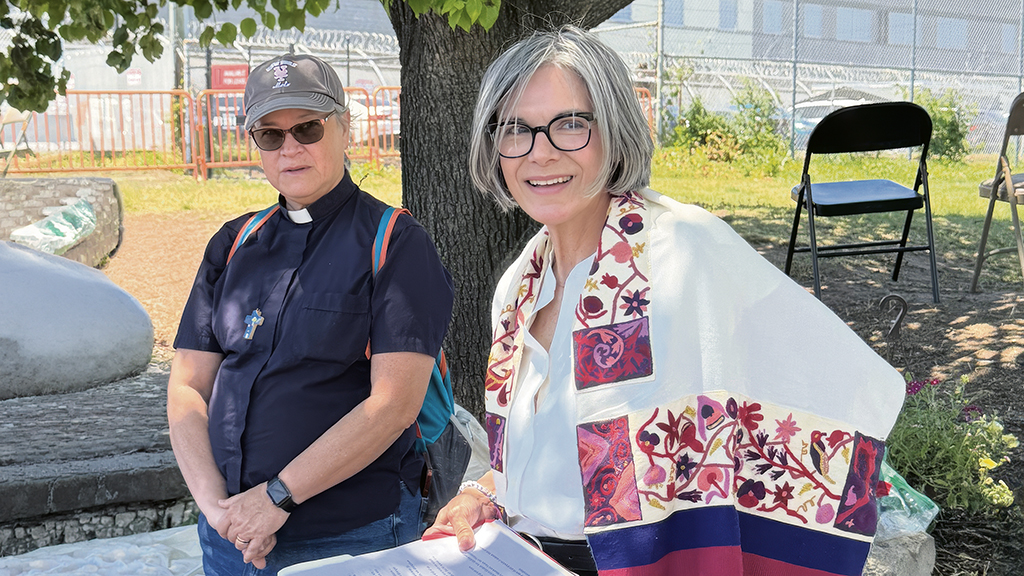
It’s a pity that the phrase Jewish journey has become so entirely cliched that it’s now unusable, because if it weren’t, it could be used to describe Rabbi Anne Laurent’s path from Brittany to a life in Essex County and then to the walls of Delaney Hall, the ICE detention center in Newark.
But what a long, idiosyncratic, winding, and inspirational trip it’s been.
Anne and her twin sister, Catherine, were born in 1967; when they were 4 years old, the family moved to Brest, in Brittany, where both their parents had roots.
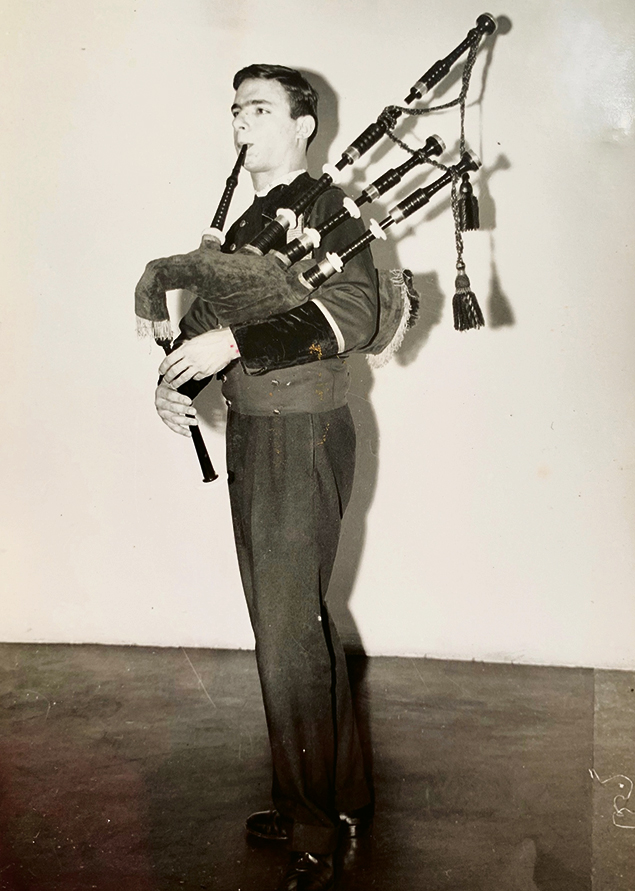
Brittany is in France, but it’s home to an ancient Celtic culture — its name isn’t a version of Britain by accident — and it has a separate identity. Rabbi Laurent’s father, Donatien Laurent, was an ethnomusicologist and linguist who specialized in Celtic music and Brittany’s oral tradition. He was born in Paris but his family came from Brittany.
Rabbi Laurent’s mother, Francoise, was born just before World War II. “You could tell that from her name,” which means French, Rabbi Laurent said. “It was an act of resistance” against the Germans.
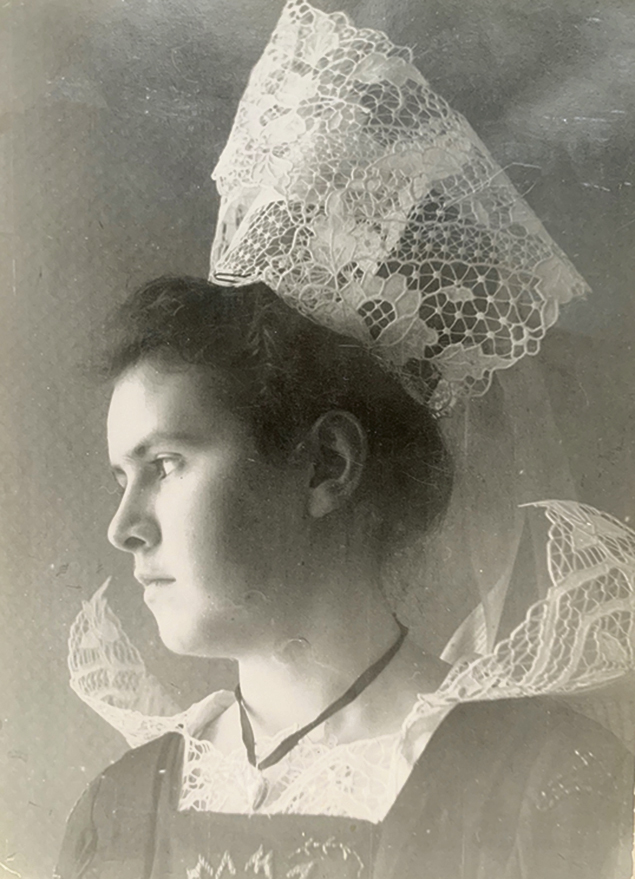
Her mother’s father, Pierre Prigent, “was very Breton,” Rabbi Laurent said. “If you meet a Prigent, you know they’re from Brittany.” And “pierre” means stone — “he was the stone of the family,” she added.
Parts of his story have echoes of the stories we hear of Native American children in boarding schools in the United States and Canada; not as brutal, but with the same goal — eliminating the local culture.
“My grandfather didn’t learn French until he was 7 — and as I tell this story, they resonate with me from my time as a chaplain, talking to people who spoke only Yiddish, not English, until they went to school,” Rabbi Laurent said. But her grandfather’s story had a twist.
“All the children at school spoke Breton. The rule was that you were not allowed to speak Breton at school. If you did, you had to wear a wooden block around your neck. You could only get rid of it by ratting on someone else.
“So the children learned that you had to speak French at school very quickly. My mother never learned to speak Breton.
“They were a lower-middle-class family. He was a railroad worker, and my grandmother, Andree, was a schoolteacher. My grandfather went to school just until sixth grade.
“It’s hard to understand how affected we were by the war if you didn’t live in Europe,” she said. “Brest is on the Atlantic coast, and it was a war harbor, so the stories are right there, and you walk by them in the street.
“One of the stories I heard early on, and that resonates so strongly with me now, as a Jew, is that before the Germans invaded Frence, their strategy was to divide and conquer. Brittany had an extraordinary culture that the French had tried to destroy over the last 100 years. It was incredibly precious to people, and they could see how much damage might be done in just one generation. My grandfather’s native language was Breton, but he couldn’t teach it to his daughter.
“So the Nazis came in offering a very enticing deal. They said, ‘We will finance your school and we will promote your culture, which is dying. We might even let you separate from France. We will finance your newspapers, in the Breton language.” And although part of the Nazis’ enticements were shrewd tactics, part of it also was because “they were obsessed with the volk — with the purity of the blood.
“‘And all you have to do is keep quiet about what we are doing with the Jews,’” she said the Nazis told the Bretons. It wasn’t about local Jews, because there weren’t many; Brittany is remote and deeply Catholic. “Brittany isn’t insular but it is rural, and it was deeply humiliated by losing its culture, which was extraordinary, but the French considered to be inferior.”
There was a lot of racism in France, she continued, and the Bretons were among its targets. “My grandfather fought in World War I,” she said. “He was put on the front lines — it was Bretons, Senegalese, and a few Jews.”
Her grandparents didn’t bite at the Nazis’ lures. “They joined the resistance right away.” Why? “Because it was the right thing to do. It was clear enough that what the Nazis were doing was wrong, and they didn’t want armed men in the streets. They didn’t want to speak German.”
“My maternal grandfather always talked about the war,” Rabbi Laurent said. But he never talked about the Jews, or the Holocaust.
“I found out about the Holocaust late,” she said. “Because we weren’t Jewish.
“I knew that my grandfather had been a hero. I knew that he blew up the railroad tracks that he had laid.
“He had a baby at home, and he was doing acts of resistance, putting his family in danger. He just couldn’t have lived with himself if he hadn’t done it. I don’t think that he saw it as courage.” Instead, Rabbi Laurent said, her grandfather, who was born in 1892 and so was in his late 40s, saw it as a task that he could do. “He said, ‘I know the railroad system, because I have laid those tracks, so I can take them down. They are my very modest skills; here is how I can apply them.’”
Her uncle Henri, at 17, also was an active member of the resistance.
So when Anne was about 9 or 10 and first heard about the Holocaust, “I asked my grandfather, ‘What did you do to save the Jews?’ He was the warmest, most loving, funniest man ever, and I thought for sure that he had hidden families, had done something, I didn’t know what.
“And he said that he hadn’t. He said ‘We didn’t know any Jews. We didn’t know how to help.’
“And that stayed with me.
“My grandfather was so heartbroken about that. It was something he carried to the end of his life. The shame of what he could have done.
“Until now I had thought that he must have known. He said once that he’d heard rumors that people were snatched off the streets and taken to camps, but I don’t know when he would have heard those rumors.” It was not only way pre-internet, it was before television. “And in a repressive regime, even listening to the radio was dangerous,” unless of course it was state radio.
Her father’s family, on the other hand, were assimilated Bretons. “They were wealthier; my grandfather, Pierre Laurent — another Pierre — was an engineer. They were entranced by Breton culture, like Jews who rediscover Jewish culture. My dad, who was raised in Paris and learned Breton late, wanted to marry someone from Brittany.”
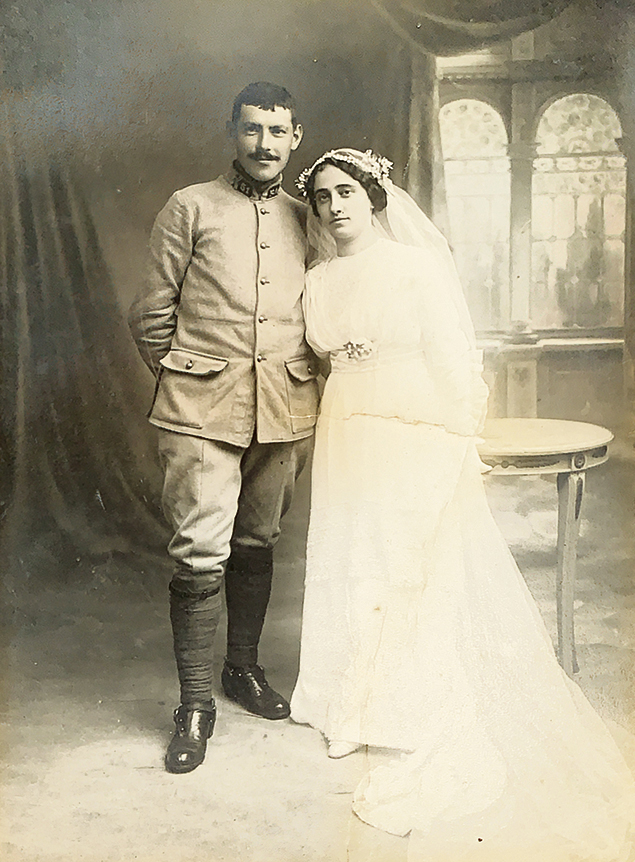
He did.
“My mother was studying sociology in a little town in Brittany, and he already was a grad student. And she had a Breton last name. It was like a Smith marrying a Rosenberg” — if the Smith’s family originally had been Schwartz or Shapiro.
Rabbi Laurent grew up in a Catholic family in a Catholic town, but “my mother was an atheist she said. “A humanist. I was confirmed, and around that time, when I was 8, I discovered the Bible. I asked my mom a lot of questions about God, and she got annoyed with me. She had a Bible that she used as a reference — she was a French teacher — so she kind of tossed it at me, and said, ‘Instead of asking me questions, go to the source.’
“I was a big reader — and my mom did tell me that I could skip the boring passages — and I started at the beginning. I still have that Bible at home. It had incredibly thin paper and gold leaf, and I couldn’t believe that I got to hold it. I started reading Genesis — there was evening and there was morning, the first day — and I thought, oh my gosh, this will explain the world to me. I will find out about God and life and death.” (During this time, her sister was not reading the Bible, Rabbi Laurent said; instead, “she was running around, playing sports and making friends.”)
“I loved it. There were stories about people cheating and people dying and people fighting, and it was absolutely fascinating. I was at the age when you start having an ethical sense, a sense of right and wrong, and there were some answers there about what is right and what is wrong. Love the stranger, protect the orphan — that resonated with me in a personal way.”
It took her about a year to work through what she then would have called “L’Ancien Testament.” When she finished it, she started on the New Testament, “but it didn’t really work for me,” she said.
Although she hadn’t had a first communion, she went to catechism so she could be confirmed, Rabbi Laurent said. “I was 9; I wanted to go. My mom didn’t want us to, my dad didn’t insist, so I had to ask my mom to let me go, and she did. And I was a star student.
“At one point I said to my mom, ‘This is not working for me. I only believe in the Old Testament.’ And she said, ‘That is the Jewish book,’ and I said, ‘Fine, I am a Jew,’ and she said, ‘You can no more be a Jew than you can be a Black saxophone player.’ There was at that time no conception that you could convert to Judaism. Judaism was a race, and you could not become Jewish. It was not an option.
“So I sort of shelved the idea, although I became fascinated with the literature that was coming out at the time — Philip Roth, Bernard Malamud, Cynthia Ozick, Saul Bellow.”
When she was around 18, Rabbi Laurent decided to teach herself Hebrew.
“From her time as a student, my mom had a friend, Zeev Sternhell, who was a very famous political scientist in Israel.
“He had been orphaned in Poland during the Holocaust, managed to make it to France, and then, at 15, went to Palestine by himself. Then he came back to France to study.
“My mother had stayed in touch with him. I remember one day a letter came, addressed to her, and on the back it said Jerusalem.” That was the return address. “I thought that this was amazing. People can actually write from Jerusalem? It was like getting a letter from Babylon.
“My mother started telling me about him, and then I could not rest until I could go to Israel.”
Turning 18 is a major big deal in France, Rabbi Laurent said. When she and her sister hit that milestone in 1985, their parents gave them each 2,000 francs — it must have been about $500 then, she estimated — “I was like, I am taking an airplane, and I am going to Israel. And I did,’” she said.
“I met Zeev, and I went back and I went back and I went back,” she said. “I found that I couldn’t get into an ulpan, because I wasn’t Jewish, but I could hang out and listen to Hebrew being spoken, and I learned it.”
Back in France, Rabbi Laurent went to college, majored in English and American literature, and then went on to graduate school at the University of Paris. She studied with Rachel Ertel, a child Holocaust survivor who became perhaps France’s top expert in Yiddish culture in France, as well as American Jewish literature. She was an extraordinary presence, and “she took me in,” Rabbi Laurent said. “I did my master’s thesis on Leonard Cohen, who was like my rabbi.
“By then I was pretty fluent in English, and at the same time that I was doing my master’s, I was also doing a B.A. in Hebrew language and literature at the Institut de langue orientale” — the Institute for Oriental Language — “the only place where you could study Hebrew without being Jewish.”
At around that time, Rabbi Laurent decided that she should try to talk to a rabbi. “The French Jewish community is so small, and it has suffered so much, that it is insular,” she said. “I didn’t have any friends there. But I felt that I could really manage very well in Hebrew, and that I could go speak to a rabbi. I’d never had the nerve to do that before. I chose the rabbi of the Copernic synagogue.” That’s the Union Libérale Israélite de France, in Paris; it’s the oldest Reform shul in the country.
“I don’t remember the rabbi’s name,” she said. “He was British. I had to camp outside his office for an entire day. I had called repeatedly for an appointment; I got one finally, at 10 a.m., and he let me in at about 4 p.m. Everyone else kept coming in, but not me.
“I didn’t know about sending a potential convert away three times. I don’t know why I stayed, but finally I went in, and he said, ‘You know, you could convert, but it will take at least five years, and nobody is going to marry you. You are never going to find a husband here.’
“I believed him. I thought that he probably was right. Remember, I was reading American Jewish literature, all about shiksas.”
So why did she keep going, keep learning more and more about Jews and Judaism? “I had no choice,” she said, sounding like her grandfather.
“First of all, I didn’t keep going,” she clarified. “I went to Costa Rica and Nicaragua with a boyfriend, and I learned Spanish really well. He was there as an agronomist, and I was still doing my B.A. in Hebrew, through the mail, and I was also working on my master’s, and then on my Ph.D. thesis — which I didn’t get,” she added. “It was going to be about Philip Roth and Salman Rushdie, about how they were trying to talk about their communities to the outside world. They both dealt with that in a similar way. It was about identification and identity and the transformation of identity. And I was also working on enslaved people’s narratives on freedom.”
One thing that is important to realize about Rabbi Laurent is that she is deeply academic, an intellectual by instinct as well as by training. She did get to New York, where she studied at Cornell, and then at Harvard. At all those places, she focused on Jews in America, “which was a promised land, a melting pot. And also, America had liberated France. There was no other country for people who had been born in France in the 1960s and ’70s than America. It was the ultimate dream.”
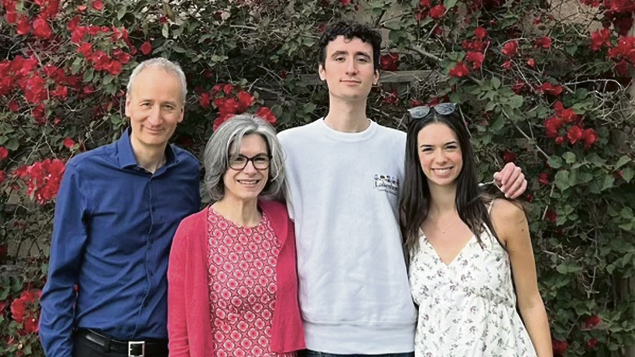
When she was at Harvard, Rabbi Laurent met her husband, Greg Bryan, an astrophysicist now at Columbia, who is from Calgary. They got married in 1999, “and we have two amazing kids, Lily, who is 26, and Gabriel, who is 24. Both of them are in computer science and data science.”
When they got married, “it was weird, because I did not have any doubt that Greg was the right person for me. He wasn’t Jewish, and that was unresolved, and the longing was still there.
“He got a tenure track position at Oxford, so we went there. It was close to my family. We had arrived. Lily was born there. And then I got pregnant with Gabriel, and a couple of hours after he was born, he started having trouble breathing. They took him, and then they called me at night” — she was still in the hospital — “and said, ‘Your baby is not doing well.’ My husband joined us, and they said they saw a mass between his lung and his heart. They didn’t know what it was, but they knew that it could be serious.
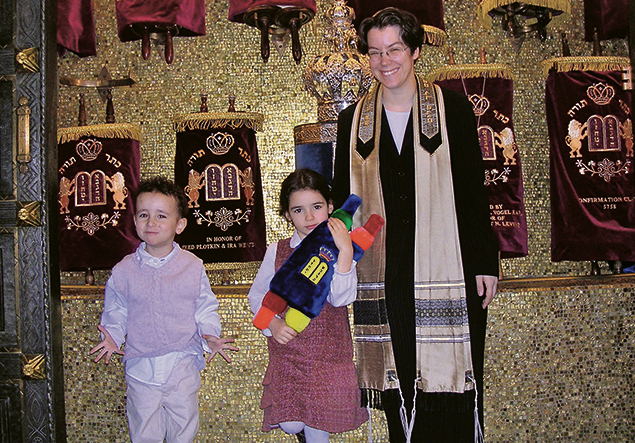
“So they said to me, ‘Do you want to see a chaplain?’ and I said, ‘Yes, I want to see a rabbi.’ They said, ‘Can you call your rabbi?’ and I said, ‘No, because I am not Jewish.’ They said, ‘I’m sorry, but if you’re not Jewish, you can’t have a Jewish chaplain.’ I didn’t have anybody. Just my Bible.
In the end, Gabriel was fine, “but I went home, and literally the next day, as I was holding him, I thought, ‘If, when my child possibly is dying, my first instinct is to ask for a rabbi, we need to pack up and go to America. We need to convert. This is life and death.’”
The nature of the English Jewish world would have made it much harder for her to convert there, she explained. “I felt like America was the country where I could become myself.”
So Dr. Bryan gave up his job at Oxford — “he got a good job at Columbia, and he’s tenured,” his wife said.
“The day after I arrived, I sent an email to Rabbi Rick Jacobs, the head of the Union for Reform Judaism, and I said, ‘This is who I am, and I want to convert.’ I never expected an answer, but he answered me the next day. He said that there is a Reform synagogue down the street from you” — that was Congregation Rodeph Sholom, on the Upper West Side. “I went there, and I thought, ‘This is my home.’ I went to speak to the rabbi, shaking like a leaf. It was Lisa Grushcow, who’s now in Montreal. She welcomed me, and it was unbelievable.
“We had our first Shabbat dinner; it was with Micah Lasher’s mom, who was a very welcoming congregant.” (Mr. Lasher is now the Democratic candidate to replace the retiring Jerry Nadler in Congress.) “It was like all those years of tension were just gone.”
Rabbi Laurent began a job at the Heschel School as the assistant director of admissions as she worked toward conversion at Rodeph. She and her two children soon were converted — she had both the knowledge and the history of wanting it deeply — “and a year later, maybe a little less, Greg converted too.
Everything was wonderful for a while, but then Rabbi Laurent started experiencing strange, disturbing physical symptoms that eventually were diagnosed as primary lateral sclerosis, “a rare condition that affects the nerve cells in the brain that control movement,” according to the Mayo Clinic’s website. “It kept getting worse and worse,” Rabbi Laurent said.
During that period, she talked to Rabbi Grushcow
, who asked her, “What do you want to do with the rest of your life?” and her immediate answer was “I would love to go to rabbinical school.
“I hadn’t thought about it before, because it didn’t seem possible, but I thought that if I am going to die tomorrow, this is what I want to do.”
She applied to Hebrew Union College — Jewish Institute of Religion, got in, and loved it. “My neurological issues were under control,” she said. “It hasn’t gotten any worse. That will be the mystery of my life.”
For three years, everything was good. The family moved to Bloomfield and joined Temple Ner Tamid there. And then she got sick; she was wheelchair-bound for some time, and had to drop out of rabbinical school.
But then, the rabbis at Ner Tamid, who knew her, knew the depth of her convictions and her learning and her connections to the Jewish tradition, Jewish life, and Jewish knowledge, gave her private smicha. She was, after everything, a rabbi. “I didn’t feel that I deserved it,” she said, but she was determined to live up to it.
She started once again to get better physically, and she decided that she should use her knowledge, her background, her understanding of what it feels like to be sick — “all those years of feeling isolation and disconnection and loneliness that come from being diminished physically, the sense of being less than” — and her memory of what it felt like to be the immediately post-natal mother of a possibly desperately ill newborn, to become a chaplain.
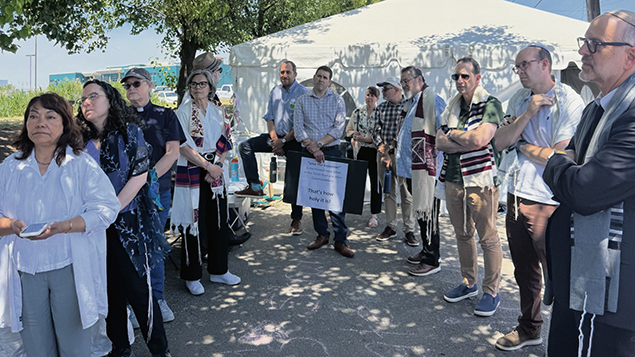
“When you go into the hospital, you lose your clothes, you lose your name, you lose everything that makes you a person in community,” she said. “And also, I have a fascination with people’s stories. So I started doing clinical pastoral education with an amazing man, Tedford Taylor, a Quaker, who is at Cooperman Barnabas.
“I was seeing two kinds of patients — people who had gone through the Holocaust or who had parents shaped by it, and because I was the only chaplain who spoke Spanish, I also was seeing young people from El Salvador, Guatemala, Honduras, Ecuador. They all had incredible stories of survival.
“I saw that there is a universal story. We are all doing the best we can with what we have. And the dream of America as a refuge for everyone, with its promise of freedom and prosperity.
“If there is one word that comes out of all these narratives, from Ecuador, from Uzbekistan, it’s courage.”
Eventually, Rabbi Laurent left her work as a chaplain. And then “someone at Ner Tamid, Jeff Plaut, stood up during Shabbat services and said that Delaney Hall in Newark is the biggest detention facility on the East Coast. He said something like ‘Maybe we’re not ready, but it’s happening, and we have to go.’
“He sent an email in May 2025, and I went, and I have been going back ever since.” She hates it, she says, but still she feels drawn to it, because there are people there who need help, and she wants to do what she can. Like her grandfather.
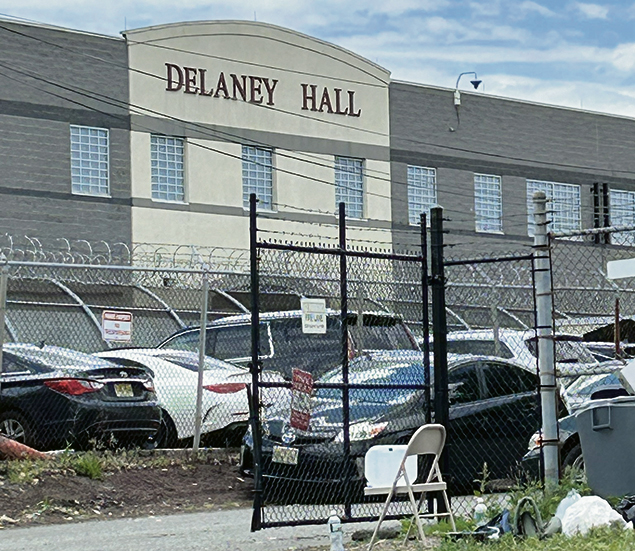 Because she is a chaplain and speaks Spanish, Rabbi Laurent has been able to go inside to talk to prisoners there, although that no longer is the case. “Things have been changing a lot,” she said.
Delaney Hall is “a massive detention center in the middle of Chemical Corridor in Newark, and it can hold 1,100 people,” she said. “It is a toxic wasteland. The air is not breathable. Trust me, as soon as you set foot there, you know it. The smell is putrid. There are cancer-causing chemicals everywhere, including in the water and in the grass. It is not fit for human beings.”
Being inside “didn’t feel dangerous, but it was awkward,” she said. “I am not outgoing. There were maybe six volunteers there, and I didn’t initially understand what they were doing.
“The first thing is that you have to park illegally. There is no place to park legally. There are no legal parking spaces. If you are undocumented, the last thing you want to do is to break the law. So you are there to visit someone, maybe for the last time, but they could grab your car, which you need for your livelihood.
“You have to wait to get in to visit, sometimes for four hours, sometimes six hours, and there is no protection from the elements. It could be pouring rain. It could be 100 degrees. You could be pregnant. You could have children with you. You have to wait on line. There is no food, no water, no bathrooms, nothing for children to do, and you are maybe going to see your husband for the last time.
“You could get to the gates, and find out that there is a dress code, but nothing is written down. If you are wearing a skirt, it has to cover your knees. You can’t wear sandals or a sleeveless top or shorts. You cannot wear crocs. Once, they said you could not wear navy blue.
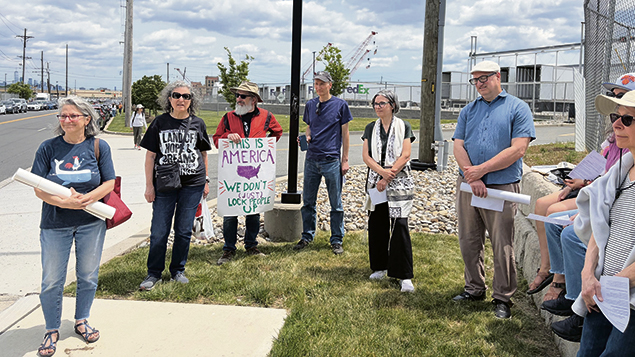
“My first job, once I got in, was to ask people why they were there. One after another, they told me that they had just gone to regular ICE appointments and had been picked up, or driving their kids to school, or driving to work. I came back after that first day, and I sat in my car, and for the first time I felt fear like I never had felt it before. It all seemed so random, and so scary.”
It all seemed particularly terrifying to Rabbi Laurent, because although her circumstances were different — and she is not brown, and has a nearly flawless American accent — she too is an immigrant. She became an American citizen in March.
One of the prisoners she visited, before such visits no longer were permitted, was a French-speaking man from Burkina Faso in Africa, “which is an incredibly repressive place,” she said. “He was a truck driver, 32 years old, who somehow managed to learn French. He’s an amazing guy. If he’d been given the opportunity, he’d be an engineer, or running a company. He got into political trouble, and he had to flee for his family’s safety, and for his own. He bought an airplane ticket to Brazil, and then he walked to the Texas border and asked for asylum.
“Talk about courage.
“He was held there for four months, and then transferred, with no idea of how long he’d be there.
“It’s one thing to be in prison. You’ve been tried and convicted, and you know how long your sentence is. He was held in Texas and then sent to Delaney. He has not had a minute of freedom in this country. He had not committed any crime.
“He is such an incredibly smart guy. When I met him, he spoke perfect French; by the last time I saw him, he had learned Spanish fluently. His ingenuity, his intelligence — he is so bright, and so desperate. He is still there, but I can’t see him anymore. I think we will never meet again.”
More and more Jews have started going to Delaney Hall, Rabbi Laurent said, and more and more synagogues in both MetroWest and North Jersey have organized trips there. On Tisha B’Av, a service drew many shul members from a number of communities.
“My message is that we need to be there,” Rabbi Laurent said. “There is what our faith demands of us. This is the soul of Judaism. This is the ethical foundation of Judaism. ‘You shall not oppress a stranger, for you know the heart of a stranger, because you were strangers in the land of Egypt.’
“I know the debate between particularity and universality in Judaism. It is the exact same debate that we have in Brittany, and that my grandfather and I answered in different ways.
“Do I stay safe and not risk anything, cultivate my little garden, or do I want to put into practice what our tradition asks us to do? This is the moment for action. The soul of Judaism is justice and kindness and looking after the stranger and the poor and the orphan and the widow.
“I am speaking as someone who was not born Jewish or American, saying that as Jews we know what trauma looks like.
“One thing that has kept me going is the resilience and the kindness I have been shown, and am still being shown. The gratefulness of people who will come back. Sometimes someone gets out and the family comes back and brings food. I remember on Mother’s Day, a family cooked chicken and rice and beans for 200 people. They got up at 3:30 in the morning to cook. These are people who have nothing. That keeps me going.
“And I keep going back to my mother’s friend Zeev. He said that no one got out of Poland unless a Christian helped them get out. That is how he got out, when he was a little boy. I keep thinking that we have to be those people. There are so many resources in the Jewish community. There is a wealth of knowledge and contacts and money and education, and we have to use it.”