

Learning to teach about Israel
Educators go to Israel to put curricula in context
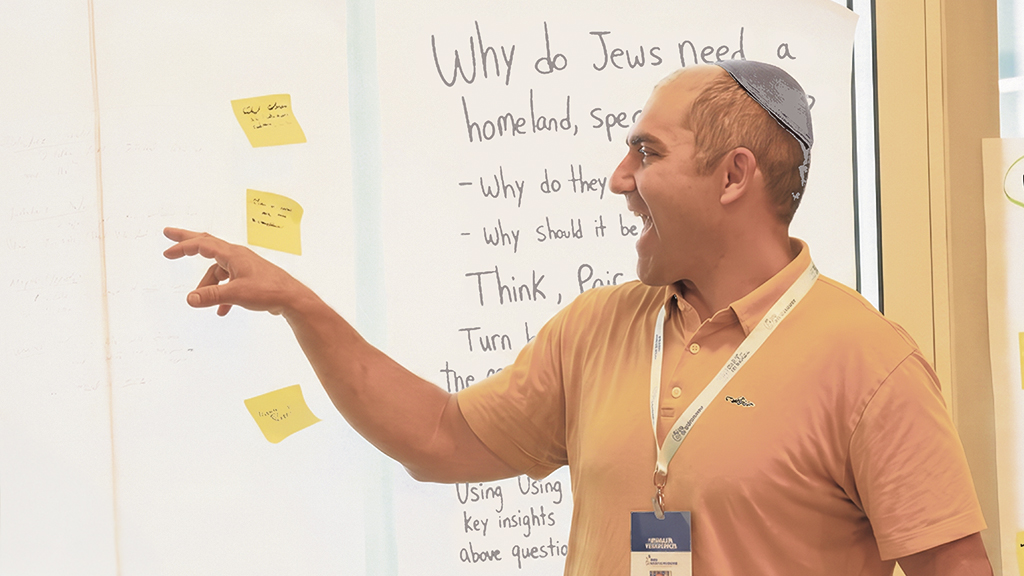
Teaching about Israel’s history right now is not a job for the faint-hearted.
It is also highly unlikely that anyone would have tried calling visionary educator Tikva Wiener of Teaneck faint-hearted. Not ever.
So now Ms. Wiener, through the organization she created and heads, Kadima Coaching, is teaching teachers how to teach about the history of the Jewish people in the land of Israel. Kadima Coaching — the long form of its tagline is “Supporting Jewish schools and organizations as they wonder and plan for what Jewish education could be” — offers a range of programs to help teachers, administrators, curriculum developers, and other educators combine the best of Jewish education with the best, most cutting-edge strategies for general education.
“Our goal is to help schools worldwide implement best practices in education, whatever that might look like in their school, and to help with whatever concerns they may have,” Ms. Wiener said. “A lot of it has to do with social emotional learning, and some of it now — a lot of it now — has to do with developing Jewish joy and pride and love of Israel.”
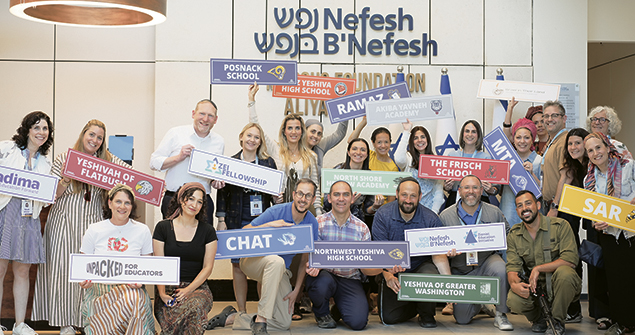
Kadima Coaching works with schools in 20 cities in eight countries and about that many languages worldwide, Ms. Wiener said. And it reaches about 10,000 students. Kadima has partnered with Nefesh B’Nefesh, the organization that helps North American Jews make aliyah, Nefesh B’Nefesh’s education department, the Zionist Education Initiative, and other organizations including Unpacked for Educators — whose vice president, Sarah Gordon, lives in Teaneck — to create yearlong programs that can help teachers in Jewish high schools teach about Israel. In June, the first cohort of that program, the ZEI Fellowship, met for an intensive week in Jerusalem. Ms. Wiener and Kadima’s chief academic officer, Rabbi Tavi Koslowe, also from Teaneck, accompanied them.
The program uses a curriculum that ZEI’s director, Rabbi Josh Spodek, created. “What I love about it is that it’s not just about Zionism,” Ms. Wiener said. “It doesn’t start with nationalism or Herzl.” Those are important elements of the story, but they don’t come in for a millennium or two. Instead, “it’s the story of the Jewish people in Israel, so it starts with the Tanach,” the Bible, “and Avraham,” the first of the patriarchs.
In showing the Jewish people’s age-old connection to the land of Israel, ZEI’s curriculum “goes through art and archaeology and the material culture that shows the presence of the Jewish people in Israel.”
It uses the evidence available under, in, and on the land of Israel that shows that Jews are indigenous to it. “Our texts are oriented toward the land,” Ms. Wiener said. “Our prayers are oriented toward Jerusalem. There has always been a connection between the Jewish people and this land.” Now, after Zionism and the founding of contemporary Israel, the country today “really is an old-new land,” she said. “And there is much beauty in that.
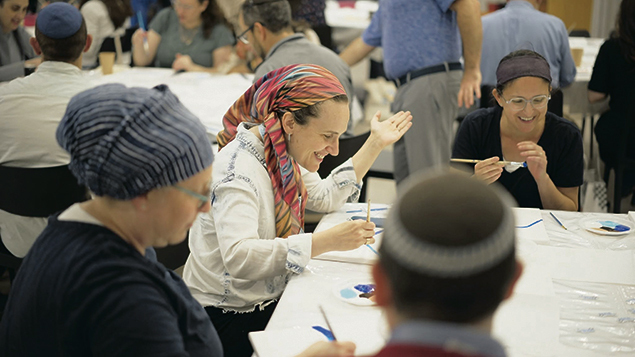
“You can be a secular Israeli, but your references often are going to be biblical stories, because those are the stories of the Jewish people. And I love it.
“I also love the way this curriculum is Israel education, not Israel advocacy.” It’s not at all that she’s opposed to advocacy, she said; advocacy easily can grow from this curriculum. But before people can advocate effectively, should they want to, they have to know what they’re advocating for.
“Here, we want to strengthen our children with the story of the Jewish people in our land and about our land. If you want to turn that into advocacy, go ahead. And if you just want to know it and feel bonded to your own religion, you can do that too. So this isn’t about what you do when you get to a college campus. It’s not talking points. But on the other hand, if you want talking points, you have them.
“You’ll know that the Jewish people always have been connected to the land of Israel. You’ve learned about the archaeology. So if someone tells you that the Jewish people are not indigenous to the land, you can be, like, that’s funny, because every time we put a shovel in the ground, we end up finding something written in Hebrew,” or some other object that makes the connection between the people and the land of Israel clear.
“But that’s not the driving force behind the curriculum.”
ZEI created this curriculum. Kadima came in because “the curriculum is being implemented and piloted in different schools across the world right now. But what he” — Rabbi Spodek — “wanted from Kadima — and what I got very excited about — was that he said that often curricula just sit on shelves. They don’t get used. He really doesn’t want that to happen with this curriculum.
“I think that what’s exciting about the curriculum is its comprehensive approach. But what he felt strongly about was having it live and breathe in actual educators’ classrooms, so he approached us for the ZEI fellowship.
“The idea is to invite educators from North American Jewish day schools of all denominations to apply for this fellowship. They would take the curriculum and use it however they want to use it in their classes.” Not all the fellows specialize in Israel education; some do, but others teach Tanach and both general and Jewish history, among other subjects, Ms. Wiener said.
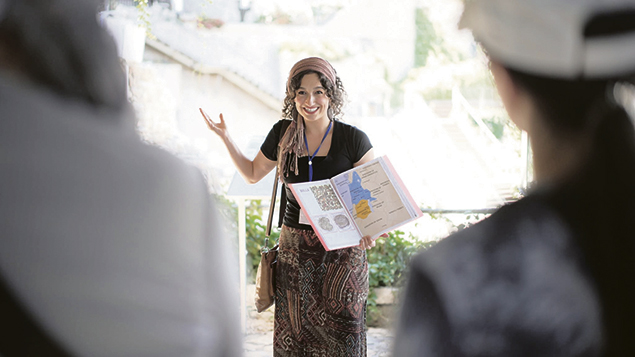
“We brought 12 fellows from a range of Jewish high schools, both geographically and denominationally, from America and Canada,” she continued. (Despite that geographic range, quite a few of them live in New Jersey.) “We created a week for them where they were immersed in different content sessions, about Zionism, art, archaeology — and we didn’t shy away from the ugly. There is much beauty in this old/new land, and there also were and are tensions.
“What Josh specifically wanted from us was to integrate student-centered pedagogies into the year. We want to hit head, hands, and heart. We want the students to engage with the content not only cognitively, intellectually, cerebrally, but also emotionally and spiritually.
“So we had, among other things, an Unpack session about the top five Zionist movements, and a session about the conflict, and then we went right into a Socratic seminar. We took them on a trip to the Bible Lands Museum, and from there to Ir David,” the archaeological site called the City of David. “We heard from Israel in Their Land” — a group that teaches through archaeology.”
It was all serious, but it also allowed for fun. Shark Tank-style fun.
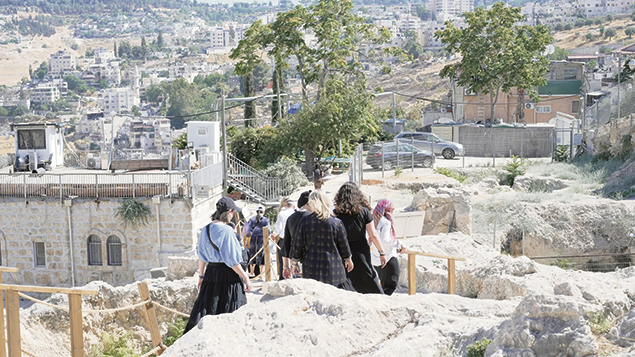
The 12 fellows were paired into six teams, and each team chose two artifacts and pitched their importance to a panel of experts, including the head of Ir David; Eylon Aslan-Levy, the British-Israeli former IDF spokesman who is now “a social media influencer and an archaeology buff”; and Roei Shalom, the CEO of the Israeli-made sock company called Groovim. The goal was to become the team to convince the experts that the artifacts it chose so powerfully tell the Jewish story that they’d become the inspiration for a pair of socks.
“What could be a better representation of Israel as an old/new land than printing images of these ancient artifacts on socks?” Ms. Wiener said.
All of these are experiences that can be used in a classroom, or to inspire a teacher.
The educators also learned strategies for teaching about the conflicts roiling Israel now. “We modeled how you might do it,” Ms. Wiener said. “You don’t come in on Day One and talk about the ugly. You come in on Day One and you show the beauty. You show the incredible story. You build the joy. You build the connection. And then, once your students feel comfortable and connected to Israel, then you can introduce some of the difficult conversations.
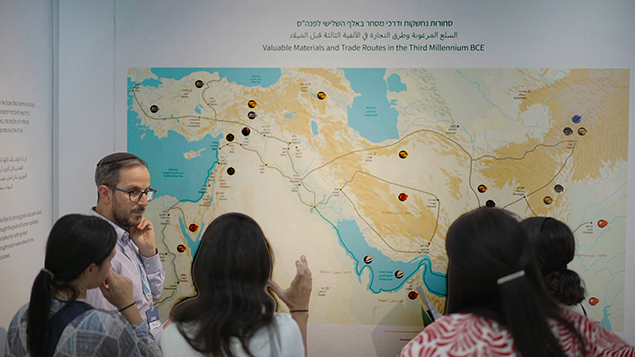
“We did that by going to the National Library of Israel, where they brought us ancient and modern maps of Israel. They are incredible to look at, and they’re also a good segue to difficult conversations, because maps obviously are contentious. It was an incredible day, an incredible workshop, and also visually very exciting to see those beautiful maps, which were drawn for all sorts of different reasons.
“And the aim also was to show Israel as the repository of our civilization, whether we were at Bible Lands or Ir David or the National Library, this is the place where the Jewish people’s story is held.
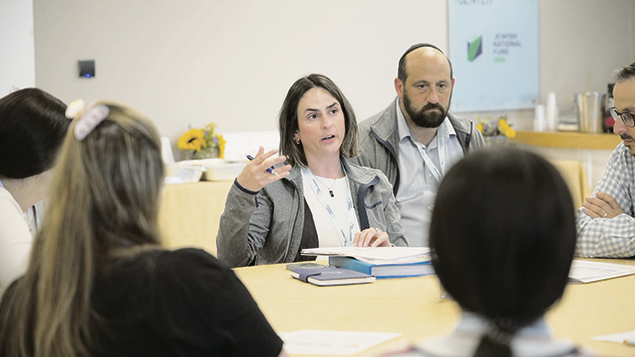
“And then we had difficult conversations, and then on the last day, the fellows started to plan what their year would look like. What could Israel education look like at their school? What are the places in the school where it could live? In the Tanach department? The history department? Jewish history department? Israel education department? Maybe more than one place could house this story. And how could they bring in more archaeology to make things more visceral and real for students? There was a lot of appreciation for hearing and seeing the places where these Torah stories took place.
“People thought, ‘Look, here’s how I could explain Avram’s journey, or what idolatry looked like at the time, or where battles were fought.’ There were a lot of aha moments where they thought, ‘This could really come alive for my students.’”
The educators, who are back home now, will meet online for nine webinars, and then in person in February, for two days this time, in Miami, and then once more, for a celebration of learning, in New York in June. There, “the fellows will present what they worked on all year,” Ms. Wiener said.
ZEI, Kadima Coaching, and the other partners already have begun to plan for next year’s cohort, which will be in Israel from July 7-14. Applications will officially open this October. To learn more, go to www.zei.nbn.org.il/fellowship or email zeifellowship@nbn.org.il.