

Emphasizing positive Zionism
AZM president Mark Levenson of West Orange is optimistic about the movement
Two Jews, three opinions, right? Or the lone castaway on a desert island who builds two shuls so there can be the one he doesn’t go to?
Or, maybe more generically, cats in a bag?
That’s the way the job that lay leader Mark Levenson of West Orange began in December might sound. As the president of the American Zionist Movement, he’s heading “an umbrella organization of 51 groups, from left to right to center, including youth organizations and national organizations.” Its website, azm.org, lists those members, and the range is impressive, from the ZOA to Hadassah to Partners for Progressive Israel. It includes the alphabet soup that is all the major North American youth groups — NCSY, USY, NFTY, BBYO, Young Judea, and the new Club Z, among many others.
It’s an inclusive, impressive list.
When Mr. Levenson, a lawyer and Orthodox Jew who’s been active in many Jewish local, state, national, and international groups, and who has led many of them, became president of the AZM, he saw a need, in this undeniably fraught time, to be positive, he said.
“While I do a lot of things in the Jewish world, the AZM was of particular interest to me post October 7,” he said. He’d worked his way up its ranks — he’d been vice president in its last administration — “but I felt that we have to do a much better job on the Zionism front,” he said. He thinks that defensiveness is less helpful than positivity, and that inclusivity is more helpful than narrow exclusiveness, at least within the Jewish world.
While hi
s own “personal views on Zionism and Israel certainly lean right, and a lot of my past positions have been to the right, I know that we can’t get by with speaking only to the Jews in our own pew,” he said.
“And I thought that I could bring something positive to the table in terms of trying to promote Zionism more positively, and lead the organization in that direction.”
That’s not to say that “antisemitism isn’t horrible,” he continued. “I’m never going to excuse it. I’m never going to say, ‘Gee, you know, we have to accept a little bit of it.’”
But, given that strong belief, “there are a lot of great organizations out there that do a really good job of fighting antisemitism. And although obviously we’re all far from perfect, and antisemitism is getting worse, and of course the AZM is always going to be against antisemitism, and we can play a little bit of a role in fighting it, I don’t think of that as being an area where we can move the needle.
“Where we can move the needle — and not overnight — is in positively promoting Zionism, not only locally but nationally, and even with our interactions with the World Zionist Organization” — an even broader umbrella organization than the AZM, and one to which the AZM belongs — the Jewish Agency, and other national Jewish institutions.”
When he became AZM’s president, “I felt strongly that we had to spend a lot more time on the Zionist education and programming effort,” Mr. Levenson said; to that end, he and his fellow officers created five task forces — for youth and outreach, communications, rapid response, media, and the one he sees as most important of all of them, the Zionist education and programming task force.
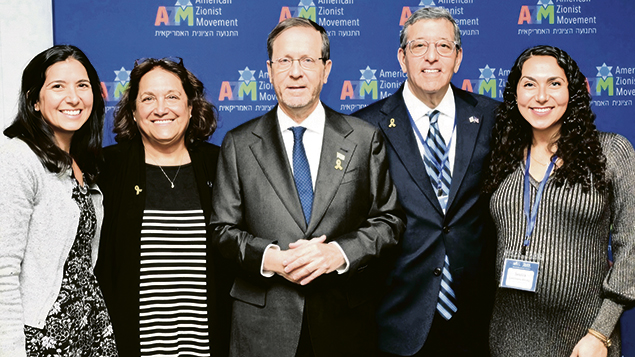
Much of his time so far has been spent on installing this new structure, Mr. Levenson said. He’s worked with the other eight officers who make up the cabinet. “I’m proud to say that six of our officers are women,” he added. “All five of our vice presidents are women, and the chair, with whom I work closely — more closely with than anyone other than our executive director — is a woman.” He feels strongly that the AZM should be run by people who represent the broad spectrum of Jewish life. It’s not for any abstract reason, he said, or to meet any political goal, but because “there are so many talented people around, of all stripes, shapes, and forms, and we need a better balance of them. Not just male and female, but also observant and non-observant, and with different religious and political views.”
As makes sense in an organization made up of leaders of so many other organizations, the AZM’s structure is complicated. Aside from its other tasks, it runs the World Zionist Organization election in the United States, and the membership of the board depends on those elections. “We try to keep it as balanced as possible, because I want this organization to move forward,” Mr. Levenson said.
“We want to promote Zionism and Zionist educational programming, and to keep as much noise out as possible. We all have our own personal views, and we all think we’re 100 percent right. And even if we don’t think that, if we think that we’re only 92 percent right, we’re not going to convince someone else of how right we are if that person’s view is vastly different from ours.
“I want our organization to be as forward looking as it can be, and I want us to be as civil as we can when there are disagreements.”
The reason for all of this, for him, is that “like all of our officers, leadership cabinet, and board members, I bleed blue for Israel.
“Most of my children’s relatives are there. Most — virtually all — of my grandchildren’s cousins are there. We’ve been blessed with 26 family members who have served actively, both as officers and on reserve duty. Many have served multiple 100 days. Two of them have been injured — thankfully they’re okay.
“So I bleed Israeli blue and white.
“On a bureaucratic and functional basis, at AZM we do have some different views from some Israeli national institutions on how Zionist education and programming should be run in the United States.
“Historically, the World Zionist Organization would put someone in the U.S., and that person would be responsible for coordinating the WZO’s Zionist efforts here.
“The U.S. is the biggest diaspora. Biggest Jewish diaspora, and also biggest Zionist diaspora.”
Many American Jews know about the Jewish federation system that helps raise funds and allocate them — our newspapers are centered in the catchment areas of the Jewish Federation of Northern New Jersey and the Jewish Federation of Greater MetroWest NJ — and some know about the umbrella organization called the Jewish Federation of North America, to which they belong.
Fewer American Jews know about the 45 Zionist federations spread around the world, Mr. Levenson said, but “the U.S. has by far the largest one. And we feel that we are the ones who should be designing and carrying out how Zionist education and programming efforts happen here.
“Of course, we want to partner and collaborate with our Israeli colleagues, because a lot of the shlichim” — the young emissaries — “come from there, a lot of content comes from there, and of course it’s all about Israel. But still, that doesn’t mean that Israel should be telling us how to run these efforts here.”
He praised Yair Lootsteen, a Canadian-born Israeli from the liberal Zionist organization Arzenu, who’s the new head of the WZO’s Israelis Overseas department.
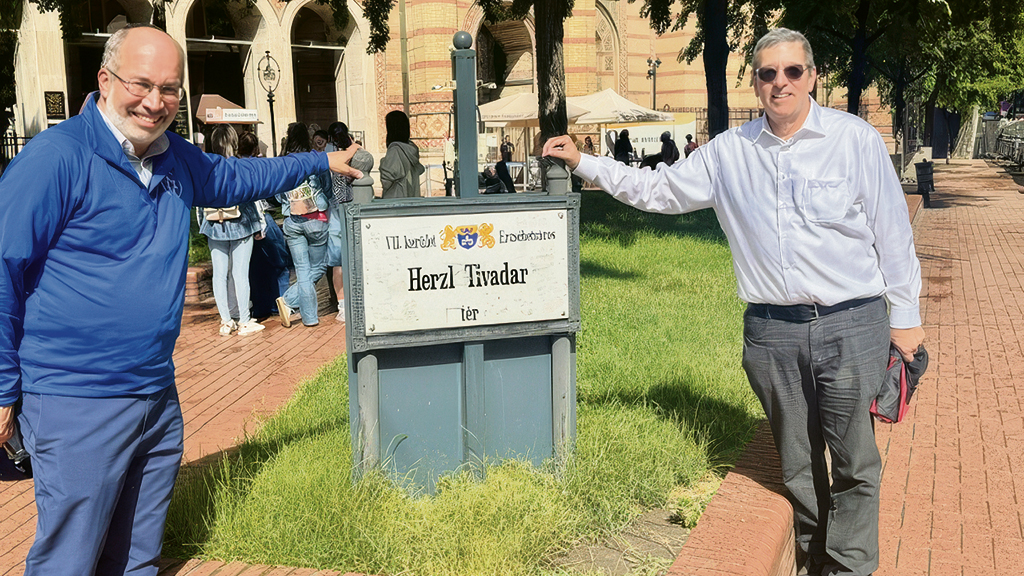
Mr. Levenson talked about the meeting in June that saw representatives of 29 of the 45 Zionist federations — from English-speaking or mostly English-speaking countries — meet in Budapest. “To my memory and knowledge, that was the first Zionist federation gathering outside Israel,” he said.
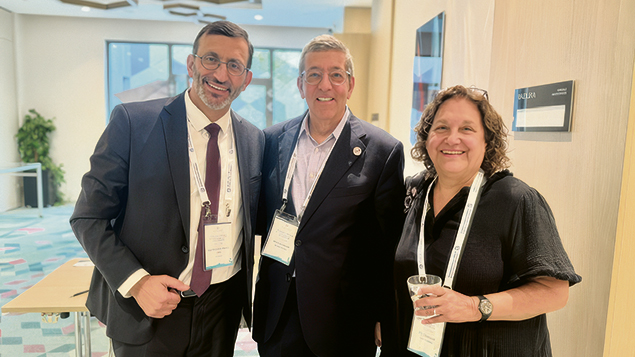
It was both exciting and a bit of a work in progress, he added; it’s a three-day conference, but because one of those days was Shabbat, there could be full davening, but not only could there be no writing or amplification, there also could be no translation, because to do it at scale, would require electronics. So it would be hard to have more than one primary language on Shabbat. Logistics are always a challenge.
“And it was one of the greatest Zionistic experiences of my lifetime, and I’ve had quite a few,” Mr. Levenson said. “We came into this conference without high expectations.” Bureaucracy has a tendency to get in the way of collaboration, even among allies.
Countries with smaller Jewish populations face different kinds of problems than we do in the United States, Mr. Levenson said. In some ways, the antisemitism here is worse.
“This was shocking to us, but it also was very uplifting,” because the Americans got to see the creative, often heroic ways that other Jews in other places cope. “America often is looked up to as a big brother, and I’m not diminishing America’s role, but it was mind-blowing to see what is being accomplished in so many other Zionist federations.
“South Africa may be the best Zionist federation — per capita, they may be the best in the world. They live in a very hostile governmental environment — they can’t bring Israeli soldiers into the country — yet they figure out the way to promote Zionism, and they are such strong Zionists.
“And we all know what happened in Bondi Beach in Australia, but Australia has an incredibly amazing Zionist federation. And then you have small countries, places like Serbia, Romania, Bulgaria, Latvia, where there are very few Jews, but they are very proud Jews.” Representatives from those countries were at the meeting. “Shockingly, there’s less antisemitism there than we have here, but nonetheless, they’re very very small. They don’t have anywhere near the numbers that we have, but it was so wonderful to see their efforts, their leadership, their love of Zionism. There was a tremendous amount of collaboration coming out of it.
“We have a lot of interesting things planned. Our federations are going to work with each other, and we might mentor some of the smaller federations.
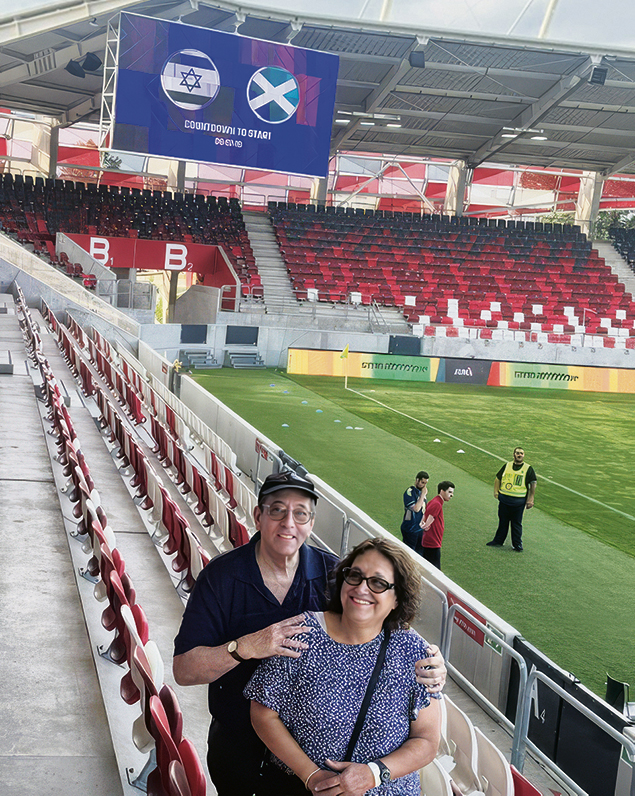
“We saw how united we are. We have different views, but there was no acrimony, no bitterness, no fighting. It was just a wonderful feeling, where we saw we have the same view about Zionism.”
There are countries where it is actually hard to be openly Zionist, and their representatives were at the meeting too. “We all know what a disaster France has been post October 7,” Mr. Levenson said. “We know what a disaster the U.K. is, and that it will likely be more so under the new leadership. And the U.K. and France have gone down the tubes in being helpful to Israel and trying to protect their Jewish citizens.”
Some of the smaller Central and Eastern European countries support Israel, at times quite strongly, Mr. Levenson said. “They’re opening embassies in Jerusalem.”
He saw something that shocked him in Hungary. “I saw posters and stickers there from post-October 7.” Hostage posters. Still up, although the hostages are home; not torn, not defaced, as they often were here. “I saw less security in front of synagogues and institutions of learning in Budapest than you see here in America. And I wore my yarmulke around Hungary, and there were no issues. No problems.
“There were more kosher restaurants in Budapest than at home.”
Wait a minute, Mr. Levenson. More kosher restaurants in Budapest than in Teaneck? Well, no, he agreed. But maybe more than in other parts of Jersey! Including Essex County!
He went on a tour of Holocaust sites in Hungary, “and they describe the Holocaust with no whitewashing, no attempt at any moral equivalence.” It was heartening, he said.
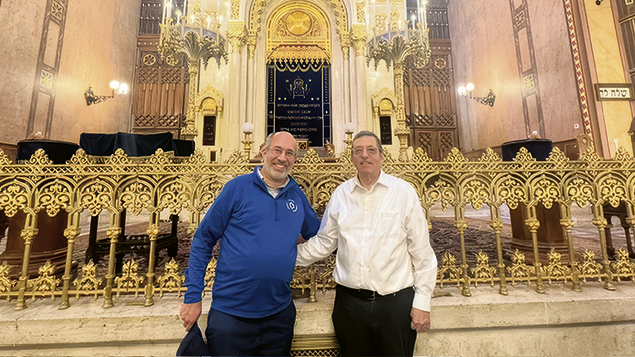
“It was a fantastic trip, but a little depressing, because there are more Jews in New York City than anywhere else in the world, the amount of antisemitism that’s going on here is upsetting. The mayor,” Zohran Mamdani, “is taking apart the structure that helps protect Jews. It’s concerning. He’s telegenic and he’s articulate and he loves a microphone — he also hasn’t changed his views, he’s doubled down, and he’s not the only one saying that.”
There is antisemitism coming from the right as well, he added. “The trash that comes out of Tucker Carlson or Candace Owens or Nick Fuentes. There’s no whitewashing what extremists on either side do, and it is horrible from both sides, and we are mindful of it.
“It is disconcerting. And we think that the American Zionist movement has a very strong role to play. It would be great if everyone could do everything without staff, and without money. But you need money and staff to do things. We are going to have bigger budgets. We are going to hire a senior professional who will be focused mainly on our Zionist education programming efforts and related matters, and we’re looking to grow out staff over the course of the next year.
“I’m very excited about the announcements we’ll be making.”
By its charter, slates of delegates to the World Zionist Congress must be at least 40 percent women, and it has to be 25 percent young people. “So we have a built-in pipeline of youth in our very active Zionist Youth Council,” Mr. Levenson said. “We have a lot of programs we’re working on, here and collaboratively with Israel.
“We’re very excited. Things won’t change in a day. They won’t change in a week. It won’t change in a month. I think that eventually, when we get past the midterm elections here in the U.S., we’ll be heading toward a non-war situation. That is my prayer and hope. But whether or not that happens, we will continue to do what we need to do.”
Being a Zionist doesn’t mean putting on blinders. “Israel’s not perfect,” Mr. Levenson said. “The government’s not perfect. No government’s perfect. I have issues. Certainly, I have issues with the draft issue in Israel.” The death rate for IDF soldiers is highest among the religious Zionists, the group to which Mr. Levenson and his Israeli relatives belong. National service is an appropriate alterative, he said; simply not serving is not.
Despite the irrational rage that the word “Zionist” seems to evoke around the world right now, “I think Zionism is affirmative,” Mr. Levenson said. “It’s not merely defensive. Unity is not uniformity. Debate Israeli government policies while remaining committed to Israel’s legitimacy, security, and future.
“And remember that Israel and the diaspora, in my view, are mutually reinforcing. A strong Israel strengthens Jewish life worldwide. We need that vibrancy on both sides, and active, critical Jewish communities are very important. Diaspora communities bring advocacy, philanthropy, leadership ideas, and civic partnership with Israel. That needs to continue.
“Zionism requires participation. It’s practiced through education, voting, advocacy, philanthropy, travel, cultural engagement, community leadership, public service, and aliyah.
“So the question is — is the Zionist movement in a vulnerable position? Zionism is absolutely under intense pressure, but it’s also energized. October 7 exposed antisemitism, misinformation, generational uncertainty, and internal polarization.
“And at the same time, it revealed the depth of Jewish peoplehood. American Jews mobilized through philanthropy, advocacy, travel, public demonstrations, and direct relationship with Israeli communities.
“The challenge we all have now is converting that emergency solidarity into enduring engagement.”
Learn more about the American Zionist Movement at azm.org