

History does sometimes echo
A look at antisemitism in the Soviet Union then — and at home now
History doesn’t repeat itself. Not exactly. That would be too easy.
But it does echo.
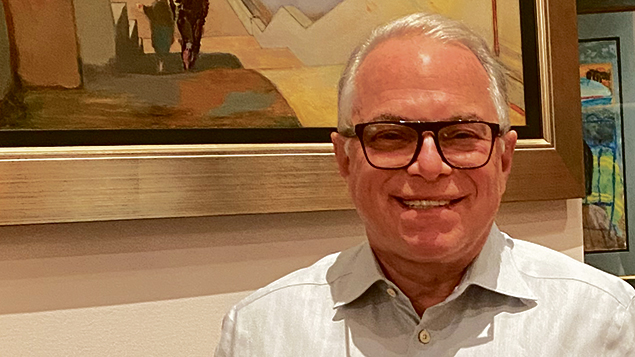
Alexander Smukler of Montclair lived with harsh antisemitism, coming both from the government and the surrounding culture, until he was able to leave the Soviet Union in early 1991.
He’s watching it rise again now. It’s not the same — and it’s much less harsh — but he can recognize themes from the past, coming to putrid life again. Antisemitism never seems to die. It just morphs into forms that make sense in the world in which it finds itself.
When an academic doing research on antisemitism asked him what he remembered about it in the Soviet Union, Mr. Smukler started looking back in his archives, rereading his personal notes. He was particularly interested in an organization called Pamyat, a right-wing group whose name translates from Russian to English as “memory.”
“Pamyat was one of the most antisemitic, anti-Zionist movements, and it appeared suddenly in the early perestroika years in the Soviet Union,” Mr. Smukler said. (Perestroika, which literally means “reconstruction,” was an economic reform that Mikhail Gorbachev attempted in the late 1980s.)
“Pamyat became very popular very quickly,” he said. “It took just months for us” — that is, members of the underground Jewish movement — “to realize that it was a massive movement, with hundreds of thousands of members. They conducted massive demonstrations in different parts of the Soviet Union, and they had active cells in the most important and famous universities. They claimed that they wanted to reclaim the Soviet Union and bring it back to pre-revolutionary times.
“Some of them were monarchists. Some considered themselves true socialists. It was a weird combination.” But a belief that held them together was antisemitism. “They used extremely strong antisemitic slogans and anti-Zionist propaganda.”
Some of that propaganda “blamed Jews for creating communism and organizing the revolution that killed the Romanoff family, starting the terror against the Russian aristocracy and the intelligentsia, destroying Russia, and preparing it for the Stalinist dictatorship.”
That was the right-wing side of Pamyat. Some of the members of that wing were monarchists; some of the most reactionary and violent of them were members of the Black Hundreds, a group that first appeared sometime around the very end of the nineteenth century or the beginning of the twentieth, and between then and the Russian Revolution in 1917 were (or at least are thought to have been) responsible for bloody pogroms against Jews, particularly in Zhitomir, Odesa, and Kishinev. A reconstructed version of the Black Hundreds emerged in the late 1980s, as monarchist and antisemitic as ever.
“Ironically, there were other groups inside Pamyat who were very Stalinist and socialist,” Mr. Smukler said. “They were ‘true communists’ and ‘true socialists,’ whose 100 percent crazy main idea was that after Stalin’s death the country moved away from true socialism.
“All of them were united on a platform of antisemitism and anti-Zionism, blaming Jews in every possible way, for everything from the October Revolution to the Red Terror under Lenin. They blamed Jews for not fighting with the Russian people during the Second World War. They denied the Holocaust; when they didn’t deny it completely they said that it was not against Jews but it was against Soviet citizens. They said that Jews had no right to identify themselves as victims, because Russia lost 20 million people, and Jews lost only six million.
“They blamed Jews for the entire socialist system. They never called for physical violence against Jews. They never called for pogroms. But their slogan was ‘Jews out of Russia.’” There was some irony to that demand, given that so many Jews wanted to leave but were not permitted to do so.
“Eventually, by the end of 1989, Pamyat was considered to be a project of the KGB and very conservative people inside the Politburo, who were fighting against perestroika and against Gorbachev personally,” Mr. Smukler said. It’s a long and complicated story, too long and complicated for this story now. He recommends a book by Mark Deich, “Pamyat As It Is,” that explains the movement thoroughly and well. For now, we just need to know that it ended, years later, with the coup against Gorbachev that eventually led to the fall of the Russian empire, but he was focused on 1987.
That was when Mr. Smukler and his colleagues, a steering committee of the Jewish underground, “were called to a secret place outside of Moscow, where we met for a discussion of how Jews should react to a public, openly antisemitic movement.”
Each of them was responsible for a different fact of the committee’s work. He was in charge of samizdat, the underground literature that the government did not want them to see, Mr. Smukler said. Also, at 27 the youngest member of the committee — a refusenik who had applied for a visa to leave the country seven years earlier — he was tasked with taking notes and writing minutes of its meetings.
Ten of the members of the steering committee were able to get to the meeting. They were all being watched — “we lived under 24/7 surveillance,” Mr. Smuckler said — so how did they manage that?
“There were lots of ways,” Mr. Smukler said. “I didn’t wear wigs or change my appearance in any way. But if you’re driving a car, for example, you take side streets. I also had a different car, which was parked at an apartment building. So I went through the building’s main entrance, left through the service entrance, and got into this different car.
“The best way to disappear was in the subway. Into the crowd. Because remember that back then there were no surveillance cameras.
“They listened to us all the time, and sometimes they followed us, but we already knew who was following us. We recognized their faces and we recognized their cars. They always used the same type of cars.
“On routine days they were lazy. They just followed us, one or two guys who would replace each other. So I could jump onto the subway, the way I was trained to do for years. They did their job and we did our job.
“The KGB’s goal was to monitor our contacts with foreigners. It was counterintelligence. They were looking for our contacts with foreign journalists.”
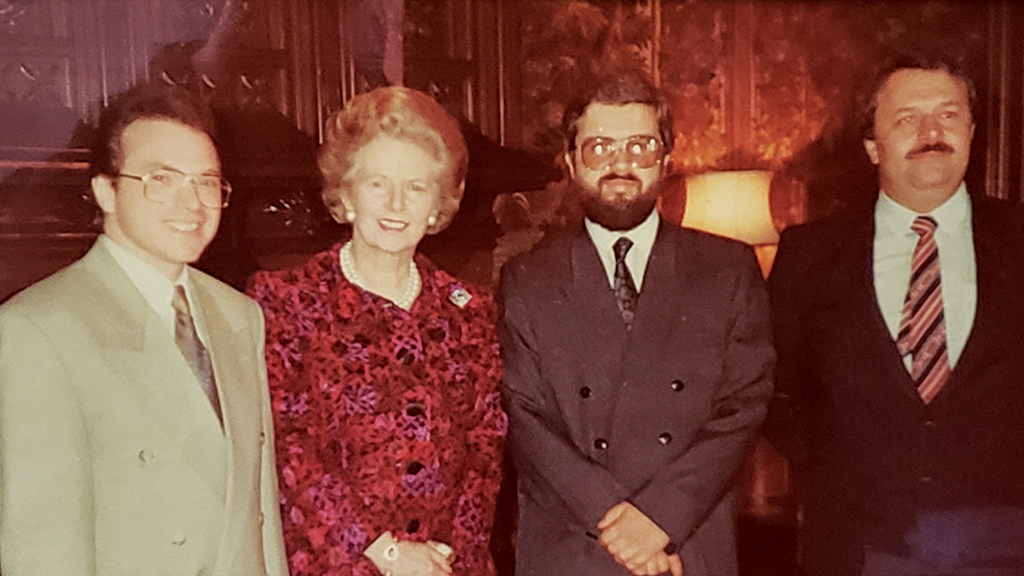
Or with foreign leaders. Mr. Smukler and his colleagues, including Valery Engel — a distant cousin of the late Bronx congressman Eliot Engel — were able to evade this KGB followers, using the subway trick, to get to the British embassy to meet with Prime Minister Margaret Thatcher.
“It was much easier back then,” he said.
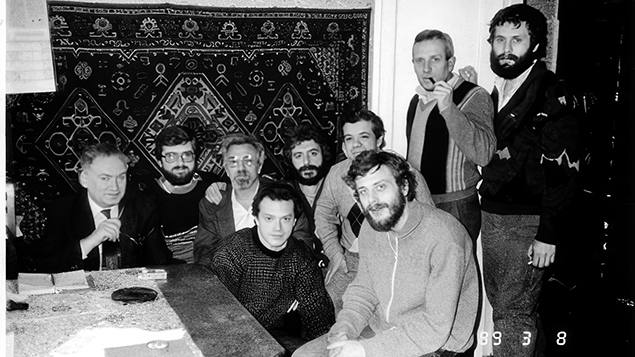
When Mr. Smukler looked at the notes he’d taken from that meeting in 1987, “I suddenly realized, oh my God, this is exactly what we could write about our time, and it’s relevant to publish it today.”
The reason for the meeting was to consider how Jewish leaders should respond to the threat posed by Pamyat and the antisemitism it encouraged. The committee was part of a network “that united tens of thousands of people across the country,” Mr. Smukler said. What should they do? “We had to tell them how to behave and how to react to the danger.
“We have the same situation now that we did then, except that we always assumed that Pamyat was created by the government and couldn’t exist without it. It was government financed and government organized. It got permission to public gatherings; in the Soviet Union, nobody except the government could create and support such a massive political movement.” That’s not what we’re dealing with here.
But the points with which the members left the meeting are relevant today, Mr. Smukler said.
“Point one: Jews are not responsible for the rise in antisemitism. It arises within the society that produces it and reflects deeper political and cultural problems. It was like a sarcoma on the surface of Soviet society; it was a malignant growth, a signal of a serious, deep disease.”
In fact, he added, the Soviet Union collapsed just four years after this meeting. Everyone there could feel the rot, but nobody thought that the disease was as far gone as it proved itself to be.
The second point, Mr. Smukler continued, was that antisemitism became fashionable, particularly among young people. It was chic to hate Jews. “It gave them a ground to unite with other people,” he said. It was a particularly potent ideology because they came to it with minds free of any knowledge, sympathy, or empathy. The history that they were taught was sanitized. “They had no idea what antisemitism was. No one knew about pogroms. They didn’t know who Trotsky was.”
Instead, “they all thought that Israel was a fascist, apartheid state. Their antisemitism was connected with Israel. They had never seen a real Jew. There were no visible Jews, with kippot or peyes, in the Soviet Union.
“So suddenly we see thousands of young kids marching in the streets, wearing the black shirts that were the uniform of the Black Hundreds. Back then, we couldn’t realize what really triggered those strong antisemitic feelings, and then we realized that they had been poisoned by Soviet anti-Zionist propaganda. They had no clue about history. They had no clue about who killed the Romanoff family. It was just slogans. It was poison created by the KGB.”
The thing about fashion, though, is that it is cyclical. “Antisemitism eventually will go out of fashion,” Mr. Smukler said. And then it will rotate back onto the runway, wearing an outrageous, eye-catching new outfit, and the cycle will start again.
“The third point is that because it’s fashionable, and because we did nothing wrong, we should not waste our time fighting it, and proving that we are not guilty. The burden of proof is on them. If they want to prove that we are guilty, let them prove it.
“History is full of examples of that. Of lies. One example — blaming the Jews for not fighting in the Red Army during World War II. Antisemites spread the story that Jews did not fight. That they hid. Antisemites denied the Holocaust, and they denied that Jews contributed enormous numbers of lives to fighting the war. Russian propaganda hid that.
“Russians never heard about Jewish resistance during the Second World War. They never heard about the Bielski brothers. They never heard about the Warsaw ghetto uprising. Pamyat lied. Pamyat used the lie about dual loyalty, and that meant that Jews were the fifth column in the Soviet Union. They said that because the Jewish community was so strong and so connected, that must mean that they were getting instructions from Israel about how to destroy the Soviet Union.
“So we sent a message to our community, saying stop! Stop! Stop! Stop wasting money, influence, and effort to try to write articles about the war. Some people tried to go to Pamyat meetings and stand at the podium to tell them the truth. To say that we love the Soviet Union and we love communist. Stop doing that.”
Instead, the committee urged its network realize that the Pamyat movement, and the antisemitism behind it, was “a political instrument that somebody created, organized, financed, and nourished. Somebody is trying to use that massive human movement for his own purposes. In order to understand the nature of that political movement, which looks and sounds very dangerous for Jews, it is important to understand who is behind it.”
Remember, Mr. Smuckler said, this was way pre-Facebook. Pre-social networks. Way pre-flash mobs. Organizing mass movements took a lot of work.
In the end, historians have uncovered who was behind the movement. Those figures include a former KGB chief, Vladimir Kryuchkov, and Yegor Ligachev, an influential Politburo member.
Meanwhile, back in the Soviet Union, the committee told its network not to fear pogroms. It was unlikely that such violence would erupt; it wouldn’t help Pamyat or its enablers. It would cause too much instability to be useful.
“So we had to discover who is behind Pamyat, and once we did, we had to fight against it. We said stop being afraid that the pogroms will start tomorrow. If they do, maybe we will all sacrifice our lives, but it will start only if someone at the top gives a specific order for it, and he won’t.”
There was one last piece of advice that the committee came up with. “Antisemitism can make Jews more Jewish,” Mr. Smukler said. “We, as true Zionists, had to give people the idea that they always have a safe place to go to. They could immigrate to Israel.”
Something worked. “The number of students in our schools in 1987 increased maybe 20 times. When Jews saw young people in black shorts on the streets, shouting ‘Jews out of Russia’ and ‘Israel is a fascist state,’ they learned Hebrew, they applied to immigrate, and our movement became a massive response to Pamyat.
“Eventually, almost 2.2 million Jews left Russia.” Including Sasha Smukler, his wife, Alla, and their young children.
The situation today here is unlike the situation in the Soviet Union 40 years ago, but aspects of it — the demonization of Israel, the Jew-hatred coming from both left and right — is not entirely dissimilar. When history doesn’t repeat but starts ever so slightly to rhyme, it’s a good idea to pay attention to it.