

‘Talmud of America’
For July 4, the Pardes Institute looks at the Declaration of Independence guided by Jewish texts

We Jews are known for our devotion to text.
To say we read carefully is to understate ludicrously. We examine every word, every noun for its solidity and apparent meaning, every verb for its active or passive message, every repetition and alliteration and metaphor for whatever might possibly be hidden in them. We stare at the text through slitted eyelids or from odd angles or in different seasons with their different lights.
We are called the people of the book, but that’s too general. We’re the people of the words and the letters and the spaces between them.
But of course we are not the only people to have foundational texts whose meanings we read for stability as we change.
We also are Americans, and we as Americans also have texts whose roots are revolutionary and whose meanings guide our lives.
We have laws and regulations and proclamations and executive orders, from many layers of government. Our courts read and reread and reinterpret the Constitution as the world and the acceptable ways of looking at those documents shift around us.

And then there’s the most foundational document of all for these United States, the Declaration of Independence, written and signed in steamy Philadelphia in July 1776, 250 years ago.
The Jerusalem-based Pardes Institute of Jewish Studies teaches Jewish texts to a diverse group of Jews, like-minded in their pursuit of learning but otherwise widely diverse, and through that creates Jewish community.
Its president, Leon Morris, embodies much of that diversity (although of course no one person could contain all its multitudes). He’s American by birth; he, his wife, Dasee Berkowitz — both Pardes alumni — and their three children made aliyah in 2014. His smicha is from Hebrew Union College-Jewish Institute of Religion, but his connections to all three Jewish streams, Reform, Conservative, and Orthodox, are so strong that he’s impossible to label.
Last winter, Rabbi Morris started thinking about what Pardes’ contribution to the United States’ 250th anniversary could be.
The result of his deliberations, his consultation with the Pardes faculty and all their work is a 28-page pamphlet, “The Talmud of America.” It’s free, and available both online and in hard copy. (See below.)
The essays in the pamphlet are apolitical, but “there are challenging ethical issues that we want to bring to the fore,” Rabbi Morris said. That’s an abstraction; he wanted Pardes to take on abstract questions and apply its own specific vision to them.
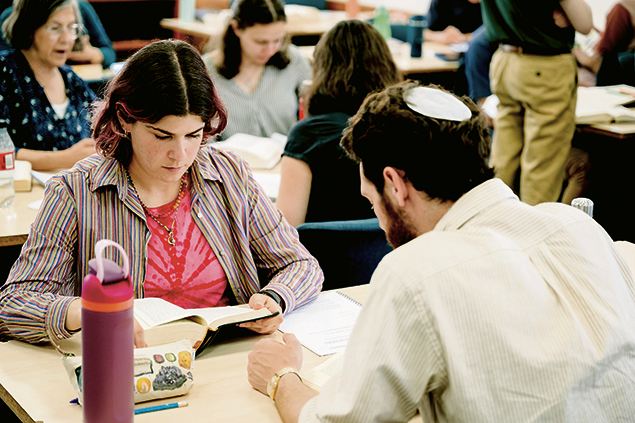
“We pride ourselves at Pardes as being probably the most diverse beit midrash” — study hall — “in the world,” he said. “There are people here in their 20s and people in their 70s. There are women with their heads covered and women in tank tops. There are men with kipot and men without kipot. There are women with tzitzit and men without tzitzit. There are Jews of color. There are Jews by birth and Jews by choice.

“What unites everybody in the beit midrash is their love for studying Torah.
“America also has common texts. And because July 4 is the anniversary of the Declaration of Independence, we want to provide a basis for learning and for unity, for transcending polarization, through a discussion of this text, just as we overcome Jewish polarization by uniting the Jewish world around discussion of Jewish texts.”
Discussion of Jewish texts involves respectful disagreement — both the noun and the modifier are important here — and the discussion of American texts should aim for that tone too, Rabbi Morris said.
Given all that, it made sense to use the method Jews traditionally use to study text, the method that the Talmud uses. Take a word or a phrase from the text, apply other texts to it, and see what happens.
Do that, and voila! You have “The Talmud of America — Commentaries on the Declaration of Independence.”
“Initially I wanted to have 10 faculty members each write a brief commentary, but I realized that we couldn’t do it,” Rabbi Morris said. “Each commentary would have to be about 250 words, so none of them could have the depth and sophistication that we want. So we opted for four essays, with a forward.” Questions follow each essay, to help clarify readers’ thoughts, and there’s a separate teacher’s guide as well, so “educators can take the main ideas and shape a class, whether it’s junior high, high school, college, or adult education. It’s great for educators, and also for rabbis as the basis of sermons.”

Rabbi Morris did not want the project to be fluff. “We didn’t want it to say something like, ‘All these great ideas in the Declaration of Independence? We Jews came up with them first. And isn’t it great how much everything Jewish corresponds to everything in the Declaration?’
“We didn’t want that. We wanted something filled with tension. We really hope that friend groups or families would talk about it, maybe even this Shabbat, at the dinner table.”
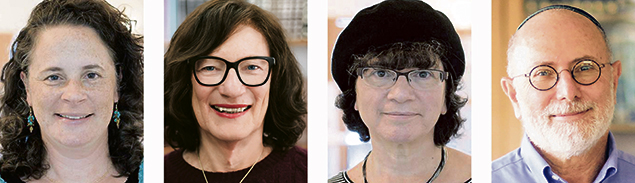
The first essay, by Rabbi Rahel Berkovitz, focuses on the Declaration’s opening, centering on the concept that “all men are created equal.”
Or, as Rabbi Berkovitz puts it in the opening of her essay, “Human beings are equal not because a political document declares it, but because every person is created in the image of God. And yet, as we will see, the Jewish tradition also recorded, with disarming honesty, the human tendency to betray it.”
“Rahel takes the idea from the famous passage in the mishnah saying that whoever destroys a life destroys a world,” Rabbi Morris said. That’s universal. But the Talmud says that “…anyone who destroys one soul from Israel, the verse implies about him as if he destroyed an entire world” (Mishnah Tractate Sanhedrin 4:5). That’s particular.
“She compares that to how long it took America to understand the phrase ‘all men are created equal’ to encompass women and people of color; about the very narrow, parochial, particularistic interpretation versus a much more universal interpretation, how that has played out and continues to play out both for Jewish and American life.”

The next essay, by Yiscah Smith, focuses on words further down in that opening paragraph, the ones about the “unalienable rights” to “life, liberty, and the pursuit of happiness.
“She’s interested in how our sense of rights changed over time, and how an increasingly isolated individualism maybe transforms the notion of rights that carried an element of communal responsibility to something more individualistic and more selfish, in how willing we are to apply this principle from Genesis to every person in the world and, the reticence at a certain point in Jewish history to do that,” Rabbi Morris said.
“She explores those rights. How do we experience them in Jewish tradition? She talks about the Mode Ani” — the traditional first-thing-in-the-morning prayer — “the first words that you say when you wake up, and feeling great daily gratitude for being given another day of life. With liberty, she looks at the notion of herut” — freedom — “and she brings in Rav Kook” — Rabbi Abraham Isaac HaKohen Kook, the first Ashkenazi chief rabbi of Mandatory Palestine, and a theologian who explored and defined religious Zionism — “about the difference between being a slave and being a free person. What does it mean to really be free?”
She brings Victor Frankl, the psychiatrist, philosopher, and Holocaust survivor, into the discussion of the pursuit of happiness. “Frankl says that the pursuit of happiness is really the pursuit of meaning,” Rabbi Morris said.
“The third essay is by Leah Rosenthal, who is our most senior faculty member,” he continued; she’s been at Pardes, which was established 54 years ago, for 40 years.
“Leah wrote about what on the surface seems a technical and boring phrase about prudence and the right of rebellion.” Despite prudence demanding that the situation — any situation — remain unchanged, at times the “long chain of abuses and usurpation” make that impossible. Then, “it is their right … to throw off such government,” the Declaration tells us.
“Her essay is about what would warrant throwing off structure and foundation,” Rabbi Morris said. “She brings in a fantastic Talmudic passage from Kiddushim that also will seem very technical at first. It’s about orphans who inherit property when they are minors. Can they have the case retried when they reach their majority?
“It’s really about stability. The question that she’s interested in pursuing here is that stability definitely is a value. How do you know when you’re reaching the tipping point where the principle involved is so important that you’re willing to undermine societal stability? She’s reacting to the founders’ decision to throw off British rule, but clearly the question has contemporary resonance. She’s trying to determine when you maintain the status quo and when you have to throw it off to maintain a sense of integrity.”
And then David Bernstein, Pardes’ dean emeritus, writes about the last part of the Declaration in the last essay. That’s where the signers “mutually pledge to each other our lives, our fortunes and our sacred honor.”
“He juxtaposes that with the threefold promise of the Shema, to love God with all your heart, with all your soul, and with all your might.” Just as the structure of those two pledges are similar, so too is the promise, Dr. Bernstein writes. “It’s a way of indicating what you feel so strongly about that you would devote your life to it. It’s about articulating a hierarchy of values, about realizing what you are willing to transcend comfort and security and maybe even survival for,” Rabbi Morris said. “It’s really about leading a life of ideas.
“And there is an allusion to October 7 in his essay,” Rabbi Morris added.
Dr. Bernstein ends the essay with a reference to that nightmare day. “The past two years have reminded us of the fragility of life and the reality of sacrifice,” he wrote. “They have also highlighted the resilience of individuals and communities who refuse to surrender their values in the face of adversity. In witnessing acts of courage and devotion, we are inspired — but we are also challenged. Inspiration alone is insufficient. The question that remains is how we translate these moments into sustained commitments in our own lives.”
The idea of America is vitally important to Americans in general and Jewish Americans in particular, even when those Jewish Americans add another identity and become Jewish American Israelis, Rabbi Morris said.
“I think that most American Jews, whether or not they live in the States, are grateful to America,” he said. Pardes’ “Talmud of America” “is a gift to America.
“America was the first country in the world to grant Jews full rights from the get-go,” he continued. “In Europe, there was emancipation; Jewish Americans were just part and parcel of America.
“I know that American Jews are feeling very challenged now, experiencing what feels like substantive and in some cases existential threats. But I think that this project pays tribute to what really has been a significant exception in Jewish history — this whole project of America.
“Our sense is that our ‘Talmud of America’ would be a unique offering to the Jewish people, something a little different from a Fourth of July barbecue — or this year a Fifth of July one, because the Fourth is on Shabbat this year.
“We hope that this is something of substance, that can bring greater depth and greater meaning and greater sophistication to July Fourth this year.”
The Maimonides Fund gave Pardes a grant that allows it to mail out about 10,000 copies of “Talmud of America,” and the fund also supported advertising to promote the project. “We wanted to get it into everybody’s hands,” Rabbi Morris said.
Although its connection to the Fourth of July is obvious, the ideas it holds are relevant year-round, he added; it might be particularly useful in the run-up to the midterm elections on November 3.
“Talmud of America” is free. Copies can be downloaded online — they’re at pardes.org.il/talmud-of-america/ — and so can educators’ guides.
Hard copies are available as well. They’re also free. They’re available at the same link, pardes.org.il/talmud-of-america.
It’s all thanks to the support of the Maimonides Fund.
Learn more about Pardes at pardes.org.il. Learn more about the Maimonides Fund at maimonidesfund.org.