

Alisa would have wanted this
Steve Flatow talks about program supporting Ethiopian-Israeli women
When Alisa Flatow of West Orange was murdered on a bus in Israel in 1995, the terrorists who killed her also killed an entire world — a world of possibility, of creativity, of family and joy and love and life.
To be clear, those Iranian-backed terrorists also killed seven young Israeli soldiers. That was another seven worlds that were extinguished.
But — no, not but, and — and when Alisa died, her parents donated her organs, directly giving life to patients and acting as an example for many more potential donors.
They gave money in Alisa’s memory to support Israel, the country she loved, to support Jewish education, a cause in which she believed, to support Jewish women, a group she cared about deeply, and to do active good in many ways, some of them public, others not.
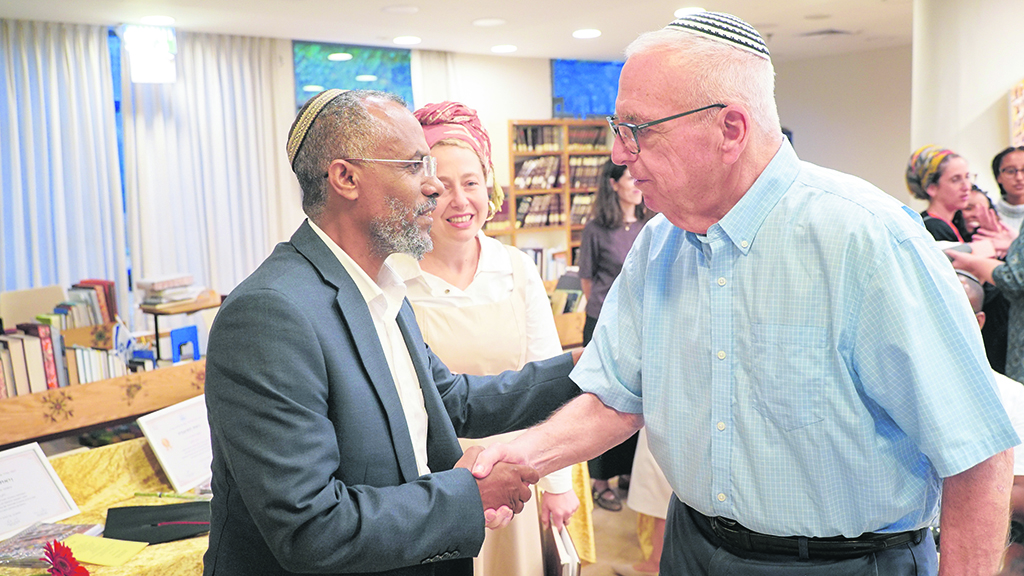
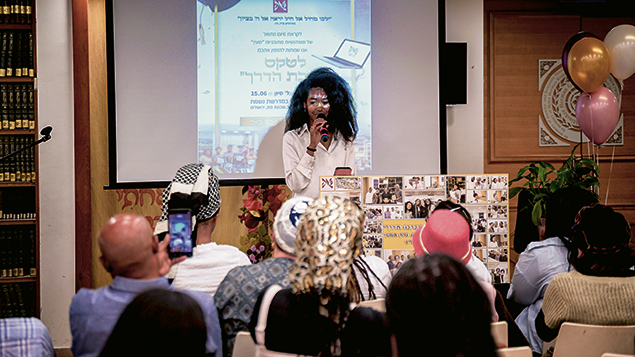
The Flatows have endowed the Alisa Flatow Memorial Scholarship Fund at the Jewish Foundation of Greater MetroWest. That fund now supports three programs. One of them, the Nishmat Seminary’s Maayan program, held a graduation ceremony for seven students last week. “Alisa was a student in Nishmat when she was murdered,” her father, Stephen Flatow, said. “We became very close to the school,” so it was a logical place for them to support. He’s also become a member of its executive committee.
The Jerusalem-based Nishmat — to be formal, it’s Nishmat: The Jeanie Schottenstein Center for Advanced Torah Study for Women — is, as its name makes clear, a seminary that gives women the chance to study Torah and Talmud. The building in which the study takes place is the Alisa M. Flatow Building, and many of its programs carry her name.
Nishmat’s central program, in which Alisa was enrolled when she was killed, is for young women — Israelis between their national service and college, Diaspora Jews between high school and college — who want to immerse themselves in the kind of intensive text study that’s more often provided to young men than to them.
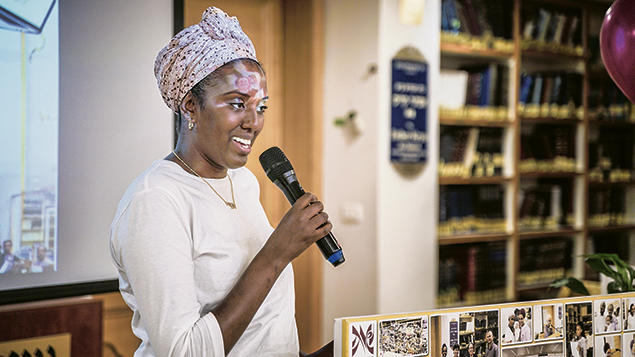
Nishmat’s Maayan program is for young Ethiopian-Israeli women, some of whom come from challenged backgrounds and all of whom benefit from support and mentorship as they integrate into Israeli society and prepare for exciting, fulfilling jobs in Israel.
The Flatows now divide their time between Israel and New Jersey; last week they were in Israel, so Stephen Flatow was able to be at Maayan’s graduation.
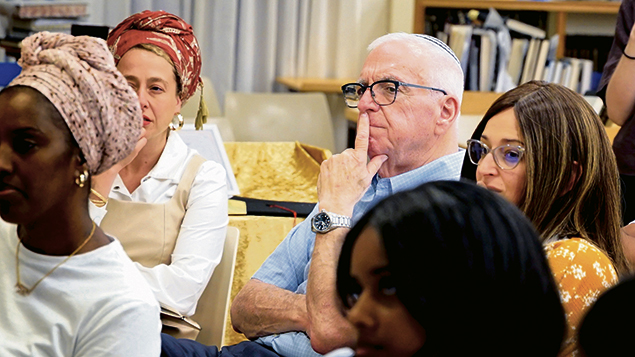
He was deeply moved by what he saw. “Ethiopian-Israelis don’t have a cakewalk here in Israel,” he said. “It can be very difficult for them. I believe that all the graduates this year were born here in Israel, but their parents weren’t, and they struggle to be accepted. There is discrimination in some communities. They look different, and they’re easy to notice. Some of their customs are unique, they have some holidays that the rest of us don’t know.
“Remember, they were separated from us for thousands of years. They have a Torah, but it’s written in Ge’ez, an Ethiopian language.”
The goal is to help the Ethiopian Israelis fit comfortably into mainstream Israeli culture without losing their own culture.”
He talked about some of the insults that Israel’s critics hurl. “They accuse Israelis of being part of an apartheid state,” he said. “They accuse Jews of being racists and colonialists. And here we have our people, who are so valuable and precious to us that we do whatever we can to help them fit into Israeli society.”
Julie Lehmann Weisman is Nishmat’s development director. She made aliyah about 20 years ago, she said, and has been at Nishmat for about 15 of those years, but she grew up in Teaneck, a proud graduate of the Teaneck public school system and the Bergen County Academies.
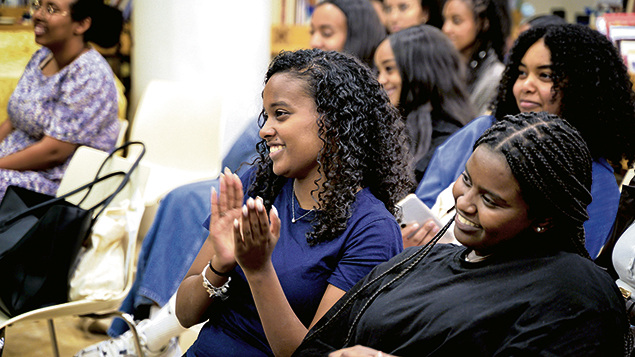
“About 25 years ago, the founder of Nishmat, Rabbanit Chana Hankin, realized that the Ethiopian aliyah was not succeeding as well as it should have been,” Ms. Weisman said. “So she said that we’d bring in Ethiopian Israeli students and teach them Torah for half the day, and the other half of the day we’d give them the academic tools and skills they’d need to get into college.”
That’s what she did. The students flourished.
As time passed and needs changed, the program was tweaked. “Originally, it was to help them finish their college entrance exams,” Ms. Weisman said. “Then it was to help them actually get into college. And then we saw that they could get accepted to college, but without some mentorship along the way, they might not make it to the end and get the degree.”
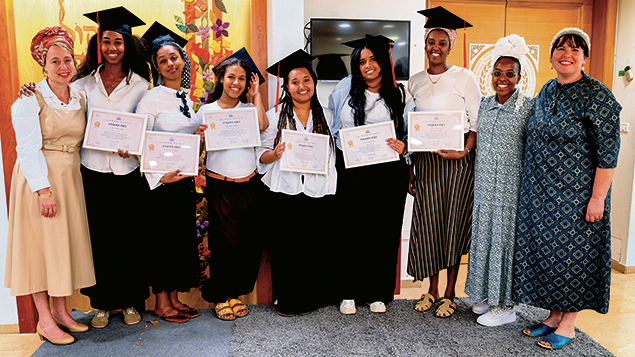
Most Israeli undergraduates take three rather than four years to earn their bachelor’s’ degrees, Ms. Weisman said; the college is less interested in providing a general liberal arts education than in preparing students for professions. “So we created a three-year college program where after spending a year with us getting into college, where we fill the gaps in their education, we can accommodate them through college.”
The students in the program fan out to local colleges and universities for their coursework, and those institutions grant them their degrees, but they live at Nishmat, which provides them with another home and a second family, offering community and mentorship; it gives courses in such academy-adjacent subjects as how best to use your computer, study skills, and how to balance life as a student with all the other demands, including work and family life. (Some of Nishmat’s students also have jobs.)
The students in the program are selected carefully, Ms. Weisman said. They can’t be so confident and adjusted that they don’t need help and they also can’t need so much help that their success would be unlikely. Both of those situations would waste resources. The goal is to find the young women who fit between those two groups of outliers.
The students’ goals also have changed over the quarter-century that the program has run. At first, Ms. Weisman said, students would earn degrees that would allow them careers as teachers, nurses, and social workers. Those are all noble fields, she said, and there is great need for professionals in them, but they’re not the only possible choices.
“Over the years, we have diversified,” she said. “This year, we did have one social worker, and one in nursing. Also, we had one in data science, one in biochemistry, someone with a chemistry and biology double major, one in bioinformation, and one in occupational therapy.
“We also have a professional advancement program,” she continued. “The women in it — about 18 each year — are in the workforce. We assign them a woman mentor, they choose a goal, and they work one-on-one for about nine months.”
Ms. Weisman talked about a mother and daughter who toured the school a few weeks ago. “An Ethiopian Israeli woman was looking at Nishmat as a school for Torah study for her daughter,” she said. In other words, she was looking at the school’s main program, the one it’s most known for. The one in which Alisa Flatow was enrolled.
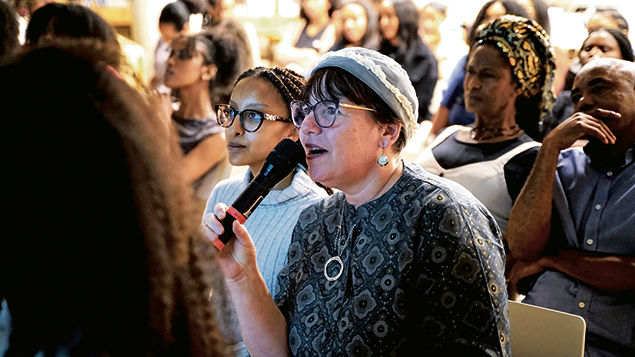
“One of the staff members stopped her in the beit midrash and said, ‘Hi, who are you, what are you doing here?’ And the mother said, ‘I studied in your Ethiopian program 25 years ago, and now my daughter is looking for Torah study.’”
Full circle, and complete success.
Of course, all of this takes money. “The program is entirely dependent on the generosity of donors,” Ms. Weisman said. Just to look at the students is to understand how much it can do, Mr. Flatow said. And to look at the faces of the students as they graduate, to see the joy coming off the screen and into the world, is to understand that.
Learn more about Nishmat, and about its Maayan program, at nishmat.net.