

‘The Penny Is Gone’
American grandson translates Russian grandfather’s book

Emil Bezverkhny’s life followed a classic tragic arc. He was brilliant — a wildly creative, innovative physicist and inventor whose gifts would have been welcome anywhere. He was optimistic and resilient, kind and loving.
Like all tragic heroes, he had a fatal flaw, but unlike most of them, it was not a character flaw. It was not hubris, not excessive self-regard or lack of generosity or close-mindedness to anything.
His fatal flaw was that he was a Jew in the Soviet Union.
Dr. Bezverkhny wrote a manuscript about his life — he called it a meditation, not a memoir, and it includes both. It’s deeply, richly layered — not a beach read. Rich earth, not sand. Dr. Bezverkhny did not expect “The Penny Is Gone: A Soviet Jew’s Meditations on the Jewish Question” to be published, but his grandson, Emil Pitkin, with help from other family members, has translated it into English, Ben Yehuda Press has published it, and Dr. Pitkin will talk about it in Teaneck on Monday, July 20. (See box.)

Dr. Pitkin, who was born in the Soviet Union in 1987 and left as a small child, is a formidably accomplished man. He graduated from Harvard with a concentration in math, then from Wharton with a doctorate in statistics, but — and?— his website, emilpitkin.com, showcases his original and translated poetry and prose, all lush and self-aware and clear and sometimes funny and always thought-provoking. He’s a high-tech entrepreneur, a teacher at Wharton who was the youngest ever to lecture there, and a living, breathing example of what Russia lost when it made leaving there an inevitable choice for Dr. Bezverkhny’s family. (Emil Bezverkhny didn’t make it out of Russia alive; he died there at 56, in 1984, just a few years after he finished “The Penny Is Gone,” in 1982. He missed his chance to leave.)
There are so many ways to start writing about this book, and this life. “It was never meant for publication,” Dr. Pitkin said. “It was never meant to be read by anyone outside the family and the most intimate friends, since the content of his recollections were so subversive and so antithetical to the foundations of the Soviet regime that the consequences for him would have been unthinkable if it had gotten into the hands of the authorities.”
Emil Bezverkhny was born in Vynkovtsy, a Ukrainian shtetl, in 1928. “Like so many Jewish families, in a temporary burst of freedom after the revolution they left their hard lives behind and ventured to Leningrad,” Dr. Pitkin said. “They” were Dr. Bezverkhny’s parents and his baby sister; the revolution was the one that started in 1917, turned Russia Soviet, and allowed Jews to leave the Pale of Settlement for cities.
“But very soon they tasted the bitterness of hardship, with the onset of the war” — World War II — “and the siege of Leningrad, which caught them in the eye of the storm.” The family was evacuated “to the hinterlands of Russia, and returned to Leningrad at the end of the war,” Dr. Pitman said. Dr. Bezverkhny described that period of his life — when all the men in his large extended family who were old enough to be drafted left for the war, and many of them never returned — with almost hallucinatory attention to unexpected detail.

“He writes with pride that every man capable of bearing arms from the family did so, and the only two men who didn’t were studying in university in scientific fields that would allow them later to contribute to the benefit of their country,” Dr. Pitkin said.
There was no time for school then, so his grandfather “was an autodidact who made up for the lost years of education,” Dr. Pitkin said. “He had a restless, voracious, polymath mind, as you can tell from his writing. He found everything interesting and worthy of savoring in those early days.”
He found that physics was chief among his many intellectual loves, and he was admitted to Leningrad University Faculty of Physics.
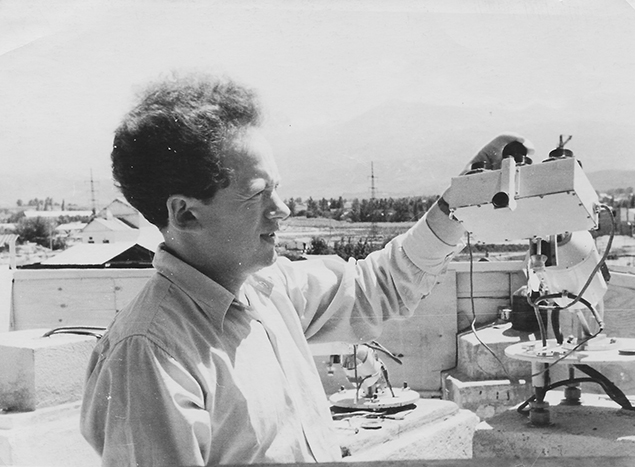
In the Soviet Union, college graduates looking to continue their education could not apply wherever they wanted to, Dr. Pitkin said. “Freedom of choice was not exactly happening.” They were told where they could go. His grandfather was sent to Alma-Ata, in Kazakhstan. As always, “he made the best of it,” and soon he was admitted to a doctoral program, “and soon thereafter was conducting important, novel experiments in ozone measurements in the field of atmosphere physics.”
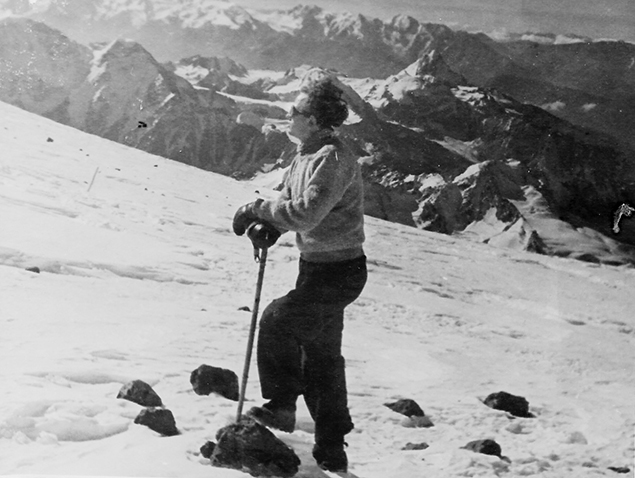
He also became an avid mountaineer. “He ended up climbing Mount Elbrus,” the highest peak in Europe, just north of Russia’s border with Georgia,” Dr. Pitkin said. “He was turned onto it by one of his mentors. He climbed not as an idle sportsman, but as a scientist. At the highest point on the mountain, in this rarefied air, he conducted scientific experiments measuring ozone concentrations.
“You can begin to identify the theme of someone who’s always living a life of creative ferment.”
Once he earned his Ph.D. he returned to Leningrad, “joined a classified military research facility, and pursued more physics work, primarily in the field of laser research, with patents and publications and research accomplishments.”
Those accomplishments brought him both intellectual and tangible success.
“And then, in the late ’70s, during the Brezhnev era, in a Kafka-esque turn of events, he was fired from his job, for reasons that could not have been any other than his Jewish origins.
“In the book, very much like in Kafka’s ‘Trial,’ he runs around trying to understand of what he stands accused, finding no answers in this absurd, bureaucratic, and of course antisemitic hall of mirrors.
“He wrote a telegram to Brezhnev asking to have his rights and his dignity as a citizen restored, but instead he is blacklisted, and 50 research organizations denied him a chance to work on his beloved physics.
“His work was his livelihood, it was his honor, it was his dignity. It was both tangible and intangible. It was everything that is important to a man.
“In the final saga of his chapter, he finally, finally, finally, and so uncharacteristically wins — maybe wins — this war of attrition with the faceless bureaucratic regime, and he is granted a position in a third-tier research institute in Leningrad that had been a refuge for Jewish physicists who had been fired from top research organizations under similar circumstances.
 “He is once again developing new research programs, new experiments. He believes that he will rise again. And then, in a climactic, tragic lifting of whatever naïve illusions he still might have had, the research director tells him, ‘Of course, others will get the credit for your work. Of course, you will lead all of our experiments, and maybe we’ll make you a lab assistant.’
“He was still an exile there. This was the extent of his freedom. And this is where he refers to a comment that his father had made long before, that what is permitted to everyone else is not permitted to the Jew.”
Because Dr. Bezverkhny was who he was, though, his creativity refused to be drowned. “When he worked at that institution, again he plunged into the work. He developed new applications for lasers, except this time it was in the realm of agronomy and agriculture, because that’s where he was.” It was the restless brilliance that propelled him, allowing him to move from one area to another.
“The book begins in such a funny way. It begins with his funny youth. Even during the war, as a lad, he was full of optimism. He believed that better days would come. Through his research, through his family, through the Jewish tradition, he always lapped up optimism in ungodly quantities. But at the end, it’s a steady descent to the seventh circle of hell, where he understands the answer to the question that opens the memoir.”
The question that opens the book that Dr. Pitkin does call a memoir, despite its calling itself a meditation, is why all the Jews are leaving the Soviet Union. “This was in the early ’80s, when hundreds of thousands of Jews had left a country that guaranteed equal rights under its constitution. Jews whose ancestor had worked to accelerate the revolution in the single most important event of the 20th century in the Soviet imagination. Jews who had given their lives and souls during the world war.
“So it was a steady removing of the blinkers from his eyes, a steady coming of age, a steady loss of innocence.
“There’s a moment in the book where his father had run a factory in wet salt leather hides, and he hired Jews. He hired whoever was best for the post. This was at a time when Jews already were being dismissed for being Jews. So his number two was leaving for Israel, and they have a phone call where they’re speaking past each other in different languages. The number two tells my grandfather, ‘I’m leaving so that my daughter can have equal rights in Israel,’ and my grandfather, who’s still young and naive, doesn’t understand what this man is prattling on about.
“There’s a bitterness, a kind of rue-ing, as he looks back at the conversation, but he remembers it. It leaves an imprint.”
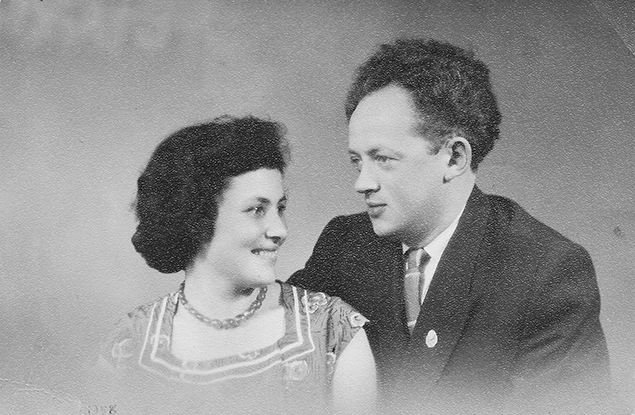
His grandfather had yet another talent. “He was a brilliant artist,” Dr. Pitkin said; the book includes some of his portraits of family members.
Then there was Dr. Pitkin’s grandmother, Rita Shifman, who was born in Kyiv in 1929. Children went to school for 10 years then, and his grandmother went to 11 schools during that time. “She was an only child, her father was an officer, he was posted in different places, and she and her mother followed him.
“Despite those peregrinations, she was an exceptional student who graduated at the end of the 10th year with a gold medal, one of only two students in her city to do so.” The medal was for students who received top marks in every subject every year, and it “entitled you to admission to any university of your choice. She chose the Leningrad University Faculty of Physics.” That’s where she and Emil met, and soon they married. Like her husband, Rita was assigned to graduate school in Alma Ata — at least the government allowed married couples to be assigned to undesirable locations together —and there Dr. Pitkin’s late uncle, Igor, was born.
His mother, Zorina Bezverkhny, was born a few years later, after the family returned to Leningrad.
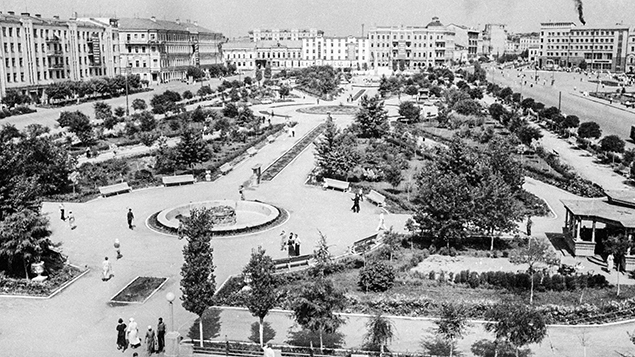
Ms. Bezverkhny became a physics teacher, so “she was able to do what she loved,” her grandson said. Unlike her husband, she was able to leave the Soviet Union, and her grandson knew her. “She had a magical ability to teach math. I was a beneficiary of that skill, because she was my first math teacher.
“She brought Soviet mathematics textbooks with her, so when I was 7, we studied Soviet algebra, and when I was 9, we studied geometry and trigonometry. I always looked forward to learning math with my grandmother.
“How many youngsters can honestly say that?”
His mother “grew up in a happy, light-filled house and had a happy childhood. And that made the tragedy of my grandfather all the more acute.
“When he lost his job, the house immediately darkened, and most acquaintances cut off contacts with him, out of fear for their own hides. He became virtually untouchable, but for close family and the closest, most intimate friends, whom we’ll never forget.
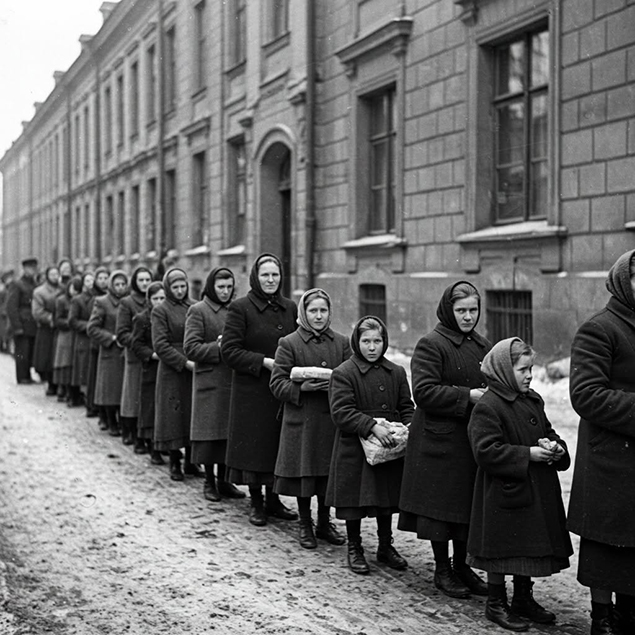 “And it all happened because he was Jewish.”
But there was another side to this story. “There’s a moment in the book when an envelope shows up on my parents’ doorstep, with the equivalent of several months of salary in it,” Dr. Pitkin said. “And all that’s written on it is ‘The physicists of Leningrad.’”
His family’s connections with Jewishness were deep.
“My grandfather’s grandfather was a rabbi in a very small shtetl called Sharivka,” Dr. Pitkin said.
“My great-grandfather, when he lived, led the seder, and his wife had a seat reserved for her in the Leningrad synagogue. My grandfather also led the seder. His Judaism was indelible. There was never a moment of doubt before whom he stood. The proverbs of his Jewish ancestors were always on the tip of his tongue, and yet at the same time he identified profoundly with Russian culture, and these two were never in conflict with each other.
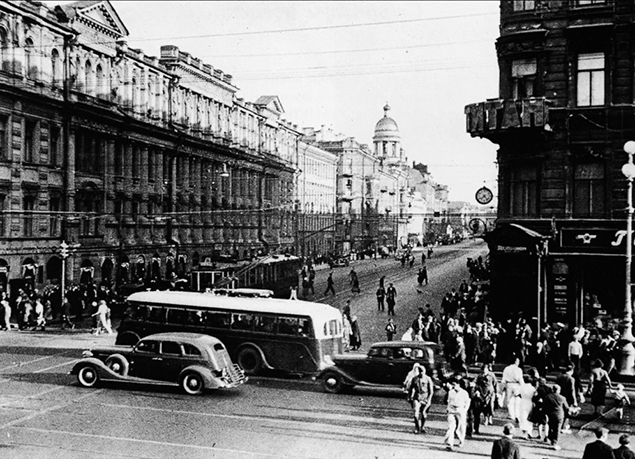 “Russian poetry, Russian art, Russian architecture, all of this was as dear to him as the idea of motherland. And they were intuitive Zionists, understanding the miracle of Israel and the refuge of Israel. They were natural Jews.”
Dr. Pitkin’s father, Dr. Mark Pitkin, also is a scientist. “He’s also a brilliant man, and a proud Jew,” Emil Pitkin said. “When he was in the Soviet Union, he headed the laboratory at the Institute of Prosthetics in Leningrad. His field is in designing prostheses for amputees. Now he’s a professor at Tufts, teaching physical medicine and rehabilitation. In the ’90s, he founded an international hockey league for amputees.
“My mother is also a scientist,” he continued. “She worked at the Institute of Antibiotics in Soviet Russia before she came here, and she just retired as a senior executive at a publicly traded company. She led a division with over 100 people, and her Ph.D. is in virology.”
Dr. Pitkin will talk about all of this, and much more — including about his other, equally impressive grandparents, and his other family members, because there is so much more to say, on July 20.
One more thing here, though. What does “The Penny Is Gone” mean?
“It comes from a parable my grandfather’s father brought from the shtetl, about a boy who was crying because he lost a penny. When a passerby tries to calm him by giving him another, penny, the boy cries again. He says, if I hadn’t lost that one, I’d have two.
“My grandfather, of course, is speaking about the Jews who were leaving Russia. New Jews will be born, but those who might have contributed to their society are gone forever. Those who might have contributed to the arts and to letters and to the sciences will never return.
“My mother, my late uncle, my grandmother, my two cousins and I, his descendants, who left Russia because of that atmosphere of antisemitism, we are also those pennies. We left, and we’re gone. We have contributed with pride to our adopted homeland of the United States. These are contributions that might have benefited the country of our birth if we hadn’t been spat out.”
Instead, his grandparents’ descendants have greatly enriched this country.
Who: Emil Pitkin
What: Will talk about “The Penny Is Gone” by Emil Bezverkhny
When: On Monday, July 20, at 7:30 p.m.
Where: In Teaneck
Why: Dr. Pitkin translated his grandfather’s book
What else: There’s a wine-and-cheese reception
Hosted by: Lori Fein and Martin Ramirez
How much: $25; includes signed copy of the book
For address and Zelle/Venmo info: Email teaneckreception@gmail.com