

Getting on the Baklava Express
British-American Jewish philosopher-musician tells what’s been instrumental
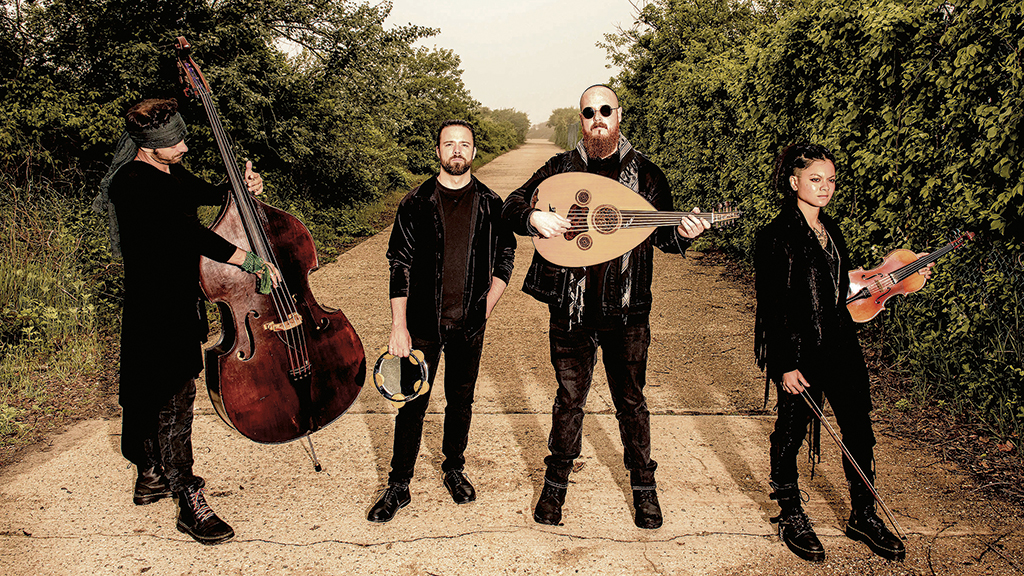
When I suggested that Josh Kaye’s motto might be, “I sing, therefore I am,” he laughed. “That’s a good one,” he said during a Zoom interview from his home in Brooklyn. “I may have to steal it.”
Mr. Kaye, 36, is a composer and leader of the band Baklava Express, which will be among the headliners at the Greek Jewish Festival on May 17.
Oh, and yes, he’s also a professor of philosophy. (Okay, okay, adjunct professor.)
Mr. Kaye, 36, grew up in a musical family in London; when he was 14, he moved to the South Shore of Long Island. But his musical training started far earlier. “Piano was my first instrument,” he said. “I can’t remember a time that I didn’t play piano. I probably started when I was three or four years old.
“I began playing guitar in high school. My plan was to go to the Berklee College of Music and study guitar. But my parents cautioned me. They wanted me to go to a liberal arts college with a good music program and also get a real degree.”
His parents’ theory was that if he had a non-music major, he’d have something to fall back on in case the guitar thing didn’t work out. So he majored in philosophy, because as we all know, the world is facing a critical shortage of philosophers. But as it turned out, that was a wise choice.
“If you’d asked me in high school what I was going to do for work, I would have said something stupid like my rock band is going to make it,” Mr. Kaye said. “We’re going to get signed by a major label and go on tour. I was delusional.”
But as it turned out, “I really liked philosophy. It was one of the first subjects in school I was actually good at and really enjoyed.”
So after graduating from the University of Hartford with a B.A. in 2011, Mr. Kaye decided to continue his education, but only if he could attend a school in Manhattan. That would allow him to play gigs when not studying. Or, vice versa, not study when he had a gig. The kind of deep questions he learned to wrestle with while working on his master’s degree at the New School, where he was class of 2013.
“I’d studied jazz guitar and just kind of hit the ground running when I moved to New York,” he said. “I started showing up to open jams and socializing and meeting people. I’d be hired for gigs here and there, and in a good way it stated to snowball. I would be playing this gig and meet that person who would call me for another gig.”
Still, he entered a Ph.D. program at the New School. “The plan kind of shifted at that point. I was saying I guess I’m going to be an academic. I’ll become a philosophy professor, even though I like playing music as well.”
As it turned out, that didn’t last long. “At a certain point the balance shifted again,” he continued. “While I was in the Ph.D. program, I was playing more and more gigs, and thank God, the gigs were paying more and more. I was teaching as well, doing adjunct work. And between the adjunct work and gigging, I was doing okay. I was paying my bills and started falling out of love with academia.”
He concluded he didn’t want to be a full-time professor, because that would likely mean leaving New York and gig opportunities behind. He liked teaching, but had the credentials and experience to continue as an adjunct. In fact, he’s already signed up to teach a course on Jewish philosophy at Adelphi in the fall.
He’d always felt “a very strong connection to the musical element of Judaism. Growing up I really liked going to shul, mostly because of the music. I really enjoyed the European cantorial style, which I’ve had a hard time finding in the States.”
Jewish music became more central in his life one evening in Brooklyn, he said. “I’d been playing guitar for many years in New York’s jazz scene and swing scene. I played a lot of ’20s and ’30s style music. But I’d always loved the oud, which features prominently in Sephardic and Mizrahi music.” The oud is a Middle Eastern instrument similar to a lute or mandolin.
“I was living in Bay Ridge, which is now a densely populated Arab neighborhood, and I kept bumping into Arab music everywhere. And that helped me broaden my palette.
“I started to really feel a connection with the music, because I think it reminded me a lot of the music I heard in shul. There is a lot of overlap between Arab music and Jewish Ashkenazi music and Mizrahi music, of course.
“One day I was coming home from a gig with my guitar and I passed this barber shop. It was closed, but the Egyptian man who owned it was in there playing music with a friend. He was playing an oud and his friend was playing a darbuka, the hand drum, and singing. They saw me looking inside, saw that I had a guitar, and they were like, come in.
“We started talking and I asked if I could try to play the oud. But I couldn’t do anything with it. I couldn’t get a good sound out of it. I felt so frustrated, but I also felt it was kind of like a challenge. So on impulse I bought one that night on Amazon. Over the next few months, I really just dove headfirst into the instrument. By all accounts from my Arab friends and neighbors, I picked it up very quickly. Funnily enough, many of them credited it to the fact that I’m Jewish.
“Once I gained some competency with the instrument, I found a community of musicians who play that kind of music in New York City. And I just started all over again, going to jams, networking, and getting hired for this gig and that gig. At some point, I started to feel more of a connection with the oud than the guitar. It sort of felt familiar in a way that is hard to explain. But I really think it’s because it reminds me of the music I used to hear when I was young.”
He felt so comfortable he began composing on the oud. Well, on the oud and the subway. “It’s a strange process. It almost always happens when I’m passively in motion, like on a train. Almost all my songs were written on the subway. And when I say written, I mean that’s where I got the inspiration.
“I’ll be sitting on the subway and hear a melody in my head. When I get off the train, I’ll sing the melody into my phone. When I get home, I’ll listen to it, figure out how to play it. My phone is just filled with dozens and dozens of these little notes of me singing a melody, and the songs are just me stitching these pieces together.”
They were good enough to convince Israeli violinist Omer Ashano to give up a slot he had at a small Brooklyn jazz festival and join Mr. Kaye in a band that played his music.
“I didn’t want to call the band the Josh Kaye Quartet. I wanted it to have a name, but I couldn’t think of anything. So that’s when Omer said, ‘Why don’t we call it something stupid like Baklava Express, and we’ll think of a real name later.
“But it stuck.”
Mr. Kaye grew up in a Jewish area of northwest London, and he went to a Jewish primary school and a Jewish high school. “I didn’t know anyone who wasn’t Jewish. And it was the same when we came to the States.
“We moved here shortly after my bar mitzvah. We moved to the Five Towns, which is also very much an Orthodox enclave.”
Asked the differences between those two communities, he said “in New York, I find the Jewish communities to be very self-segregated. I’m speaking of course in generalities, but if you’re Jewish and you live in New York and you’re Syrian I can tell you where you live. If you’re Bukhari, I know the neighborhood you live in. Or if you’re Persian.
“So growing up in London, my friends were Persian or Iraqi or Yemenite, but I went to this Ashkenazi shul. So I would get this really broad smattering of musical culture and food culture that I have a hard time finding in the U.S. I have to shul-hop to get the same experience.”
In general, he says, Judaism “works a little differently outside the U.S. American Jews are somewhat spoiled for choice in terms of both the number of synagogues they can go to” as well as the shul’s affiliation.
“In my experience, in England, Israel, South Africa or other places where my family is from, almost everyone goes to what would be considered an Orthodox shul. But what they do halachicly on their own is kind of up to them. Don’t ask. Don’t tell.
“We kept kosher but would have no compunction about turning lights on or off or watching TV on Shabbas.”
Or presumably play guitar.
Mr. Kaye’s band, Baklava Express, will appear at the Greek Jewish festival May 17 at the Kehila Kedosha Janina Synagogue and Museum on Broom Street on the Lower East Side. For other dates, check the website: baklavaexpress.bandzoogle.com