

Nearly blind, but with unlimited vision
‘Looking Up’ documents Eitan Armon’s scaling both heights and hindrances

He may have lost his sight, but he never lost his vision.
That’s the tagline of a new documentary feature film, “Looking Up,” about Eitan Armon’s 1,800-foot climb up Yosemite Valley’s El Capitan vertical rock formation.
The climb is hard for anyone — but it’s even more challenging for Mr. Armon, who has lost 95 percent of his vision to a rare congenital disorder, retinitis pigmentosa.
Mr. Armon, who was born in 1996 and lived in Maryland, was diagnosed when he was 21 and a lone soldier and sharpshooter in the Israel Defense Forces. He’d gradually been losing night vision and peripheral vision — a common sign of RP.
The award-winning film, to be screened this month at the JCC MetroWest in West Orange and the Kaplen JCC on the Palisades in Tenafly (see box), explores themes of resilience, perseverance, and personal responsibility that align strongly with Jewish values.
“I think this is a perfect l’chaim,” Mr. Armon says as he gets his first lesson in rock climbing. “Part of life is challenging yourself and sometimes being scared of doing things you’ve never done before.… It comes down to focusing on what you can control and being honest about what you can’t.”
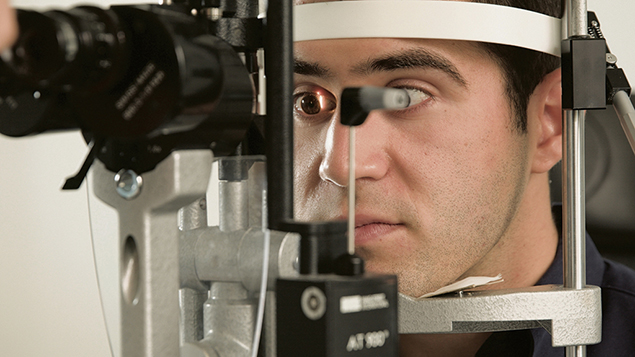
Following his diagnosis, Mr. Armon returned to the United States and graduated with honors from Columbia University with a major in neuropsychology. Today, living in New York, he’s a financial analyst for healthcare services companies. And as a member of the Foundation for Fighting Blindness’s Strategic Council, he mentors people with visual impairments and advocates for emerging RP treatments.
An experimental treatment that he received as part of a Johns Hopkins clinical trial has stabilized his remaining sliver of vision for the past eight years.
At Columbia, Mr. Armon befriended the daughter of New York-based documentary producer-director Elena Neuman of NeumanFILMS. After Ms. Neuman agreed to help him make a promotional video for the Hopkins clinical trial, he became close with the entire family.
But the promo video project was scuttled, leaving Ms. Neuman with wonderful footage — some of these scenes were shot in Bergen and Rockland counties — that she was determined to use somehow.
These segments include, for example, Mr. Armon’s inspirational meetings with Israeli positive psychology expert and former Harvard lecturer Tal Ben-Shahar, co-founder of the Happiness Studies Academy; and with Closter-based real estate developer Robert Heidenberg, who also has RP. (Mr. Armon’s wife of three months, Tamar Arenson, spent many of her formative years in Closter and attended Solomon Schechter Day School of Bergen County. She also appears in the film.)
“I’d gotten to know Eitan pretty well and was so inspired by him and his positivity,” Ms. Neuman said. “I felt like this could be so much more than just a promotional video, that he could be helping people with all sorts of limitations, not just visual limitations. We were discussing what to do with the footage we’d shot when Eitan started talking with my husband, Jay Lefkowitz, a lawyer and passionate amateur rock climber. He told Eitan about climbing El Capitan with our son a few years earlier. Eitan, being the outdoors enthusiast that he is, started peppering Jay with questions.”
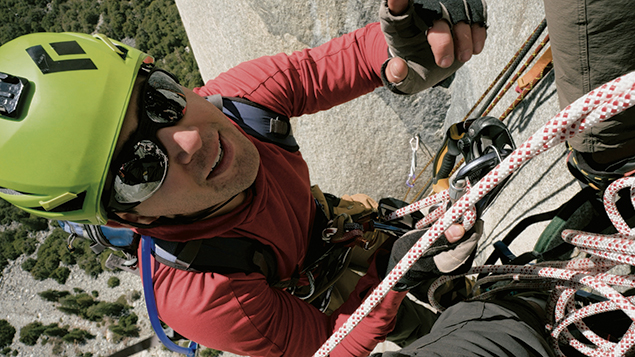
He found out that Mr. Lefkowitz was planning to trek a more challenging El Capitan route, the Zodiac. Ms. Neuman recalled, “Jay looked at me, then looked at Eitan, and said, ‘Why don’t you join me? You’re strong and motivated; this is something you could do.’ That’s how it turned into a climbing film and a feature film.”
“Looking Up” marks Ms. Neuman’s feature film directorial debut, and it was an unusually difficult project to pull off.
“I’m not a climber,” she said. “So, for the four days of the climb I wasn’t able to direct the film. That’s a very uncomfortable place to be as a director. Luckily, I had Jay up there, and I gave the cinematographers 20 single-spaced pages of instructions. But I couldn’t really even communicate with them while they were up there.”
Her efforts paid off handsomely; she won the 2025 New York Women in Film and Television Award for Excellence in Documentary Directing. “Looking Up” has been screened at about 20 film festivals, some of them specifically Jewish.
“We premiered ‘Looking Up’ a year ago January, at the Miami Jewish Film Festival, the largest Jewish film festival in the country,” she said. “I didn’t make it as a Jewish film. But the head of the festival said, ‘For sure this is a Jewish film!’ I think the fact that Eitan served proudly in the IDF, and is an unapologetic Zionist, is part of the backstory of the film, and it’s unusual for the IDF to be portrayed that way in American cinema.”
Ms. Neuman, formerly a journalist with the Jewish Telegraphic Agency and producer of many films for Jewish organizations, noted that “Looking Up” has a scene showing Mr. Armon visiting his Israeli “adopted family” in Ra’anana as they’re setting the table for Shabbat dinner. This subtle detail, too, “rings Jewish” and brings Mr. Armon’s Israeli connection to the fore.
“This is a film about resilience and grit, and if Israel is anything, it’s a country about resilience and grit,” Ms. Neuman said. “It’s never articulated in the film; it’s just in the values of what the film is about.”
Mr. Armon mentioned another Israeli connection he made more recently: A collaborative study sponsored by the Foundation for Fighting Blindness, Johns Hopkins University, and Hebrew University. The research involves RP patients – there are some two million globally – whose condition is caused by the same extremely uncommon genetic mutation.
“My mutation is super rare,” Mr. Armon said. “When we started this project, we thought I was one of maybe 20 people in the world with this mutation, but it turns out there’s a fairly critical mass – in rare-disease terms – in Israel. This study has the potential to help me and a lot of other people who are in my shoes.”
Those shoes haven’t only scaled cliffs. Mr. Armon also is an avid skier, hiker, and dancer.
Finding joy, balance, and meaning in life is a Jewish value with which he was imbued,” he said.
“And I love the idea of the Hebrew word ‘natan’ – “given” – “being a palindrome; what you give to others you get back. The idea behind the film is geared toward paying things forward, being part of a collective and something bigger than yourself. These ideas tie back to our cultural, religious, and spiritual traditions.”