

‘Liberation’ time for Betsy Aidem
Veteran actress, 68, bares all about her latest featured role

Betsy Aidem, 68, began preparing for her current role when she was a preteen.
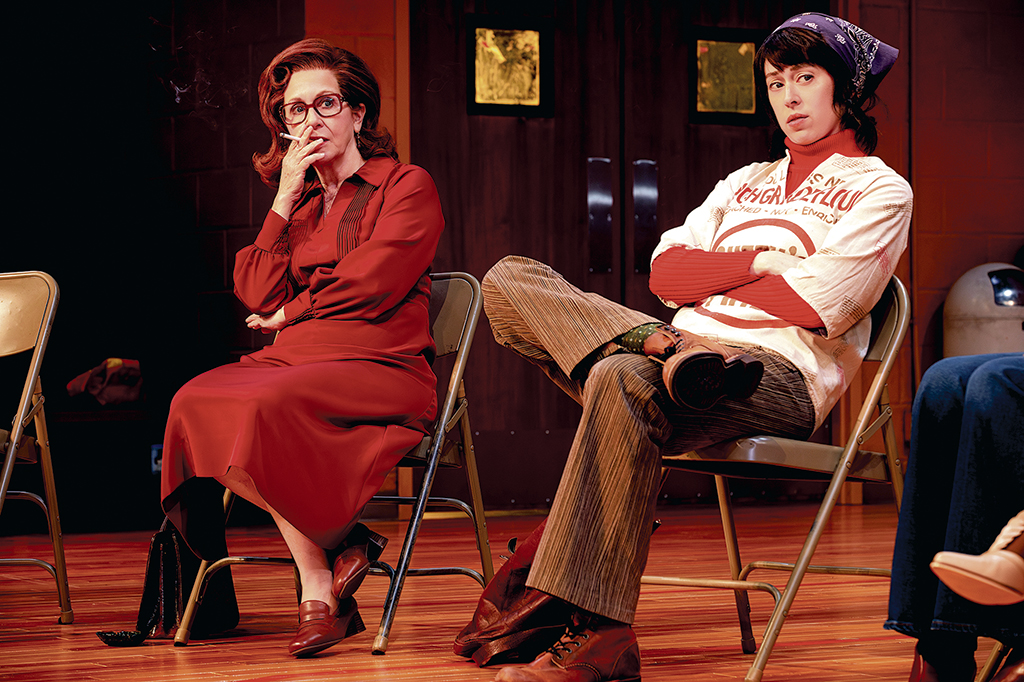
Ms. Aidem, 68, is one of the stars of the highly acclaimed new play “Liberation.” The New York Times called it “a Tony-worthy ensemble plotting a revolution.”
The revolution is what then was called “women’s lib,” and the action is centered on a women’s consciousness-raising group meeting in Ohio in the early 1970s.
Ms. Aidem plays Margie, the eldest woman there, stuck in a marriage that in many ways was typical for the era. She is as much servant as wife, unfulfilled but also unable to leave because she doesn’t even have a driver’s license.
Unwittingly, Ms. Aidem started working out her approach to the role when she was growing up in Phoenix. That was when she asked her parents why she couldn’t go to Hebrew school like her older brother.
In a Zoom interview, Ms. Aidem told me her mom, Roberta, said: “‘Well, girls don’t go.’ And I said, ‘Why not? I want to go.’ She said, ‘Well, I’m not doing another day of carpools. So you are going to have to jump into your brother’s class, even though the boys are older.’
“So I jumped in. I was the only girl there with 25 incredibly hyperactive 12-year-olds. I turned out to be very good at it, because I have a natural ear for the language. I also have a photographic memory, so I memorized the prayers faster and could say them faster than all the boys.
“That was something that made me think I have an aptitude for this. I was the first girl to be bat-mitzvahed at my temple. It was 1970, the era of Gloria Steinem, Ms [magazine], and Billie Jean King. And that phrase, ‘burning your bra’ was floating around.

“I made a speech where I said I was happy to have an opportunity not usually afforded to girls, and I hoped that would bode well for my future, that I could break down other barriers. So one of the guests there came up to me and asked me if I was going to burn my bra.’
“‘Oh come on,’ I told him. ‘I’m just 13 years old.’”
Considering the time and place, that man’s reaction isn’t surprising. Her parents were registered Republicans. Her father, Howard, was a surgeon; Roberta was a homemaker. But Roberta, Ms. Aidem makes clear, was no Margie.
“She was very savvy about investments. She took what my father earned and made hay out of it. She could have run a company. You don’t get credit for being a homemaker. But when you’re doing three children’s carpools and all their different lessons and all their applications for college and summer camps, that’s like a full-time job.
“She was no pushover. If she felt something wasn’t going the way she wanted, she was vocal about it. She was no shrinking violet, and so, yes, I very much think of her as an example.”
Ms. Aidem landed her “Liberation” role….well, let her tell it:
“I was sent the script from [playwright] Bess Wohl’s agent. I had heard about the play through another friend who’d been sent the script but hadn’t been able to do it. She said, ‘You might want to take a look at this.’
“Then Bess came to see a play I did down at the Wild Project [“The Ask”], about the ACLU and the nature of charitable giving. She said once she saw it, she knew I was the right person to play Margie. So they offered me the part, and I think my first reaction was, oh my God, this is great.”

If you’ve read anything about “Liberation” you no doubt are aware that at the beginning of the second act all the ladies disrobe on stage, apparently a turn-off to some of the women offered roles in the play.
“I think I was sloppy 13th,” Ms. Aidem jokes. “But both Bess and Whitney [White, the director] deny that. They said ‘Oh, no. We always had you in mind for the role.’
“But people did turn it down because of that. That’s a completely individual decision. I respect anyone making it.
“I just happen to say this is one thing I’ve never done. I’m 68 years old. Let me see if I can do it now. First of all, this is not on film, which is unforgiving. And it’s not a sexual scene. It’s not gratuitous. It’s about people looking at themselves and saying this is what I love about my body. And this is what I hate.
“There’s usually some kind of emotional trigger. So the context of this scene is about a lot of things beyond nudity. It’s about how we build the limitations in how we see ourselves as a whole being.”
What was striking to her is the way the nudity is approached now and how this scene might have been handled when she first got into theater. “This generation has the advantage of HR and intimacy directors attached to equity production,” Ms. Aidem told me.
“So when I was doing plays in the 1980s, if there was a scene where you were supposed to make out with a guy, you just had to figure it out yourself. There wasn’t someone there guarding your sense of safety. That’s the thing I think they” — the younger cast members — “can’t fathom, but it was part of my upbringing.”
Still, despite the protections, getting the women comfortable “was a very slow process. We would take off a few things but kept our underclothes on. They put curtains around the rehearsal room where all the outside windows are. And we cleared the room of all unnecessary personnel.
“Our intimacy coordinator, Kelsey Rainwater, came in and talked to us. So we didn’t really do fully nude until the day before we left the rehearsal room. So we all feel we’ve been very well taken care of.
“But to put it in context, it is just a 13-minute scene in the middle of a two-and-a-half hour play. So that it became a central focus of many is because it is so unusual. But it is just another way of showing the progress the characters make in trusting each other.”
Margie is the latest in a Broadway winning streak for Ms. Aidem. “I’ve been lucky. I’ve been given great roles the last five years.”
Before “Liberation,” she was Grandma Emilia in “Leopoldstadt,” a play set in a wealthy Viennese Jewish community in the first half of the 20th century. It was written by Sir Tom Stoppard , who did not learn that he had Jewish roots and that all four of his grandparents had died in concentration camps until he was an adult.
“I didn’t have a huge part in ‘Leopoldstadt,’ but just to do a Tom Stoppard play while Tom is still with us really made me happy and excited,” she said.
She followed that with a Tony-nominated role as Marcelle Salomon Benhamou in Joshua Harmon’s “Prayer for the French Republic.” That play centered on a French family debating whether it was safe to stay in France in the face of rising antisemitism.
“Josh Harmon wrote a beautiful story, and that part was really a great gift,” Ms. Aidem said
Meanwhile, based not only on the reviews but also on the positive audience response, “Liberation’s” limited run has been extended at least until the end of February.
“There’s a very young audience coming to the play,”’ Ms. Aidem said. “That’s incredibly gratifying. I’m used to performing before people who have subscriptions. But just to see how many young people are coming to the theater and getting something out of it is surprising and very satisfying.”