

Women reading a woman’s story
Groups throughout North Jersey meet to learn and lein Megillat Esther
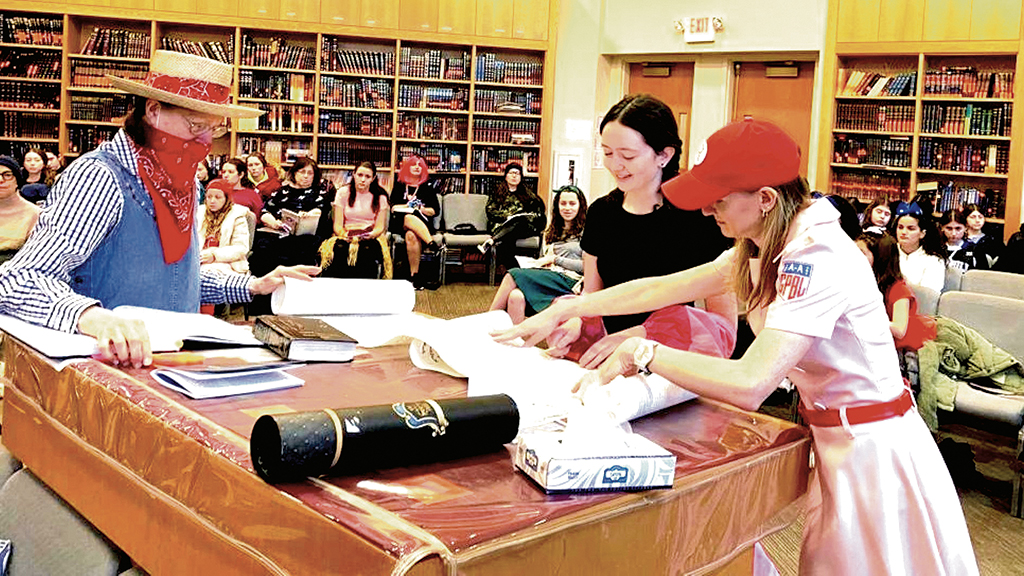
This Purim night, Dr. Ann E. Shinnar will mark the 40th year that she has chanted all or part of Megillat Esther for other Orthodox women. She started in Bala Cynwyd, Pennsylvania, in 1986, and has continued the tradition at Teaneck Women’s Tefillah since moving to town in 1995.
“TWT women held their first megillah reading on Purim 1978, although the group didn’t use the name Teaneck Women’s Tefillah until 1982, when they started meeting monthly for Shabbat and bat mitzvahs,” Dr. Shinnar noted.
In mainstream Orthodox practice, leading prayers and chanting — “leining” — from the Torah and from other biblical scrolls on holidays is a male domain. Women who wish to take liturgical roles may do so in all-female environments, which has given rise to women’s prayer groups. Some are affiliated with synagogues, while others, like TWT, are independent.
There are also informal groups that meet only on Purim for Megillat Esther readings that are by women, for women. Purim is, after all, a holiday centered around a female heroine.
A directory compiled by the Jewish Orthodox Feminist Alliance includes 80 women’s megillah gatherings internationally; the organization estimates that around 100 such events take place annually around the world. JOFA offers resources, including the Project Esther App for learning how to chant Megillat Esther; and an online guide and checklist for organizing a women’s reading. (Go to jofa.org, click first on Resources and then on Holidays and Shabbat.)
“For many of us, the opportunity to learn how to lein and publicize the miracle of Purim through our reading is what attracts us,” Dr. Shinnar said. She even knows of a distant female relative who leined Megillat Esther in 1930s Galicia.
The recently retired Touro University chemistry professor cited three talmudic passages discussing the three holidays where women played key roles in salvation and therefore are obligated in the time-bound mitzvot of these holidays. Those holidays are Pesach, Purim, and Chanukah. This means that on Purim, women are obligated to hear Megillat Esther at night and then again in the morning.
In Orthodox synagogues, one reader usually chants the entire 10-chapter scroll at night and another reader leins it in the morning. Many women’s groups offer one reading, either at night or in the morning, and divide the chapters among different participants.
“Several bat mitzvah girls have read the entire megillah,” Dr. Shinnar said. “But having multiple readers allows for greater participation by our TWT group members. Our readers enjoy engaging with the text; some even use different voices to portray the characters of Esther, Mordechai, Ahashverosh, and Haman.”
Judy Landau, who lived in Teaneck from 1973 through 2022, when she made aliyah, co-coordinated the nighttime reading every year from 1978 through 2022, except one year when her family was on sabbatical in Israel. She was also one of the readers.
“I started out leining several chapters and slowly reduced the ‘inventory’ as others came on board,” she said. The eighth chapter remained “hers” as the years went on. “It was hugely meaningful to me and I miss it still!”
Talia Goldman, the organizer of a private annual women’s megillah reading in Fair Lawn on Purim night, learned to lein the entire megillah as a 12-year-old in Baltimore. Yet she likes splitting the 10 chapters among six or seven local women who “feel pretty passionate” about chanting Megillat Esther.
“I’m happy to share it, because women have few opportunities for this in the Orthodox world,” Ms. Goldman said. “A man can lein Torah publicly any week. For women, it’s really meaningful to have it be a group endeavor. It fills a space of connection to Torah that we don’t often get the chance to do. We’re reading a woman’s story and feel our voices are able to be heard.”
The morning women’s megillah reading at Teaneck’s Congregation Rinat Yisrael started in 2019. “The women who read range in age from just after bat mitzvah to over age 70, so there is a special multigenerational aspect that is unique to our reading,” coordinator Tirza Bayewitz said.
“Ann Shinnar has graciously practiced with many of our first timers and helped them perfect their reading skills and project their voices. Many of the readers have also expressed to me that preparing the leining brings a greater appreciation and understanding of the text itself, which is especially rich with Megillat Esther’s double entendres, chiastic structures, and linguistic flourishes, which reveal deeper levels of meaning to the miracle of Purim.”
At Teaneck’s Congregation Netivot Shalom, the women’s Megillat Esther reading has been ongoing for at least two decades. The current co-coordinators are Rachel Brenner, Jessica Langer, and Tammy Jacobowitz. Dr. Jacobowitz, chair of the Tanakh department at SAR High School in Riverdale, said that there are more women who are interested in reading than there are chapters to distribute. She makes a point of including younger readers, such as recent b’not mitzvah.
“Each year, we have a reading in the morning, scheduled to be a half hour after the regular minyan, so that men and women can share childcare,” Dr. Jacobowitz said. “It is a spirited, warm morning of women’s religious connection. I love hearing women’s voices read the megillah – especially since one of the heroes of the megillah is a woman, Esther. It is an empowering, spiritually uplifting experience.”
Here is a partial list of local women-only Megillat Esther readings this year.
FAIR LAWN
March 2, 8:30 p.m. at a private home. Call Talia Goldman at (443) 845-4147.
March 3, 9:30 a.m. at Congregation Ahavat Achim. Call Elianna Kaplowitz at (646) 410-3041 or email her at eliannakaplowitz@gmail.com.
LIVINGSTON
March 2, organized by local residents. For more information, email shirawald@gmail.com.
RANDOLPH
March 2, 5:45 p.m. at Mount Freedom Jewish Center. Email Leah Gruss at lpg1001@gmail.com.
TEANECK
March 2, 6:30 p.m. at a private home, sponsored by Teaneck Women’s Tefillah. Email teaneck.womens.tefillah@gmail.com to reserve a seat.
March 3 at Congregation Netivot Shalom. Email info@netivotshalomnj.org for more information.
March 3, immediately following the 8 a.m. shacharit at Congregation Rinat Yisrael. Call the shul office at (201) 837-2795, ext. 3, or email eyurowitz@rinat.org.