

Playing together
Israel’s Polyphony visits New Jersey
Even if you strip it of anything to do with politics, it’s a fascinating idea.
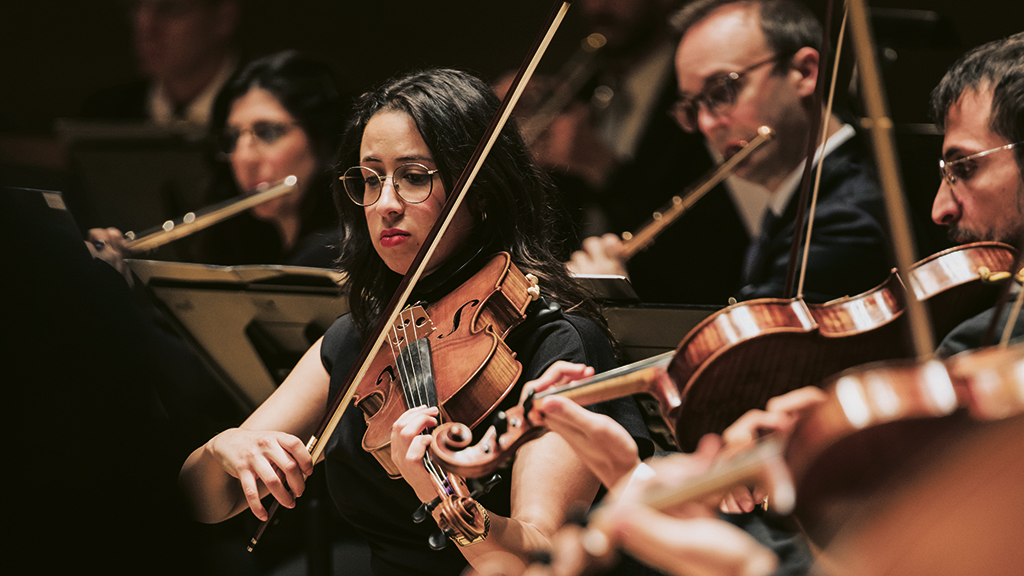
A chamber ensemble of young musicians, alumni of Polyphony, will be part of “A Taste of Home,” a program that includes both music and food, but not as in having good food available while you listen to good music.
And there’s something about the idea of combining things that are good in themselves but generally stay in their own lanes that makes particular sense for Polyphony.
Polyphony is the educational nonprofit organization that provides music education to Israeli children — all Israeli children who qualify, Jewish or Arab. It’s not a feel-good group. It trains talented children to play, listen to, and understand classical music. It teaches understanding each other, and through that understanding to value civil society, by placing a high value on high-quality art.
An ensemble of five Jewish and Arab musicians, all Polyphony graduates, will be in Pennsylvania — they will offer “A Taste of Home” in Philadelphia — and then go to the JCC MetroWest on Monday, October 12, for a concert, cosponsored by Temple B’nai Abraham of Livingston. (See below.)
As we first wrote in a story in this newspaper in 2024, Polyphony was created by Nabeel Abboud Ashkar, a 48-year-old Christian Arab from Nazareth, who grew up in a home full of classical music. His parents — his father, Duaibis, was an engineer, and his mother, Maha taught deaf children — loved it, and his older brother, Saleem, was a child prodigy then and now is a pianist who not only performs but also is an assistant professor at Brown.
Mr. Abboud Ashkar studied music throughout his childhood, went to Tel Aviv University and double majored in physics and music — he’s a violinist —and tried to make a life for himself in Israel. He was a diligent student, a perfectionist who demanded even more from himself than his parents demanded from him — and that was a lot. He didn’t fit in particularly well — he was a Christian Arab living among Jews, dealing with the Second Intifada, and also a classical musician and a physicist, both fields hard to explain in casual conversations.
He moved to Germany after he graduated from college, intent on studying music. That’s because, as he told us two years ago, he was better at physics. He thrived there. He became a member of the West-Eastern Divan Orchestra, founded by Daniel Barenboim and Edward Said. Barenboim is the Argentinian-born pianist who has Israeli, Palestinian, and Spanish citizenship and the reputation of a living legend; Said was the controversial Palestinian-American academic and author of “Orientalism,” who taught at Columbia and was famous both for his hatred of Israel and his advocacy of the concept of postcolonial studies.
Daniel Barenboim listened to Nabeel Abboud-Ashkar talk about Nazareth, about the untapped potential in the city, and his dreams of a conservatory — that is, a music school for children and teenagers, as the term is used in Israel — that would tap some of that potential.
Mr. Barenboim challenged Mr. Abboud Ashkar to create such a seminary, and Mr. Abboud Ashkar, whose background in physics and music left him a business naif, decided to accept the challenge.
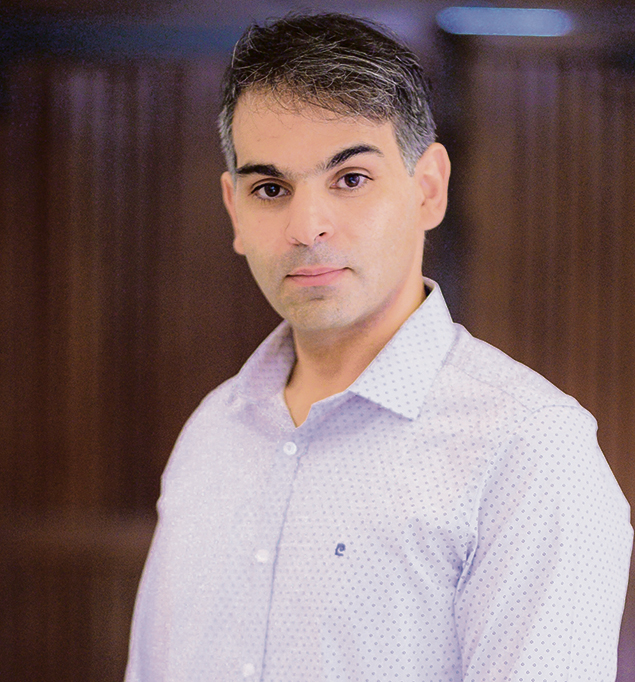
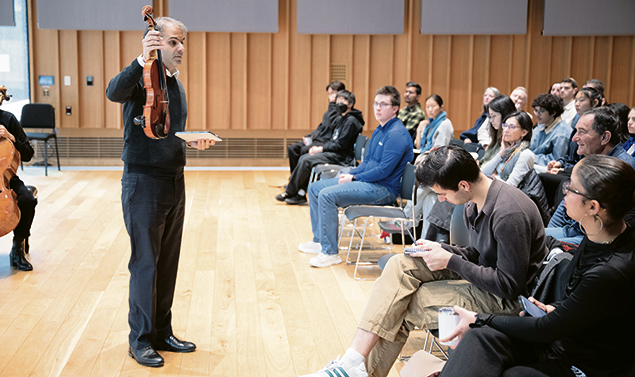
He taught himself to run a conservatory, devoted himself to founding and growing his school, and he succeeded wildly. The school began in 2006 with Arab students, and then, in a leap of faith but also of determination, it began to accept Jewish students too.
“We realized how powerful classical music and excellence are in breaking long-existing cultural barriers and the segregation between Arab and Jewish communities,” he said in 2024. “We realized how music could be a common ground where communities could come together and create partnerships.”
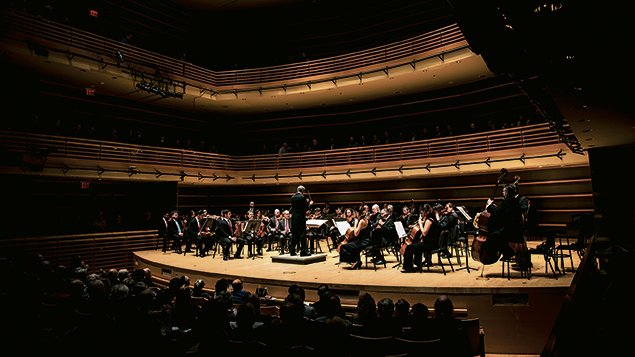
In 2012, the school, which had been the Barenboim-Said Conservatory, had grown in stages to include the conservatory, for kids in kindergarten through their senior year of high school; the two-year Music and Society Seminar, for talented high school students; and the Galilee Chamber Orchestra. That professional group, composed of equal numbers of Arabs and Jews, made its Carnegie Hall debut 10 years later, in 2022.
Polyphony has soldiered on through covid, October 7, and the war in Gaza. It uses the model it created, of Arab and Jewish students working together to produce high-quality art, focused on beauty rather than division, to work beyond music to help form a multiethnic community.
Now, “we’re coming for a small tour with young musicians,” Mr. Abboud Ashkar said; of the five, all in their 20s, some of them Jewish, some Arab, two are now students at Juilliard and two others are studying music in North Carolina.
Mr. Abboud Ashkar created “A Taste of Home” with his friend Michael Solomonov, the famous Israeli-American chef whose best-known restaurant, Zahav, was named as “outstanding” by the James Beard Foundation in 2019.
“I have been thinking about doing it for many years,” Mr. Abboud Ashkar said. “I shared the fantasy with Michael, and he said, ‘Well, we have to do it.’
“I first met Michael about three years ago. He was very interested in Polyphony, and he started to get more and more involved, and to support it in many ways. And then this idea became not just support, not just an appreciation, but a collaboration. Going through that process together was very enjoyable to me, because of our friendship.”
As for the program, “It’s not just having food and listening to music. It’s thinking about food and the cultural journey, which is in some ways relevant to Polyphony. It’s about how music can capture and express conflicts and diverse identities and cultures.”
The musicians will play four pieces at “A Taste of Home.” Each will be preceded by Mr. Abboud Ashkar’s explanation and followed by the food. Because the explanation — which will not be dry explication but storytelling — the music, and the food each will be presented separately, the audience will be able to savor each one individually and as complements to each other.
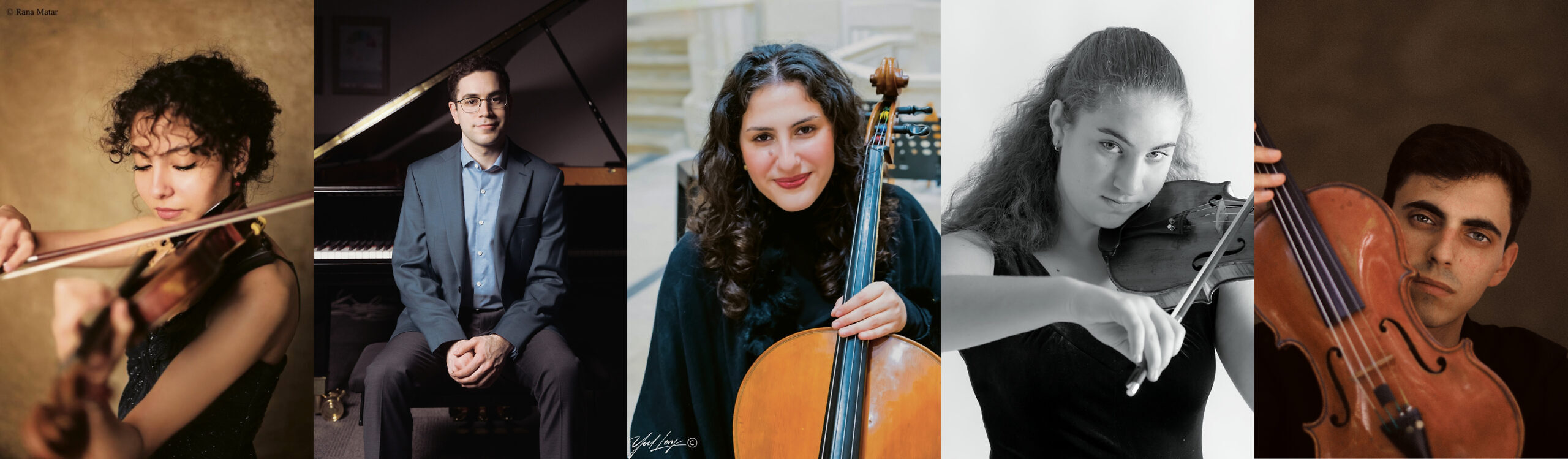
“We are going to start with an Arabic song from Andalucia, in medieval Spain,” Mr. Abboud Ashkar said. “The next piece will stay in Andalucia, but with the music of de Falla. There’s a lot of symbolism there, and a lot of connections to complex realities. And then we will play the music of Paul Ben-Haim, about what defines Israeli music. We’ll play one of his songs, Song Without Words, which combines East and West, local traditions with Western compositions.”
It’s about home, Mr. Abboud Ashkar said. “Where is home? What is home? That’s part of the question. So each piece, each musical work, each historic period represents home for someone somewhere.”
So the evening will combine intellect, soul, and body. Because Mr. Solomonov’s food is not only delicious but also lovely, it will include a visual element as well.
It’s not clear what to call “A Taste of Home.” It’s a concert, but it’s more. There’s no obvious noun for it, because it’s a new art form. So far, it will be performed and presented only in Philadelphia, on October 8, but “hopefully we can take it on the road,” Mr. Abboud Ashkar said. It will not be the performance Polyphony presents in MetroWest. “‘A Taste of Home’ embodies yet another kind of collaboration, and the more people collaborate, the more they understand, and the more joy they can get.”
During the last three years, since October 7, “we have not had a lack of challenges, and some impossible moments,” Mr. Abboud Ashkar understated. “We have had plenty of those. But if I’ve learned anything over the last couple of years, it’s how important what we are doing is for our communities.

“That’s communities, plural,” he said. “The Arab and Jewish communities, the people who share the same values and believe in the same goals. They hold on to Polyphony, and programs like Polyphony, very dearly and very strongly, because it represents the hope of what a better future would look like. So the level of commitment and stepping up from our partners, community members, and supporters has been strong.
“We are a unique voice in this complex reality. I am not saying that we are the only voice. I am not saying that we are the most effective voice. But what we do through classical music and excellence and reaching really high levels of artistic achievement gives us that uniqueness, and people admire that.
“So, yes, Polyphony continues, despite all the interruptions, obstacles, uncertainties, and moments of lack of security and safety, and moments of real concern for the future of our region.
“Powerful, strong forces are taking our region into directions that we’re concerned about. But despite all these things, Polyphony seems to have the resilience to continue.”
Does he have hope for the future?
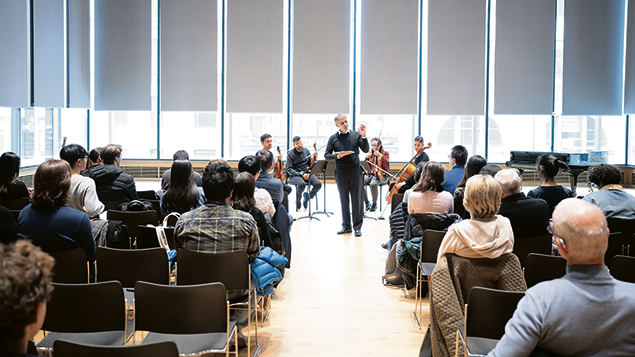
“I think if we were completely desperate, we probably wouldn’t be fighting as hard as we do fight to continue our work. Sometimes it’s accompanied with the sense that this is the only reasonable thing we can do that could have an impact.
“Sometimes you feel helpless against all these big, major forces that dictate what is happening. There is that sense of helplessness, but being part of Polyphony to some extent brings a sense of empowerment. It feels like, well, I cannot fix the big picture, but at least I can do this.
“And if I’m touching the lives of tens or hundreds of people, families, children, in this reality, that’s already something worth doing.”
Clifford Kulwin, who retired as the senior rabbi of Temple B’nai Abraham in Livingston about a decade ago, and his wife, Robin, both longtime music lovers, have strongly supported Polyphony. The group often stays at their house when they’re in the metropolitan area.
“I support Polyphony because it is the culmination of two things about which I care deeply,” Rabbi Kulwin said. “One is classical music, which is a personal passion. The other is that Polyphony represents an Israel where Jews and Arabs can live not only peacefully but harmoniously, both literally and metaphorically.
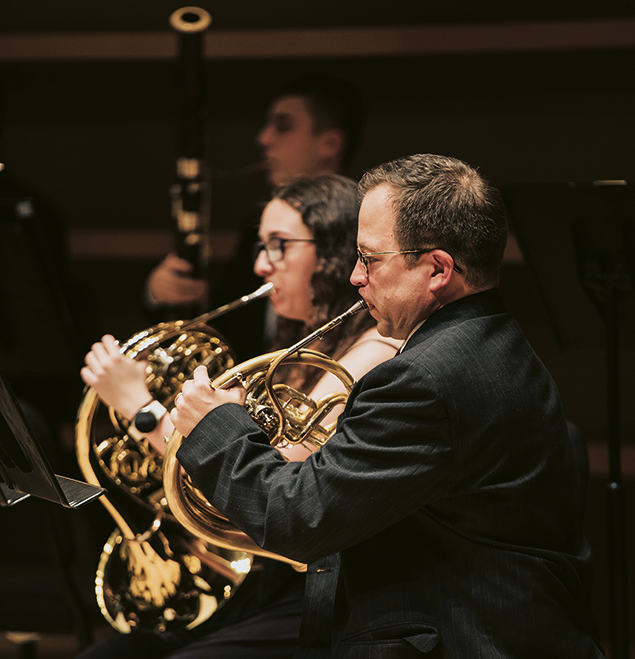
“I hope that members of the local community will attend the performance, both to enjoy music by brilliant young artists and to support the Israel where Arabs and Jews not only coexist but work together.”
It’s not all abstract and impersonal for Rabbi Kulwin.
“Last year, a Polyphony alum, an Arab Israeli who’s now in graduate school in the United States, came to one of our Passover seders,” he said. “In addition to the brief, impromptu, and wonderful pre-seder concert he gave us, his presence enriched our gathering. It brought new perspectives and meaning to our ritual, and especially to the conversation around the table.”
His guest didn’t have to say much to make Rabbi Kulwin reconsider the words he’d known all his life from a slightly different angle. “I admit that it caused me to look at the Haggadah text in a way that I had not previously considered,” he said. And that’s not at all a bad thing. It’s actually a kind of polyphony, which is “a musical style or texture that combines two or more simultaneous, independent melodic lines.”
It doesn’t mean giving up your understanding of the world; it just means considering another understanding at the same time.
The world can use more polyphony, and more Polyphony.
Learn more about Polyphony at polyphony-education.com.
Who: Polyphony, led by Nabeel Aboud Ashkar
What: Will perform Mozart’s String Quartet No. 15 in D Minor. K 421 and Schumann’s Piano Quintet in Eb Major Op 44
When: On Monday, October 12, at 7 p.m.
Where: At the JCC MetroWest in West Orange
For tickets: go to jccmetrowest.org and click on the link for the Polyphony Concert on the homepage or call (973) 530-3400 to learn more