

‘The Landscape of Our Memory’
Artist duo uses many media to memorialize Holocaust victims
Despite the widespread impression most of the Jewish Holocaust victims were killed at death camps, like Auschwitz-Birkenau in Poland, nearly half of the slaughter happened outside those killing centers, far from any major concentration camp. Instead, Jews were shot in forests or vacant fields near their hometowns, sometimes in darkness but often in broad daylight.
“One by one, the Nazis and their collaborators shot to death over two million Jews and members of other targeted minorities as they built an empire of blood and soil across Eastern Europe,” Dr. Jacob Labendz, the director of Ramapo College of New Jersey’s Center for Holocaust and Genocide Studies, said. Those murders often are called the dispersed Holocaust. Sometimes the perpetrators of these mass killings weren’t Nazi officials — they were locals, their Jewish victims’ neighbors.
Not all the victims were Jews. The Nazi murders targeted many other groups as well, including Ukrainians, Poles, Roma, gay men, lesbians, people with disabilities, and other human beings they considered unworthy of life.
Gabriela Bulisova and Mark Isaac are multidisciplinary artists from Prague who collaborate on long-term projects designed to bridge the gap between fine art and documentary techniques. In their most recent project, “The Landscape of Our Memory,” the pair uses many artistic strategies, all of which draw directly on the landscape of the dispersed Holocaust, conveying an important environmental sensibility. The exhibit, co-sponsored and co-produced by the Center for Holocaust and Genocide Studies and Stockton University’s Sam and Sara Schoffer Holocaust Resource Center, “translates the traces of atrocities into a language all of us can understand,” Ms. Bulisova said.
“Gabriela and Mark are among the most thoughtful artists I’ve ever worked with,” Sydney Jenkins, the director of the Galleries at Ramapo College, said. “Their work introduced me to fresh areas of artistic and scholarly exploration that I was only vaguely aware of — in particular connecting genocide and ecocide,” the extensive destruction, damage to, or loss of ecosystems. Dr. Labendz agreed. “With ‘The Landscape of our Memory,’ Gabriela and Mark help us sense the blood that still calls out from the killing fields of the Holocaust, flows through nearby rivers, and whistles among trees that witness, but cannot see.”
Ms. Bulisova said that “The Landscape of our Memory” was created under the auspices of two Fulbright grants in Poland, “but the project now includes commemorations of those who lost their lives at the Terezin Ghetto in the Czech Republic and mass killings in Ukraine. The project uses a variety of antique and modern techniques, all of which are closely linked to the landscape in which the tragedy happened.
“Since every part of our project is closely connected to the environment where we collected our samples, we can explore the environmental history of the Holocaust and the relationship between genocide and ecocide,” she added.
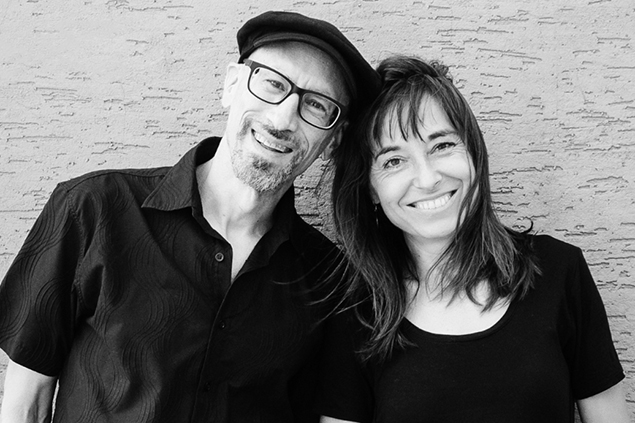
Ms. Bulisova and Mr. Isaac each received an MFA in photography from the Maryland Institute College of Art in Baltimore. “Gabriela was teaching at the time, but we met in the office of the head of the graduate photography program there,” Mr. Isaac said. “We remained connected, each working independently. Gabriela was working intensively on a series about mass incarceration in the United States. It was a subject I was also interested in and I began to help her.”
Ms. Bulisova is from Slovakia. Mr. Isaac is originally from Queens but lived in Cleveland and Washington, D.C. before he and Ms. Bulisova, who now are married, moved to Prague in the Czech Republic. They’ve lived in Ukraine, where Mr. Isaac had a Fulbright grant, and in Siberia, because Ms. Bulisova also got a Fulbright; both had Fulbrights that brought them to Poland. For the last six years, they’ve lived in Prague.
“It was natural that we began collaborating on projects,” Ms. Bulisova said. “We had different styles, but they began to naturally combine.” Twenty years later, in what the artists describe as an ongoing project, “The Landscape of our Memory” brings in antique processes, new processes, audio, video, still photography, and writing.
The project, as it is exhibited at Ramapo College, contains four distinct artistic modalities. “The centerpiece consists of anthotype portraits. This technique creates photographs of people from plant material,” Ms. Bulisova said. “To produce these images, we gathered plants and flowers growing at mass graves, made photosensitive emulsions, and exposed them in the sun to create loving tributes to some of those who lost their lives.”
Because the plants are gathered from the mass gravesite where a person’s body still lies, the final photograph may contain something of his or her remains, at the molecular level. “These portraits restore each person’s humanity and avoid consigning them to the status of faceless statistics,” Mr. Isaac said. The artists used Yad Vashem’s detailed archives for their research.
“First we would find the site where these things happened, then we would look into the logistics of traveling there, then we would search the archives to make sure we could obtain a portrait, then we would gather the plants,” he continued.
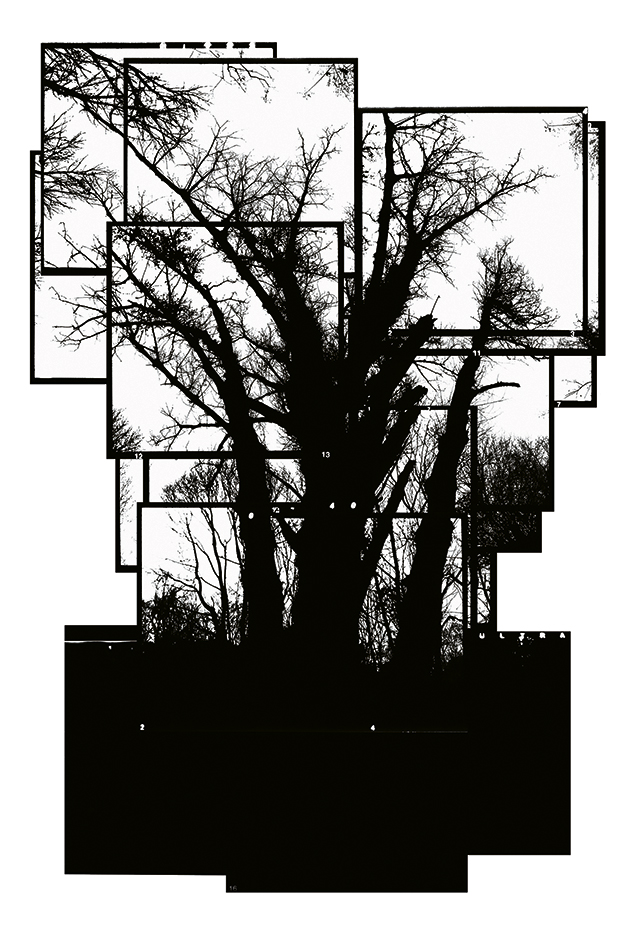
“For those for whom we did not have a name or a portrait, we used other techniques, like photographing ‘witness trees’ to memorialize them. Using a World War II-era analog camera, we made images of the trees that stood there. We listened to the interior sounds of those trees and recorded them.” The artists believe that trees have a rich inner life. “It’s not within most people’s experience to hear sounds coming from inside of trees, but we felt that the trees provided testimony to what was happening in their vicinity,” Mr. Isaac said.
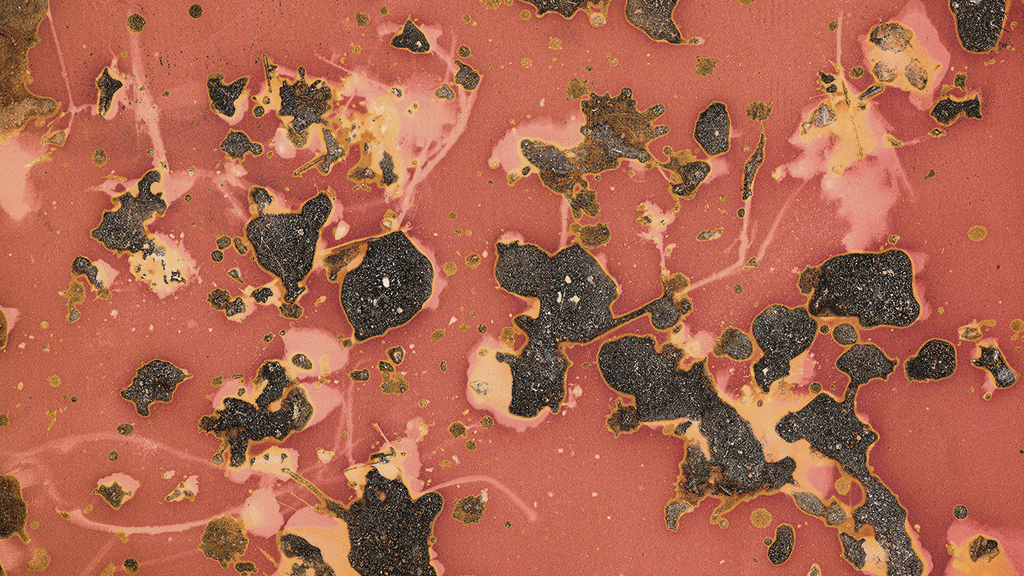
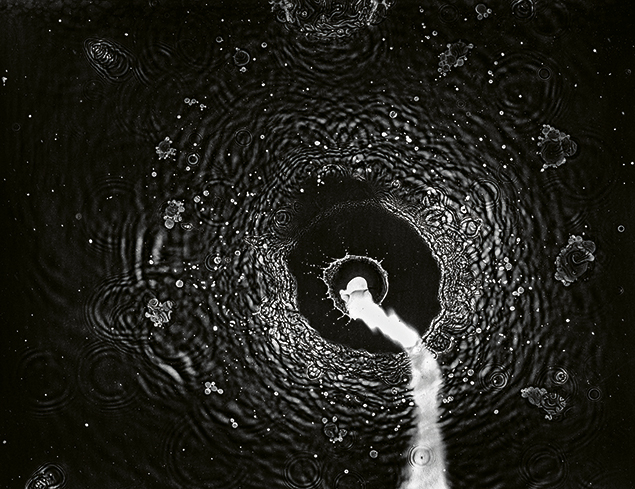
After gathering water from rivers where the ashes of victims were dumped, the artists used a “watergram” technique. “This captures water in motion in the analog darkroom to commemorate those who were murdered,” Ms. Bulisova said. “Finally, the ‘lumen print’ process, in which organic material is placed on photosensitive paper and exposed in the sun, creates abstract images that demonstrate the uniqueness of those individuals lost in the Holocaust.”
Mr. Isaac’s great-grandmother, Maressa Offen, was murdered on March 9, 1942, in Mielec, Poland. It’s important to note that Mr. Isaac did not embark on this project for family reasons only. His strong feeling was that he had to do it because “we cannot let human beings, Jewish and non-Jewish populations, be unremembered, whoever they are.
“Since we have a photograph of her and know the site where she was buried, my great-grandmother’s anthotype will be displayed at Ramapo College throughout the installation,” Mr. Isaac said. “In the exhibit, each anthotype notes the lost person’s name, the site where they were murdered, and the plants, flowers, and leaves we used to make the emulsion.
In 2017, before Russia’s full-scale invasion of Ukraine, the artists were in southern Ukraine, in the Mykolaiv/Odesa region, working on a Fulbright project on an environmental issue. “Veterans who were returning from the war in the eastern portion of Ukraine that borders Russia — the Donetsk and Luhansk regions — were helpful in our project,” Ms. Bulisova said. “They pointed out an open steppe and told us it was an important place to remember. The place they were pointing to was a ravine in the village of Bogdonovka. At the time they pointed to it, we didn’t understand its significance, but we later learned that this was the site of one of the biggest massacres in the history of the Holocaust — a place where in winter of 1941, over 40,000 Jews were marched to that point and burnt, shot, and frozen to death over a period of several days.
“Not only is the site not commemorated, it is under-memorialized. It is largely a forgotten event.”
This was the first time the pair were confronted with a mass killing site that was far from any major death camp. “We were completely unaware of these killings,” Ms. Bulisova said. “This was when we promised each other that we needed to create a project to commemorate those who were lost in this part of the tragedy.”
The individual techniques and strategies the artists used for “The Landscape of our Memory” were selected because they didn’t want to focus on atrocities, but instead wanted to commemorate people, their lives, and their stories.
Yahad-In Unum, an international organization that conducts research, videotapes witness testimony, and collects forensic evidence of executions that took place between 1941 and 1944, identified 2,000 documented killing sites. (The organization’s name combined the Hebrew word “yahad” — together — with the Latin words “in unum” — as one.) The group’s founder and president, the French Roman Catholic priest Father Patrick Desbois, has devoted his life to confronting antisemitism and furthering Catholic-Jewish understanding.
According to Yahad-In Unum, Central and Eastern Europe is heavily dotted with the forgotten graves of Jews murdered in the dispersed Holocaust. Its victims rest in unmarked graves scattered around forests, roadside ditches and fields. Although some members of local communities hold onto the memory of the victims, in many cases, the locations of these nameless graves and the number of people resting in them remain unknown.
For the artists’ purposes, Yahad-In Unum was helpful for understanding the scope of the dispersed Holocaust and for reading witness testimonies, “but their maps don’t reveal the exact locations of the killing sites,” Mr. Isaac said. “By contrast, Fundacja Zapomniane, whose mission is to search for, locate, study, and commemorate the forgotten graves of Polish Holocaust victims, was more useful to us in our day-to-day work.”
“In Bialystok, Poland, where two killing sites were identified, we would consult Yad Vashem archives and the Jewish Historical Research Institute archive,” Ms. Bulisova said. “In the Czech Republic, we would consult Terezin’s local archive and Yad Vashem, and in Ukraine we consulted the Babyn Yar archive and Yad Vashem to see if we could find the name and photograph of a specific person who was killed at that site. If we don’t have the photos or the archival research, we are committed to taking a step to reclaim those people and restore their existence.”
The artists visited more than 45 killing sites in Poland. Some are kept up and preserved and others are not. “The vast majority of the local Poles who are responsible for the upkeep of forgotten history are not Jewish,” Ms. Bulisova said.
“Every single part of this project is closely connected to the landscape in which the tragedy occurred. It gives the project a very important environmental sensibility,” Mr. Isaac added. “All of our techniques acknowledge the growing scholarly consensus about the relationship between genocide and ecocide.
“With this in mind, the history of the atrocities of the dispersed Holocaust can be looked at through a wider and more diverse lens that includes nature, soil, trees and plants,” Ms. Bulisova said.
“The Landscape of our Memory” is at the Kresge Gallery in the Berrie Center at Ramapo College of New Jersey through December 4. For more information, go to ramapo.edu/holocaust/landscape.