

Who will live and who will die
A look back at September 11 and forward to Rosh Hashanah
![UAF 175 crashes into the south tower of the World Trade Center on September 11, 2001 [TheMachineStops
(Robert J. Fisch)]](https://static.timesofisrael.com/jewishstanddev/uploads/2026/09/CS01-UA_Flight_175_hits_WTC_south_tower_9-11_edit-Topaz-Gigapixel-4x-scale.jpg "UAF 175 crashes into the south tower of the World Trade Center on September 11, 2001 [TheMachineStops
(Robert J. Fisch)]")
Each one of us who was old enough to be sentient on September 11, 2001, has memories and stories, and connections to friends who have their own sets of stories. This is my story.
It started like a not-quite-regular day because of its startling beauty.
There was what many of us later came to think of as a September 11 sky, so blue that it looked almost implausible, with absolutely no clouds. Just the purest, most exquisite blue.
It was so blue that I decided to skip minyan that morning. It was September 11, 2001. My daughter Shira had died nine months earlier, so I was saying kaddish for her. (It didn’t work very well, but that is an entirely other story.) But it was my daughter Miriam’s first week of her junior year of high school, we had a convertible, and we could open it to that spectacular sky. So we did.
We lived on the Upper West Side. We drove very fast up the Henry Hudson, I dropped her off in Riverdale, and went over the bridge, even more glorious than usual because the arches soared up and into that perfect blue and then danced down again.
As I parked in Teaneck, WNYC was talking about some kind of accident downtown. It sounded — what? Weird. It sounded weird. A small plane flew into the World Trade Center. What?
By the time I got upstairs, at around 9, it was clear that something terrible had happened. We all gathered around the tiny, nearly prehistoric television someone dug out of an office closet and we listened to the news.

Meanwhile, my two rabbis, Roly Matalon and Marcelo Bronstein of Congregation B’nai Jeshurun on 88th Street, had gone downtown for a meeting.
“Marcelo and I had prepared a study session for BJ board members, in preparation for the chaggim,” the holidays, Roly said. (At BJ, our rabbis are known by their first names; normally I’d still go with the formal Rabbi Matalon, but not here.) “Somebody had gotten a room for us to meet at the Tribeca Grand Hotel,” as the Roxy Hotel New York was called back then. “So we boarded the subway at 86th Street on the way to this study session, which had been called for 9 o’clock.
“We got off at Franklin Street, like 10 or 15 minutes before 9. As we got out of the station and were crossing the street, we start seeing cars with sirens, not police cars, unmarked cars, with sirens, going down the street at 100 miles an hour. We didn’t know what was going on.
“We crossed the street, where there was a little plaza, a little park, and people were standing there, looking up, and one man said, ‘A plane just hit the tower.’ We were all standing there, seeing the smoke, and the guy said, ‘I saw it.’
“He said that it was a small plane, and the people there were wondering what had happened. Did the plane get lost? And then a guy who was standing there with his cellphone said, ‘I’m talking to my girlfriend, who’s in New Jersey, and she’s watching the news, and they said that apparently it was not a small plane.’
“More people started gathering, looking up at the tower and the smoke, and Marcelo and I decided to go into the hotel and see what this is all about. So we walked into the hotel.”
By then, people already knew that something “very serious was happening,” Roly said. “The hotel provided some screens, and people watched the news on TV. It became apparent that it was a terrorist attack. Eventually we saw the second plane hit the tower on TV, and then people started coming to the hotel. They were dusty. They had dust on them. They were confused.

“Eventually Mayor Giuliani walked into the hotel with his entourage, and he said, ‘Everybody, get out, get out get out get out of here. Get out of the hotel.’
“So Marcelo and I started walking north,” away from the World Trade Center. “There were a lot of people doing that, walking north on Sixth Avenue. We saw a lot of people. Some of them were covered in dust, and some of them were sitting on the curb.
“They looked like they were lost. They looked like they were haunted. They were just sitting on the curb, staring at the street, covered in dust.”
Two of the people headed for the BJ board meeting were Elga Kron Stulman and her husband, Stephen Stulman. Elga, who was an extraordinary person, maybe the most gifted welcomer of people ever born, had been 6 years old on Kristallnacht; she and her parents were able to get out of Germany soon after that. She later said that she’d forgotten about the experience — she knew the story in deep detail and by heart, of course, but she’d forgotten what it looked and sounded and smelled like — until September 11, when the sounds awakened the walled-off memories. It affected her deeply for the rest of her life.
At the same time, my sister, Lynn Makler, was at work at Westinghouse High School, in Brooklyn, where she was a librarian. Everyone at school could see the smoke billowing across the East River. Parents came by very quickly to pick up their kids — they might have been high schoolers in a fairly tough neighborhood, but these parents weren’t going to let their children be exposed to unnecessary danger.
So Lynn, with no students to care for, asked her principal if she could give blood. He said yes, so she walked to a nearby hospital. Because she was one of the first people in, she didn’t have to wait long, she said; by the time she was done, there was a long line of people waiting to donate.

The terrible thing that no one waiting on line knew then was that there was no need for blood. There were very few survivors. The dust-covered near zombies roaming the streets and resting on the curbs had not gotten into the buildings. They were physically unharmed — except for that dust, which of course turned out to be highly toxic — but they were scarred by what they had seen.
Then there was my friend Rich Moline, who worked for the United Synagogue of Conservative Judaism, lives in Chicago, and was in town for a meeting at the organization’s headquarters at 155 Fifth Avenue. Like the Tribeca Grand Hotel, it offered a clear sightline down to the World Trade Center.
By the time the meeting started, at 9, everyone there knew that something had happened not too far away, and no one could concentrate on business, so “a number of us went down to the sidewalk and looked south,” Rich said. “We saw lots of billowing smoke. It was too far away from us to see people running away from it, but we did see the second tower collapse.”
What did that look like? “It just fell. It just collapsed,” he said. “I can’t think of any analogy. It just collapsed. And then there was a big plume that in retrospect I realize probably was a combination of smoke and ashes.
“It was shocking and it was scary.
“Some people let out audible sounds. They weren’t really screaming. It was more gut-wrenching. It wasn’t screaming out of fear. It was the sound of anguish.” That sound came out of him too, he realized, Rich said.
“It was surreal. Totally surreal. We didn’t know if we were at war, if we were going to war, if other places were being attacked. There were all sorts of rumors about attacks on the State Department, on the Capitol, on other cities, on the West Coast, in downtown Chicago. I think I remember that Chicago was evacuated, out of an excess of caution.” (I checked. It was.)
As they walked north, in shock themselves, Roly and Marcelo saw long lines at phone booths — that was toward the beginning of the cellphone revolution. Lots of people had them, but there were still many phone booths. And that was a very good thing, because the circuits that cell phones used were so overloaded that it became nearly impossible to get a call through. Still, eventually, “we had a chance to let our families know that we were safe,” Roly said.
“We were on our way uptown, and then at some point we turned around. We felt a wave. We turned around and the building was coming down. It was terrifying. It was like a wave of wind and dust coming up Sixth Avenue.
“I remember the people sitting on the curb covered in dust, on the stoops of their townhouses, or on the stairs, and looking at each other, or looking down, or looking off in the distance, completely confused. I remember women without shoes. I guess they must have been wearing heels, and they took them off, so they were barefoot.
“These images are searing. And then seeing the tower come down, and then the people in line, waiting. Nobody knew at the time that nobody was coming out alive. People still had hope.”
My daughter Miriam also learned about the problems with cell phones. She was at school at Horace Mann, where I’d dropped her, just an hour or so earlier, in what became the Before Times. Most of the students at that K-12 private school live elsewhere, in Manhattan or Westchester or New Jersey — not far away, but not a short walk either. So the school prepared to keep any young child who could not be picked up by a parent or caretaker, or any teenager whose parent could not get there in person or be reached for permission to go to a more local friend’s house, to sleep in the gym that night.
Meanwhile, Miriam told me then, because most of the older students had phones, they gathered in clusters around a teacher, trying over and over and over again to reach their parents, then shoving the phone at the teacher in triumph as the parent gave permission and the teacher recorded it. Miriam and three of her friends ended up at a fourth friend’s house, in Yonkers. No one had to sleep at the school that night. It was days before anyone could return there.
My husband, Andy, worked just north of Times Square then. His employer, Morgan Stanley, had offices in the World Trade Center — they were the largest tenant in the second tower. But Rick Rescorla, the firm’s head of security for that office — who was an extraordinary man, whose online biography is well worth reading, and whose memory should be honored — had planned for this and other disasters thoroughly, and had made sure that the firm’s employees evacuated immediately although the Port Authority had ordered everyone to shelter in place.

That’s why almost all of the firm’s roughly 2,700 employees who worked in the tower survived. Mr. Rescorla and 13 members of his security team were the only Morgan Stanley workers who died; that’s because they went back up to make sure that everyone else had left.
They were heroes.
And Andy and his colleagues at the Times Square office were able to walk home. He was the only one of the three of us to sleep in his own bed that night.
Roly and Marcelo eventually were able to get back uptown, “and we started organizing phone calls to anyone we could find in our database who worked in the World Trade Center.”
One of our friends, a BJ member, had a ticket for the flight that crashed into the Pentagon. But it was his son’s first day of kindergarten at the Abraham Joshua Heschel School, and his wife convinced him to rebook for a later flight, so he was sitting at the terminal in Newark when the crash happened. Another friend who worked at the World Trade Center was planning on getting in late because it was the mayoral primary that day, and he voted first. When he got to the Trade Center, he said, he saw dust-covered people running away from it, so he did too.
There are many such stories. Many of us know about people who were lucky, and others who were not. There is not much to do with such knowledge other than to sit with it.

Lynn, who lived on Staten Island, eventually was able to get home. She’d carpooled in and went home the same way. It was unspeakably weird, she said — and so unspeakable that nobody talked. But they stared. As they drove west on the nearly deserted BQE, they could see the black smoke billowing out toward them.
Back at BJ, “Felicia” — that’s Rabbi Felicia Sol, then an assistant rabbi and now senior rabbi — “was in charge of organizing all that, so Marcelo and I went down to the hospital, because there might be people there who needed assistance,” Roly said. “We went to Bellevue. There were lines of people outside, trying to inquire about their loved ones, people who had wedding pictures and other documents with them, waiting on line.
“We were trying to talk to people, to comfort people. And then we were told that there were some chaplains inside already, so we should go to another hospital. We did, and it was the same thing, people standing outside. And there were also long lines of people waiting to give blood. They didn’t realize yet that there was no need for blood.
“So eventually Marcelo and I went back to the office. We were trying to think what to do. We organized a prayer vigil that evening. We sent a message to everybody that we would do a gathering. People were reciting psalms. A lot of people went to that.”
Andy went. I did not. I wasn’t able to get home that evening. The bridges and tunnels all were closed inbound. So I stayed with my friends Marilyn and Bruce Steinthal in Haworth; Marilyn and I sat on her deck, under that still spectacularly blue sky, and drank red wine. There was nothing else to do.
The next evening — Wednesday, September 12 — because of BJ connections, Roly and Marcelo were able to go back downtown. “We were able to take the subway to 14th Street, and then we got on an Army Jeep, and they took us to the area,” Roly said. “It looked like the apocalypse. There was fire, there was smoke, everything was gray and black. Really apocalyptic. We got to a building, a bank, that was right across the street from one of the towers, and that’s where people who were trying to find people who were alive, or collecting body parts — first responders — were coming to take a break, and to get some relief.
“I remember that their eyes were burning because of the chemicals, so Marcelo and I were washing their eyes. We were given bottles with some kind of eye rinse. And occasionally they would bring bags with remains.

“We stayed there for a number of hours. Nobody was coming out alive. They were hoping against hope that someone would, but no one did.”
I also think about the first responders. I particularly think about Richard DeMaria, because I’d gone to the salon he owned in Westfield to get my hair cut for maybe two decades. (No, that made no sense, but that’s yet another story.)
Richard was not who you’d think of as a typical hairdresser. He grew up in Irvington, a drummer, the son of an engineer. He was very smart, girl-crazy, and obsessive; he realized that working in a hair salon was a very good place to meet girls. It turned out that he was very good at cutting hair, and at running businesses too. It all worked — he married young, had kids, and stayed married. He fought in Vietnam. He grew up Catholic but became an evangelical Protestant, his politics were right-wing, and whenever I got my hair cut, we’d talk religion and politics and family. He wasn’t like anyone else I knew, and he was wonderful.
When the planes hit the Twin Towers, he got in his car and drove to the pile as a first responder; his military background and connections got him in. He worked there for a long time — different from cutting hair, but it had to be done — and then, in 2014, he died of cancer, most likely from all the poison he’d breathed during all his time downtown.
Meanwhile, back in Chicago, Rich had gotten home on Thursday. There were no planes flying, but he took a train. He remembers going back to O’Hare to retrieve his car. It was eerie, he said. He had to walk through the ground floor of the terminal, by the abandoned baggage carousels, to get to the parking lot. Airports usually are noisy places, but “I could hear my footsteps,” he said. And then when he got to his car and put the key in the door (because back then keys went into doors), “I could hear that too.”
That Friday night, Andy and Miriam and I went to our friends’ house for Shabbat dinner. We walked the few blocks between our apartment and theirs at dusk. That evening, people stood silently outside their doors, holding candles, bearing witness. It was extraordinarily powerful and moving.

You couldn’t smell much from downtown during the day on the Upper West Side, but at night, I learned then, the wind tends to shift and blow uptown. Every evening for weeks, we could smell the evil being blown up toward us. We could smell it strongly that night, just three days after the attack, but somehow the conscious beauty of the candles prevailed.
Roly remembers that too. “There was a sense of incredulity and shock, of course, but there also was a tremendous sense of community. Of us holding each other.”
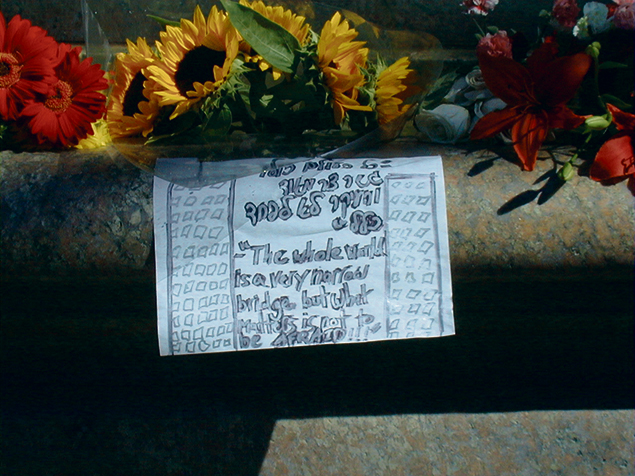
The Firemen’s Memorial, a stately set of steps leading up to a fountain bookended by sculptures of Duty and Sacrifice — women holding dying firefighters — and a bas-relief of horses pulling a fire engine, is at the end of my block. On the morning of September 12, 2001, someone taped a drawing on the fountain, below one of the many bouquets of flowers people had been leaving since the day before. In Hebrew and in English it quoted Nachman of Bratzlav — in words often set to an ear-wormy melody — “The whole world is a very narrow bridge, but what matters is not to be afraid.”
Rosh Hashanah started on Monday night. We couldn’t just walk into shul; we had to go through metal detectors. That was the start of the kind of security that has tightened in the last quarter-century. Until then, there hadn’t been much; that first year, as we waited in a line that went around the block to get into shul, I remember thinking that we probably presented an alluring target to terrorists.
“I remember saying to Marcelo — and this was not at all unique to us — ‘What does this mean for humanity?’” Roly said. “‘What does it mean for the country? For the world?’ The world was changed in very profound ways, and we were facing tremendous uncertainty.
“We were just beginning a new year. It was Rosh Hashanah, and mi yichyeh and mi yamut?” Who shall live and who shall die, as Unetaneh Tokef, one of the season’s most iconic prayers, puts it. We ask that question every year, but we almost never are forced to face it that starkly.
“I often think about that Rosh Hashanah,” Roly said. “We just threw everything we’d prepared for our sermons in the garbage and prepared something new.”
That was 25 years ago. The world has changed immeasurably since then, but people have not.
It’s not clear if the first night of Rosh Hashana falling on September 11, a quarter of a century after that monstrous day, represents irony or redemption. It’s easy to be cynical. Maybe it’s just a cosmic irony. Or maybe, just maybe, it’s the chance for a new beginning. So that’s the point. Let’s not be afraid.