

Transition at Sinai Schools
Arielle Greenbaum Saposh talks about her new job and the school’s consistent values
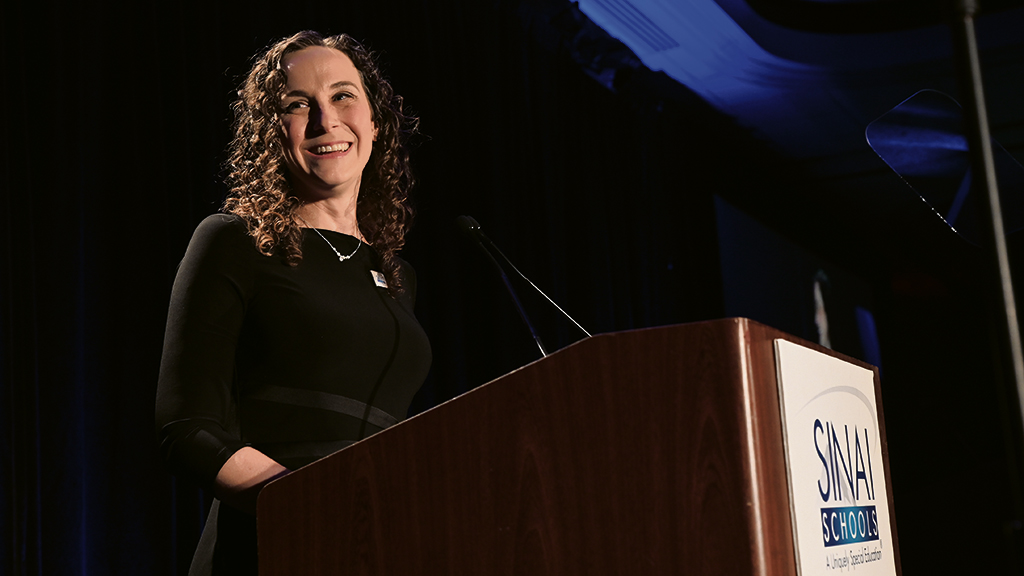
Sometimes a person seems just absolutely right for a job. A natural.
It seems, in fact, as if there are only two people who possibly could have that position — the man who held it for decades and the woman who is transitioning into it right now, with the enthusiastic help of the man.
Okay, Let’s use names here.
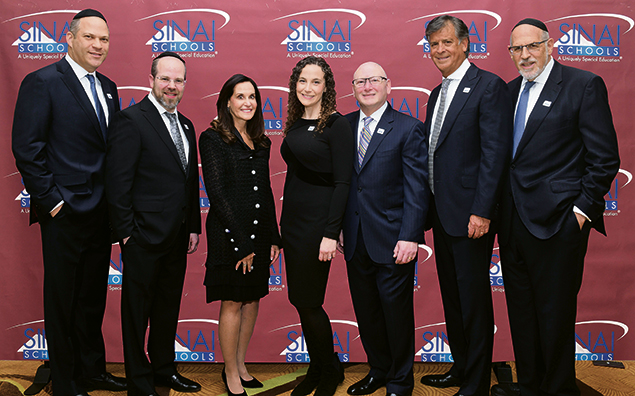
Arielle Greenbaum Saposh of Englewood is the Sinai School’s new managing director. She’s replacing the formidably accomplished Sam Fishman of Fair Lawn (and now also of Florida), who became the school’s strategic advisor and managing director emeritus.
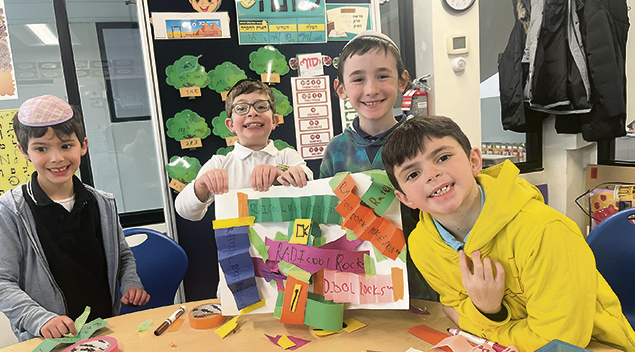
The Sinai Schools is the plural name for a singular organization that educates Jewish children with special needs. Instead of siloing itself off in its own building — which, to be clear, is an entirely reasonable thing to do — it runs its own six schools inside bigger day schools in Bergen and Essex counties and now in Queens and the Bronx, too.
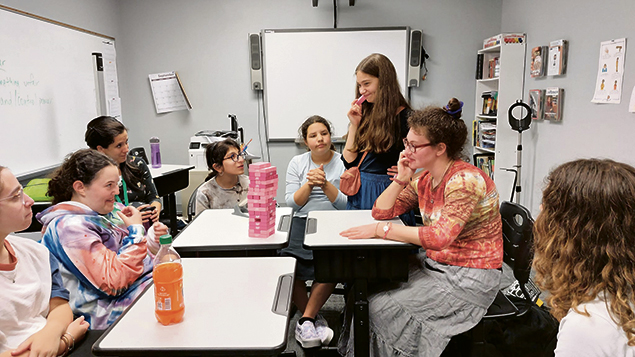
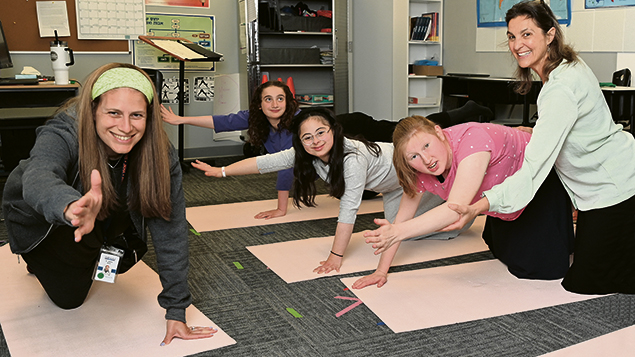
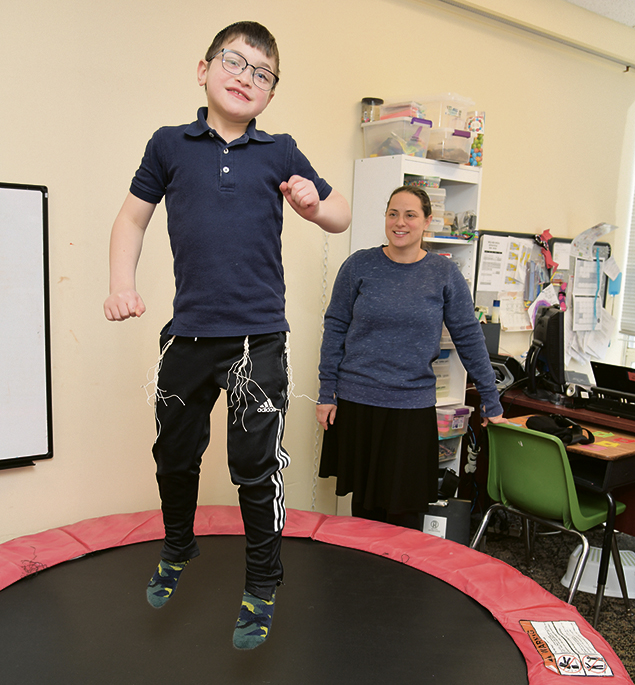
Each child is given an education tailored to that child’s own specific needs. Instruction is either individual or in very small groups. Occupational, physical, speech and language, and art therapy are available to each child, depending on each child’s needs. The school offers counseling and help in acquiring social skills, and school professionals work with students’ outside therapists and medical caregivers if that’s appropriate.
This sounds so ideal and so elaborate as to be pie in the sky, but it’s not. It’s very real, as a visit to any of the schools shows.
And then there’s the other part of what Sinai offers; that’s for the mainstream neurotypical students in the larger school that surrounds each Sinai organization.
Sinai exposes neurotypical students to kids with special needs. It shows everyone that everyone else is also just a person, neurotypical or not, with or without special needs, with or without talents that have nothing to do with the presence or absence of special needs. This helps tear down the stigma that can surround people with special needs, both on an individual and a broader level. It’s changed the lives of Sinai students and of their neurotypical peers.
All of this means that it’s vitally important to keep Sinai going. And as it models in just about everything it does, that demands partnership; in this case, partnership between the business and academic offices.
And that brings us back to Ms. Saposh.
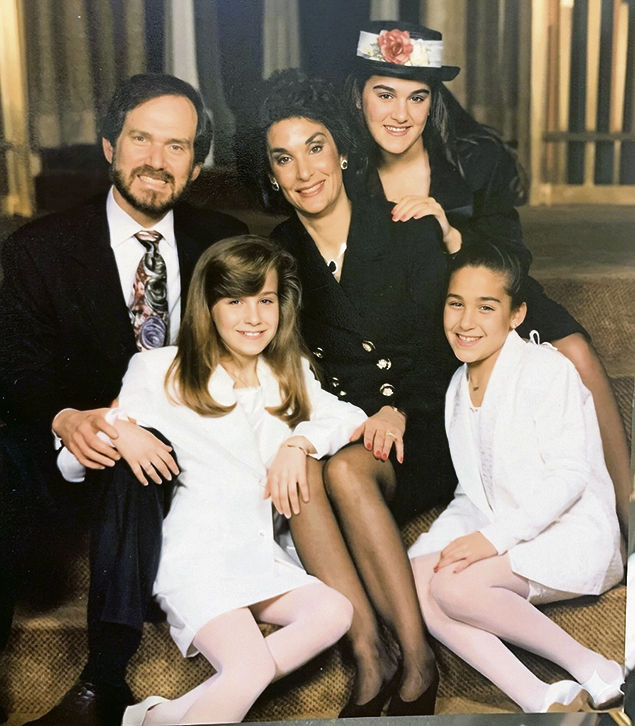
Arielle Greenbaum is from Livingston; she and her sisters — she’s the middle sister — went to public school, but they also went to Camp Ramah in the Berkshires. “I came home from camp and told my parents that I wanted to go to Jewish school,” she said. As a parent now, she’s a little surprised thinking back about her own parents’ reaction to that demand. “Although they hadn’t been paying tuition, they listened to me, and they said, ‘How can we say no to that?’” So Arielle went to the Solomon Schechter Day School of Essex and Union, as it very wordily was called then (now it’s the Golda Och Academy), from fifth through eighth grades. Then she went to Newark Academy in Livingston for high school.
“We went to Ramah all along,” she said. “I credit my parents with my Jewish journey, but much of who I am today, in terms of my observance level, is because of Ramah.”
As with many hardcore Ramahniks, the next step after aging out as a camper was coming back on staff. Arielle did. That’s where she met her husband, Yoni Saposh of Teaneck. They both went to college at the University of Pennsylvania, where she majored in history and political science, concentrating on recent American politics.
That was a longstanding interest of hers; during high school and college she had internships in government agencies. So, logically, after she graduated, “I worked in politics,” Ms. Greenbaum, as she still was then, said. “I worked for the New Jersey Democratic Committee on the campaign in Passaic County. I worked on the whole ticket — the senatorial race, the congressional race, and the three county positions. It was great! And I think that all my candidates won.”
Because jobs with candidates have built-in end dates — whether the candidates win or lose, they stop running, at least officially — she had to get another job after election day. She did, with Susan Bass Levin, who was the first deputy executive director of the Port Authority of New York and New Jersey. “She became a mentor to me,” Ms. Greenbaum said. “I was living on the Upper West Side, commuting to Trenton by car every day, and I was loving every second of it.
“It was about an hour and a half commute, but I needed my car because I was the advance team. I got to meet so many people. I was exposed to so much.” So about a year and a half later, when Ms. Greenbaum tried to figure out her next move — law school or graduate school in public policy — she consulted her mentor. “She was a woman and a lawyer, and she convinced me that I should go to law school. And I am thankful for that advice, because I don’t think that if I got a degree in public policy I’d be where I am today.”
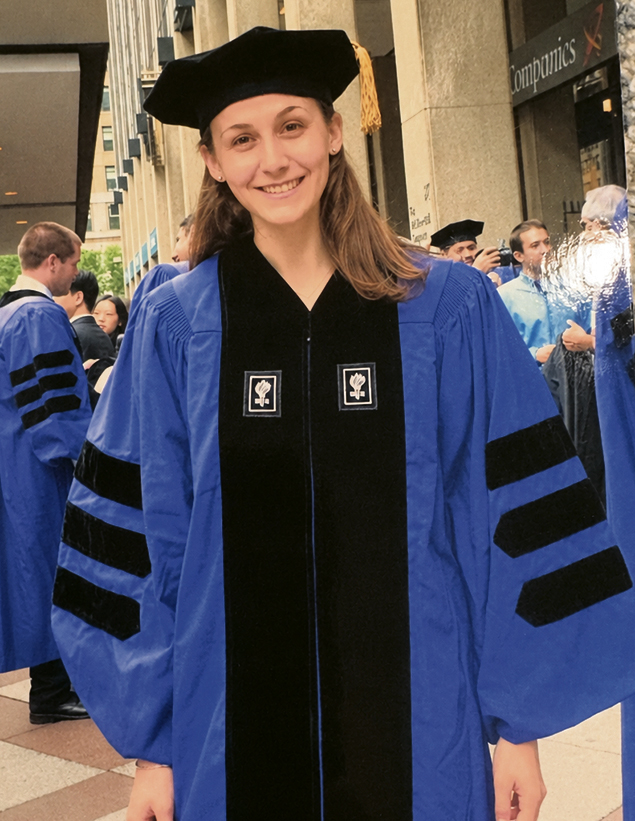
Ms. Greenbaum started law school at the University of Michigan; she got engaged during her first year, so she transferred to and then graduated from NYU, and she got married at the beginning of her second year.
“After I took my last final but before graduation, when I was picking up my cap and gown, my husband said, ‘Do you want to move to London?’” He worked for BlackRock, and the firm asked him to move there for a few years. “It was a great opportunity for me, and great timing for me, because I wasn’t leaving a job.” She worked for Debevoise & Plimpton doing tax law in London, and she became a mother there.
The family lived in northwest London. “It has kind of a similar feel to Brooklyn,” Ms. Saposh said. “It is not the suburbs but not the city. We could go two stops in one direction” on the Underground “and be in the heart of downtown London, and two stops in the other direction and be surrounded by kosher supermarkets and stores.” They belonged to the modern Orthodox South Hampstead Synagogue.
Then, after two years, it was time to go home. “Yoni had the opportunity to go back,” Ms. Saposh said. “We loved London, but all our family on both sides were in the United States.
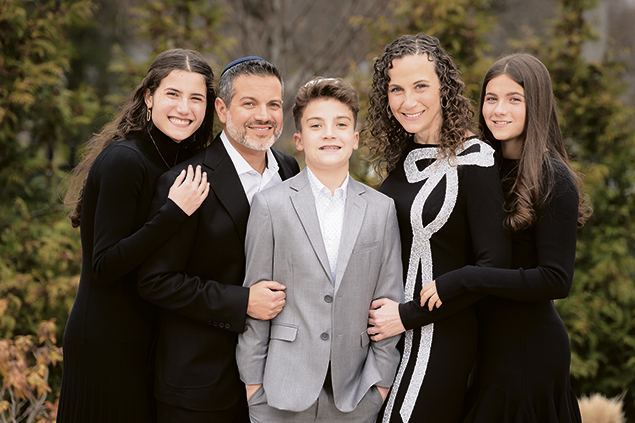
The Saposhes also had two more children; the family now includes an 18-year-old daughter, a 16-year-old daughter, and a 13-year-old son.
“Then I worked for the Port Authority, for a state assemblywoman, and then for the city of Englewood,” Ms. Saposh said. “For four and a half years I was the assistant city manager and director of human resources. I worked hand in hand with the city manager in dealing with legal issues around finances and the budget.
“I really loved that experience. It was the first time that I could really bring about change professionally. I could see an impact as a result of work that I was doing. In college I was all about the federal government, big issues, big-picture things, and I think that subconsciously I looked down on local government. But the place where you really can make a difference is local government. It can really impact people’s lives, and I was able to help with that.
“I was very involved in negotiating the contracts with the police and fire departments, and the hiring process at the library, and with all kinds of issues having to do with outside counsels and lawsuits. I really got to see the ins and outs of local government. Ultimately, I became a certified public manager.
“But then I realized that I didn’t want to be a city manager. I did not want to live and work in the same place. If you do that, when you go to shul, when you go to ShopRite, when you go to the soccer field, people are talking about how bad the city was at shoveling snow.
“I wanted to work farther away from home. I wanted a separate life.
“I also got frustrated with the bureaucracy. You really can bring about change and see the impact of your work — that was true and is true — but you see that there are a lot of things that can’t be changed.”
She knew she didn’t want that. “So the question was — now what?”
She moved to a law firm, Winne Banta Basralian & Kahn, P.C., “where I was doing employment law and representing municipalities and school boards,” she said.
“Through that, I spoke to a client who had an employee-handbook question, and I ended up on a phone call with Sam Fishman and Rabbi Rothwachs.” Yisrael Rothwachs is the Sinai School’s dean — to give him his full title, he is Leo Brandstatter z”l Dean Rabbi Rothwachs.
“I thought we’d dealt with the issue, but then I got an email on Sunday from Sam, saying ‘Please call me in the office when you get this.’ I was with my mother-in-law and sisters-in-law. We were having lunch. And I see this on my phone. I thought it was really strange. I had finished the work. What could be so urgent? Why is he at work on Sunday?” (Partly that’s because Mr. Fishman always was at work.) “I asked if I could call him tomorrow.” She did.
“And now here I am.”
All of her background — her lifelong Jewish connections and commitment, her understanding of politics on both the abstract and the local level, her law degree — made her perfect for Sinai.
“It was serendipitous,” Mr. Fishman said.
“When we hung up the phone, we said to each other, ‘Are you thinking what I’m thinking?’” Rabbi Rothwachs said.
Mr. Fishman explained the background. He and Rabbi Rothwachs had that phone call with Ms. Saposh in 2016. “Sinai finally had gotten past the financial crisis of 2008,” which had hit the school hard, “and we were regrowing. We saw the opportunity to really expand, to open additional schools, to serve more kids, and to serve them better.
“I felt that we needed to build more of a professional staff, starting with a strong second in command. And in 2016 I was 59 years old. I had no immediate plans to retire, I felt that it would be a really good idea for me to identify someone who could help build the school, and could develop into a future leader of Sinai.
“And then Arielle came along.
“Rabbi Rothwachs and I were so impressed with her work and her obvious intelligence, her background and her comportment.
“Fast forward to now. When I think about my top five accomplishments, I would say that somehow convincing Arielle to join us was one of the most important. She is amazing. Whatever expectations we had of her she quickly exceeded and developed very quickly not only as my protegee but as my partner. For the last five years, and more intensely over the last two years, she and Rabbi Rothwachs and I have developed a wonderful partnership.
“Two years ago, we amended Sinai’s bylaws formally to acknowledge this partnership. Arielle was promoted from assistant to associate managing director, with the formal recognition that she would succeed me when the time came.”
That time was September 1, when Mr. Fishman stepped back. “I will do many of the things that I always have done, but on a part-time schedule, and that will be to support Arielle and Rabbi Rothwachs and the board.”
For her part, the decision to move to Sinai — a move that she had not considered until it fell in her lap — had to do with how Ms. Saposh felt about changing her formal relationship to the Jewish world. “I had spent many years as a lay leader within the Jewish community” — she’s been, among other things, a board member, vice president, and president of her shul, Kehilat Kesher; a co-president of the parents association of the Solomon Schechter School of Bergen County; and on the governance committee of Camp Ramah in the Berkshires — “and I had to decide if I wanted to continue having a career outside the community and continue as a lay leader or become a fulltime Jewish professional,” she said.
But her choice was made on other grounds. “Ultimately, I chose to join Sinai because I believe in Sinai’s mission, and I believe that parents should be able to choose a Jewish education.
“I had been warned that when you stay as a Jewish lay leader you work with smart people who believe in being intellectually challenged, and you are not going to find that in the Jewish nonprofit world,” Ms. Saposh continued. “Nothing could be more incorrect. That was the opposite of my experience. It has been a privilege to collaborate with Sam and Rabbi Rothwachs, to be part of the team, to help so many students and their families, but it doesn’t end with Rabbi Rothwachs and Sam. It has been incredible to work with so many dedicated employees on both the business and the education side. These people work hard day in and day out to help our students and their families. And I include our partners in our partner schools.
“That is the Sinai model. It’s all about collaboration. Between the education and business offices, between Sinai and the partner schools, between the teachers and the therapists, all trying to help our students and their families.”
The way the world is changing is not good for any of us, but it is particularly bad for the most vulnerable among us. “The needs in the community are expanding,” Rabbi Rothwachs said. “We have had 45 years of growth at Sinai, and we look at times like these, where there is a transition, and it prompts reflection.”
Antisemitism is affecting the school. “We have seen it since October 7,” Rabbi Rothwachs said. “There has been an influx of students from public schools — that’s fortunate for the students, but the reason is unfortunate. Many of our students have encountered antisemitism in public schools.”
“These are kids who are vulnerable and might be picked on anyway,” Mr. Fishman said; now there’s yet another reason for bullies to do so.
But the overwhelming feeling that comes from the Sinai professionals is their commitment to the school and “the students it serves. Ms. Saposh is confident in her knowledge that she made the right decision 10 years ago. “I am so glad that parents don’t have to choose between a special education and a Jewish education,” she said. “Sinai is a reality.”
Tzvi Solomon of New Milford is the president of Sinai’s board.
“We’re so excited about Arielle,” Mr. Solomon said. “And what’s been so special about this transition is that it’s been done so intentionally, and Sam has done so well by the organization in ensuring that there would be — and there is! — a smooth transition.
“When you have long-time professionals, transitions can be challenging. We’ve been so blessed, from the board’s perspective, that Sam has handed us this opportunity with Arielle, to allow her to transition to this role, and with Sam’s blessing.”
“The north star has been having Arielle transition to this role. She knows the organization. She’s been with it for 10 years, and she brings such a wealth of knowledge.
“But I don’t want to focus on what Arielle brings to the table from an intellectual perspective — her ability to handle complex situations — as much as what she brings from the heart. There are a lot of very good professionals out there, and there are lot of good people with good hearts out there, but what Arielle has demonstrated is the ability to have both. To execute and produce and ensure that the organization is in good hands.
“We are very excited about the love and the care and the understanding of the holy work that we do that she brings, and that she also brings her core competency and her skills and her ability to think strategically.”
Sinai’s work demands all those skills, because, Mr. Solomon said, “you know what we always say — if you’ve met one Sinai student, you’ve met one Sinai student.” In other words, if you want to work at Sinai as either a professional or a lay leader, be sure to leave the cookie cutter at home.
Mr. Solomon is from Teaneck — “born at Holy Name, and Holy Name is a friend of Sinai,” he said — and he’s a financial advisor. His connection to Sinai began about 20 years ago — and he’s 36 now. He was in high school. “It really started when I was a freshman at TABC,” he said; that’s Torah Academy of Bergen County, the all-boys high school that’s a Sinai partner.
“It started as chesed for me,” he said. Of charity. Of loving kindness. And of duty. “It was about being nice to the Sinai kids. And then, as my years in TABC went on, there was no reason to think of these as a chesed scenario. I was like, ‘These are just kind of cool kids. They want to play basketball and to go out to lunch and to have handshakes and to talk about the football game. So I switched my lens from basically doing constant community service in the hallway to just being a friend. To just be normal.
“We had a Sinai student on our basketball team. He got a jersey and he would come to practice and he would play in some games. I think back to some of my more meaningful memories of TABC, and that’s one of them. I remember going to the Sinai play at Ma’ayanot” — the girls’ high school in Teaneck that also partners with Sinai. “These are all meaningful moments.”
As he graduated from TABC, and eventually from Yeshiva University, he stayed in touch with Sinai, and with some of the Sinai friends he’d made. “And eventually the organization asked me to get involved in a young leadership capacity.”
Not only is Mr. Solomon the president of the board, but he and his wife, Erica, “with the Sinai professional team, helped found what’s now called the Chazon Society” — the Visionary Society — for people under 40. It’s to ensure that young people learn about Sinai, support it, and talk about it with their friends whose children might be candidates for it.
“Arielle’s been a tremendous advocate — a real force — in developing, nurturing, and appreciating the next generation of donors.”
There are many reasons for people to get involved in Sinai. “In the end, we’re all one community,” Mr. Solomon said.
Why has he retained his loyalty to Sinai? “Erica and I were very blessed,” Mr. Solomon said. “We have choices about where to send our children. I feel a responsibility for children who want to have a Jewish education. Sinai isn’t the right choice for everyone, but when I see a student who could benefit from it, I want to make sure that we can help that child go to that school.”
People might not realize how naturally Sinai students fit into the partner schools. “It just happens so much more naturally than people expect,” he said. “Just like I was never told to be nice to them, I was never told to include them. It just happens.
“The generation of students who are in our partner schools are incredible, and I like to call them out.” Despite what we’re usually told about that generation — their inwardness, their screen addictions, their need to look good without actually being good — “I see incredible kids who are volunteering their time, being kind, and trying to do the best they can.
“We see volunteers in the Friendship Circle, and Chai Lifeline, and Yachad. These are outside of Sinai” — but that’s okay. What these teens, in and out of Sinai partner schools, are doing “is not normal,” Mr. Solomon said. “It’s very, very special.”
Learn more about the Sinai Schools, including how to apply, how to support, and the Chazon Society, at sinaischools.org.