

Being alert to ‘Red Alert’
New miniseries tells four true stories about October 7
“Lior, let me just interrupt. I think it’s important, because we didn’t make this film for political reasons. We purposely stayed away from anything political. We made the show for a reason that is not political. And I think it’s good to talk about that.”
Lior is Lior Chefetz, co-creator and director of the four-part miniseries, “Red Alert,” and the interrupter is Lawrence Bender, its producer. It’s October 6, and the pair are in New York to promote the film’s debut on Paramount+ on October 7.
The series tells four different stories about that day, and despite Mr. Bender’s suggestion to the contrary, it is of course very much political. It is impossible for anything about October 7 not to be political.
But if you only have a 30-minute Zoom, there’s no point in debating, and certainly there’s no time for it. So I ask him if it’s not political, what is the reason behind the film?
“The reason we’re telling this story is that people have to understand the truth of what actually happened,” Mr. Bender said. “The more people see the show, the more chance we have to create a conversation. The more people will have a chance to understand what actually happened and maybe change the conversation. That’s one of the biggest reasons we did the show.”
Changing the conversation about Jews and Israel is something Mr. Bender has been doing for years, and it is a subject we’ll return to later. But first I tell Mr. Chefetz that as an outsider it seems to me that in at least one way this must have been an easy subject to film. It would be hard not to make a dramatic and emotionally wrenching film about that day. On the other hand, for you and the cast, the events still must be fresh and disturbing. What was it like?
“It’s a really interesting question,” he tells me. “My previous project, called ‘The Stronghold,’ came out as a movie two years ago. It was about the 1973 Yom Kippur War. So we had a 50-year perspective on that topic, and that’s a bonus. It allows you to see the themes in a more clear way.
“On the other hand, we started the research on our October 7 project, ‘Red Alert,’ three months after the events. In January ’24. And as an artist, a filmmaker, working out of a raw open wound, you work more from the gut, from instinct.
“It gives you a somewhat different energy, which is as truthful as working from a perspective of many years. But it’s different and very strong.
“What gave us our power to tell the stories the way we told them is by working very closely with the permission and blessing of the real people whose stories we were telling. It’s a husband and counterterrorism police officer looking for his injured wife, also a police officer, who disappeared from the Nova music festival.
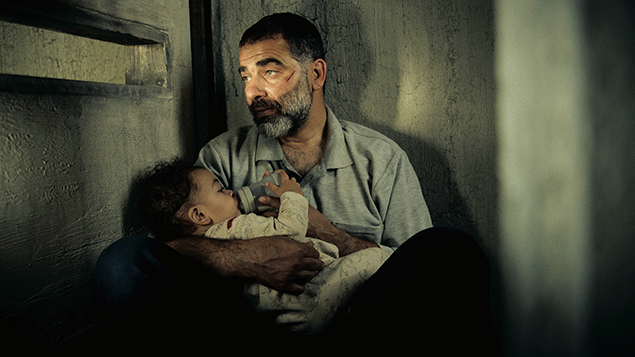
“We have an Arab man just driving on his way to work with his wife and baby. They got shot at [by invading Hamas terrorists]. His wife is murdered and he has to hide with a seven-month-old baby still being breast fed. He needs to keep the baby quiet, because, if not, terrorists roaming a nearby intersection will find them.”
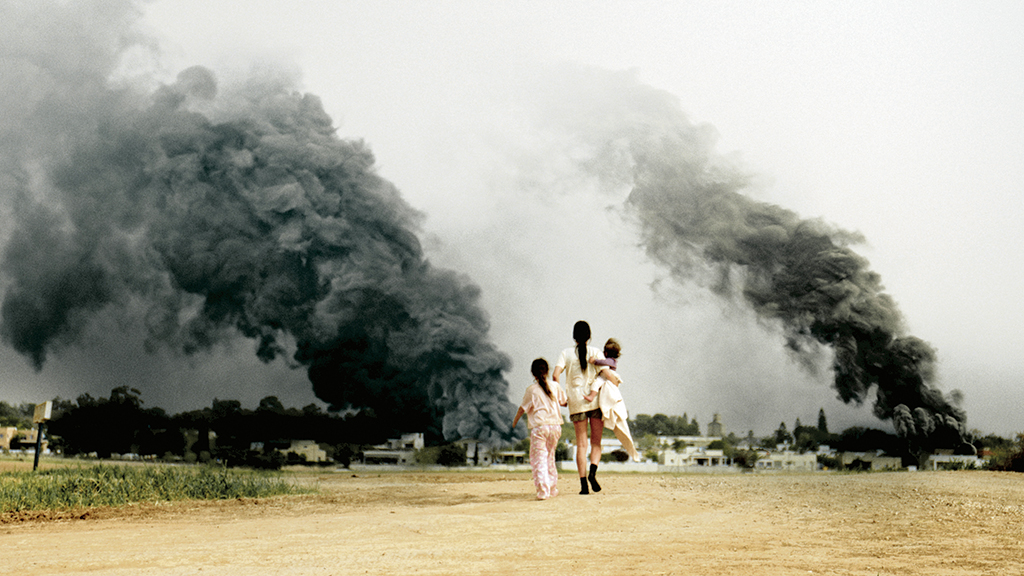
There are two other story lines, as well. One is about a family whose father and 12-year-old son are kidnapped to Gaza while the mom manages to escape and bring her two daughters to safety. The fourth involves another mom, who went out in search of her son, an IDF soldier, who was home on leave, grabbed his weapon, and raced out to fight terrorists invading his village.
“Our stories are about regular folks that are facing these really incredible situations, and deal with them with courage and selflessness,” Mr. Chefetz said. “By getting their permission and working very closely with them, having them with us on some of the shoot days, it really gave us the confidence that we are telling the story in a truthful way.”
Not surprisingly, there were actors who turned parts down. “We had more than one refusal, actors who said it was too close,” the director said. “‘This topic is too hard for me.’ But, on the other hand, the actors who said yes, they were the right actors for the role.”
Because he was American, Mr. Bender felt that “I needed to be sensitive.” On the other hand, he really wanted to push ahead, “because the world quickly became antisemitic on October 8, for some reason that is still unimaginable.
“So I engaged with Lior and our partners in Israel about whether it was too soon. We decided it was not too soon. Also, we felt it was really important for the Israeli people themselves to be reminded why we are here in the first place.”
But the process was not easy, especially in the beginning, when Mr. Chefetz and his co-creator, Ruth Efroni, found themselves in a dark place. “Because the events were so horrific, we lost our footing,” he said. “We lost all sense of meaning, of what was good and what was bad.” It was then, just months after the attack, that Ms. Efroni suggested doing an October 7 film.
“When we researched the stories, we discovered that many offered a glimmer of hope. In some, we managed to find a humanity that reminded us of who we are and what it means to be good in the face of this extreme evil. We also looked for stories that have a dramatic arc in them. So we have a hero, who has a very concise objective.”
Mr. Chefetz was very successful. The Arab man was hiding in a shelter that looks like a bus stop, shushing his baby, when Israeli soldiers approached. But so did the nearby terrorists, who hid and planned to ambush them. Though he risked being shot by both sides, he jumped out of hiding to warn the IDF troops. For his valor, he received the Medal of Honor and was awarded permanent Israeli residency.
Tali Hadad, the woman who went in search of her son, was repeatedly told to go home, that her quest was too dangerous. But when she discovered that no ambulance could reach her village to evacuate the wounded, Ms. Hadad, a kindergarten teacher and the mother of six, loaded her private vehicle with people in need of medical care and made repeated trips to the nearest aid station. She was awarded the President’s Medal for Civilian Bravery.
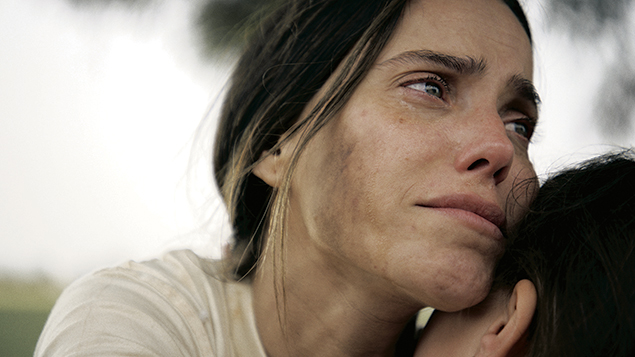
Another story involved the Yahalomi family. The father, Ohad, died in captivity, and the 12-year-old son, Eitan, was released after 51 days in captivity. The mom, Bat Sheva, managed to escape from her captors and save her two daughters.
Finally, the police officer, Kobi, managed to fight his way to where his wounded wife, Nofar (both names are pseudonyms), was hiding. He has returned to duty. She is still recovering from her injuries.
Asked what he hoped the film would accomplish, Mr. Chefetz said, “Many people look at the conflict in the Middle East as black-and-white. It’s very easy for someone to say the other side has no right to exist. Of course this doesn’t lead to any solution.
“But if people will be open to learn from a show like ours about the inciting incident of the Israel Gaza war, which we did not start and we did not want, to understand the context of how it started, they will realize that the conflict has many shades of gray. It has nuances, and that can lead to a conversation that potentially can help repair the situation.”
Mr. Bender echoed those sentiments: “There’s a chance people will start to understand there’s a reason why we got here. How we solve the problem, that’s another story. But if we understand how we got here, it can create a conversation, create another contact for how people look at Jewish people, how they look at Israel.”
Mr. Bender was born in the Bronx, in the shadow of Yankee Stadium. When he was 7, his family moved to New Jersey. That’s where he grew up, mostly in Cherry Hill. He remembers experiencing antisemitism while attending Cherry Hill High School East.
“These were my ‘friends,’” he said. “They’d tell me I was a good kid for a Jew. It was a pain in the ass, but it wasn’t like I was threatened or anything like that. It was like, people call them micro-aggressions. Sometimes it was a little more than micro-aggressions.”
But what ultimately brought him to “Red Alert” and life as a social activist occurred much later. As he recalls: “In 1998, we screened ‘Goodwill Hunting’ in Camp David. President Clinton and Hillary, Secretary of State Albright and many others were there with me and Matt Damon, Ben Affleck, and Gus Van Sant.
“At the time, though my career was going really well, I thought there was something missing in my life. I didn’t know what it was. But being there, I really felt that these people were trying to make a difference and that is what was missing from my life.”
At first, he concentrated on being an advocate for the arts. Then he moved into three principal areas: nuclear proliferation, climate change, and Mideast peace, Israel and Jewish issues.
He went on to produce “An Inconvenient Truth” (he won an Oscar for best documentary for that film), its sequel, “Countdown to Zero,” and a passel of films with Quentin Tarantino.
On the day we spoke, there was fresh talk of a peace initiative. I asked Mr. Bender if he thought it would work. “I’m really hopeful for the war to end and the hostages to come back and start to rebuild their lives,” he said. “You can’t keep going like this forever.”
On the day this was written, you could actually see a truce, if not peace, on the horizon.
On the day you read this, the living hostages are back home.