

A son displays his parents’ lives
Ben Stiller films a documentary about Jerry and Anne

Ben Stiller was having issues.
It was 2020, and covid was in charge of the world. His father, Jerry, had just died, five years after his mom, Anne Meara. He was separated from his wife and children. And as he notes at the start of his compelling and honest documentary, “Stiller & Meara: Nothing is Lost”:
“Things were not going great in my personal life. I felt out of balance from my family, from my kids, and a little bit lost. I started to think about my parents and all the stress and tension I remember seeing as a kid. The pressure when they were working together and how they stayed together through it. I wanted to somehow understand how they did.”
For the record (and for the sake of the young’uns), while Jerry Stiller likely is best remembered as Frank Costanza on “Seinfeld” and Arthur Spooner on “The King of Queens,” before those TV roles he and his wife, Anne, were the hottest comedy duo of the 1960s. Many of their routines were centered on their relationship, an Irish Catholic girl and this Jewish boy.
The film was of special interest to me because I’d written about Jerry Stiller several times, and I’d found him one of the most accessible and sincere celebrities I’d ever spoken to.
I’d interviewed him some time in the late ’90s, about a dramatic role he played in an HBO miniseries. A month or so later, I arranged to meet him in Westport County Playhouse in Connecticut, where he was appearing in “After-Play,” co-starring his wife, who wrote it.
We met for the first time after the show, in the hospitality tent set up next to the theater. He immediately paid me a compliment: while he was looking out toward the audience, “I was trying to figure out which one you were.”
This being well before Zoom and Face Time, he couldn’t figure out how I’d managed the article based on our brief conversation. He made it seem as though it was the best thing ever written about him.
Typically, celebrities are your best friends when you help promote their latest project, but subsequently disappear. But Mr. Stiller wasn’t typical.
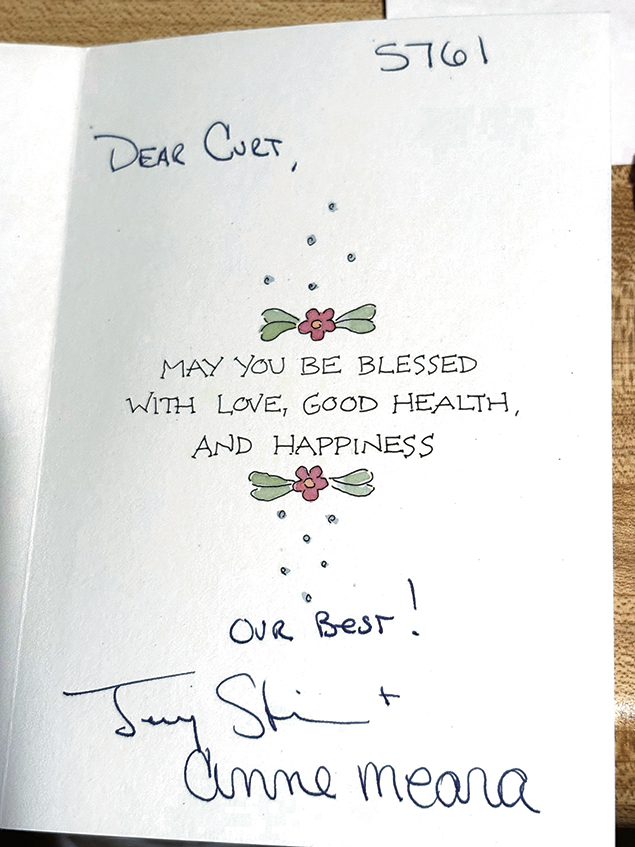
For several years after that, I’d receive High Holiday cards from him and Anne. I had his phone number and he always made himself available if I needed a quote. In fact, the only time he declined was when I asked for help arranging an interview with his son, Ben. He wouldn’t get involved in that.
My curiosity was piqued. And for the most part, I was not disappointed.
Ben Stiller’s project began when he brought his camera to his parents’ expansive Riverside Drive apartment in Manhattan. He and his sister Amy were there to clean up more than a half century of memories before it was put on the market. He wanted to film it the way it was.
But in the process, the Stiller siblings discovered a treasure trove of memorabilia: reels and reels of home movies; videos of their parents’ appearances on Ed Sullivan and Mike Douglas and elsewhere; and tape recordings of the couple trying out material. They even recorded themselves arguing.
Given the wealth of material, the film kind of grew organically from that. Some of it was familiar to me. The two met at an agent’s office. Jerry was sitting waiting to get in when Anne stormed out, accusing the agent of chasing her around the desk.
So what else could Jerry do? He invited her out for coffee and — this part was not in the film — she quickly impressed him by putting the silverware in her pocket for later use at home.
“I thought she was kind of interesting, someone with guts like that,” Jerry told me.
But much of the rest was new to me. Anne didn’t consider herself a comedienne. In fact, she resisted the comedy partnership because her real interest was in acting.
Her mother committed suicide when Anne was a young girl. It’s difficult to know if it was a causal situation, but she grew up to be an alcoholic, a further strain on her marriage.
One of the most poignant scenes in the film shows Amy and Ben watching a film of their mother and debating whether she was drunk at the time.
Working together, living together, in stressful and demanding jobs, the parents argued a lot, which obviously affected the kids. Ben recalls receiving a film camera from his father: “When they were away or fighting or not focusing so much on us, [filming] was an easy something to fall into.”
Their parents’ frequent absences also impacted the children. And Ben was determined not to repeat the mistakes of his own parents. But he interviews his daughter, Ella, 23, who tells him she “can’t remember you being around when I was young.”
This prompted Mr. Stiller to say: “The irony is that I thought I was doing so much much better than my parents.”
In any event, making the film leads to a happy ending in real life. While filming during covid, he moves back in with his wife, Christine Taylor, and their family. Eventually, Christine and Ben reconcile.
And importantly, he says, the process has given him “so much more empathy for them now.”
I was, however, a bit surprised that Mr. Stiller made no mention of his parents’ foray into advertising. Their radio commercials for Blue Nun wine not only catapulted the company’s sales into the stratosphere, they also changed the face of advertising, making humor a more acceptable tool.
I was also disappointed that Mr. Stiller made no mention of his Jewish roots. Ms. Meara converted to Judaism, and Jerry Stiller told me that she was chiefly responsible for the family’s observance of faith, from getting the kids to Hebrew school to making family meals.
He was honest about everything else.
“Stiller & Meara: Nothing is Lost” is streaming on Apple TV.