

It’s never too late to write
Author publishes book about widowhood at 81
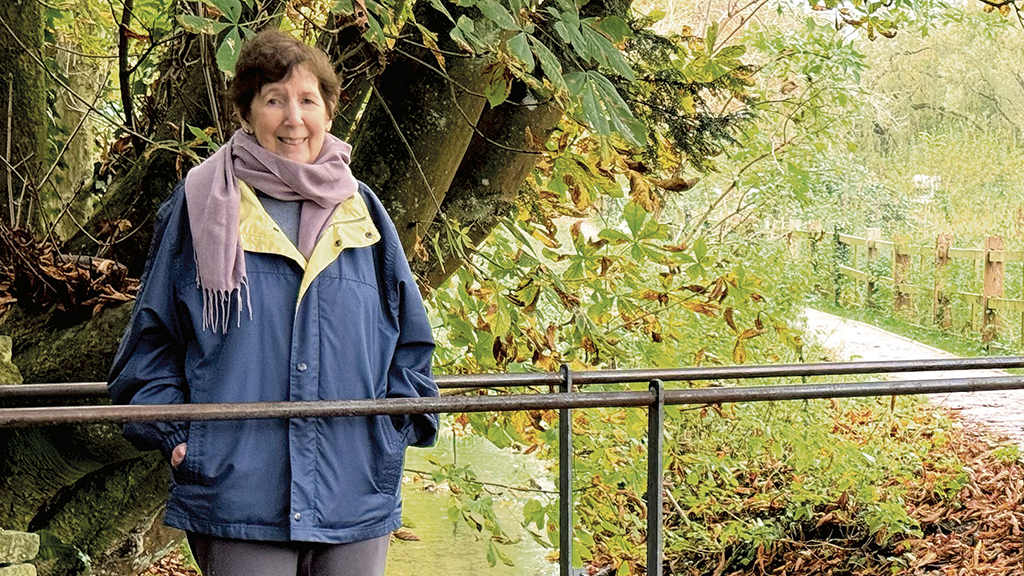
There doesn’t seem to be much point in living for more than 80 years, making it through joy and sorrow and boredom and beauty and everything else that life offers, having many careers, each of them involving at least one of the arts, gaining the wisdom that comes from all that living — and then not doing anything with it.
There seems to be very little point in going from always living with someone — parents, roommates, your husband, your children, then just your husband again — and then finding yourself widowed and alone for the first time, in your 70s, without somehow making art out of it.
And why be gloomy about it all the time, when you know that sometimes it’s funny? Not always funny, sometimes heartbreaking, but also sometimes funny.
That’s why Jacqueline Sideman Guttman, widowed in her early 70s and now 83, decided to write about what it felt like when that happened to her, and then, knowing that it’s hardly an experience unique to her, to put the essays into a book, publish it, and market it.
Ms. Guttman will talk about her book, “Widowhood and Other Altered States,” at the Englewood Public Library on March 24 (see below); she’s planning other local programs as well.
Ms. Guttman didn’t start out as a writer, she said. She grew up in Kew Gardens Hills, in Queens: “When I was a kid, my spelling and grammar were always very good, but there was nothing creative about my writing.”
What she really loved was music.
She graduated from the High School of Music and Art, the famously hard-to-get-into artists’ launching pad in Manhattan. Next, she went to the State University of New York in Potsdam, the northernmost college in the state university system, majoring in music education, and then to graduate school at NYU, earning two masters’ degrees, one in music education and the other, later one in arts administration.
She began as a flutist and a music teacher, but after about nine years, the rheumatoid arthritis that had plagued her since her late 20s made it impossible for her to continue to perform, and she felt that if she couldn’t perform, she couldn’t really teach music either.
“My neck and shoulders and arms and hands were all painful, and I was throwing drugs at myself to play. I was accompanying a cantor, and I was in a lot of pain, so I took my regular medicine and then another medicine, and I felt like my head was going to leave my body. And then I took Benadryl to counteract that, and then I thought, ‘This is ridiculous. I’m not doing this right.’
“So I went to the end of the season, and then I put the flute away.”
That was her first self-reinvention. Ms. Guttman became an arts administrator, and spent almost a decade working in the gloriously beautiful Wave Hill, the public gardens and performance center in Riverdale. She became the director of performing arts there. “I had to write brochures and press releases, and that kind of writing became so easy for me that I could do it in my sleep,” she said.
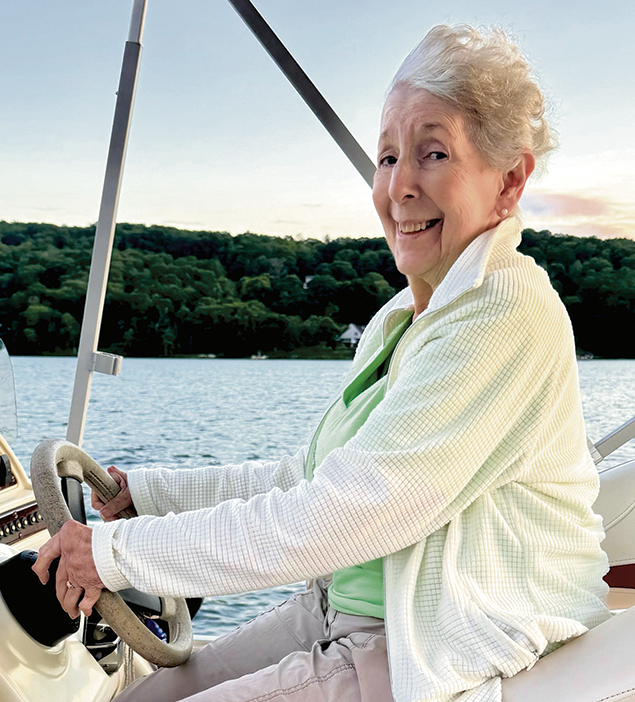
When she left Wave Hill, she became a consultant in art education and art management. “I started writing again,” she said. “I wrote curriculum guides to go along with artists in school programs. I did a lot of writing and it was easy for me, but it wasn’t complex, so I thought that I was doing something wrong.” (She wasn’t.)
A dear friend, Stefanie Mandelbaum, an artist who taught math, asked Ms. Guttman to work with her to write a book, “ARThematics,” about a method of teaching mathematics by combining it with art to make abstract concepts visual and therefore more understandable. Ms. Guttman is no mathematician — that part came from Ms. Mandelbaum — but her love of the visual combined with her love for writing, and her love for patterns that came from her love of music, all came together.
Next, the National Guild for Community Arts asked her to write a book, called “Partners in Excellence,” “about the partnership between community art schools and public schools, and I did.
“But I didn’t think of myself as a writer,” despite all the evidence to the contrary, Ms. Guttman said. “I only wrote how-to books, never anything creative.”
She and her husband, Howard Guttman, had moved to Teaneck, where they lived for 29 years; for the last 25 years, she’s lived in Englewood, first with Howard and then alone since his death in 2017. The couple had two sons; both are married with their own children.
They were active members of Temple Emeth in Teaneck; Ms. Guttman was on its board and was its president. She also was the director of its adult choir, Kol Emet, a position she held for 18 years.
From 2003 to 2010, Ms. Guttman was the development director at the Thurnauer School of Music at the Kaplen JCC on the Palisades in Tenafly. “I went there for three months and I stayed for six years,” she said. “I fell in love with the children. I would go to the Gift of Music concert there, and I would cry through the whole concert, because it was so beautiful. That was my litmus test. If I cried, it was a good concert.” She always cried.
She also did some consulting work for what was then called the Old Church Cultural Center in Demarest; its name since has been changed to the Art School at Old Church to make clear that the art school is a thoroughly secular organization that meets in an old building that once housed a church.
So Ms. Guttman was constantly reinventing herself, she was active in the local community — she joined many local arts groups — and it always involved some combination of music, visual arts, and writing.
Then Howard died in 2017, and she knew that she had to do something to keep the grief and loneliness at bay. She joined a writers’ group, full of people serious about their craft that still is together today. When the pandemic hit, they met online. And the members encouraged Ms. Guttman to keep writing.
She published her book when she was 81 — Grandma Moses comes to mind, she acknowledged. To do something for the first time at an age when most people assume that any first is far behind them was not novel for her family.
She had a sister, who had been seven years older than she was and died five years ago, who always had been a musician. “She was very dynamic, and a very fine pianist, but she played only for fun, and mostly pop music.
“When she was 65, she became a jazz pianist. She played gigs, restaurants, places like that. Her name was Bunny Beck.”
“Bunny Beck?” I asked.
“Yes, that’s what she called herself. She always had been called Bunny since she was a baby.”
“What was her real name?”
“Frederica Levinson.”
“Bunny started composing when she was in her 70s,” Ms. Guttman continued. “She wanted to get all the music that was inside her out. And I said, ‘Wow. You should promote yourself as a Grandma Moses.’
“She hated the idea. She couldn’t stand the idea of aging and wanted nothing to do with it, so she did not receive that idea well.”
Her sister wished that she could have had more of the music she wrote performed, so Ms. Guttman is toying with the idea of presenting it. Her background means that she knows exactly how to do it. She might, one day.
Ms. Guttman’s decision to publish some of her essays was driven by people’s reactions to them. She’d been going to a bereavement group run by the Jewish Federation of Northern New Jersey. “We’d talk about a topic like, say, what do you do with your wedding ring? And I’d mumble, ‘Oh, I wrote something about that.’ So the facilitator said, ‘Would you like to bring it in to read it to us?’ And I said yes.
“The first time, I read a piece called ‘1000 Napkins.’ There was a woman in the group, a very nice woman, who never smiled. She’d just sit there, with no affect.
“And I read the piece out loud, and I looked up, and I saw that she was laughing.”
That story, “1000 Napkins,” is about the napkins that a dear friend brought to Ms. Guttman’s house when Ms. Guttman was sitting shiva. She’d been asked to contribute to the paper goods, part of the list that Temple Emeth had put together.
“My friend went to Costco, where everything is in bulk, and it turned out to be a package of 1,200 napkins. There were about 1,000 left after shiva. I didn’t want to throw them away.”
That’s what the story is about. What do you do, as a new widow, with approximately 1,000 paper napkins? (Read the book to find out.)
The book is for widows; widowers also read it, and from what they tell her, they love it. And it’s not only for people her age, Ms. Guttman said. “The youngest woman in my group came over to me. She’s 49. And she said, ‘You’re writing about my life.’ And I couldn’t believe it. She has two teenage daughters!”
The book is self-published. “Given my age, I really didn’t have time to try to get an agent,” Ms. Guttman said. Her sons and their wives are pitching in to help with design and publicity.
Learn more about Ms. Guttman and her work, including the new essays she’s posting there, at her website, jsgutmann.com
Who: Jacqueline Sideman Guttman
What: Will talk about her book, “Widowhood and Other Altered States”
Where: At the Englewood Public Library, 31 Engle Street
When: On Tuesday, March 24, at 2 p.m.
What else: reservations are necessary. Call (201) 568-2215 ext 8230 or to go englewoodlibrary.org