

‘Don’t Cry For Me, My Yeshiva’
Documentarian-comedian-playwright adapts his adoption as plot for a show
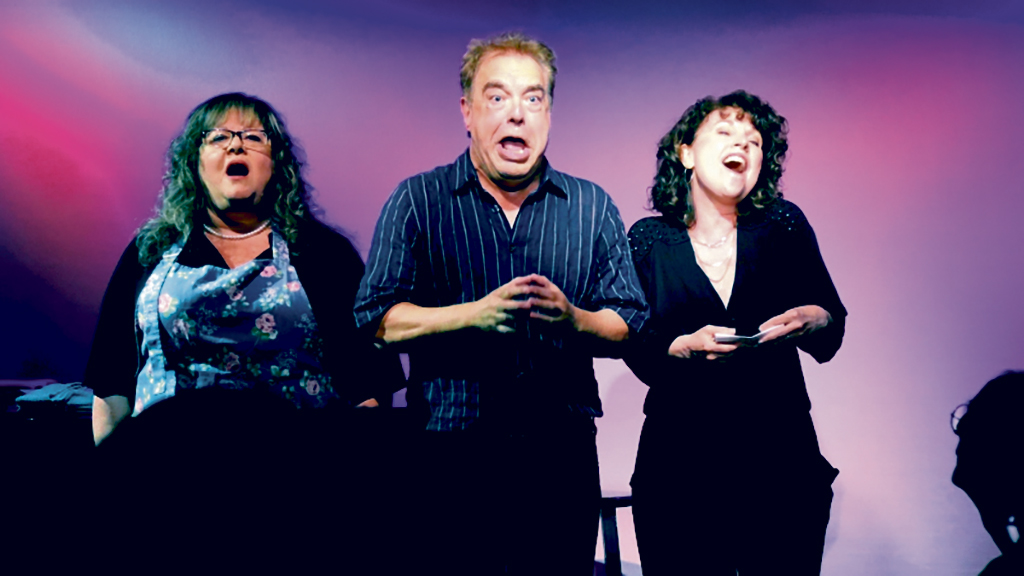
Joseph Fox’s father, an Orthodox rabbi, died in 1992. The day before the funeral, “My cousin, who also was a rabbi,” approached him, Mr. Fox said. “He said to me, ‘You don’t have to sit shiva for your father, because you’re adopted, and if you’re adopted you’re not halachically related to your father.’”
Of course, Mr. Fox already knew that he was adopted. But the comment was unnecessary, hurtful, and cruel. “It also was bad timing,” Mr. Fox, 65, said during a Zoom interview from his Brooklyn office. “This was the night before my father was supposed to be buried. Even if you felt that way, what human being would choose that moment to say something like that?
“It was a big blow to me. I went through my life thinking my family was my family, and to be told that religion was the thing that nullified me — that was very traumatic.”
It also freed him. “It put me into a tailspin, but it made me say to myself enough is enough. It was time to live the life I was meant to live.”
Mr. Fox had spent much of his life as a closeted gay man, though the closet door wasn’t entirely shut. “When I did come out” — this was shortly after his father died — “people would say no big surprise. I was 32, wasn’t married, and no one ever saw me with a woman, so you know that might have been a clue.”
We’re speaking because Mr. Fox has written and performs in a play about his life, with music, called “Don’t Cry For Me, My Yeshiva.” It is set around his experiences filming “Question One,” a documentary about a 2009 battle in Maine over a referendum to legalize same-sex marriage. Ironically, in order to appear unbiased and interview people on both sides of the issue, Mr. Fox had to go back into the closet.
Mr. Fox was born in Los Angeles and adopted shortly after birth by Rabbi Samuel J. Fox and his wife, Edith. Rabbi Fox was the spiritual leader of Congregation Chevra Tehillim in Lynn, Massachusetts — today it’s a church, his son reports — and he also had headed the Massachusetts Council of Rabbis and the Orthodox Rabbinical Council of Greater Boston. The Foxes had been married for two decades, were unable to conceive, and desperately wanted a child.
“I think they searched the world,” Mr. Fox said. “At that time, the Orthodox circles were not that large. But they just tried to put out the word, ‘I’m an Orthodox rabbi looking to adopt a child.’ Somehow, they got connected to a rabbi in Los Angeles.”
That led to a 19-year-old unmarried, pregnant young woman who was an actress and a singer. “It was very important for my parents to adopt a child who was biologically Jewish,” Mr. Fox said. “My parents went through the process several times, but had to pull out because they discovered that the birth mother wasn’t Jewish. So the answer is yes: my biological mother was Jewish.”
But Joe knew little about her. “When I was 16, I found my adoption folder. I wasn’t supposed to find it, and that yielded every piece of information I needed to know. It included my birth mother’s name, the circumstances of my adoption, when my parents went to court to finalize the adoption. I discovered everything by accident.”
It took four more years before he and his birth mother met — circumstances recounted in the play.
It was about this time, too, that Mr. Fox was coming to the realization that he was gay. “I don’t think there was an exact moment in time,” he said. “It evolved. I started having dreams. My first dream was of McLean Stevenson of ‘M*A*S*H.’ I know, right? Why I didn’t dream of Alan Alda I don’t know. I knew something was off.”
It was a quandary. He knew he was attracted to men, “but it’s being drummed into your head, especially in my yeshiva, in the Orthodox Jewish world, that homosexuality and being Jewish are incompatible. That it was a sin. If you want to be a good Jew, you couldn’t be a homosexual.
“So although I had feelings and I knew I was leaning in that direction, this was the ’70s, when being open wasn’t that great an idea in the larger society, let alone in Orthodox Jewish society. So I clamped down those feelings and played the straight cover story for the next 15 years.”
Meanwhile, he studied journalism in college, went to Israel for two years, where he picked pomegranates at a kibbutz, returned to the United States, and became a freelance writer.
“I really did a lot of interesting things,” he said. “I went to South Africa. I went to Northern Ireland. My interest was really docu-journalism, which is storytelling. My hero in life is Studs Terkel, who was a phenomenal oral historian. I always told stories through the words of ordinary people.”
He and a photographer with whom he often worked founded Fly On The Wall Productions, a company that produces both slick corporate films for a variety of clients and also documentaries like “Question One,” which received highly favorable reviews during its brief theatrical release, was shown on PBS, and now is available on both Apple TV and Amazon Prime.
“This was my first time actually experiencing homophobia in a really intense manner,” Mr. Fox said of his time filming in Maine.
“I knew that if I was going to make an honest documentary, I had to find a way of connecting to the other side, to find a bridge. And that yielded some interesting results.
“There was this one woman, who became one of the main characters in the film. I had to find a way of seeing within her heart, of reaching her so that she would share her story with me, and it was really the bridge of Judaism that connected us.
“I spoke about my father, who was a rabbi. She was a very religious woman, evangelical. That reached her. She saw me as being one of the children of Israel, who believed in principle. That was our connection that led us to be able to relate to each other as humans. It taught me that we need to try hard to find commonality, even though our views might clash.”
She is one of several characters played by Mr. Fox. The group includes his rabbi cousin — yes, that one. There’s also a lot of music that — as its title implies — are Broadway show parodies. Other actors play Joe’s two moms.
“Don’t Cry For Me, My Yeshiva” will play on June 21 at 7:30 at the 92nd Street Y. Tickets are $18. There will also be a show at the Green Room on July 13 and another at Don’t Tell Mama on a July date to be determined.