

How a philanthropist thinks
Jeffrey Solomon considers the Jewish community’s past and future
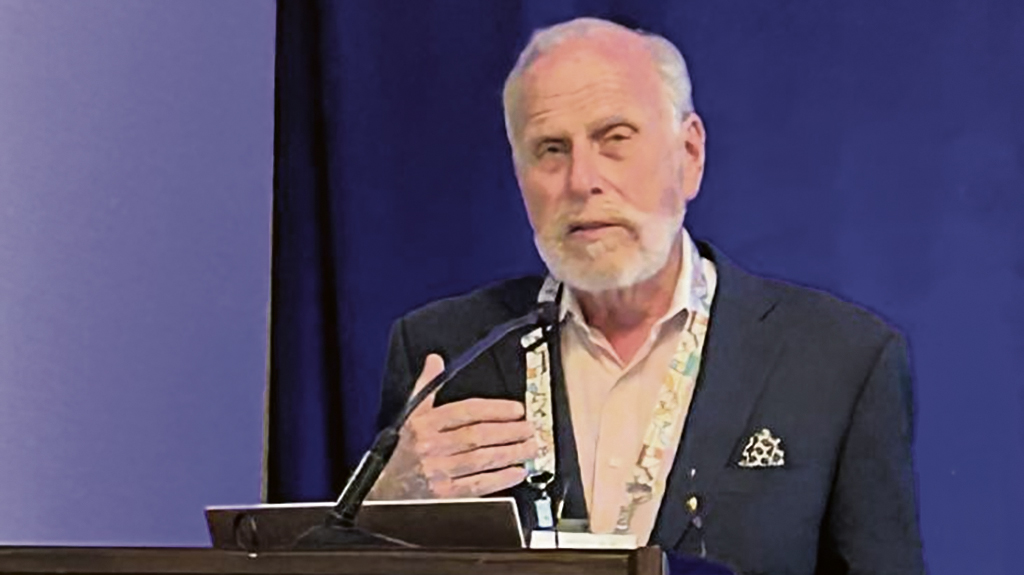
Jeffrey R. Solomon is an eminence grise in the Jewish community, in a good way. In the best way.
He has been just about everywhere and knows just about everyone. He’s the former president of the Andrea and Charles Bronfman Philanthropies and one of the founders of Birthright Israel; his resume is so long that to offer it here would be to leave no room for much else. He is an expert on philanthropy, on the Jewish world, and on the intersections between the Jewish world and the outside world.
He’ll speak at a the JCC of Central New Jersey on Monday, October 5; the talk’s ambitious name is “Critical Issues in Jewish Life: Leadership, Philanthropy, and Defining a New Zionism.” (See below.) I am honored to be in conversation with him that evening.
Dr. Solomon, whose Ph.D. is in community psychology, grew into social activism naturally. He’s from Washington Heights, aka Frankfort on the Hudson; like most of the Jews of his generation he’s the child of Holocaust survivors. His path to the Jewish organizational world ran through the civil rights movement, Columbia, and New York City politics; he’ll talk about that long, strange road on Monday evening.
He also will talk about how he sees the Jewish community now, at this odd, uneasy time, and where he thinks it’s going. And not to dangle any spoilers, it’s fair to say that he is not without hope.
“I was blessed to work in the golden era of American Jewish life,” Dr. Solomon said on a recent phone call. “Much of that golden era had to do with Israel’s position in the world and the way it was perceived. And now, you know, we’re at a very different moment in time.”
It’s not as if there had not been antisemitism in American life before, or even since the end of World War II, when it went underground, at least among respectable people.
Dr. Solomon quoted Abe Foxman, the Holocaust child survivor who went on to lead the Anti-Defamation League and who had a finely tuned understanding of antisemitism, as well as a deep compassion for everyone except antisemites. Mr. Foxman, who lived in Bergen County, died earlier this year.
Talking about antisemitism, “Abe used to say that Europe had lots of laws and no consequences,” Dr. Solomon said. “The United States had no laws — and it had consequences.” Mr. Foxman also used to say that America always had antisemitic sludge curdling below ground; in the last decade, and most specifically since the murderous Unite the Right rally in Charlottesville in 2017, the sewage covers have been lifted and the filth has oozed to the surface.
“I think that we are at an inflection point in American Jewish life,” “Dr. Solomon said. “I think that this is somewhat like the 1890s, with the beginnings of the organized Jewish community, or the 1920s, with the end of immigration and the beginning of what was then called scientific philanthropy.”
The 1890s saw “the beginning of the tension between the German Jewish communities in the United States that wound up in large Eastern cities in the 1840s and 1850s and the Eastern European Jews, who started coming here in the 1880s, and were very poor.
“There were something like 1,100 Jewish organizations on the Lower East Side” — shuls and schools and aid associations and burial associations and labor organizations and landsmanshaftn — and that was neither efficient nor effective. Nor was it neat. “So the established communities, the German Jews and the earlier Sephardic communities, started charities, meeting needs and cleaning up.
“The underlying principle really goes back to de Tocqueville, who wrote in the 1830s that Americans are very unusual because they volunteer to help one another. There was such synchronicity between American and Jewish values — I think that’s why the Jewish community has thrived on American soil.”
In the 1920s, when the second great wave of Jewish immigration ended, largely because of restrictive laws that Congress passed, the philanthropic world organized more effectively, based on new understanding of how such organizations could flourish. “It was the organizing of federations with allocations committees and studying needs, and ideally having the money following the needs,” Dr. Solomon said. It was far more efficient and far more effective.
Those arrangements were in synch with what was happening in the outside world, with such organizations as the United Way, but “proportionately, the federations represented a larger share of the budgets of the agencies,” he said. “In 1940, the federation grant to Mount Sinai was 50 percent of its budget.
“Today, of course, there is no grant to Mount Sinai.” The world has rearranged itself again.”
Now, Dr. Solomon said, “private philanthropy today has exceeded federations and other organized philanthropy. We’re looking at foundations that weren’t here 40 years ago. Or 30 years ago. Or in many cases 20 years ago.”
That’s neither clearly good nor bad.
Sometimes individual philanthropists come up with ideas that are, objectively speaking, stupid, Dr. Solomon said. When someone who can fund a program begins it, “who’s there to confirm that this is a good use of philanthropic funds?
“We want to keep the energy of innovation and the entrepreneurial spirit very much alive in Jewish life. But we also don’t want to see money wasted.”
Sometimes those odd or even seemingly outrageous ideas work. Take, for example, Birthright Israel.
“Birthright is 25 years old, and it’s about to take its millionth participant to Israel,” Dr. Solomon said. “If you go back 25 years and read the articles that appeared when it was founded, everybody said that these are two crazy rich Jews” — Charles Bronfman and Michael Steinardt — “who are starting a program that makes no sense.”
“And those two crazy rich Jews were right. It’s proven to be the most effective Jewish educational program in history.”
There’s another program founded by an entrepreneurial philanthropist that’s also been enormously influential, Harold Grinspoon’s PJ Library, Dr. Solomon added.
“If you look beyond the Jewish community, the pattern is that private philanthropy becomes the passing lane of society. It takes the risk and comes up with the creative ideas, and then government takes it over.
“There’s an example in New Jersey. Now we don’t think about the fact that when you drive on a two-lane road, there’s a line on the right side that shows where the shoulder or the ditch next to the road begins.
“That line never existed until an engineer who made some money on patents and started a foundation said, ‘I can save lives by creating that line.’” That was John Van Nostrand Dorr, a Rutgers graduate and Thomas Edison protégé who spent much of the last part of his life advocating for that line, and winning it.
To return to the Jewish community, and the inflection point on which he says we teeter, Dr. Solomon believes that the idea that antisemitism is pushing young Jews out of the Jewish world is wrong. “There’s as much of a surge into the community as out of it,” he said. Young Jews’ feelings about Israel are mixed, and “the data is confusing, but this year there will be 30,000 participants in Birthright.”
The numbers had been down because of covid, he said, and now they are rebuilding, because so much of the demand for the trip is word of mouth, and there hadn’t been any when the trip was shut down. But it’s rebounding now. It’s not clear if the numbers are up because they include people who would have gone over during those covid years but have put it off until now. And, he said, there is one discomfiting fact. “There’s much less social media reporting among Birthright participants than there used to be,” he said. They’re not posting about their trips. They seem not to want to draw attention to their trips to Israel.
“These are temporary issues,” Dr. Solomon said. “And it’s complicated by the current government in Israel. If October 27,” the Israeli election, “goes the way it should, that might change the dynamic.”
There is so much to talk about — intermarriage and what it means, how the children of intermarried families are raised, the divisions within the Jewish community, what the effects of increased antisemitism will be both within the community and outside it — that the discussion on Monday night can go in a number of directions.
Given Dr. Solomon’s breadth of experience and depth of knowledge, all of them are fascinating.
Who: Dr. Jeffrey Solomon
What: Will talk about “Critical Issues in Jewish Life: Leadership, Philanthropy, and Defining a New Zionism”
Where: At the JCC of Central New Jersey in Scotch Plains
When: On Monday, October 5, at 7:30 p.m.
How much: It’s free
To register: Go to jccnj.org and either scroll to October 5 on the calendar or search for “Solomon”