

Back to Parksville, again and again

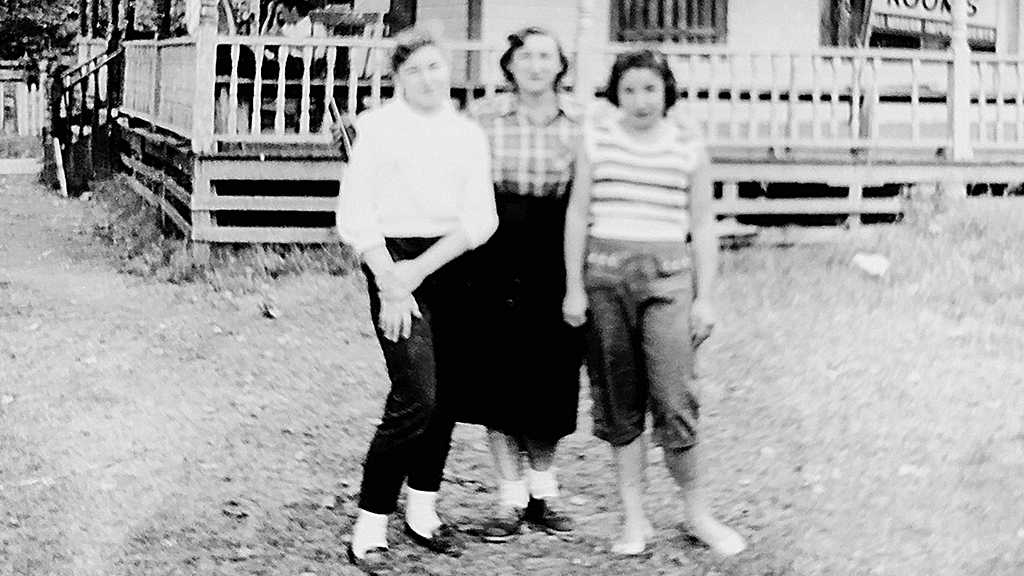
We’ve left Parksville, but honestly, it has never left us. It appears on every front porch equipped with old-fashioned rocking chairs; every boulder-strewn, rambling brook with impossibly clear water chilled to freeze out the summer heat; every shady hideout with birds and insects cheerfully singing whatever it is that birds and insects sing about. And then comes the yearning to be there, to sit on the Adirondack chairs under the giant pine tree that our young grandmother, Peshka, planted 100 years ago, and to have memory assault us with the ghosts of our lives, those many of our people who shall never return, the reminders that we are the pitiful few old and feeble remnants of those glory days when we were young, the last generation of our family that called Parksville home.
We are those who can no longer climb to the piano rock to bask in the sun, or the third hill to roast potatoes, or play softball on the first hill, or slide down muddy, rocky Lookout Below. It is we whose mother, simply called Mom, will no longer be crafting a meal to sate us when we have decided it’s finally time to sit for a few moments and eat what she has spent hours preparing.
It’s July, and that’s the season for Parksville. We know, and we hear the Bauman House calling, even though it has long been buried, returned to the earth, and been replaced by an oversized, underutilized United States Post Office.
Get The Jewish Standard Newsletter by email and never miss our top stories Free Sign Up
My sister Janet, my younger sister, has arrived from Israel, her home for these past 60 years. There she, along with her magnificent husband Zeev, z”l, raised a beautiful, multigeneration sabra family of peace-loving warriors. She is raging about politics, despising Bibi and Trump and their all-too-willing imperious acolytes. She has come here to briefly escape the land she loves, proud to be called a Zionist, and to make visits to the places where she grew up, those places like Parksville that embraced her and gave her American roots. It’s not hard to understand her ambiguous emotions these days, when honest and fair government is increasingly nowhere to be found, replaced by a hostile shell of hatred to sustain the empowered, who are gouging us all with schemes to benefit themselves. The problem remains that there is nowhere to hide, no promised land, no land of the free and home of the brave. Only Parksville, a tiny village, where memory stalks us at every bend in the road, but brings us back to that place that sheltered our lives, even if that nostalgia is romanticized just a bit. Indeed, all of us are confused by those often-beautiful phrases that have not always melded into reality.
A scant few days ago she and we made the drive, no longer as onerous as it was in times past. Before express highways, the Parksville trip would meander through every small town on the way, and take a minimum of four hours from our Weequahic home. Today it is far less scenic but it clocks in, according to Waze, at one hour, 45 minutes. Today there is no overweight mongrel named Phoebe searching fitfully for a comfortable perch in the un-air-conditioned car and never finding it, panting and dribbling all the way. There are no enormous suitcases packed with winter coats among the summer gear, since we always knew Parksville was cold at night, even in July and August, and there was barely room for the sandwiches Mom packed since Dad always said the places on the road were not clean and they certainly weren’t kosher.
Clearly, we recognized that getting there was not half the fun, or any fun at all. There simply was never a choice. If we wanted to be there we had to get there. And if it was the equivalent of steerage class, no legroom and fellow passengers infringing on whatever crumbs of space we might briefly find, so be it. Fortunately we never had to contend with sharing armrests. What a relief!
Thus we touched the sacred ground for a short few hours. Last year’s visit was highlighted by the dedication of a road marker by the Borscht Belt Museum, perpetuating the existence of Parksville as a bonafide historic Catskill resort town. The opportunity to stay overnight, in a town that was once home to about 65 hotels and innumerable boarding houses and bungalow colonies, no longer exists. Only one small bungalow colony remains. The hotels are all ruins, archeological digs, even the famous Young’s Gap, the pride of the town.
The decline began in the 1960s and is now complete. Various idealists and dreamers have tried to reincarnate the old village shops and the glorious resort destinations. None have succeeded. In some cases, the shells of buildings are somewhat intact. In others, empty lots or burnt vestiges of swimming pools or guest bedrooms remain, useless sites for historians or photographers to capture what was, but what will likely never return. The shul still stands, maintained by unknown precious guardians, but abandoned by worshipers. Does it still house sifrei Torah? I don’t know.
The real end of Parksville as we knew it is up the road from where our own Bauman House once stood, in the Parksville Hebrew Cemetery, journey’s end for many of those who spent their lives building businesses in what has since become a moribund ghost town, sparsely populated, with country roads paved with our cherished memories. The cemetery is beautifully preserved, somehow, and we perused the burial sites of so many we had known, the names retrieved from our lifetime memories: the Fiddles, the Kaplans, countless others. We wanted to go home again, but we couldn’t. Home is no longer there. The piano rock, however, remains, covered by nature’s concealing power, no longer visible. It is a huge rock, weighing thousands of pounds, and will remain for eternity, while all that man created will sink into the earth and disappear.
We drown in the memories of our grandparents and parents, our aunts, uncles, cousins, friends and neighbors, and the innumerable guests who returned summer after summer. We remember the love stories. After all, it was there that our parents fell in love, creating our own life stories. It was also there that my husband and I first fell in love, in 1957, creating our own dynasty. Without Parksville, I remind myself often, there would be no me or them or us. Such is the power of a place.
So we returned again to that place where our souls soar and our remembrances are expansive and exquisite and the world is always perfect. Parksville awaited us. Yet again we were truly unprepared for the desolation and abandonment of what was once such a brilliant and vibrant center of our lives. There is nothing for us to do about that.
Rosanne Skopp of West Orange is a wife, mother of four, grandmother of 14, and great-grandmother of 12. She is a graduate of Rutgers University and a dual citizen of the United States and Israel. She is a lifelong blogger, writing blogs before anyone knew what a blog was! She welcomes email at rosanne.skopp@gmail.com