

‘You have to honor it’
Zalmen Mlotek and Steven Skybell will sing ‘Songs of the Holocaust’
Every year, Jewish communities face the question of how to commemorate the Holocaust.
Yom HaShoah, the day of solemn evocation of one of the worst acts of evil in recorded human history, which somehow, unbelievably, despite all the advances humankind has made, happened at what now still is the outer edge of living memory, was created in Israel in 1951. After a great deal of debate about the best date (lots of Jews, lots and lots and lots of debate) it was set for the 27th of Nissan, just about halfway between the end of Pesach and Yom Ha’Atzmaut, Israel’s Independence Day.
Every year, local organizations, either separately or together, mark the day. The challenge is how to acknowledge the horror while leavening it with some glints of hope, because hope is necessary for human survival. Every year, organizations create programs that used to include survivors and now mainly their children and grandchildren, talks, film screenings, and the hours-long reading of the names of a tiny fraction of the people slaughtered in the Shoah.
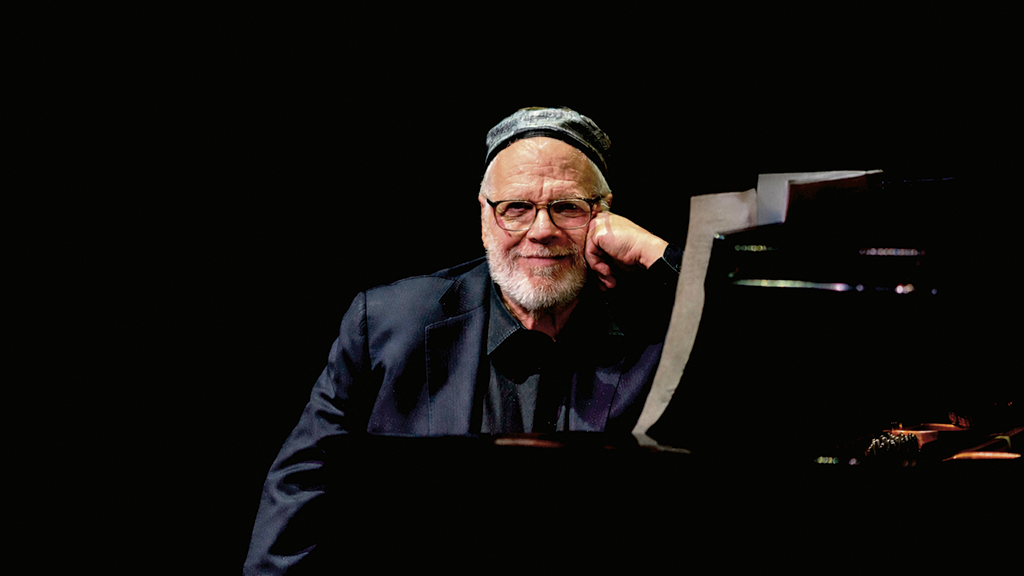
This year, the Jewish Federation of Northern New Jersey will mark Yom HaShoah in Wyckoff with music. (See the box for details.) Zalmen Mlotek of Teaneck, the artistic director of the National Yiddish Theatre Folksbiene in the Museum of Jewish Heritage in lower Manhattan, and Steven Skybell, who played Tevye in the Folksbiene’s production of “Fiddler on the Roof” in Yiddish, will present five Yiddish songs.
The songs were written by Shmerke Kaczerginski, an extraordinary man — poet, musician, partisan — who was born in Vilna in 1908, was part of the underground resistance in the ghetto there, was part of the Paper Brigade that smuggled precious Jewish books and artifacts to safety, fought the Nazis in the ghetto during the uprising, and then escaped at the end, and survived the war.
After the war, “instead of trying to go to find his home or emigrate to America or Israel, he decided to stay in war-torn Europe and go from displaced persons camp to displaced persons camp, or to the hotels and other places where survivors lived, and interview them,” Mr. Mlotek said. “He would ask, ‘What songs do you remember singing?’ And he would transcribe them.
“He transcribed several hundred songs. They were first published in 1946; my mother published the first English translations in the 1970s.” Mr. Mlotek’s mother, Eleanor Chana Mlotek, was a musicologist; she and her husband, Yosel Mlotek, collected and compiled five volumes of Yiddish music. Each song is presented in three ways in those books — in the original Yiddish, in transliteration, and in translation. The amount of work that must have gone into that is monumental.
The Mloteks were and are an immensely musical family. “My son Avram” — that’s Rabbi Avram Mlotek — “jokes that those songs, not nursery rhymes, were the songs of his childhood.”

Mr. Kaczerginski died when he was just 45, in 1954, in Argentina, when the plane he was on crashed. The loss of his gift was a great loss to the world, Mr. Mlotek said. “Every one of those poems he collected is like a jewel, and like a window into his world, from every point of view. There are songs of horror, songs of horrible sadness, songs of revolt, songs of hope.”
The songs that Mr. Mlotek will play and Mr. Skybell will sing come from that collection.
There’s a song called “Under the Polish Green Trees,” Mr. Mlotek said; it was based on a folk song about children playing under those trees, but in this version, the children aren’t playing. There’s a song about a child who smuggles food and ammunition into the ghetto. “It’s a kind of anecdotal history,” he said. “We can never get the full grasp of any of this by reading history.” We can understand the facts and imagine the emotion, but we can’t really feel it directly. “But when you hear a song, when you hear a poem, you get a little bit closer to the emotional reality.”
One of the songs he and Mr. Skybell will perform is “Moments of Hope” by Mordechai Gebertig, the poet and songwriter the Nazis murdered in the Krakow ghetto in 1942. “Gebertig wrote many popular Yiddish songs,” Mr. Mlotek said. This one has a jaunty melody, but the words are something else. They’re furious; they counsel patience for the Jews, because just as justice comes for villains in the end, so too will it come for the Nazis. Or, as he put it, “There was once a Haman — for you too waits the rope.”
Mr. Mlotek grew up with the sounds of Yiddish words and music all around him. Mr. Skybell, like most contemporary Americans, did not. He and his brother, Joseph Skibell (not a typo; the brothers spell their last name differently), a novelist and professor at Emory who has won many prizes — many of them specifically Jewish prizes — for writing, first tried to learn Yiddish together, on the phone, many years ago. That attempt was unsurprisingly unsuccessful. But later, when he was in a production of “Wicked” in Chicago, Mr. Skybell tried to audit a course in Yiddish at Northwestern. The class didn’t happen — not enough students registered — so instead, the teacher, Chana-Feigyl Turtletaub, taught only Mr. Skybell.
“She was a luminary in the Yiddish world,” Mr. Skybell said. “Going to her home and having the opportunity to learn to speak with her in Yiddish certainly was a step above what my brother and I can do, when it was the blind leading the blind.” He talks with great admiration about Ms. Turtletaub, who died in 2021.
He learned more Yiddish, and more about Yiddish music as Tevye.
Soon after “Fiddler” closed — it was about to go on the road — covid hit. “During covid, we met on Zoom every week, and he learned several hundred Yiddish songs that he now has in his repertoire,” Mr. Mlotek said of Mr. Skybell. “After we met on Zoom, we met in person,” Mr. Skybell added. They kept learning.
“I have been particularly struck with the wealth of Yiddish songs,” Mr. Skybell continued. “There seems to be no topic that the songs do not address. So of course, for an event like this one” — the Yom HaShoah commemoration — “the songs are very meaningful, very deep, and very painful.” Like Mr. Mlotek, he mentioned “Under the Polish Green Trees.” “It’s about the loss of children during the war, and it is very poignant. It is heartbreaking.”
He mentioned another song, “I Miss My Home.” “It’s so catchy, and sounds so upbeat, that it sounds like it could be from the heyday of Broadway musicals,” he said. But that’s just if you don’t know the words. “The message in it is almost coded,” Mr. Skybell said. “You could think that it’s just about someone saying ‘I went away to the big city, and now I miss home,’ but some clues in it make you realize that it is about someone who can’t go back home.”
He’s struck by “the juxtaposition of this very catchy, very beautiful melody with the message that is not that.”
He talked about another Gebertig song, “It’s Burning,” which “is very challenging to sing, because it is an eyewitness account of the horrors of the war.”
The last verse goes like this:
“Don’t just stand there looking on
“Hands folded, palms upturned,
“Don’t just stand, put out the fire —
“Our shtetl burns!
It was written in 1938, which makes it prescient, if not actively prophetic.
“It just goes right to the heart of the issue,” Mr. Skybell said. “If you want to sing it, you have to bring yourself completely to the material. I want to honor that. To do less would feel like it’s minimizing it. You have to go right to its heart. You can’t bypass it. You have to honor it.”
Who: Zalmen Mlotek and Steven Skybell
What: Will present “Songs of the Holocaust”
When: On Sunday, April 12, at 3 p.m.
Where: In Wyckoff; the address will be given out after registration
Why: To mark Yom HaShoah
Sponsored by: The Jewish Federation of Northern New Jersey
For information: Call Laura Freeman at (201) 820-3923 or email her at LauraF@jfnnj.org
To register: Go to jfnnj.org/yomhashoah