

Welcome to Jespy House
As it expands, the executive director explains why it matters
Let’s start with some basic assumptions.
As Americans, we all should be blessed with life, liberty, and the pursuit of happiness.
Life is hard, nothing is guaranteed, the lifelong pursuit of happiness could see a person end up with an empty butterfly net as joy flits away in the distance — but at least in theory we all should at least have a fair shot at it.
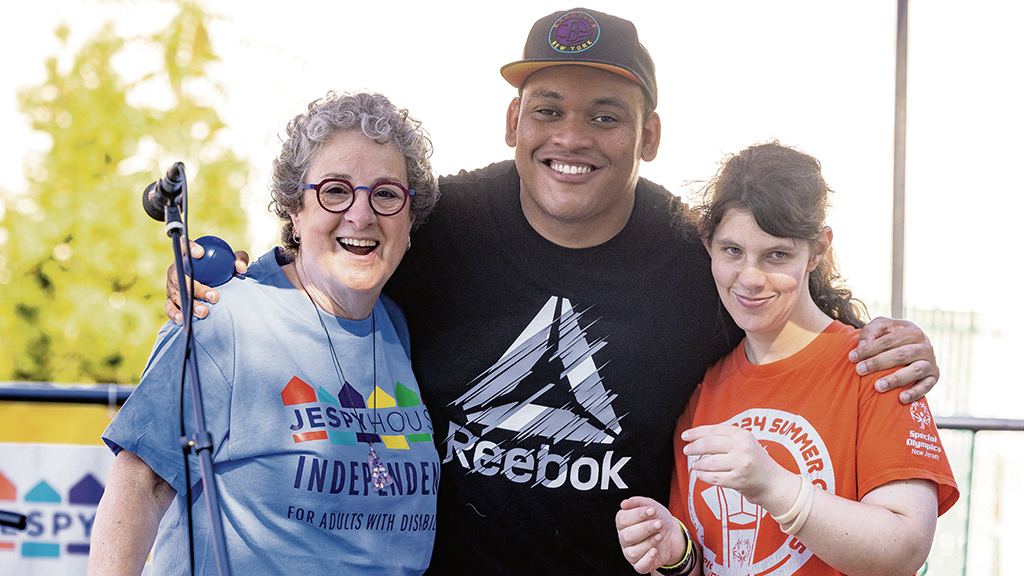
This is always easier for some people than others. Jespy House, the South Orange-based organization whose tagline is “Independence for Adults with Disabilities,” provides a wide range of day and residential programs and services to about 260 clients with intellectual and developmental disabilities — but the need for more programs, and particularly for more housing, continues to grow.

Jespy already has seven houses where its clients lead lives that are both independent and supported, in a ratio calibrated individually for each one of them. They include Och House, called a center for aging, like the others an actual lower-case-h house, with private bedrooms and bathrooms and a communal kitchen, living room, and dining room, where residents can age in place.
Now, Jespy is expanding. South Orange has approved the Jespy Center, which will replace the already demolished building that used to house the organization, along with three others that flanked it. The new center will be partly residential and also will house the range of vocational, social, educational, athletic, job-training, and just plain fun programs for which Jespy is known. Architecturally, it will blend in with the rest of the town.
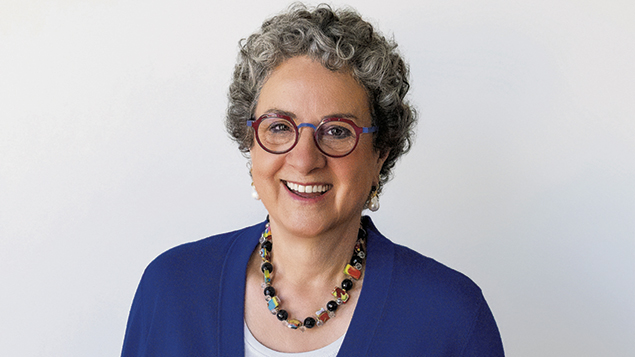
Audrey Winkler, Jespy’s executive director, explained why the expansion is necessary.
“Our clients are from 18 to 70-plus years old, and everyone has a variety of needs,” she said. “Our responsibility and obligation is to provide for them. Five years ago, we began an extensive discussion and started a road map, and that road map took us to Go Big For Jespy,” the fundraising campaign that’s aiming to raise $26.5 million to support the massive project. And it’s doing well — philanthropists Toby and Leon Cooperman have pledged to match $13.5 million in donations to the campaign.
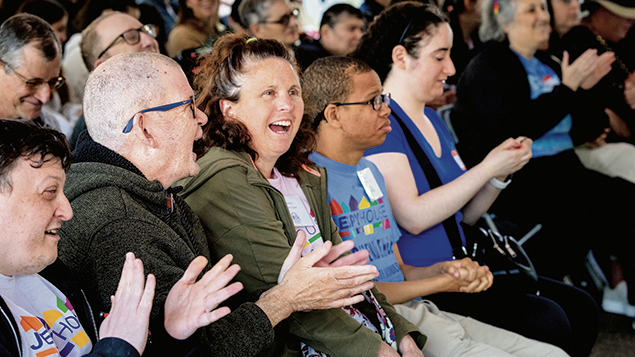
Jespy House’s clients come not only from Essex, Bergen, Hudson, and 11 other New Jersey counties, but from across the country as well, drawn by word of mouth. It is a Jewish agency, founded and funded by a Jewish family who were looking for programs for their young-adult children 47 years ago. It’s a partner agency of the Jewish Federation of Greater MetroWest.
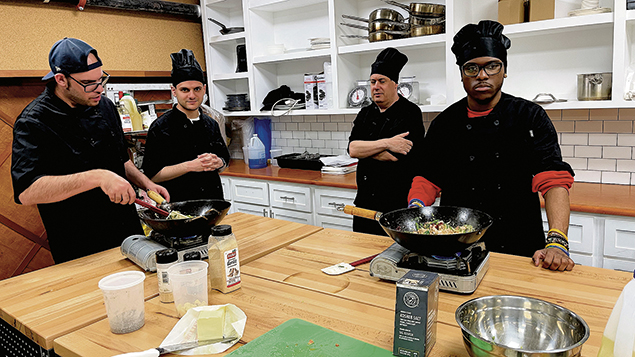
Jespy’s offerings include day habilitation, athletics and fitness, clinical and behavior health support services, engagement and enrichment programs, and work readiness and employment engagement. And note that those are just the top-line headings; each of those areas includes many programs and services.
Many of Jespy’s clients are Jewish, and many are not; the agency serves anyone it can help. Its clients spend money in South Orange, helping the town to flourish.
Ms. Winkler, who lives in South Orange, talked about how she came to work at Jespy, about her goals for the organization, her big dreams for it, and about the sensitivity that drew her to it.
She’s the daughter of Holocaust survivors.

Her mother, Blanka Berger Winkler, was from Czechoslovakia. “She and her family were in many, many different camps,” Ms. Winkler said. “My grandfather and my uncle were murdered there, but she, her two sisters, and her mother were able to come to this country” — America — “after liberation. They were liberated from Auschwitz. Before that, they’d been in Terezin. My mom was an artist and musician, and Terezin was the camp where they put artists and musicians.”
Before they got to the United States, the Berger family went to Paris, among other places. Once in New York, they moved to Washington Heights. So did Ms. Winkler’s father, Joseph Winkler; Blanka and Joseph met in Washington Heights.
“My dad also was in a variety of camps,” Ms. Winkler said. “He ended up escaping. He was on a crew that painted lines in the road. They had to open a fence to keep painting. They did. They kept painting. And then they ran off into the forest.” That saved them.
The Winkler family was from Hungary, where the Holocaust came very late and with great savagery. “My father got out with his sister and her husband,” Ms. Winkler said. “Everyone else was murdered.”
Blanka Berger and Joseph Winkler married and moved to Passaic, where their daughters, Audrey and Gigi, who is four years younger, grew up. They went to the Hillel Academy there. The family was Orthodox.

Her father had been a mechanical engineer — he was trained in Hungary — and he was able to find work in his field. Her mother was an artist, and she continued to make art.
Audrey went from yeshiva to the local high school and then to Cook College, Rutgers’ environmental school. “Then I went to Columbia for urban planning in the architecture school, and after that I found my way into the nonprofit world,
“I think that many of us children of survivors go into the helping fields. I’ve had a lot of nonprofit positions in many areas, not all of them Jewish.
“I’m really drawn to organizational management, team building, and strengthening nonprofits from the inside out, because if an organization isn’t strong and sustainable, then it can’t serve the people its mission is to serve well.

“That is my foundation,” she said. It influences her as she leads Jespy. Nonprofit leadership and management has been part of her life for so long that it has become her oxygen.
“I have taught graduate courses in nonprofit management and managerial decision-making,” she said. “For many years, I was an adjunct in Seton Hall’s departments of public administration and political science, and I also was the director of its nonprofit sector resource institute and its center for community research and engagement.
“It was very rewarding to teach people about nonprofit management and decision-making,” she said. Her career involved mediation training and dispute resolution; as she learned what does and does not work, her skill at team building grew.
She also got to work at some exciting places. After sitting on the board of the not-yet-opened Liberty Science Center, she became its director of operations, “building and training the teams that would actually open the building.” She stayed there for five years, and loved it. “It was wonderful,” she said. “Before then, we didn’t have a big science center in the area. Everyone — from children to adults — was about to learn about science there in different ways, using different media. And it was super successful.”
From there, she went to the New Jersey Performing Arts Center in Newark — better known as NJPAC — and that, too, “was really wonderful,” she said.
Next, she took what was by then 30 years of experience to form a consulting company, working with clients who ran nonprofits.
All of this prepared her for Jespy.
Elaine Katz, “one of the VPs at Kessler” — that’s the Kessler Foundation, whose mission is to fund research to help people with disabilities — “and an amazing human, who I had worked for in the nonprofit world,” recruited Ms. Winkler for Jespy’s board. “She said that they could use my talents, so would I consider it, and I said yes,” she reported.
She loved sitting on the board — “it was a wonderful experience — and then the board and Elaine asked if I could step in temporarily” to head it. The agency’s longtime executive director, Lynn Kucher, had retired, and it needed a stopgap. “I jumped in and I absolutely loved it, so when they said ‘Would you stay?’ I said yes.”

That was almost 10 very rewarding years ago. “I stopped teaching, I finished up as a consultant, and I have just loved every minute of it. It has been 9 1/2 years of joy.”
That’s lovely, Ms. Winkler, but why?
“I built a great team, we have a great team, and this is an incredible mission,” she said. “I absolutely adore working with the clients and their families. It just has been a joy. It’s incredibly challenging, and there have been a lot of steep hills to climb, but we have done it successfully.
“We have developed a very sustainable business model for a nonprofit. It is not an easy task. And our client base is growing, we are very much in demand, we have waiting lists” — that’s what the new building will alleviate — “and it’s just been wonderful.”
Ms. Winkler described the group of people she’s assembled. “It’s really great,” she said. “There are a lot of initiative takers. For me, as a manager and the leader of the organization, initiative is everything.
“Yes, there’s accountability, and yes, of course you have to do the right job at the right time, but taking initiative and really going above and beyond is what I look for in leaders in the organization.
“We have a senior team, with incredible managers and supervisors. What I’m incredibly proud of is that over the last few years we have built an amazing leadership ladder, and we are hiring primarily from within.
“So people come in at the DSP level” — that means as director support professional — “and move up this leadership ladder, training more, learning more, working more with our clients, working in different departments in the organization.”
That also means that although “it’s bittersweet,” Ms. Winkler said, “when people move on to take opportunities, I am thrilled for them.

“It is a wonderful thing for me, because they learn a lot — our requirements for training far exceed what the state requires — it really works to our advantage.” That’s because sending highly trained and passionate people out into the world, to try to replicate what Jespy does in other places, helps clients like Jespy’s, and that’s the entire point of the whole huge exercise. Helping people.”
Still, she added, there is no place like Jespy, at least that she knows of, anywhere.
That’s because, “as we always say, we’re a 360-degree organization, because we provide services for our clients that touch every part of their lives,” Ms. Winkler said. “That’s the model that we all should be working toward.”
She hopes that work on the new building will begin soon. The construction management firm will work through the winter, she said, so the new Jespy House might be able to open during the next calendar year.
“My plan is to stay here for a very long time,” she said.
 She returned to her parents’ story.
“My parents came out of a horrifying situation,” she said. “My mother always said that we never should judge people on the outside. You always have to look at what’s inside. So I grew up in an environment where I didn’t judge people very much for what they looked like on the outside. She said that you had to have a good heart.
“They had empathy.
“We grew up in a neighborhood of survivors. My parents’ social group was made up of all Holocaust survivors. That was their social environment. You’d go to shul and hear tons of different languages.”
Just as her mother once had made art in Czechoslovakia, she continued to make art here.
“I feel so fortunate that my parents didn’t carry hate,” Ms. Winkler said. “They certainly could have — but they didn’t. I don’t know how they did it, but they were always optimistic.
“The biggest gift they gave me was teaching me not to judge people. I was raised to really get to know someone, to talk to them, to listen to them, not to judge them by what you see on the outside.
“That’s how I hope people see my clients. It’s not about what they see. It’s about who they are. And it’s about who you are. That’s what’s really important.”
To learn more about Jespy House, go to jespyhouse.org. To contribute to Go Big For Jespy, go to jespyhouse.org/GoBig.