

Telling her grandfather’s story
Third-generation survivors take on the responsibility of memory
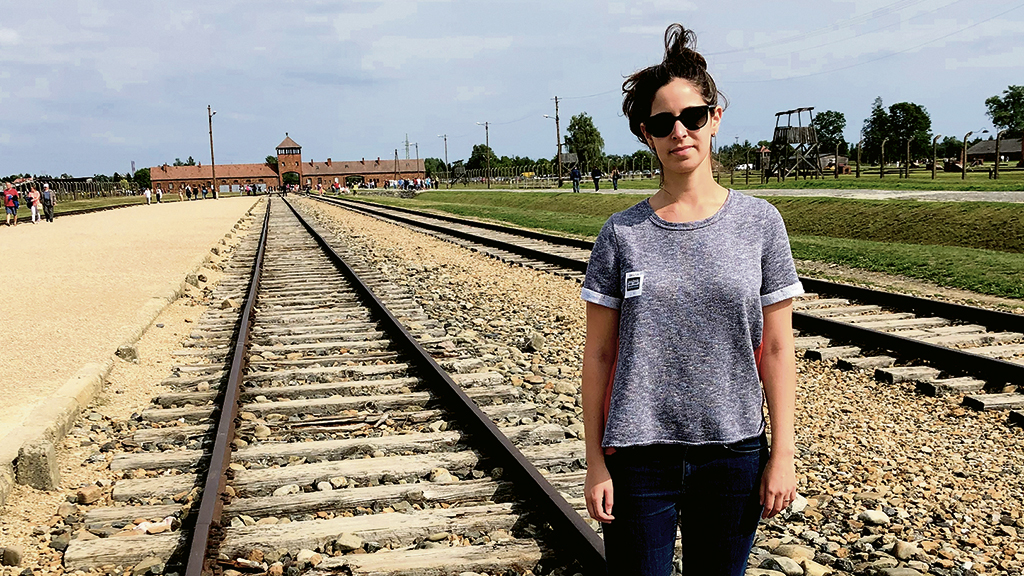
Logan Brenner always knew that her grandfather, Leo Brenner, had survived Nazi concentration camps. But she didn’t think about it very often until well after she married another grandchild of survivors.
Since then, Dr. Brenner has thought about it very often. She’s now an active member of 3G, an organization for survivors’ grandchildren, and she’ll talk about her grandfather’s story on Thursday, July 9, in River Edge, in a program for the JCC of Northern New Jersey. (See below.)
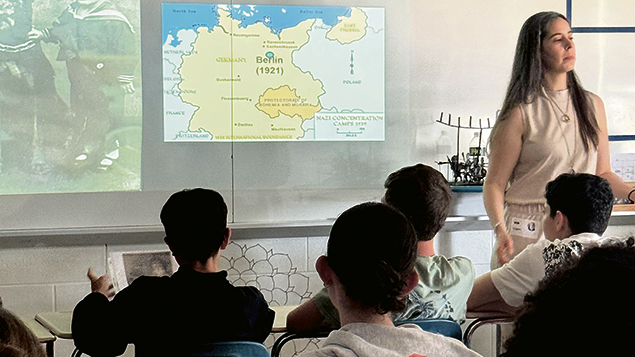
Dr. Brenner has told her grandfather’s story to New Jersey middle school and high school history classes and Jewish community organizations throughout the last year.
Dr. Brenner is an assistant professor of environmental science at Barnard College in Manhattan. She lives in Haworth with her husband, cardiologist Dr. Yonathan Litwok, and their two children, Gili, 5, and Lihav, 2.
The JCC of Northern New Jersey — formerly the YJCC of Bergen County — offers programs for young families and older adults. Dr. Brenner, Dr. Litwok, and their children are active members there. So when Erica Danziger, its program and community outreach director, met Drs. Brenner and Litwok, she realized that they had stories to tell.
“I held onto that information, hoping that at some point in time Logan might consider sharing her grandfather’s story,” Ms. Danziger said.
It took several years for Dr. Brenner to delve into her late grandfather’s history, but in March 2025, in an effort to become an effective speaker about the Holocaust and its survivors, she took part in Living Links, a four-week intensive virtual course offered by 3G New Jersey, a nonprofit organization that creates an outlet for Holocaust remembrance and education throughout the state. 3G empowers grandchildren of Holocaust survivors to learn and compellingly discuss their family’s Holocaust experiences with students and community groups. “In her talks, Dr. Brenner encourages others, who may be 3G survivors, to engage in their own journeys of exploration so as to keep the stories of those who survived the Shoah alive,” Ms. Danziger said.
Dr. Brenner grew up in Philadelphia; her father, Dr. Ira Brenner, is a psychiatrist and psychoanalyst who has specialized in trauma, including the trauma of Holocaust survivors and generational trauma.
While talk about the Holocaust was somewhat in the air when she was growing up, “my parents didn’t push me to come to it until I was ready,” Dr. Brenner said. “I knew that my grandfather, Leo, who died in his early 70s, when I was in second grade, had been imprisoned in three different concentration camps in Poland and Germany from 1939 through 1945, but it did not pique my own interest until later. My father’s ongoing interest in the Holocaust, inspired by my grandfather’s experience in the Shoah, provided me with the tools to do my own research. I couldn’t passively inherit his reservoir of knowledge; I had to look into it on my own.”
Dr. Brenner went to Skidmore College and graduated in 2012. “I met my husband, Yoni, through mutual friends in 2012,” she said. “He was living in Jersey City and attending medical school at UMDNJ, and I was starting my Ph.D. in New York City.” Her doctorate is from Columbia and the Lamont-Doherty Earth Observatory, in earth and environmental studies. “It was a while before we discovered we were both 3G survivors,” she added.
The couple married in Philadelphia in 2016.
“In 2018, Yoni was in the process of chasing down a specific story about his paternal grandfather, Zygmunt Litwok, who had buried a Torah the night before the Nazis came to his town in Poland and captured his family,” Dr. Brenner said. “That was the catalyst for his research. Another one of his grandfathers, Zvika Ariav, who now lives in Israel, was hidden in a monastery on the border of Belgium and France by Père Bruno, who was later honored as Righteous Among the Nations at Yad Vashem.” (Father Bruno was a Belgian priest who saved about 400 Jews during the Shoah.)
“And a third grandparent, Genia Kohn Litwok, who was liberated from Auschwitz-Birkenau, survived, immigrated to the United States, and passed away a few years ago from covid.”
“We’re going to Israel as a family in October to celebrate Yoni’s grandfather’s 90th birthday,” she added.
“While Yoni was researching and putting the pieces together of three of his grandparents’ experiences, I’d not yet immersed myself in exploring my zaydeh’s past,” Dr. Brenner said. “Yoni signed up for training and became involved in 3GNJ’s events and workshops and began giving talks.” She recalls asking herself why she wasn’t interested in doing the same thing as her husband. “I was a professor and I liked to talk and give presentations, but things weren’t bubbling for me yet.”
“Then October 7 happened, and it was like a switch flipped,” she said.
“There was a resurgence of antisemitism and anti-Zionism, and I needed to find my own way of dealing with my feelings and making a difference.”
Dr. Brenner became fully committed to her research in 2025. “There was no going back,” she said. “Holocaust research was occupying my mind, but I was able to focus on my career. I was resourceful and determined. Doing the research suited my skill set. I went through all the Shoah Foundation interviews. I found transcripts. I retrieved documents through various foundations and archives. There were forms in German that needed to be translated to English. I had my grandfather’s work permits and deportation documents. I kept it all in what I called my Holocaust Box.
Since she became involved with 3G, Dr. Brenner and her father often collaborate on their research.
“At the end of his interview in the USC Shoah Foundation project, filmed in the 1990s, my zaydeh was asked if there was anything he’d want his great-grandkids, who he didn’t have yet, to know,” she said. “And he just started to cry. Then I started to cry.
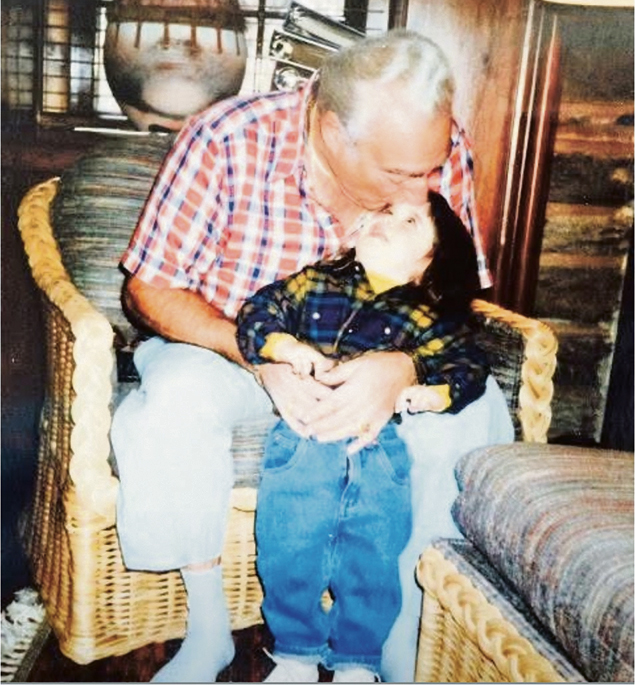
“While it can be overwhelming, third-generation grandchildren have a responsibility to really know their grandparents’ stories and think about the best ways to share that information. I knew it was time to share my zaydeh’s story.”
Leo Brenner was born in Berlin in December 1921. He was taken to Sachsenhausen with his father in September 1939, transferred to Auschwitz III — a forced labor camp at Auschwitz sometimes called Buna or Monowitz — in October 1942. His father was murdered there. He was transferred to a subcamp of Buchenwald called Altenburg in January 1945 and liberated from there in April 1945. Mr. Brenner’s mother, youngest sister, and younger brother went into hiding and survived. His other sister was killed in Auschwitz-Birkenau.
“My zaydeh came to the United States in 1946 and settled with relatives in Delaware who’d immigrated to America before the war,” Dr. Brenner said. “He met and married his wife, my bubbe Marion, in 1948.” Leo and Marion had three children; their granddaughter Logan was born in 1990.
“3GNJ’s mission is to connect the people that they train with school groups and schedule our talks,” Ms. Brenner said. “There’s one speaker per classroom and they send the speaker free of charge. 3GNJ provides a guide for teachers to prepare students who may not have had that much exposure to the Holocaust.”
Dr. Litwok’s alma mater is Marlboro High School. “Yoni and I had the opportunity to speak there,” Dr. Brenner said. “It was pretty incredible.” She also told her story to her colleagues at Barnard. The president, provost, and all the faculty were invited, and the talk was featured on Barnard’s home page.
When students hear her story and realize that both Dr. Brenner and her husband are 3G survivors, they ask her what it was like to fall in love with someone who shares that history and identity. “My answer? Inevitable,” Dr. Brenner said.
“The deeply personal talk for the JCC is designed to be accessible and engaging, offering a rare opportunity to have a deep and sensitive conversation about a topic that can be difficult for some to discuss,” Jennifer Sauer, the JCC’s director of communications and active seniors, said. “As firsthand memories of the Holocaust become scarcer, the role of the 3G generation has never been more critical.”
Neil Garfinkle of Fair Lawn, a retired high school history and Holocaust Studies teacher at the High School for Law and Public Service in Washington Heights, in northern Manhattan, will moderate the panel. Mr. Garfinkle is also a gallery educator at the Museum of Jewish Heritage in lower Manhattan and the president of Congregation B’nai Sholom/Fair Lawn Jewish Center. “I wanted someone who was steeped in Holocaust education and Holocaust studies to be the face of the program,” Ms. Danziger said. “I was thrilled that Neil accepted the invitation to introduce Logan.”
To register, emailinfo@jccnnj.org or call (201) 666-6610, ext. 2. The JCCNNJ calendar of events is at www.jccnnj.org
Who: Logan Brenner
What: Will tell her grandfather’s Holocaust survival story
When: On Thursday, July 9, at 11; lunch will follow at noon
Where: In River Edge; details after registration
To register: go to jccnnj.org/events/ or call (201) 666-6610, ext. 2