

Expanding horizons
Orthodox women academics train for leadership
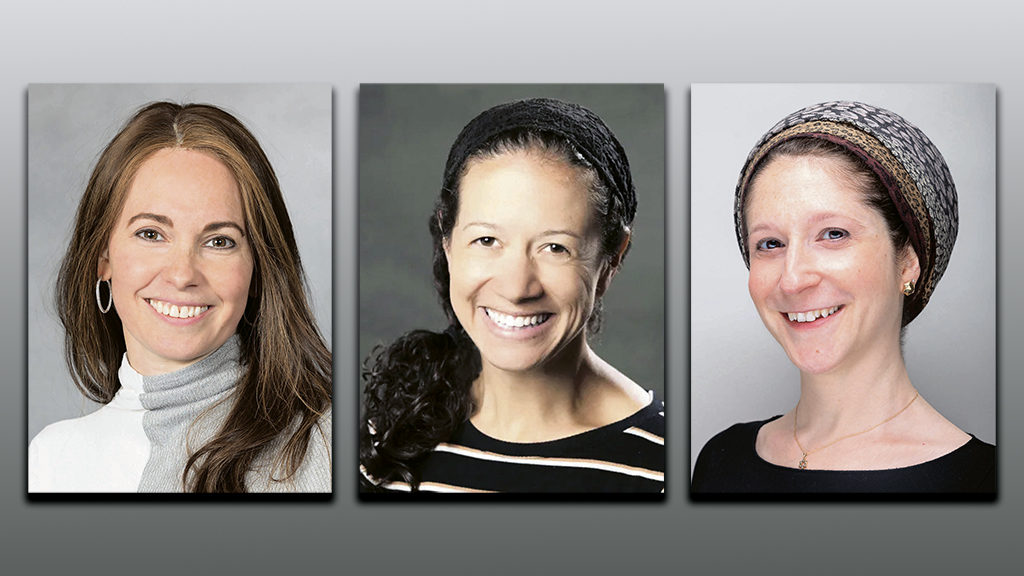
Faye Kohn and Miriam Krupka Berger of Teaneck are among nine fellows from the United States, Israel, and the United Kingdom wrapping up their first semester as Walder Fellows in the Executive Ph.D. in Jewish Studies program at Gratz College in Pennsylvania.
Gratz, the oldest independent college for Jewish studies in North America, is pluralistic. The Walder Fellowship is designed specifically to expand advanced academic opportunities for accomplished Orthodox women engaged in Jewish leadership, education, and communal life.
Ms. Kohn, director of Middle School Special Services at Yavneh Academy in Paramus, said that when she switched from teacher to administrator four years ago, while working at Rosenbaum Yeshiva of North Jersey, she took part in the YOU Lead Leadership Program of the Prizmah Jewish day school network to acquire the new skills she required.
“YOU Lead was extraordinary; it was incredible to be connected to leaders in other day schools, and we all learned from each other,” she said. She then completed Prizmah’s Orthodox Women in Leadership program. OWL is subsidized by the Walder Foundation.
“I had been a little hesitant to join a program specifically for Orthodox women; I had just finished the YOU Lead pluralistic program and didn’t feel I had to be only with other Orthodox women,” she said.
But she quickly realized that being surrounded by women who shared comparable lifestyles, experiences, and work-life issues was exceptionally beneficial.
“I credit my future in leadership to what I learned in OWL,” she said. “I’d entered leadership thinking this would have to be temporary, that there was no way I could balance this responsibility with everything else in my life. Connecting with other Orthodox women who had advanced leadership roles, and were managing them with grace and joy, I saw it was actually possible to balance the unique pressures for women in leadership in an Orthodox community. And when it’s hard, I now have people I can turn to who have similar challenges.”
She already holds a bachelor’s degree in educational psychology and a master’s degree in special education. The doctorate she is pursuing at Gratz focuses on Jewish identity formation.
“Many students in modern Orthodox communities develop a fragmented identity,” Ms. Kohn said. “It’s like their development as Jews is separate from their development as Americans or as citizens of the world.”
This disconnect, she continued, “was never the intended design of modern Orthodoxy” and could negatively impact children’s understanding of “how to square their shoulders and walk into the world proud of being Jewish” amid rising antisemitism.
She and fellow Jewish educators zeroed in on this problem several years ago while participating in the Legacy Heritage Teacher Institute of Technology at MIT. They found no existing identity studies specific to either modern or centrist Orthodox communities.
“It’s a unique space to examine identity formation, because modern Orthodoxy intentionally raises children in a way that draws on the wealth of the world’s knowledge as well as Jewish texts and observance,” Ms. Kohn said.
“I’m curious to see how that is conveyed in pedagogy and in community messaging from rabbis and community leaders, and where we see it translating or not translating. I wonder if, as a community, we’re doing all we can to prepare our children with an understanding of the beautiful heritage they have, or to help them understand the differences when there’s a conflict between Western values and Jewish values.”
As a mother of four children — the oldest of whom recently made aliyah — and as an administrator working with middle school students at the age when identity is being formed, Ms. Kohn said she believes today’s Jewish children must be “bolstered with pride and confidence” to face a more hostile world than the one in which her own generation was raised.
The other local Walder fellow, Miriam Krupka Berger, also has four children and also shifted from teaching to administration over the course of a 20-year career at Ramaz Upper School in Manhattan. She has been assistant principal of the Upper School for about five years and chairs its Tanach (Bible) department.
Ms. Berger explained that she was initially drawn to the field of education out of a passion for scholarship. She has master’s degrees from Yeshiva University’s Bernard Revel Graduate School of Jewish Studies and from Columbia University. She lectures widely at synagogues and community venues on Tanach, philosophy, and education. Despite her fulfilling pursuits, however, she found that she missed academia.
“The longer you’re in teaching, and especially when you’re an administrator, scholarship becomes less of a percentage of what you do every day,” she said. “I always thought I would love to get back to that at some point.”
The Walder Fellowship is providing her with that opportunity, in a flexible online format that fits her demanding professional and personal schedule. “It’s a big challenge, but the program was created to help people like me manage,” she said. “It asks a lot, but it’s structured in a way that makes it doable.
“I love that this fellowship opens the world of academia to women who are at a later stage in their careers. So many of them have something valuable to contribute, and this will enable them to have a really strong voice in the academic world of Jewish studies.”
Within about five years, she hopes to complete her doctorate. “I’m still playing around with what I want to do. It will be something about the way we read Tanach and how different translations and commentators ‘land’ when they are first published and how they affect how we read and understand the narrative portions.”
This is the second Walder Fellowship cohort. Ms. Berger said she contacted women she knew in the first cohort, which began last year, and they encouraged her to apply.
“This fellowship is empowering a new generation of women to achieve their professional goals and realize long-held dreams,” Dr. Leslie Ginsparg Klein, the fellowship’s director, said. “It is simultaneously laying the foundation for an emerging field of Orthodox Jewish women’s studies, positioning it for sustained scholarly and communal impact.”
The first cohort includes Teaneck native Sara Tillinger Wolkenfeld, chief learning officer at Sefaria, a nonprofit dedicated to bringing Torah into the digital age, and scholar-in-residence at Ohev Sholom Congregation in Washington, D.C.
“My specific interest is in Jewish ethics of technology,” Ms. Wolkenfeld said.
“For the last few years, I’ve been doing what I could to research and write, but I had no institutional support, no network of colleagues, and no structured path to learn more. The Walder Fellowship is providing me with all these things.”
She anticipates that her studies at Gratz will not only equip her to write a dissertation but also position her at the forefront of conversations about pressing questions of how Jewish texts can guide decision-making regarding the use of such emerging technologies as artificial intelligence.
“I look forward to completing the program and using what I’ve learned to enhance my leadership,” Ms. Wolkenfeld said.
Dr. Brendan Goldman, program director of the Executive Ph.D. in Jewish Studies track at Gratz, said feedback from the first Walder cohort indicates a profound impact even at this early stage.
“Participants consistently report that the coursework has benefited their current teaching and communal work, not only strengthening their scholarly skills but reshaping how they think about leadership, texts, and Jewish life more broadly,” he said. “The success of that first cohort has directly shaped how we continue to evolve the program.”
“The launch of this second Walder cohort confirms what we believed from the outset: When Orthodox women are given access to rigorous doctoral study, their scholarship deepens Jewish thought and strengthens Jewish life,” Elizabeth Walder said; Ms. Walder is the foundation’s president and CEO. “These fellows are not stepping away from their communities to pursue academic work — they are bringing new insight and intellectual leadership directly back into them.
“That integration of learning and lived responsibility is exactly what this fellowship was designed to advance.”