

The rabbi is a storyteller
Daniel Pernick looks back at 40 years in Pearl River — and forward to many more
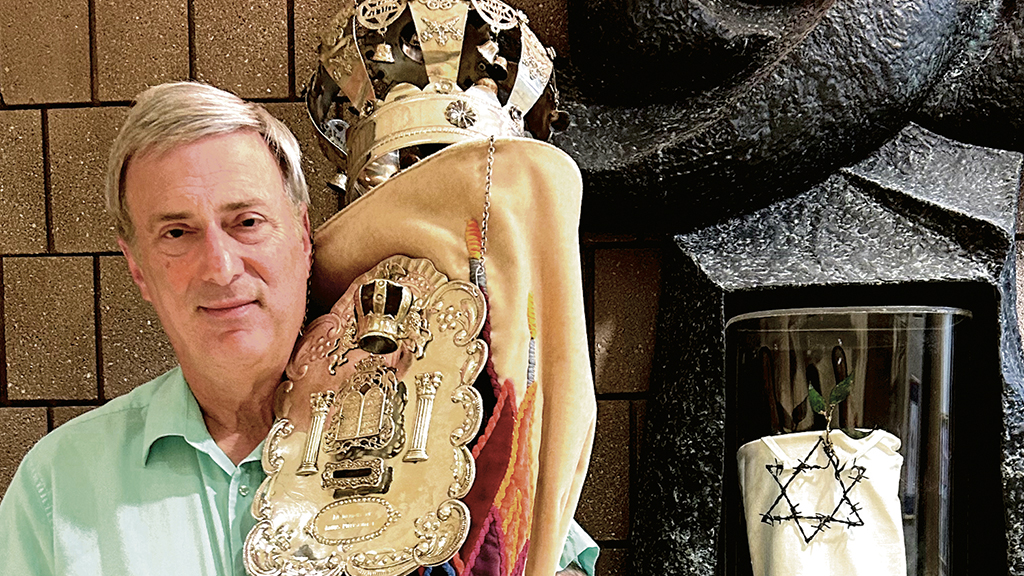
The word “rabbi” can mean many things to many people, and it’s changed over time.
For a very long time, being a rabbi has meant being a leader — however that’s manifested, officially or not, formally or not — and that’s included creating and maintaining a sense of community.
A rabbi also is a teacher; sometimes formally, more often informally, and with respect flowing in both directions, to and from the rabbi and the community.
One way to fulfill both functions is to be a storyteller. And although obviously a huge part of being a storyteller is, to be obvious, telling stories, another part of it, the less obvious part, is listening to people, forming not only formal but also genuine emotional bonds with them, and then being able to use the knowledge about human nature gleaned from those relationships — but never betraying them for the sake of a story — to share the wisdom in them with the larger community.
That’s a big job. And it’s a job that Rabbi Daniel Pernick, teacher, storyteller — and listener — extraordinaire has been doing at Beth Am Temple in Pearl River, N.Y., for 40 years now. To be clear, it’s a job he will continue to do, but 40 years is a milestone to celebrate.
As befits a storyteller, Rabbi Pernick relishes telling his story.
He’s from Detroit. Of course, there were two Reform synagogues in his neighborhood — the one he did go to and the one he didn’t. The one he didn’t go to was Temple Beth El — “the rabbi there was the one Hank Greenberg consulted with about whether to play on the High Holidays.” (The backstory — Greenberg was the Detroit Tigers’ first baseman, and its first Jewish player. In 1934, the team was battling for the American League pennant. Greenberg decided not to play on Rosh Hashanah; after talking to a rabbi, he went to shul instead of to Navin Field, which later became Tiger Stadium. Note, too, that the story has many variants.)
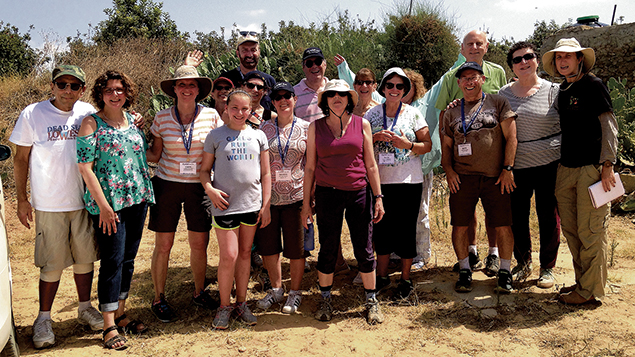
See what happens when you talk to Rabbi Pernick? You digress, and you learn.
The shul Rabbi Pernick did go to was Temple Israel. (“The Zionist one,” he said. “The other one was not.”)
Temple Israel soon moved to West Bloomfield — much as happened in Newark, the Jews of Detroit moved out to the suburbs after World War II, a slow transition that speeded up after the riots of the late 1960s.
The Pernicks also moved; they left the city for the suburbs. His father was an insurance agent and a local politician “who held elective office for 29 years and never lost an election,” Rabbi Pernick said. He was a role model for his son.
“Since it started, in the 1940s, Temple Israel has had six rabbis, and no one has ever left,” Rabbi Pernick added. Of course, eventually they retired or died, but none left for another job, either voluntarily or less willingly, he explained. The synagogue now has “six rabbis and 3,400 families.”
It was from this synagogue, these rabbis, this community, that young Dan Pernick got the idea that he should become a rabbi too. “I became bar mitzvah in 1968, when I was in seventh grade,” he said. “I don’t remember a thing about seventh grade except that I didn’t love it — except for Hebrew school. Hebrew school was separate from religious school; we learned conversational Hebrew. I was really good at languages, but not so good at Judaica. But my parents said to give it a try, so I did.
“In eighth grade, the temple still was in Detroit, and we met in the temple board room. It was a huge room. It wasn’t gaudy, but it was gorgeous. It was very impressive to a 13-year-old.
“And a few months later, Rabbi Syme” — that was M. Robert Syme, a rabbi who was very important in Rabbi Pernick’s development — “started a class in his home for boys who might want to be rabbis. I was one of them. We met in his home one evening a week. It was informal. We talked about things. We took a road trip to HUC in Cincinnati” — the Reform movement’s flagship school was the now-closed Hebrew Union College there — “and we visited Rabbi Syme’s son, rabbi-to-be Danny Syme, who went to school there.
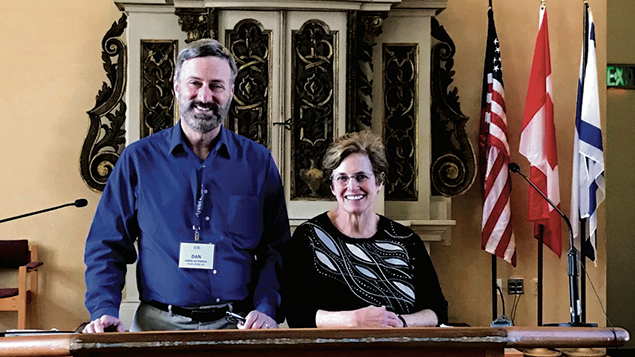
“I was the only one from that class who did become a rabbi. I remember standing in the parking lot with Harold Loss, who was the young rabbi there at the time” — he’s now 80, and still at Temple Israel. Moments like those, memories like those, all went into his decision to follow his mentors’ lead to rabbinical school.
So he spent six months as an exchange student in Haifa during his senior year of high school, commuted to college from home, majored in sociology, and graduated in three years. He went to HUC in Cincinnati, was ordained, spent the next few years as an associate rabbi in Worcester, Massachusetts, and then had to decide what to do next.
He’d gotten married — his wife, Ruthie, is from Newton, Massachusetts, and recently had graduated from Brandeis. The couple lived in Worcester; they didn’t want to go too far from family. But there was nothing in New England that was even remotely appealing; even the Reform movement’s placement director said so, Rabbi Pernick said.
So he applied for a job in Binghamton, N.Y., which is not impossibly far from Boston, “I heard that there was this place called Pearl River,” he said. “‘Where the hell was Pearl River?’ he remembered thinking. “What the heck can you do there?’
“Remember, this is 1984.” There was no GPS. Not even an internet. “I had to look it up in an atlas,” Rabbi Pernick said. “It looked like it was right on top of Manhattan, and neither of us wanted to live there. And then we found out that it’s 20 miles northwest of Manhattan. And we toured there and we found out that its nickname was Mayberry.” That was the name of the fictional small North Carolina town where Sheriff Andy Griffith, his young son, and a cast of gently eccentric characters lived.
“It suited us,” Rabbi Pernick said. “It’s a small town. It’s not fancy-schmancy.”
It’s also close to Bergen County; many of the shul’s members come from the Jersey side of the state line.
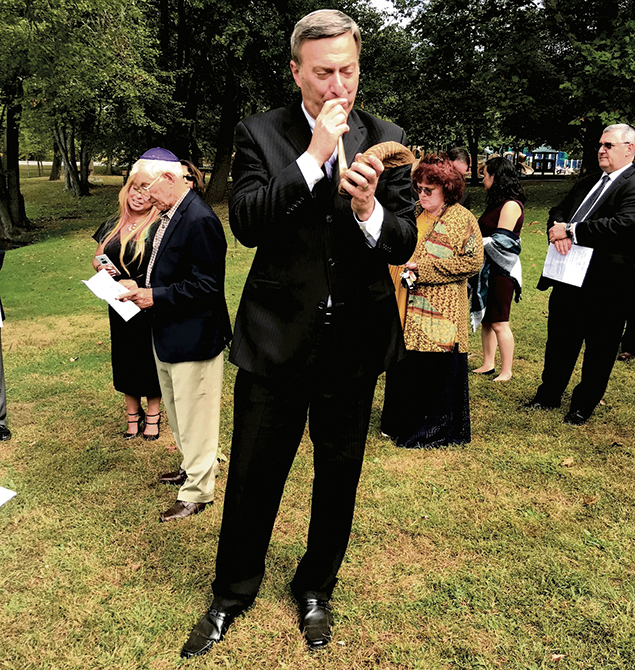
It’s where Daniel and Ruthie Pernick brought up their four children in Pearl River.
Ms. Pernick is a musician and singer; she’d sung with Zamir in Boston, and when she moved to Pearl River, she joined the Rockland Choral Society. It was her only option then. But soon she used her connections, including her good friend Rabbi Danny Friedlander, to become a co-founder of the Shirah, the choir at the Kaplen JCC on the Palisades in Tenafly.
Sarah, the oldest of the Pernicks’ children, is modern Orthodox. “She runs a classical music management agency called Dinin Arts; her husband, Joel Dinin, is a musmach from Chovevei.” That is, he’s a rabbi who was ordained at the open Orthodox Yeshivat Chovevei Torah and now works at Hillel at MIT.
The next child, Ben, is a music therapist and part-time comedian who met his Israeli wife, Hilla, over Zoom during the pandemic. They live in Holon, in Israel, now, with their son, the adorable 3-year-old Nadav. He’s not very observant, “but by his new family’s standards he’s the religious one,” Rabbi Pernick said.
Their third child, Josh, also is modern Orthodox; like his brother-in-law, he was ordained at Chovevei Torah. “He was in New Orleans, then in New Haven, and now he’s the director of Jewish life at the Washington Heights YM-YWHA.” He’s a devout Red Sox fan; his wife, Hannah, from Queens, is a Yankees fan, but they somehow work it out. And what about music? No worries. “He’s a very good musician,” Rabbi Pernick said. “He plays the trumpet.”
The fourth child, David, “just got his masters of social work from Stony Brook and is about to start working at a residential program in Williamsburg. He is an incredible musician. In Nanuet High School, he was Tevya in ‘Fiddler.’ He assisted our High Holidays cantors, and they let him do Avinu Malkenu.”
Back to Rabbi Pernick, who explains, with much feeling, why he has stayed at Beth Am Temple for so many years.
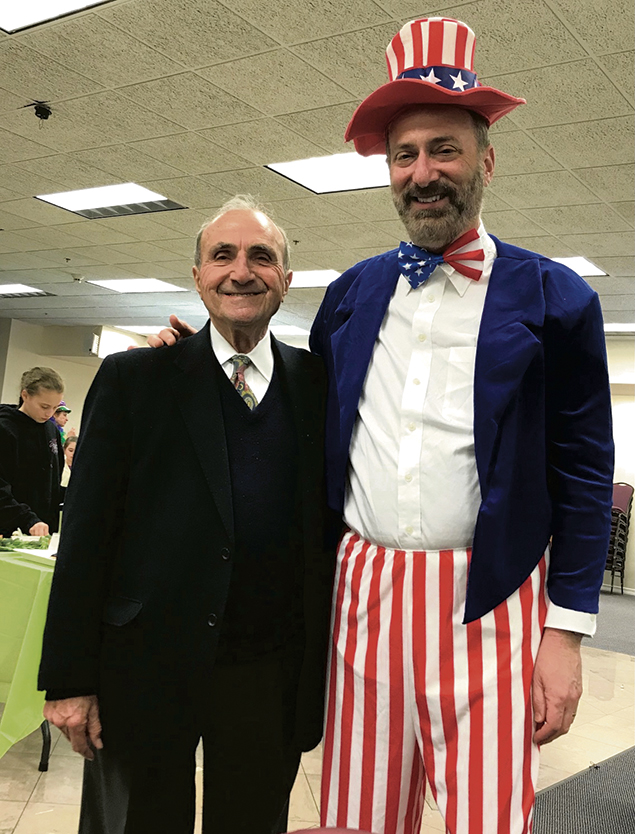
For one thing, it’s small, and he and his wife both love that basic truth.
There are two stories about being the rabbi of a small shul that influenced him greatly, Rabbi Pernick said. “Rabbi Syme told me that the happiest days of his rabbinate were when he was at a small Reform temple in Butler, Pennsylvania. He said that when you’re at a small place, you have personal contact with everyone and you are in the middle of everything. You don’t have a big staff, so almost everything goes through you, or touches you in some way.”
That was a personal conversation. And then there was the talk that he heard at a Central Conference of American Rabbis — the Reform movement’s rabbinical association — delivered by its then president, Rabbi Jerome Molino.
“He was the rabbi in Danbury, Connecticut, for I think 66 years, and it was the second year that I was a rabbi,” Rabbi Pernick said. “He gave a talk about the virtues and benefits of a small-congregation rabbinate. I think that it was around 1983, when everyone was going around at the conference asking ‘how big is yours?’ That is no longer the case; there was a tremendous revolt against it.”
Rabbi Pernick was part of that revolt. “We really enjoyed Pearl River, but everyone was saying to go for a larger temple. But Ruthie and I looked at each other, and we said, ‘We’re happy here. We’re in the New York area. We are near everything and everybody. And we are happy. So we can move, and we’d make more money, but we’d have a different quality of life.
“We wouldn’t be as happy.”
There are different kinds of rabbinates, Rabbi Pernick said. “Mine is about relationships. Although I have had to raise money, including for the building expansion — my line, which was true, was that the only person who is more uncomfortable with me asking you for money than you are is me — I am not a fundraiser.
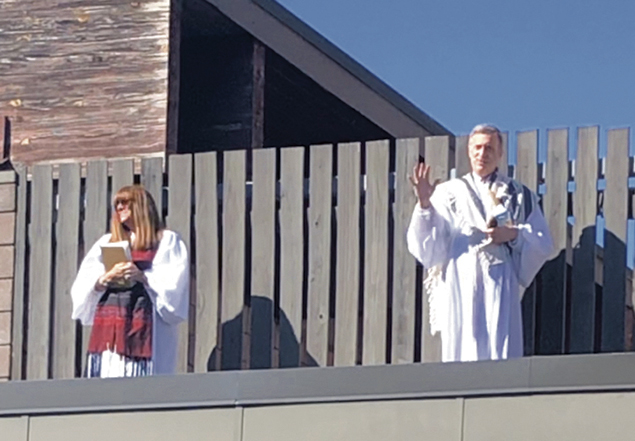
“But we did raise the funds to double the size of our building,” he added.
He explained the synagogue’s name. “We’re the only Beth Am Temple in the world,” he said. “We are always being called Temple Beth Am, but it is Beth Am Temple.” Why? Because people used to look in the phone book and the Yellow Pages, and Beth Am Temple would be first in the local listings. People actually found Beth Am and joined it that way, Rabbi Pernick said.
Jewish life — and life in general — has changed enormously since he and Ruthie first got to Pearl River, Rabbi Pernick said. “Clearly the function and definition of community has changed as people spend more and more time online.” Far fewer people actually show up; groups like men’s clubs and sisterhood find recruitment far more difficult than they used to.
Out of the three traditional reasons for a synagogue — worship, study, and gathering — all in some ways can be done online. “We stream,” Rabbi Pernick said. “We don’t know who is watching, but we can see how many computers we’re on.” People meet less in person, but they can make friends of people far away, whom they come to know online.
“It is a change, but in our case it is working well,” he said. There have been many mergers in the Rockland Reform community, but Beth Am still stands. “We’re on a dead-end street in one of the most densely populated Irish Catholic residential areas in the county — location location location! — and you have to work to find us, but we celebrated our 60th anniversary about a year ago.
“When I came here, I was 30 and the congregation was 22.” He knows three generations of families. “I was able to stay in the same place, officiate at weddings and baby-namings and bar and bat mitzvahs, and funerals. I am part of their lives, and they are part of mine.
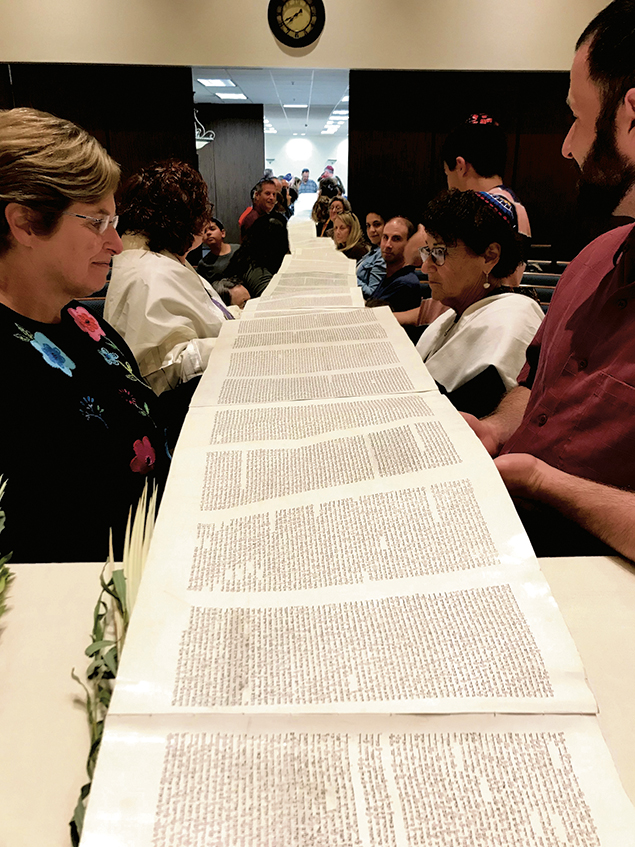
“I love the congregation. I enjoy it. It is a tremendous amount of work — most people don’t know what rabbis do, especially in smaller congregations. It’s very much 24/7. Even when you’re on vacation, you can get a phone call.
“Finding the right congregation is like dating. You can date — which I have not done for a very long time — and you can date a wonderful person, but it’s just not the right fit. You are very fortunate when you find the right fit.
“Even after 40 years, I wake up in the morning and look forward to going to work. When I am on vacation, after a few days I want to check it. I enjoy it. That says something about me — and a lot about the congregation.”
comments