

The power of silence
Suicides, grief, and unspeakable support
I was studying Parashat Shemini for my drash a couple of weeks ago when my phone rang.
The call was from a woman whom I’d met at Overlook Medical Center, where her mother was a patient. Her mother passed away in early March, and I officiated at the funeral. Sadly, her nephew Zach, a freshman in college, took his own life in early February. I officiated at his funeral as well. The family knew that they could reach out to me with any questions or concerns.
There was a moment of silence after I said hi, and then I heard: “Rabbi Lenny, Zach’s brother Josh” — a junior in college — “took his own life last night.”
Two brothers, about two years apart in age, took their own lives two months apart.
I sat at my desk in stunned silence. She told the story of the tragedy while I sat listening, tears streaming down my face.
The day, like Shemini, started with a wonderful celebration: officiating at a double baby naming. The joy was palpable, just like the celebration at the mishkan in the parasha. (Nobody fell on his or her face, but there were lots of Baruch HaShems.) After that celebration we drove to the funeral home, so I could officiate at Josh’s funeral.
It felt like the next sentences of the parasha where Nadav and Avihu, two of Aharon’s sons, brought what the Torah calls a “strange fire” that God had not commanded, and a fireball came from heaven and consumed them. In this case, both Zach and Josh were their own fires.
My point in writing this article is the next sentence, which has what I believe to be the two most powerful words in the Torah: “Vayidom Aharon.” “And Aharon was silent.”
Aharon’s silence, as he watched his sons consumed by fire, couldn’t be the silence of someone who has nothing to say. It could have been the silence of someone who recognizes that not everything can be explained, but more than likely it was the silence of someone for whom words are no longer possible.
That’s exactly the way I felt at the funeral home. I thought about the boys’ mom and dad, grandfather, aunt, cousins and friends, and I understood that silence.
In moments of profound suffering, people feel the need to fill that silence — with explanations, theology, and even comforting clichés — but sometimes the holiest response is silence, because we care so deeply that words would diminish the moment.
“Vayidom Aharon” teaches that you don’t have to explain, you don’t have to justify, and you don’t have to solve. When the world doesn’t make sense, the greatest kindness is just sitting with the bereaved, saying very little, and not leaving.
There are moments in life when loss is so deep, and so disorienting, that nothing we say means anything, but our tradition gives us a line from Tehilim, the Book of Psalms chapter 34: “The Lord is near to the broken-hearted, and saves those of crushed spirit.”
In Tanach, a “broken heart” refers to someone who feels deeply, someone who has been shaken, and someone whose defenses are gone. A broken heart isn’t an empty heart; it is a heart that has loved deeply.
The second line of that sentence is about a sense of being overwhelmed. A crushed spirit is a spirit that has carried more than it should have had to carry, and the pain itself becomes a kind of testimony to a life that mattered.
Although research in psychology and public health reveal some common patterns and risk factors that tend to show up in suicide, neither Zach nor Josh had such factors.
Neither felt isolation, nor feelings of being disconnected; they weren’t lonely, nor was either of them failing in his undergraduate programs. It was quite the contrary; both were gifted musicians with tons of friends and were each successfully completing their respective courses of study. They had parents, grandparents, and extended family who adored them, and those emotions were returned by both boys.
We can’t take away the loss, and we can’t restore what has been taken, but we can hold onto the fact that even here — even now — in the most difficult, most fragile place, there is a quiet, enduring bond between the love that was and the love that remains.
May the love that created this pain continue to be a source of meaning, memory, and, in time, even a measure of comfort.
If you’re worried about someone — or about yourself, even if you may be highly successful — please call someone. Call a friend, a relative, your rabbi, priest, or minister; call anyone, because they will be there for you. You can call or text 988, the Suicide & Crisis Lifeline, and they may provide potentially life-saving support.
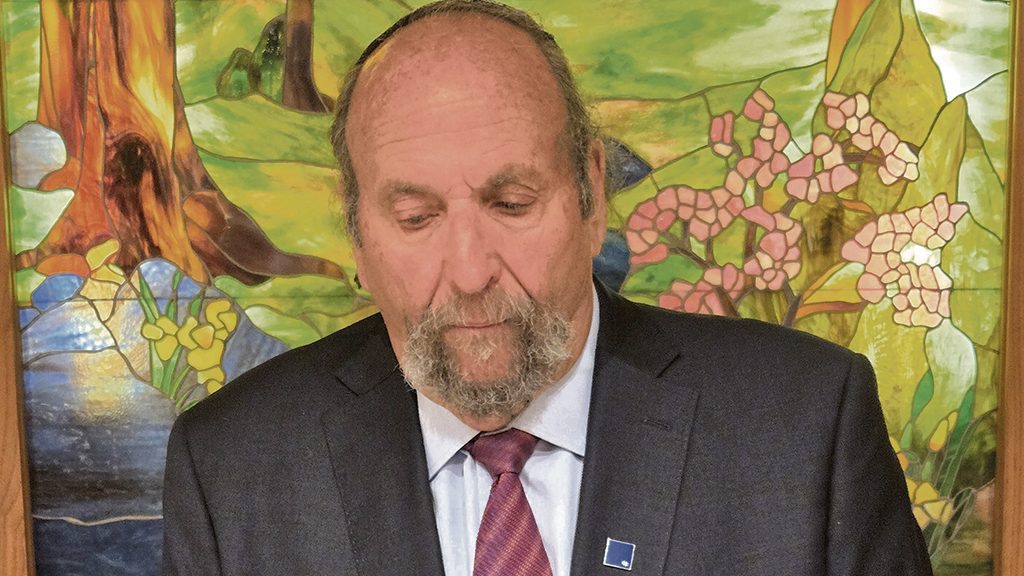
Rabbi Lenny Mandel of West Orange, who has been the cantor at Congregation Bnai Israel in Emerson for almost three decades and is a staff chaplain at Overlook Medical Center in Summit, knows that just being there for those who need an ear or a shoulder is what matters most.