

The birthday of the trees
Our correspondent goes to her first Tu B’Shevat seder
My delight in learning about Tu B’Shevat began with a birthday card for my friend Jean. A photo I had taken of the Orange Reservoir in South Mountain Reservation appeared on the front of the homemade card I mailed to her. It is a favorite local scene, with peaceful water framed by trees.
The picture reminded Jean that she needed a photo of a lake and some trees for a project at her synagogue. When I saw her soon after her birthday at our last book club meeting, Jean thanked me for the card and told me how much she loved the photo. Then she explained that her congregation celebrates the minor Jewish holiday of Tu B’Shevat with verve and joy, turning it into a festive gathering for a winter-weary congregation.
Perhaps a secular American might compare Tu B’Shevat to the international holiday of Arbor Day in late April. We use that holiday to promote environmental stewardship, but I’ve never heard of anyone celebrating with as much merriment as we did at Temple Sinai on a very cold February day. While it’s true that Tu B’Shevat falls midway through winter, its arrival signals a turning point, just as the tree-budding process is getting underway and the sap begins rising. There is no special service in the synagogue for this holiday of nature, and the most typical way to observe it is to eat fruits, especially those that grow in Israel, like dates, figs, and oranges.
Jean asked whether I had more photos of the reservoir for inclusion in the Haggadah they were revising for this year’s Tu B’Shevat celebration. “Sure!” I laughed. “I must have dozens, since I walk and hike in the reservation all the time and can’t resist lifting my iPhone to capture its beauty!” Jean told me about the fun of a Tu B’Shevat dinner, especially its wine ritual. Everyone begins with a full glass of white wine. With each successive section of the seder, some red wine is added to the cup to replace the sips taken. Gradually, the wine changes from winter white to pink-tinged to suggest spring, then a rosy shade for summer, and finally a deep red for fall. It is a simple but lovely visual journey through the year.
I was confused. Seder? Haggadah? Aren’t those terms reserved for Passover? While I know that the Hebrew word seder translates as “order,” I had always assumed that a seder dinner was just for Passover, and that a Haggadah was specifically the prayer book used to conduct a seder. Jean gently set me straight. A seder can be adapted to observe other celebrations such as for Tu B’Shevat, with its themes of trees and environmentalism. The Haggadah that guides this version is thus different from a Passover Haggadah. It can vary widely depending on the intended focus of the celebrants.
Jean invited me on the spot to join her husband, Joel, and her for the Tu B’Shevat seder at Temple Sinai in Summit. I accepted immediately, with enthusiasm, because it sounded meaningful and fun. They do a vegetarian potluck dinner, and I love to cook, so I quickly began planning a casserole I could prepare that might please a wide variety of tastes.
We arrived early to prepare the various seder plates for each table. Having done a tiny bit of online research about Tu B’Shevat, I understood that it is commonly known as the New Year of the Trees, a time to honor these sacred gifts of nature and their fruits. I also learned that the structure of the ceremony would focus on four cups of wine and the four seasons.
Jean took care to introduce me to everyone, including all the women I was assisting in the kitchen, Associate Rabbi Shira Gluck, and the cantor, David Fair. I felt both welcome and useful as I was put to work.
Together with a half dozen other women who had arrived early for setup, I helped prepare the first seder plate with fruits and nuts that have a hard outside and an edible inside. There were pistachios in their shells, wedges of cantaloupe, oranges, and sweeties, a citrus hybrid popular in Israel at this season.
The reading from the Haggadah for this segment, the actualization, that accompanied the first plate discussed how these fruits cannot be judged by their exterior, for they contain hidden goodness within. Our reading for this section drew a parallel with the divine spark that is within each of us, something invisible from the outside.
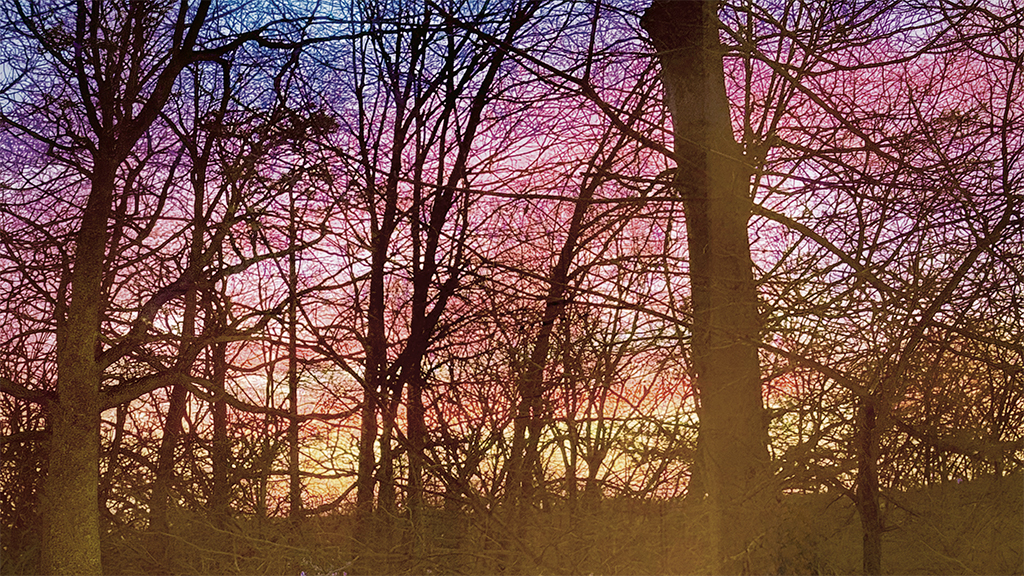
While the early arrivers had their hands busy in the kitchen, Jean was working to set the tables in the social hall and noticed the glorious gift nature had bestowed on us just outside the large windows. With some urgency, she implored us, “Come, everyone! Stop, stop, stop! Take a second and check out the sunset!” I would later reflect on how appropriate Jean’s exhortation was at this feast of the trees, so that we could all savor the gorgeous rainbow nature had painted behind the bare tree branches.
Next came the second plate to accompany the formation section of the seder. We would eat fruits that contain pits, remembering that though we typically discard pits, they are the seeds of rebirth. Soon, Jean’s friends and I had artfully laid out platters with enough pitted fruits — dates, olives, apricots, and plums — for all eight guests at each of four tables. Each fruit came from a flowering tree that was once bare, a reminder that growth can come from unexpected places. What’s more, the fruits of our own actions can be like these tree fruits, bringing sweetness and beauty into the world.
The third seder plate, to accompany the creation section of the Haggadah, bore fruits that are entirely edible, and we included grapes, figs, and strawberries. The reading for the section discusses the wholeness of the world. Likewise, the message invites us to see that every human life has worth, no matter whether if that person’s contribution is reflected through scholarship, good deeds, or social justice. In her remarks, Rabbi Gluck recalled Micah and the fig tree, from Micah 4:4, “…where everyone shall sit under their own vine and under their own fig tree, and no one will make them afraid.” That struck a familiar chord for me. It reminded me of George Washington, who used this quote on several occasions to represent freedom from oppression.
With the tables set, including the seder plates and bottles of white and red wine or grape juice on each table, 30 of us took our seats. Next to me sat a personable guy named Evan and his equally friendly wife, Sharon. I introduced myself as a friend of Jean’s, admitting that I wasn’t a congregant and wasn’t even Jewish, but that I love learning almost as much as I love a party.
Before the Tu B’Shevat seder formally started, the evening’s chairperson, Barbara, took the mic and thanked all who had helped with the party. I even got a special mention for my artistic contribution of a photo of trees around the reservoir for the updated Haggadah.
Just like at a Passover seder, participants are urged to take part in the readings. When Jean asked if I’d like to be a reader, I readily agreed, eager to take part and glad that I didn’t get any unfamiliar Hebrew words to mangle. I was charmed to see that we would start with four questions that echo the four questions of Passover.
With each different section of the seder and its accompanying plate of fruits, there was a unique blessing to offer. Naturally, we offered a blessing for each pouring of wine, too. At one point during the dinner, perhaps showing off a bit, I leaned over to Evan and murmured, “Is it odd that the bracha for the wine rolls off my tongue so readily?” It does help that I have a Jewish husband and have been a member of the JCC since 1987. Evan laughed and nodded knowingly.
Cantor Fair brought his guitar and beautiful voice to the celebration, accentuating each section with a song or two. Our ceremony started with him leading the group in singing “Hinei mah tov u-mah na-im,” a joyful song about how great it is to gather together as a community. His toe-tapping music set a jovial tone for the rest of the evening. We were there to have fun! For the next 45 minutes or so, he kept the room humming with bouncy, lively tunes. He taught the refrains to the folk songs to the willing crowd, now loosened up by the wine. Rabbi Gluck joined him for the songs, complementing his rich, joyful baritone with her pretty soprano voice. The music made me happy and did its job of lifting our spirits high.
When it came time for the fourth and final section of the seder, I think Rabbi Gluck had one of those hand-to-forehead moments when she suddenly realized that she had forgotten that she was supposed to prepare the fourth platter. “But I’m sure our kitchen can accommodate us!” she declared as she dashed to the kitchen next to the social hall and emerged moments later with an armful of spice jars. I was again reminded of a Passover seder plate with its mix of bitter herbs as spice jars were passed among the tables. My table received dried basil, which I thought made perfect sense as a Mediterranean spice that is widely used in Israeli cuisine.
The final reading to accompany the transcendence section of the seder and our fourth cup of all red wine included this line: “May it be my custom to go outdoors each day / Among the trees and grass — among all growing things…” The words resonated with me. My days feel incomplete if I have not had a chance to be outdoors in nature. The last lines of the reading for this section were particularly poignant for me:
Each day we must pause from our lives to notice the small wonders of the earth, the smell of dew, the changing colors of the leaves, the sounds of birds migrating south for winter. Only then will we know God’s paradise and experience that which is hidden in the crevices of our world.
Before heading to the generous buffet table for my delicious meal, I silently thanked Jean for inviting me and for insisting we all take a moment to witness the beauty of the day’s sunset, a fitting blessing for a celebration of the trees.
Susan FitzGibbon of West Orange is a teacher. She’s a longtime reader of the New Jersey Jewish News.
comments