

Telling Jewish stories on stage
‘Giant’ producers also reveal their own meet-cute saga — in dialogue
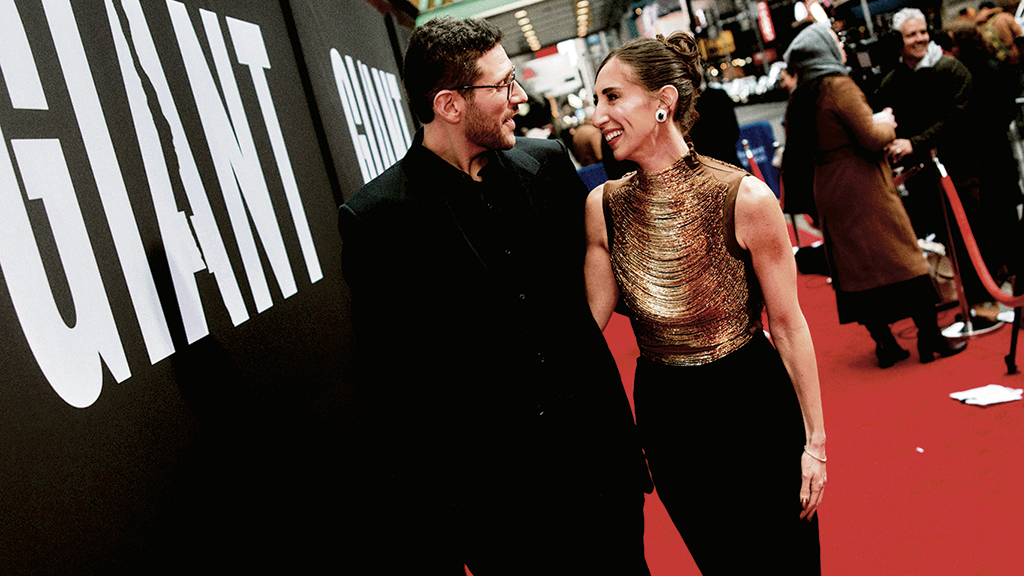
It sounds like a bad Hallmark movie.
Two Canadians grow up only miles apart, but they never meet. They come to the United States, go to the same exclusive college — and accidentally run into each other and eventually realize that it’s bashert.
Their dream is to make their way to theatre — yes, theatre ending in “re” — both in London and New York and produce Important Stuff. Now that opportunity is nigh, as the Tony Awards approach, and their play, “Giant,” is a major contender.
The background music slowly builds to a crescendo.
Don’t feel bad. I didn’t buy the story either. At least until I met Brian and Dayna Lee, who definitely are a Hallmark romcom couple. They run AF productions, which brought “Giant” to these shores from London, where last year it won the Lawrence Olivier Award — that’s the British Tony.
It is all part of their mission to tell Jewish stories.
“Giant,” for example, is about is about Roald Dahl, the writer of brilliant and fanciful tales for young readers, but also a misanthropic antisemite.
Interviewing Brian and Dayna is like watching a ping-pong match. (I was going to say tennis match, but tennis is too slow a game.)
“We met at Berklee [College of Music] in our second semester,” Ms. Lee, 37, began. “We were from the same suburb of Toronto” — she was Dayna Bloom then — “but we never knew each other. I walked into a class, and we immediately connected. We became best friends from that moment on.
“But I had a significant other. He had a significant other. The story is that he went home and broke up with his girlfriend, I ended up having two other relationships, and he waited until I opened my eyes and saw what was in front of me, which was…”
“Me,” Mr. Lee, 34, chimed in. “Truth of the matter is I saw her and thought, ‘that’s it for me.’ I think it was weird. We were in a different place, a different city, and she comes in and I hear her say to someone else, ‘I’m originally from Toronto,’ And I barreled towards her saying, ‘Me, too.’ I fell very hard and very fast and am still happy.”
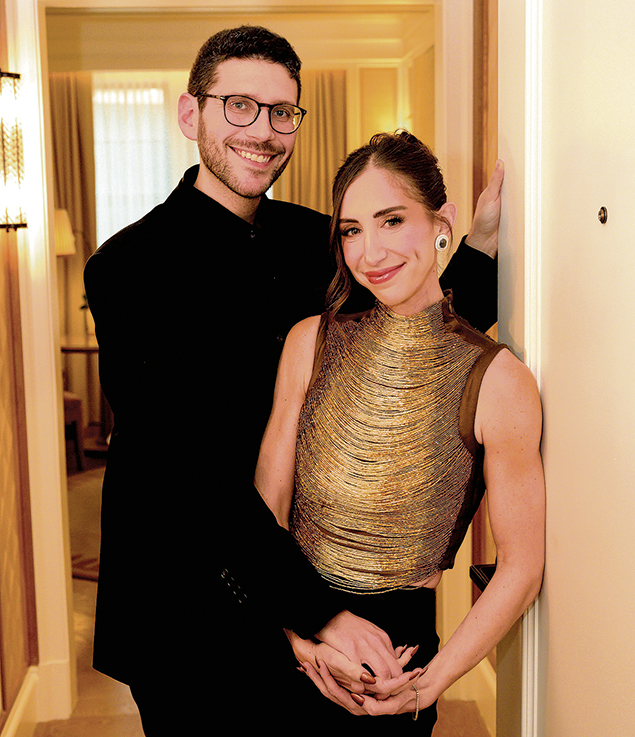
So they got married shortly after they graduated. Or maybe not. It depends on whom you listen to. How long was it?
She: A year.
He: No. No.
She: Yes.
He: No. We moved to New York. We got engaged a year after we graduated, and were engaged for two years. So we got married three years after we graduated.
She: We graduated in 2014. Got engaged in
He: 2015.
Both: And got married in 2017.
She: Good job.
Ms. Lee first worked as an intern at Warner Music, while Mr. Lee networked. “I always wanted to work in theater,” he said. “Truthfully, I got my first job because when she would go to work, I would sit at home and write emails to people I admired.
“I would ask to meet for coffee, and, after enough coffee and volunteering and banging on doors, someone said, ‘Okay, you can get my coffee in the rehearsal room, and then…”
She: Coffee turned into opportunity.
He: Yeah. Okay, so I drink a lot of coffee.
Mr. Lee seemed clearly on track for at least a shot at success as a director, but “what I really fell in love with was putting together all the pieces.” By that he meant being involved in the decision-making on hiring actors, the set designer, the lighting designer, the sound designer.
“But that also includes the business side — the marketing and how the show lives in the world at large,” he said. “I think only through the experience and meeting producers of the shows that I was the assistant director on, that I realized what I really fell in love with was producing.”
“During that time, I went back to get my master’s degree…”
He: In media management.
She: In media management, so it all felt cohesive and like the next step.
He: You went back to school because you really didn’t know what you wanted to do.
She: But I knew that I always wanted to work with you. I always thought we would be the most successful working together. It took Brian a little while to realize that could be true and that we would still like each other at the end of the day.
But if we’ve learned anything in this exercise, it’s always listen to your wife. Always.
But by then they had three kids, and anyone who follows theater (er) knows many if not most shows do not earn back their investment.
“I think ultimately what you want to do is build the career about things you’re passionate about and projects you champion,” Mr. Lee said. “But, yeah, it’s also a business, and you have to look at the overhead and how things come together. So I think there is an element of risk in running a Broadway producing office. You know, you can work and toil for eight years [on a project], and the thing can open and close. But going into that we had our eyes wide open.”
“It wasn’t lost on us, the risk we were taking, and I feel like the risk we continue to take every day,” Ms. Lee noted. “We could easily have gone into law or medicine or some Jewish job. But coming from artistic backgrounds and always loving the arts, and this being both of our dreams, it just made sense at the time to take the risk and bet on ourselves, right? Right? What better investment than to invest in…”
He: Yourself.
She: Ourselves.
He: And while we started our company, we had survival jobs. It wasn’t just that we set up a shingle and did this full time.
She: We had a full other business where we did social media management for hospitality groups, and it was very lucrative. It was influencer marketing. That taught us so much about branding and digital marketing, which made us better producers.
They dipped their toes in the business as co-producers. Typically, these are professional people — lawyers, doctors, dentists — with an extra $40,000 or so mad money they’ll invest in a show. If it becomes a big hit, they make some money and (in a dream world) get to stand on stage if it wins a Tony.
Worst case scenario, they’ve attended cast parties, received opening night tickets and a large tax deduction.
Brian and Dayna, on the other hand, were in it for the experience — and the long haul. “We continued to produce several showstoppers where we learned about the business,” Ms. Lee said. Among them: “Moulin Rouge,” “Funny Girl,” “Company,” and “The Who’s Tommy.”
“We got into this game to lead produce,” she continued. “That was always the goal. Co-producing was just a vehicle for us to get to lead producing. We feel like our strengths are in development, and we needed a property that was exciting enough or met the moment to get us to where we are today.”
That turned out to be “Here There Are Blueberries.” Conceived and directed by Moises Kaufman, who co-wrote it with Amanda Gronich, the play is about a photo album that showed concentration camp guards and support personnel at play. It was recovered by a counterintelligence officer, who found it in a trash can in 1946. it mysteriously made its way to the desk of a U.S. Holocaust Museum archivist in 2007.
At the same time, the Lees expanded their operations to England, where theatre is less expensive to produce but of artistically high quality. The two hubs of theater are “Broadway and the West End, and to us it felt very important that we are able to work across both, because there are different types of work being created in both places, and both of those interest us deeply,” Mr. Lee explained.
Their first major production was a revival of “Fiddler on the Roof,” which won several Oliviers, and then “Giants,” which the pair transferred to Broadway.
They’ve since also gone into the movie business, and somewhere in the near future is a Jewish play — they tell me the name but swear me to secrecy — that hasn’t been produced on Broadway in decades. Only this time it will feature an all-Jewish cast.
“Our Judaism has always been a large part of our lives,” Ms. Lee said. “We wanted to tell stories that have our Jewish identity and things that mean so much in our everyday lives represented on stage. That’s a huge part of our mission and picking projects.
“I also think that there’s a lot between ‘Anne Frank’ and ‘Fiddler on the Roof,’ and we feel our job is to fill in the gaps and bring color and texture to Jewish life.”
Ms. Lee’s family is from Montreal. One of her grandfathers owned a kosher deli there; he was born in British Mandate Palestine and fought in Israel’s War of Independence. “So I am one-quarter Israeli,” she said. “There’s a very famous picture of him with Ben Gurion that I have.”
She went to Sunday school. Her family celebrated the Jewish holidays and she went to a Jewish summer sleepaway camp. “But I was more secular than Brian,” she said.
“Brian went to a Hebrew day school, and grew up in a Conservative egalitarian household.
And he agreed to thank me if “Giant” wins the Tony. I have it on tape.