

Teaching more than English
Former Tenafly resident inspires Israeli students through covid and shellings
Most of us can name a few teachers who stood out for instilling in us not only an understanding of the subject matter but also for their creativity, personal warmth, and approachability.
For many students at ORT Motzkin High School, a Haifa-area school in the Israel Sci-Tech Schools network, one of those standout educators is Tenafly native Gabrielle Soffer Cohen.
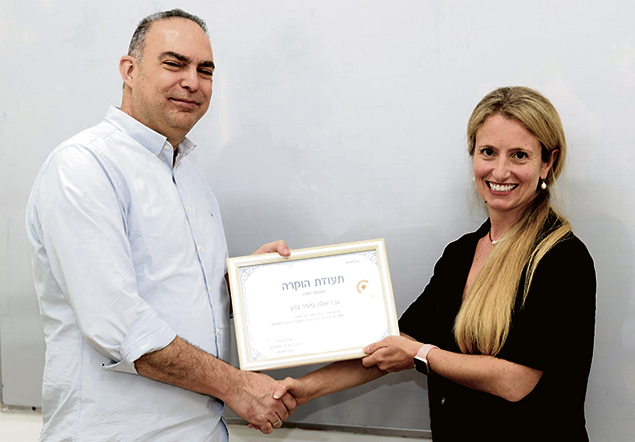
On May 6, Yom HaMoreh (Teacher’s Day), the school’s principal presented Ms. Cohen with a certificate recognizing her accomplishments in teaching accelerated English — a course roughly equivalent to an American advanced placement foreign language class.
It’s a very long way from Bergen County to Kiryat Motzkin in northwest Israel.
When Gabrielle Soffer arrived in Israel in 2019, she was 34 and ready to plunge into life in Tel Aviv. She had no idea that two days later she would meet Asaf Cohen at a local bar, setting her on a path to marriage, motherhood, and a change in career direction from sales to education.
Her parents, Barbara and Jeffrey, had taken Gabrielle and her sister, Ariella, on trips to Israel over the years to visit close relatives in the Tel Aviv suburbs. Gabrielle’s decision to make aliyah came as a reaction to those positive memories as well as negative experiences in college and beyond.
“Growing up in Tenafly, I never really sensed that being a Jew was a minority,” she said, recalling her days at Stillman Elementary School and Tenafly Middle and High School.
But she felt very much in the minority at Union College in Schenectady, N.Y. And when she later transferred to Hunter College in Manhattan, she encountered “a really big anti-Israel base” whose actions made her feel “threatened and scared to be a Jew in New York.”
After graduating in 2010 with degrees in visual arts and psychology, she began selling real estate and discovered just how deep the well of antisemitism ran in everyday life — even in conversations with people she considered friends.
By 2019, she was ready for change, professionally and personally. “I wanted to establish a relationship with somebody who welcomed Judaism or was Jewish, which wasn’t happening in New York,” she said. “I was ready to start a family, and I didn’t feel any sparks flying.”
At that point, another Israel trip with her parents and sister, during which she fell in love with Tel Aviv, convinced her to make aliyah.
Having only rudimentary Hebrew skills dating back to her bat mitzvah lessons at Temple Emanu-El, then in Englewood, first she enrolled in Tel Aviv University’s residential Hebrew-language immersion program. “I had one Russian roommate, one Brazilian roommate, and one Hungarian roommate,” she recalled.
Her cousins had mentioned that English teachers were in high demand in Israeli schools. Her future mother-in-law told her about a teaching certificate course at Tel Aviv’s Kibbutzim College of Education, which was tuition-free for new immigrants.
“I loved the course,” Ms. Cohen said. “I felt that I could make use of my creative brain and my love of literature and, of course, my English, for the good of others and to contribute to Israel in a meaningful way.”
Soon after she received her Ministry of Education certification and began working, the pandemic sent the new couple packing to Kiryat Motzkin to live near Mr. Cohen’s parents.
“I responded to a job posting on Telegram from the English coordinator at ORT Motzkin, which is down the street from my home,” Ms. Cohen said. “She really liked me from our first phone call and supported me through the interview process.”
Israel Sci-Tech Schools is Israel’s largest independent school network, educating approximately 100,000 students across 264 middle and high schools. ORT Motzkin is one of the schools in this system. In her first year there, Ms. Cohen taught the highest-level English class. The English coordinator then asked her to develop an accelerated track for the following year.
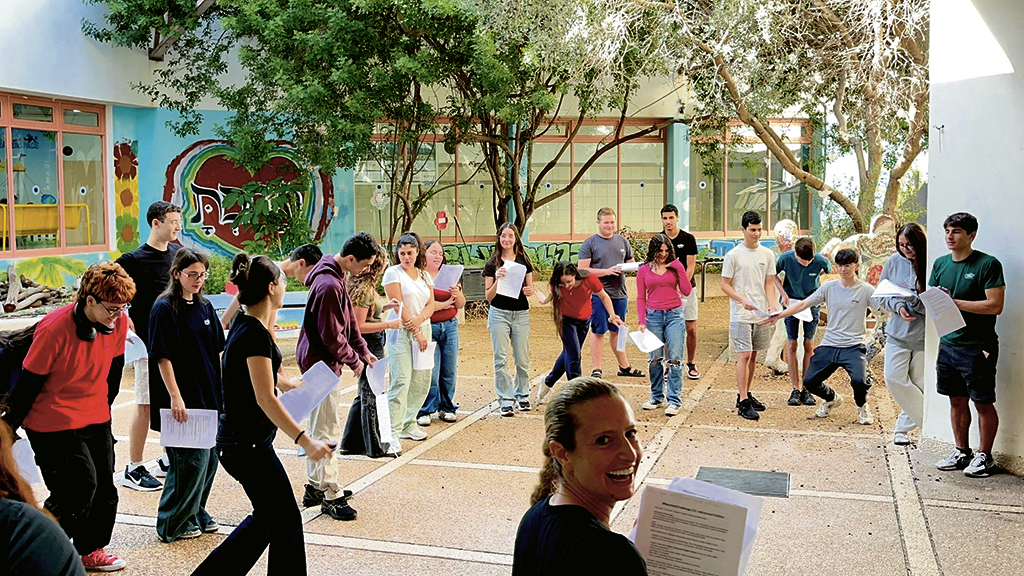
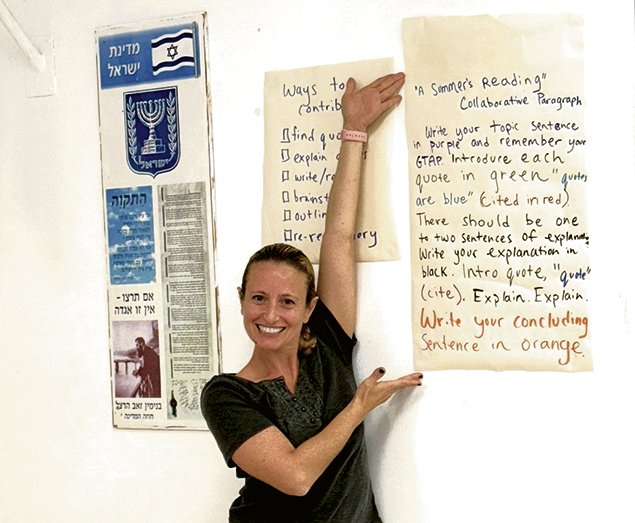
She built a curriculum for 10th- to 12th-graders based on teaching strategies she innovated or adapted from various countries. It includes classic literature, canonical poetry, Holocaust literature such as Elie Wiesel’s “Night,” media literacy and motivation theory, VR-based debates, escape-room activities, and blackout poetry sessions. Mnemonic devices, figurative language, visual art, collaborative writing, and movement are incorporated into the lessons as well.
“It was the greatest feeling in the world when it actually worked — when we implemented the program and the students loved it,” she said. “We struggle, learn, connect, laugh, and celebrate the experience of being together in English.”
Raz Frohlich, CEO of the Israel Sci-Tech Schools Network, said, “Gabrielle embodies what Israel Sci-Tech Schools stand for at their core. She left the comfort of Tenafly and chose a life of purpose in Israel, where she now shapes the voices and futures of her students in Kiryat Motzkin.
“Her classroom is more than a place of learning — it is a bridge between cultures, a catalyst for confidence, and a daily reminder that great educators don’t just teach English. They teach possibility.”
Ms. Cohen noted that many of her students approach her to talk outside of class, even though none of them come from English-speaking homes. In fact, for some of these students, English is their third language after Russian and Hebrew.
“We’ve created a community where people feel comfortable speaking,” Ms. Cohen said. “The kids see me as someone they can come to when they need to talk. They feel comfortable sharing really deep things with me. And I don’t take that responsibility lightly. Their lives can be difficult and complex, and I’m happy to be a constant for them. My students are like my family.”
The ongoing military conflicts since October 7, 2023, have made life difficult both in and out of the classroom. Kiryat Motzkin’s location puts it squarely in the line of Hezbollah attacks, periodically shutting schools and sending residents running for shelter.
“It’s been a really hard year to teach,” Ms. Cohen admitted.
“Zoom is hard for the students. I feel that a lot of them have post trauma from covid times, when we were on Zoom for a whole year and they were socially cut off. Luckily, we haven’t had to be on Zoom for very long periods since then, but during this last war we were learning remotely for three weeks,” she said.
“At least for my 10th-graders, who aren’t taking matriculation exams, I would try and keep things relevant to them. Like, I had them write letters to somebody they were very grateful to; it didn’t have to be in English. We looked at how to write a good thank-you letter and say something specific about how the person impacted them. And then they called that person and read the letter to them. The idea was from a video I showed them, which taught that expressing gratitude will boost your own happiness.”
In addition, Ms. Cohen asked her students to keep a journal during the first weeks of the Iran war. “I gave them prompts that they could answer, but I also gave them different options — instead of writing, they could take pictures every day and make them into a collage. Or they could make a playlist of songs and explain why they chose those particular songs and how the songs made them feel. And the last option was to set some physical fitness goal and keep a movement journal to report on how they felt before, during, and after. The idea was, ‘Yeah, we have this war going on and it’s really stressful, but I’m still moving.’ The students created beautiful, meaningful portraits of themselves during this time.”
On the homefront, Ms. Cohen and her husband have their hands full with their two little boys, Eli and Ari. Like all Israelis, she is hoping for greater stability in Israel’s geopolitical situation so that she can more easily schedule visits with her parents, who now live in Monmouth County, near her sister Ariella and Ariella’s family.
“I’m trying not to watch the news as much,” Ms. Cohen said. “And I’ve turned off different WhatsApp broadcasts because it doesn’t help. I’m just trying to persevere right now for the sake of my children” — both those at home and those in her high school classroom.