

Surmounting the insurmountable
How to live through illness — and come out the other side
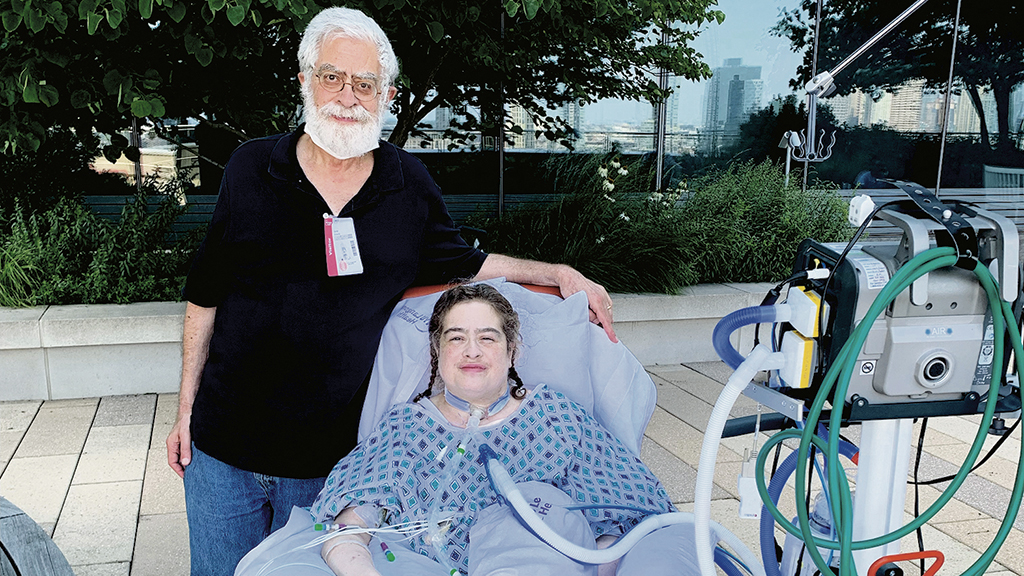
Carolyn Kanter is a living miracle.
Despite years of navigating seemingly insurmountable health challenges, she’s beginning to experience glimmers of hope.
Carolyn Strauss was born in 1975 and grew up in Pittsburgh. When she was 6, her parents divorced, and her father remarried and moved to lower Manhattan. She’d fly from Pittsburgh to New York as an unaccompanied minor every other weekend and on school breaks to spend time with her father and stepmother. “The stewardesses were always kind to me,” she said.
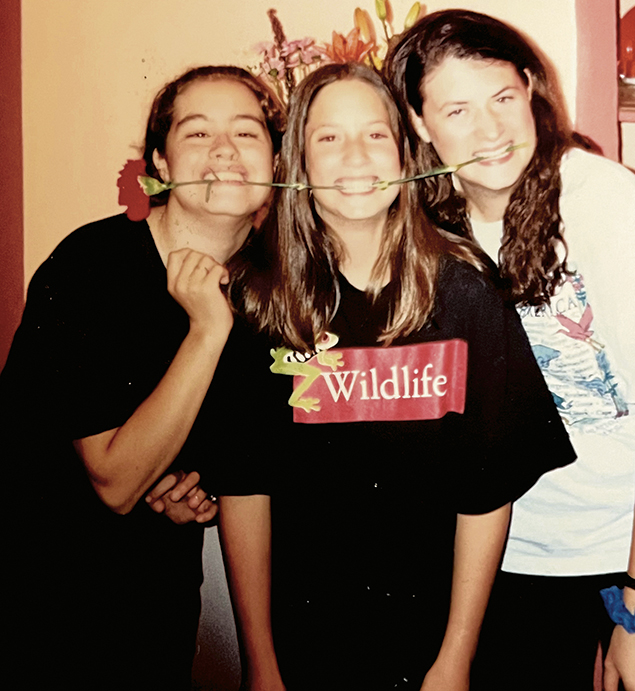
Eventually her father planned a playdate with a girl her age who lived in his building. “Deborah Cantor and I were inseparable,” she said. “Forty-five years later, I live in Riverdale and she’s in Fair Lawn. We’re still best friends.”
“Carolyn has been a dear friend since we were 6 years old,” Deborah said. “Her stepmom introduced us in the lobby of the historic Blum Brothers’ Rockfall Apartments. Carolyn often accompanied my family to outings at Flat Rock Brook Nature Center in Englewood. She’d entertain me and my younger sister, Margo when my parents shopped at Pathmark on Route 17.”
The girls grew up. After earning an undergraduate degree in psychology and social work from Ithaca College, Ms. Strauss, as she was then, moved to New York for a graduate degree in social work at Yeshiva University’s Wurzweiler School and then began to work at child welfare and foster care prevention programs. Her friend Deborah and Deborah’s boyfriend, Lowell Kirschner, who lived in Fort Lee — they’re long married now — set her up with Mark Kanter in 1998. “Deborah, Lowell, and I were members of B’nai Jeshurun in Manhattan,” she said. “We’d often gather with others for dinner after services. Lowell was friends with Mark and introduced me to him.”
The two couples remain extremely close, and the two women still are best friends.
In 2000, when Ms. Strauss was in her mid-twenties and dating Mr. Kanter, unexpected chest pain brought her to a cardiologist. “The pain turned out to be musculoskeletal, but after the echocardiogram, I was diagnosed with a rare cardiac disorder called non-obstructive hypertrophic cardiomyopathy,” she said. NO-HCM is a genetic heart condition characterized by the heart’s left ventricle thickening, but without obstructing blood flow. “There’s obstructive HCM and non-obstructive HCM, but non-obstructive is much more rare,” she said. “Without medication to treat it, my cardiologist said he’d monitor it. I remained asymptomatic for years.”
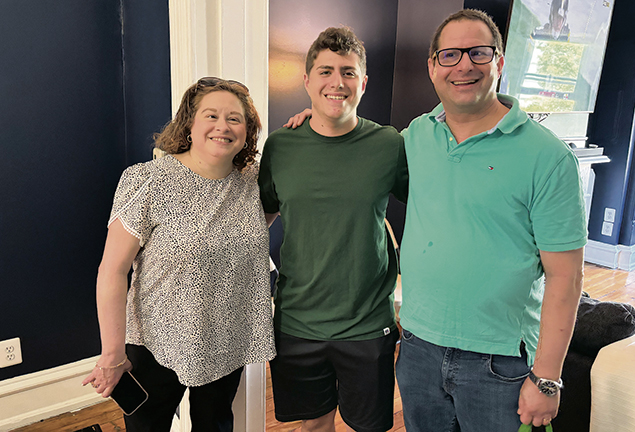
Mark Kanter and Carolyn Strauss married in 2002 and moved to Riverdale. Their son, Gavi, was born in 2005.
In December 2022, when she was 48, Ms. Kanter developed covid. Complications from the virus brought her to Columbia Presbyterian Medical Center; she was admitted there in January 2023 for the treatment of covid-related pneumonia and atrial fibrillation (AFib.) “As HCM progresses, you are more susceptible to fluid buildup that causes infection and arrhythmia,” she said. “I was hoping to see a specialist in Columbia’s HCM Clinic, but there was a waiting list.”
In February 2023, after several episodes of AFib, Ms. Kanter got to NYU Langone Medical Center through the emergency room. “I’d just started seeing Dr. Lior Jankelson, an electrophysiologist there,” she said. “He scheduled two procedures. The first, in March, was a cardiac ablation, a minimally invasive medical procedure to treat arrhythmias by destroying small areas of heart tissue responsible for generating abnormal electrical signals. The second, scheduled in May, was to insert a subcutaneous implantable cardioverter defibrillator, a device to prevent sudden cardiac death in people with abnormally fast heart rhythms.”
Shortly after these two procedures, Ms. Kanter was connected to Mark Sherrid, director of the Hypertrophic Cardiomyopathy Program at NYU Langone. “I was very lucky he was able to take me on and follow me since he treats HCM exclusively,” she said.
That summer, Ms. Kanter worked for Graham Windham, a nonprofit that works with families, as its director of therapeutic foster care. Gavi was getting ready to start his freshman year at George Washington University in the fall. Then things started going wrong; she began experiencing shortness of breath and nausea and was having difficulty walking. “I ended up back at NYU,” she said. Although she’d had an ablation, she was still symptomatic.
Dr. Sherrid hooked her up with Daniel Swistel, a cardiothoracic surgeon who was part of the HCM team. Dr. Swistel is one of two surgeons in the United States who is skilled in septal-myectomies for non-obstructive HCM. The surgery aims to thin the wall between the left and right side of the heart.
In September of 2023, Ms. Kanter had open-heart surgery. Her recovery was difficult; she was under full sedation for four days, and she remained at NYU Medical Center for about six weeks.
The next year, Ms. Kanter, who felt more stable, went to Washington with her husband for parents weekend at GW. “After Shabbos dinner at Chabad GW on Friday night, we went back to Gavi’s apartment,” she said. “But walking back to the hotel, I felt very strange, and everything went blank. I was brought by EMS to George Washington University Medical Center. A cardiac catheterization revealed I’d had a heart attack. They put in a stent, and I stayed at the hospital for a week. “Parents weekend at GW became parents weekend with Mom in the hospital. When we returned to New York, I followed up with Dr. Sherrid the next day. He ordered follow-up tests. My lab work was extremely wonky.”
Ms. Kanter was admitted to NYU for another cardiac catheterization, her second in two weeks. “Dr. Michael Divita shared news I couldn’t have imagined hearing — particularly after all I’d just been through,” she said. “I was in end stage heart failure and needed a heart transplant.” Because of her condition, it was necessary to keep her in the hospital on a milrinone pump, a specialized medical device used to deliver a continuous, controlled intravenous infusion of milrinone, a medication that helps the heart pump more effectively and relaxes blood vessels. It is used to treat patients with advanced heart failure or those awaiting a heart transplant.
Ms. Kanter described her reaction as surreal. “I was terrified. I was sad. I was defensive,” she recalls. “But the only other choice was to die.”
In order to be listed for a heart transplant, a potential recipient undergoes a series of tests. “Aside from my HCM, nothing was found that would stop me from being listed,” Ms. Kanter said. “I was a high priority because I was in the hospital. It was advantageous that my blood type was A+ — and also I’m short.” She’d learned that “the smaller your stature, the more hearts you can be matched with. It evidently relates to the size of the chest cavity.”
Ms. Kanter stayed in the ICU. After only six weeks, she was matched with her new heart. “My donor was 26 years old, and I had a child who was almost that age.” She felt survivor’s guilt as the recipient of that heart, she said; she does not know the name of her donor.
The transplant took place the evening of December 7, 2024. “My transplant surgeon, Dr. Nader Moazami, was excellent,” Ms. Kanter said. “He was like a big teddy bear.” Ms. Kanter was put on a ventilator as a result of post-operative respiratory distress, and describes “being asleep” until December 25. “So many organs were compromised,” she said. “I had fractures in my spine. I had a feeding tube, a urine catheter, and excruciating pain from pancreatitis. And, as some post-transplant patients experience, on March 7, 2025, I had a stroke.”
Mark was with her in the evenings, and her father, David and her stepmother, Rachel, were there during the day, and “my dear friend Deborah came regularly from New Jersey,” she said. “My dad was 79 years old, in excellent health and happy to help. He made it his mission to learn all about my symptoms, treatment, and recovery.
“Because I had a tracheotomy, I couldn’t talk. We’d use the white board to prepare questions for the doctors doing rounds. My husband created a WhatsApp chat for updates. Everyone was praying for me. When the rabbi in the hospital came in to say a mishaberach, we’d talk about our kids, who were similar ages.”
Ms. Kanter is grateful to the members of their shul, the Conservative Synagogue Adath Israel of Riverdale, who stayed in close touch with her husband. “He really needed support throughout a very stressful chapter of my life,” she said.
As a result of corporate restructuring, Mark Kanter was laid off from his human resources position in January. He spent his time visiting Carolyn in the hospital, looking for work and completing the necessary paperwork for her to get long-term disability.
It was hard for her to be weaned off the ventilator, so it was a very long time before she could breathe or eat on her own. She had to learn to walk again. In early September 2025, nine months post-transplant, Ms. Kanter was discharged from the hospital and moved to Rusk Rehabilitation at NYU Langone Orthopedic Hospital. Two weeks later, with clearance from her cardiac and rehab teams, she was finally sent home. Now she goes to outpatient PT twice a week and does exercises at home. “It’s often too taxing, but what’s the alternative?
“As a result of being critically ill, there are things I don’t even remember,” she said.
Deborah Kirshner is awed by her friend’s strength. “Carolyn is my superwoman” she said. “I remain in awe of her grit, determination, and resilience as she pushed through treatments and setbacks.”
Returning to normal life is hard. Therapy helps Ms. Kanter process her feelings as they come to the surface. “I’m part of a heart transplant Facebook group and a transplant support group at NYU online. One of the men in the Facebook group, Wayne Adam Greer, wrote a book about his experience — “July 5: The Day I Lived Twice.”
Ms. Kanter’s adjustment to home life also — and predictably — was a bit bumpy.
“It was rough for a few weeks,” she said. “Mark was home with me for two months while I settled in at home. “He started a new job in December. Gavi is a junior in college.”
Because the disease is genetic, Gavi has to be careful; he has annual echocardiograms. “He was tested when he was about 13,” Ms.Kanter said. “He has one of the gene markers that can lead to NO-HCM, but he has no symptoms.”
“In February, a GoFundMe site was started to help with bills, as the cost of my care is more than we can afford on just his salary. I have caregivers five hours a day for help with meal preparation and other tasks. I often use Assess-A-Ride paratransit service through the MTA or Uber to get to appointments.” Her father goes to Riverdale to care for her once a week. CSAIR delivers meals, and its rabbis, Barry Dov Katz and Katie Greenberg, visit her. She recently got clearance to attend services and was warmly welcomed by the community. “Rabbi Greenberg asked me if I prayed,” Ms. Kanter said. “I told her I talked to God. She told me ‘that’s praying.’
“To receive another person’s organ is a precious gift,” she concluded. “I embrace every day. You only get one shot at life — but I got two.”