

Don’t believe it just because you see it
Messianic Jews put disingenuous billboards on Route 4
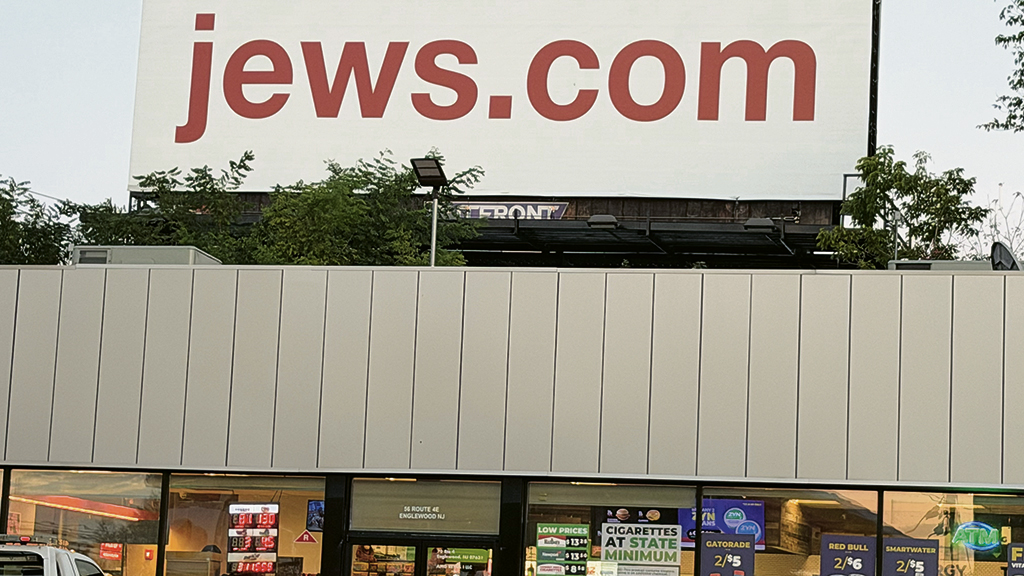
There are two big billboards, right there on Route 4, near Grand Avenue in Englewood, as you drive east toward the bridge. They’re long, low, red and white, and simple. The first one you see is on the right side of the road, above a gas station and a convenience store, and then you see the other one, on the other side, by some townhouses. They’re hard to miss.
Jews.com, they say.
They look – what? Intriguing? Inviting? Welcoming?
But insofar as they imply that they are either by or for Jews, they are misleading. Maybe disingenuous. Perhaps even dishonest.
There actually seem to be three of them on Route 4; the two on the eastbound side and the other on the west. It’s helpful to remember that Route 4 is one of the main approaches to the George Washington Bridge. The signs necessarily would get a lot of eyeballs; the GWB is the world’s busiest motor-vehicle bridge. In 2019, it is reported to have carried more than 104 million cars, trucks, and buses. (It’s not clear if motorcycles are included in that statistic.) And the bridge not infrequently hosts massive traffic jams, which sometimes stretch as far back as the signs. So if there are signs to be seen, people will see them.
(Jews.com also has put up signs in Brooklyn, according to its own Instagram account. It doesn’t specify exactly where, but the photos show that at least one is on an elevated highway, so there, too, it would get lots of views.)
Jews.com’s URL is easy to remember, so it’s possible that people will look it up when they get home.
Were you to do that what you’d find is a homepage divided in half, left to right. On the right, at the top, first you’d see the Hebrew words “bruchim haba’im” — literally “blessed are those who come,” more commonly and simply “welcome” — and then below those fairly small letters, in big, bold text, “Shalom — Welcome to Jews.com.”
Then a Jewish star, then “What if what we were taught isn’t the whole story? Begin with the welcome video, then explore at your own pace,” and then a link to a video called “What Do We As Jews Believe?”
On the left, there’s a video from Kirt Schneider, apparently the leader of Jews.com.
If you were paying close attention, you might see “What if we were taught isn’t the whole story?” as perhaps a bit off. Or maybe not. You might be reassured by “What Do We As Jews Believe?” because it’s defining “Jews” as “we.” And, of course, it’s doing the traditional Jewish thing of turning almost every statement into a question.
But if you were to watch the video on the left, or if you went a few layers deep into the text on the right — carefully written, unthreatening, bland, even reassuring text — eventually you’d realize that Kirt Schneider, who says that he’s a rabbi, the Conservative bar-mitzvahed Jewish son of Jewish parents from Cleveland, is a messianic Jew. From the group that used to be called Jews for Jesus. As in, not actually Jewish. As in, Christian.
To be clear, the problem is not that Schneider is Christian. That’s entirely his right; his business, not ours. The problem might not even be with his proselytizing. That, too, is his right. The problem is the subterfuge.
Rabbi Noam Marans of Teaneck is the American Jewish Committee’s director of interreligious affairs. He is measured as he talks about jews.com.
“The context is very important,” he said. “This is not among the top 10 threats to the Jewish people, but it is understandable why at this moment this type of advertising is pernicious and rattling.
“That is because we are living at a time when nearly all Jews have never felt more vulnerable, so we don’t take well to deception. And it’s deceptive to have a huge billboard with a seemingly innocent website with a seemingly innocent name on a major thoroughfare next to an intensely Jewish community.
“That’s true of Brookly too,” he added.
There is another context, Rabbi Marans said. “That’s a mainly positive one. It’s that nearly all Christian faith bodies have abandoned and even prohibited missionary work specifically directed at Jews.” One of those faith groups has been particularly strong in its refusal to allow that kind of proselytizing, he added. That’s the Catholic church, “which has formally renounced it.”
Rabbi Marans is careful to stress that he does not think that billboards like jews.com should be forbidden in any way. “We of course support freedom of religion, freedom of expression, freedom of the press,” he said. That makes him slightly uncomfortable in discussing the billboards. “We should not invest any of our time in elevating this unduly.” But — there isn’t always a but, but here there is —“but that doesn’t stop us from being disturbed by it, and from doing whatever we need to do to educate people about what it really is about.”
And it is upsetting. “I was rattled by it,” he said. “I was driving on Route 4 when I saw it, and I have to say that it did startle me.
“I had my suspicions about what it might be, because I’ve seen this kind of thing before. And what it was became obvious as soon as I looked it up.”
But being upsetting doesn’t necessarily make it particularly dangerous, he added. “We have to be empathetic with our people at this moment. And of course it would be a tragedy if we were to lose any of our people to missionaries. But we also should have the perspective that most of the Christian establishment and many Americans are uncomfortable with this approach, or even repulsed by it.”
The Jewish Federation of Northern New Jersey also responded to the billboards. The organization sent emails to members and sent us a statement, expressing the same values and concerns. Here is the statement it sent to us:
“Everyone has the right to practice their religion and express their beliefs. From the perspective of the mainstream Jewish community, however, belief in Jesus as the Messiah is not part of Judaism.
“When a message like this is presented in a community with a significant Jewish population, it understandably raises concerns about the impact of that message on the Jewish community. Jewish Federation of Northern New Jersey is committed to strengthening and sustaining the mainstream Jewish community, supporting Jewish life and institutions, and ensuring a vibrant Jewish future for generations to come.”