

Scouting America gets a new leader
He’s Jewish, and he lives in Hoboken
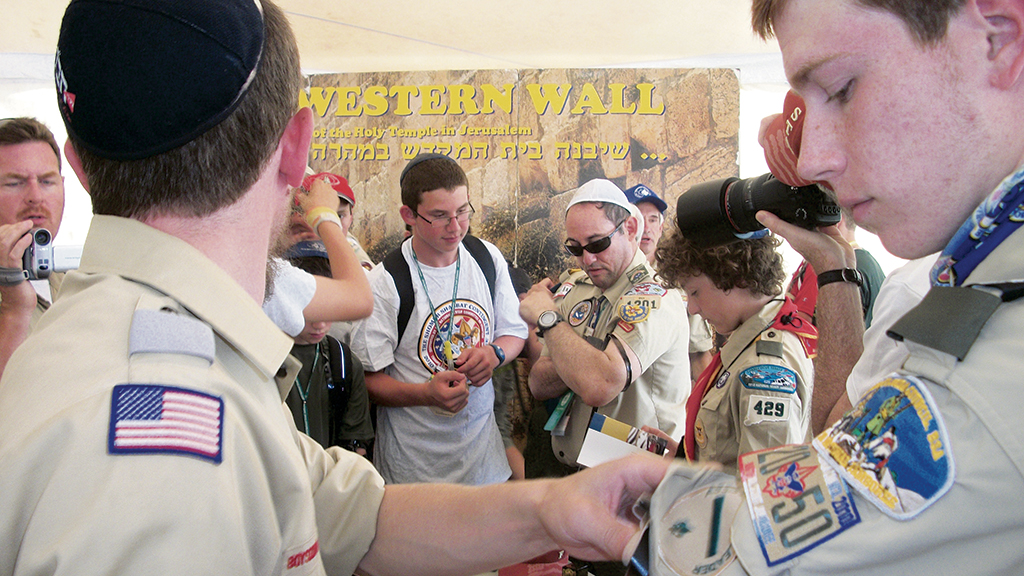
The next chairman of the organization formerly known as the Boy Scouts of America is a Jewish lawyer from Hoboken.
That’s a really big deal. Scouting America, as BSA now is called, is a 115-year-old group that includes about a million scouts, some of them girls. Its goals, as the Scouts Law up on its website announces, are earnest, positive, straightforward, far-reaching, and old-fashioned.
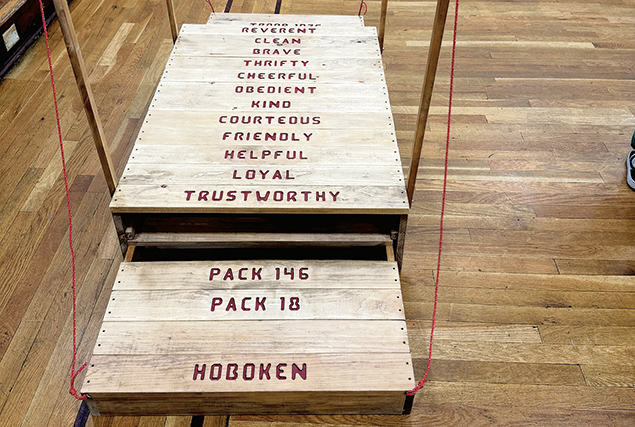
“A Scout is trustworthy, loyal, helpful, friendly, courteous, kind, obedient, cheerful, thrifty, brave, clean, and reverent,” the Scout Law decrees.
Those principles, and the organization that lives by them, helped shape and heal Ricky Mason’s life. He is a lifelong, devoted Boy Scout, and lifelong, devoted Jew, and has committed himself to being a visible member of both communities, and to showcasing the many ways in which they overlap.
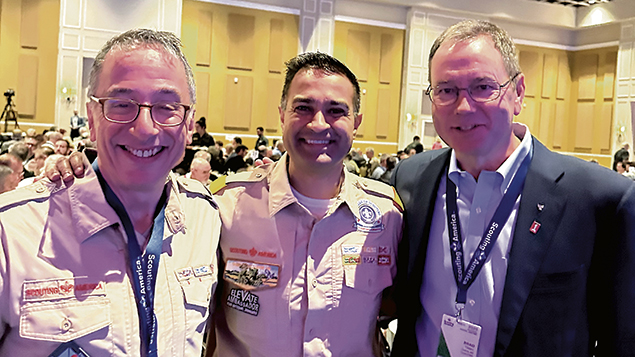
Mr. Mason is Scouting America’s chairman-elect, and here is his story.
Mr. Mason grew up in Richmond, Virginia. Like most Jews of his age — he’s in his mid 60s — he’s the grandson of immigrants. “My grandparents were from Lithuania and Ukraine,” he said. Yiddish was their first language, the local language their second, and English their third. “My father grew up pretty poor in Boston, and he was a World War II veteran. He was in a tank unit in Europe toward the end of the war; he was put in charge of captured German POWs because he spoke Yiddish. His name was Joe Nathanson, but he changed it to Mason.” Why? “My father told me that down south, Nathanson was too hard to pronounce,” he said, sounding unconvincing, probably because he was unconvinced.
Mr. Mason’s mother, Pearl Strauss Mason, grew up in Maryland, “in the shadow of Pimlico racetrack,” her son said.
“My father was persuaded by his brother-in-law to go into the radio business, and the best way to do that was to go into radio,” Mr. Mason said. “My father had a terrific voice. His brother-in-law, Fred Darwin, was in Armed Forces Radio in the Pacific theater during World War II and ended up as a newscaster on 1010 WINS. By the time we moved back up here, he lived in Queens and would do Fred Darwin’s Stock Market Report on 1010 WINS from his kitchen counter.”
Meanwhile, in Richmond, the newly renamed Mason family found an active Jewish community. They belonged to Temple Beth El, “which is still there,” Mr. Mason said. “It’s a thriving Conservative shul.
“My father did two things,” he continued. “In his day job, he was the sales manager and general manager of WLEE AM, 1480 on your radio dial. It was a successful radio station, very popular. And his really cool job was as a sportscaster. For several decades he was the voice of VMI cadets.” That’s the Virginia Military Institute.
“I have letters from the commandant of cadets thanking him for his great broadcasting.
“I like to tell people that at my synagogue, the hierarchy of holidays and events were Rosh Hashanah and Yom Kippur and then Joe Mason at the Atlanta Braves Night, to support the farm team there, the Richmond Braves. We’d get people from the Braves — some of them went on to great careers — to come to Beth El.” (No, those players weren’t Jewish, but they were big names. Mr. Mason particularly remembers a visit from Dusty Baker.)
Mr. Mason’s connection to scouting began when he was 7 years old. It was theoretical at first. “My mother was a nurse — she was in nursing school at that point — and she sat me down in the study in our house and began a career discussion. She said, ‘You are a nice Jewish boy. You are going to join the Boy Scout troop when you are 11 — you’ll skip the Cub Scouts — and you will be an Eagle Scout like your brother,’” who was six years older.
“Then she got up and left. That’s how the career discussion ended. Later we had several additional discussions.”
He doesn’t know why his mother dismissed the Cub Scouts as an option for her son — it is not a decision he endorses for other people’s children — but he thinks he knows why she wanted him to be a Scout.
“This was 1967. My mother probably looked at me and thought, ‘You are a smart, bookish kid, and you need to be toughened up.’” She’d seen Israeli kids, who looked tougher, and probably compared him to them, Mr. Mason hypothesized. “She really trusted the scoutmaster, Malcolm Kalman, who was a busy grocery store executive but did this in his free time, as a volunteer. And my brother had been in the Scouts for a number of years and was on the path to becoming an Eagle Scout.”
So, in accordance with his mother’s wishes, Mr. Mason dutifully joined the Boy Scouts, as it was called then, when he was 11. “I was not cut out for it,” he said. “One of our first trips was in a canoe, down a river in the Blue Ridge Mountains. They put me in the middle of the canoe and wouldn’t give me an oar.
“But after a while, it took hold. The Scouting method of teaching is brilliant. There are two major points. One is you divide the troop into patrols, and you give kids leadership positions — with adult supervision. So when I was 13, I was an assistant senior patrol leader, the second person in charge of the troops. We did the planning for our campouts. If you can be the leader of a patrol in scouting, later you can be the leader of a department in your place of employment or any other organization.
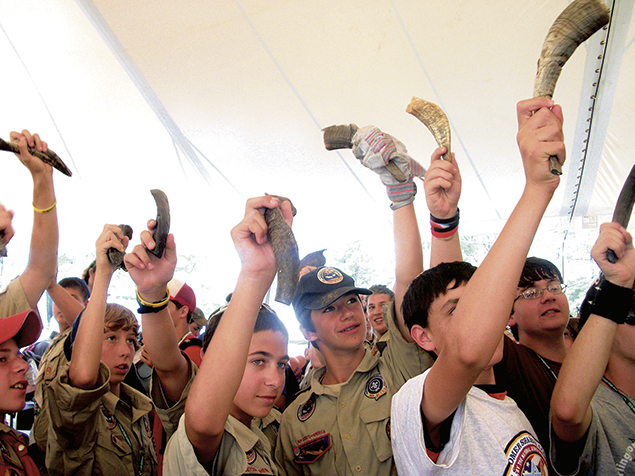 “It’s kid-driven and adult-supervised. It’s leadership training — without necessarily calling it that.”
The other point is the merit badges that Scouts earn. “You learn something substantive about a particular area — anything from camping and building a fire to how to be a good citizen.
“It’s also very interesting from a Jewish perspective. As you progress up the ranks and become an Eagle Scout, you have to do a community project. So it’s tikkum olam. It’s trying to repair the world.
“The whole method — leadership training, community involvement, learning about organizations and methods — is highly impactful.
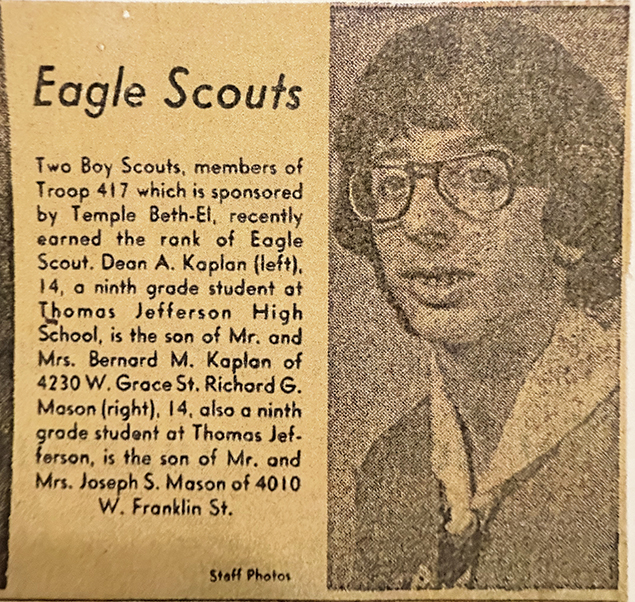
 “So I became an Eagle Scout at the age of 14.”
Yes, that’s on the younger side, he said, but it’s not that unusual.
For his Eagle Scout project, Mr. Mason went to the Scouting movement’s oldest of four “high adventure bases,” Philmont in the New Mexico Rockies.
It was 1974. Scout troops had been integrated just recently. The local Boy Scout council decided to try something new, and he was among the planners. “We had three busloads of kids go from Richmond to Philmont,” Mr. Mason said. “That’s like 120 kids, give or take. We were divided into crews of 10. My crew was half African American kids, half white kids, with an African American supervisor.
“We were in the wilderness for 10 days with kids from a completely different community. We’d had a few months of planning before then. We knew that we had to make it work. And we did.
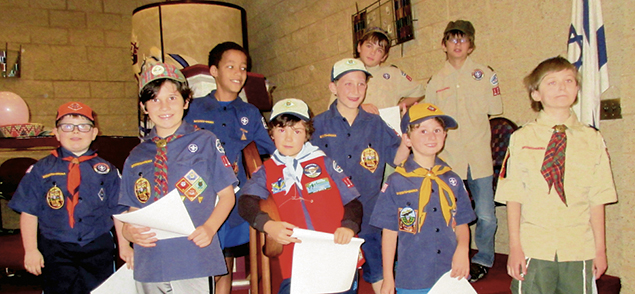
“In my mind, as a 14-year-old, what we were doing was on the forefront of what now would be called diversity, equity, and inclusion,” although that term was years away from being coined.
“It made a huge impression on me.”
But after that project — now that he was an Eagle Scout, with nothing higher in the group to aspire toward — “I got active in other organizations, and I wasn’t active in scouting in my later teenage years,” Mr. Mason said. “I joined BBYO”— B’nai Brith Youth Organization — “and became the president of my chapter.”
Meanwhile, though, great sadness was unfolding at home. “My mother got cancer, and she died when I was 17,” Mr. Mason said. “She had me graduate high school early, so that she could see my graduation.
“I was out of town, at the University of Maryland, in my first week, when I got called back home, and she passed away then. So I dropped out of college. I tried to go back — and then I dropped out again. I was headed, really, to nowhere.
“I applied to the local school, Virginia Commonwealth University, two years later, and I barely got in. The dean of admissions told me that he didn’t think that I was college material. He voted against me on the admission committee.
“I passed by one vote, and I was admitted with a conditional acceptance.”
That’s when his background as a Boy Scout kicked in.
“I had no current involvement, and I hadn’t really kept in close touch with my scouting friends, but the leadership training, the figuring out how to earn that merit badge, the scheduling to make sure you meet deadlines — all of that was buried deeply in the very upset mind of an 18-year-old. Without that, my going to college would not have worked.
“I’m convinced that without scouting, I wouldn’t have progressed in college. I probably would have been a three-time college dropout. I also wouldn’t have met my wife — I met her in college.”
Once Mr. Mason’s Scouting training resurfaced, “I did very well in college,” he said. “And then I got into New York University Law School, which was not something that ever in a million years would have happened except for scouting and the training I got.
“I did well in law school, graduated not at the very top but close, and started at my law firm, Wachtell, Lipton, Rosen & Katz, first as a summer associate. I just retired as partner.”
Mr. Mason was a partner at Wachtell for 30 years, and the chair of its restructuring and finance department. He’s now of counsel in restricting and finance there.
His wife, Beth Mason, also has had an impressive and varied career. She started out in public relations and marketing, and “rose to be the president of an ad agency,” Mr. Mason said. She left the field in the 1990s, “got involved in community affairs and then in politics, and eventually became a two-time elected city council member. After leaving politics, she went back to the travel and entertainment world where she’d worked when she was doing public relations. She bought a boutique hotel just outside Richmond, and now she goes back and forth between that city and Hoboken. The couple has two children and two grandchildren.
Meanwhile, back in the mid-2000s, Mr. Mason started to want to give back to scouting.
He’s been very involved in shul, the United Synagogue of Hoboken, since he moved to town 40 years ago. He was on the board for some years. The synagogue has a “thriving preschool,” he said; his daughter teaches there. So the shul was a prime focus of his volunteerism, but he wanted to do more.
“I got involved in the greater New York scouting council, and eventually, about 10 years ago, I became chair,” he said. “The local council delivers Scouting in the neighborhood. We also were very focused — and persuasive — in getting the national organization to open to all youth, particularly to gay kids, gay adults, and transgender kids. So over the last 15 years, Scouting America has been open to every kid and every adult.
“That is very important to me, because the program has had such a huge impact on my life. I didn’t want it to exclude a kid — it could have that kind of impact on that kid’s life.”
And then, “in 2019, the national organization came to me and said, ‘We have a historic issue with abuse in scouting.’ The issue peaked in the 1970s, with the advance of youth protection protocols. It wasn’t anything that I had ever experienced as a kid or an adult, but the national organization filed for bankruptcy.” Remember, here, that Mr. Mason specializes in restructuring law.
The Boy Scouts of America’s national organization faced more than 82,000 claims of sexual abuse, of varying degrees of severity — some were quite severe — and accusations that troop leaders had been told about the abuse but chose to look away. In 2021 the organization settled — the settlement was massive, $2.46 billion — but it had harmed its reputation and popularity.
Mr. Mason was an important part of that process.
The national leaders “wanted a volunteer who could galvanize and lead the local councils across the country, which were not filing for bankruptcy but would be expected to negotiate and participate in the settlement. They asked me to do that.
“One of them said to me: ‘You’re an Eagle Scout. You are the volunteer chair of one of our larger local councils. You are a senior restructuring professional with a nationwide recommendation.’
“They were kind of laying it on, right, but, but it was true.
“They said, ‘God put you on this earth for a reason. We need you to do this.’ So I spent the next three years of my life negotiating with survivors and their attorneys in the national BSA bankruptcy case.
“It was challenging for everybody, but it was a very important case. It was a two-pronged mission. We had to give justice and compensation to survivors, and also we had to allow the Scouting movement to continue.
“We got all 240 councils to agree to a settlement and to their share of that settlement, and that enabled the BSA to come out of bankruptcy.
“After that I was asked to join the national board. And then last February, the current national chair, Brad Tilden, asked me to be his successor.”
This year is the transition year; Mr. Mason, now chair elect, will become chair in May.
He will be the second Jewish chair, Mr. Mason said.
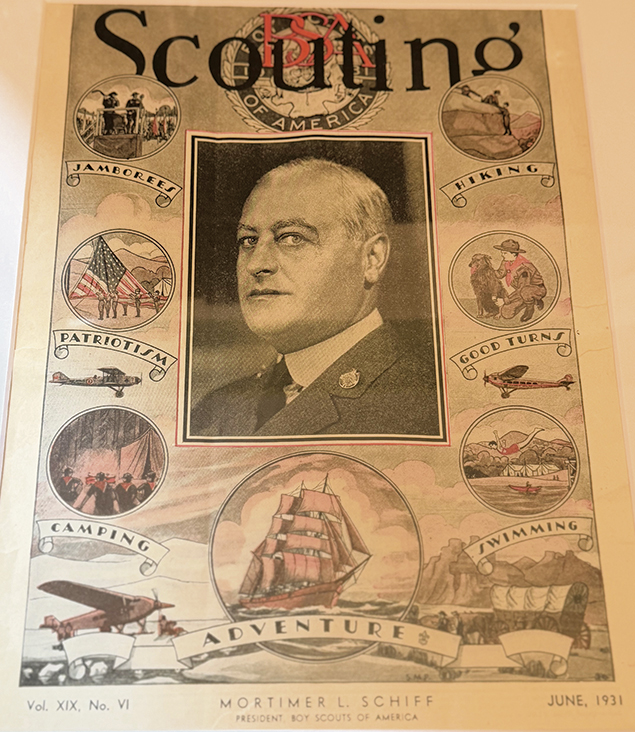
The first one, Mortimer Loeb Schiff, was a partner in Kuhn Loeb, the investment bank that later merged with Lehman Brothers; his daughter Dorothy Schiff became the owner and publisher of the New York Post when it flourished as a liberal-leaning popular tabloid.
Mr. Schiff was elected chair of the BSA in 1931. “That was a time of rising antisemitism in the United States and of course in Europe, and just 18 months before Hitler was elected to be Germany’s chancellor. That’s when the Boy Scouts of America decided to elect a German Jewish banker to be chair of what already was an iconic American institution.”
As for his own election, “I don’t believe that I am becoming the next chairman because I am Jewish — but I am Jewish, and that is part of the package.
“We are a faith-based organization. We say grace at our board dinners. At one of our recent diners, someone said, ‘All right, who is the next volunteer?’
“So I stood up in front of our national board, volunteers, and staff, and I sang the HaMotzi. And then I sang the Shehecheyanu — the blessing over something new — “because it was the first time anyone had said HaMotzi there.
“And everyone there loved it.”
Scouting America has three national leaders. The CEO is a paid position. It’s held by Roger Krone, who is white and Catholic. The national commissioner, a volunteer job, leads the other volunteers. It’s held now by Devang Desai, who is Hindu, ethnically Indian, and was born and raised in Uganda. The third, of course, is the chairman, soon to be Mr. Mason. All three were Eagle Scouts, but they otherwise are a diverse group. All three are men, but a commissioner before Mr. Desai was a woman. “The leadership team is a little different than it was a few years ago,” Mr. Mason understated.
The organization is running into some trouble with the Secretary of Defense, Pete Hegseth (or as he and Donald Trump prefer to call him, the Secretary of War) because Mr. Hegseth tried to pressure it into changing its name back to the Boy Scouts and to stop accepting girls and transgender kids. If it did not, he said, the Defense Department (or is that the Department of War?) would not continue to support it.
The two settled; Scouting America agreed to stop offering the Citizenship in Society merit badge, which went to boys and girls who “realize the benefits of diversity, equity, inclusion, and ethical leadership.” But it has refused to make the other changes Mr. Hegseth required.
“We served transgender kids yesterday and we will serve transgender kids tomorrow,” Mr. Mason said. “We have 142 merit badges, and four of them focus on different aspects of citizenship. We are discontinuing one of them.
“We have longstanding and broad relationships with the U.S. military. We serve 25,000 military families. We are one of the only ways that military kids can get continuity.
“We are not kicking out young women, and we are not changing out name back,” he said.
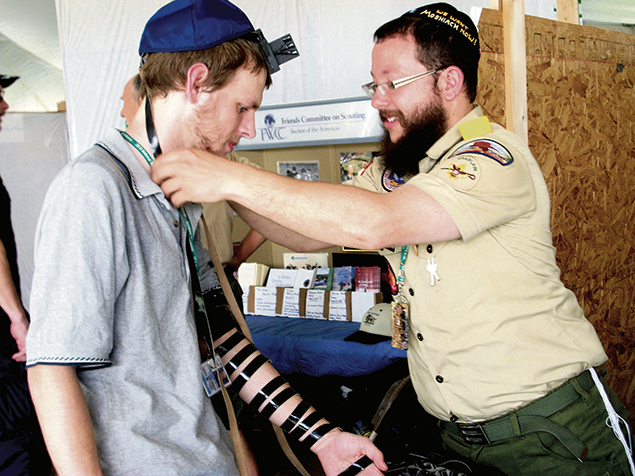
Rabbi Joseph Prouser of Teaneck is on the Northern New Jersey Scouting America Council. He has been Scouting America and the Boy Scouts of America’s national Jewish chaplain, including at both national and international jamborees. And he will give the keynote address at Scouting America’s Duty to God breakfast at the national meeting in May when Mr. Mason will be installed as chairman.
Mr. Mason is proudly and publicly Jewish in all parts of his life, including as Scouting America chairman, Rabbi Prouser said. “He is a committed, knowledgeable member of the Jewish community.”
When they recently met for lunch at a kosher restaurant in Teaneck, Mr. Mason “wore his kippah and made a bracha,” Rabbi Prouser said.
“One of his concerns is how to get word out to the Jewish community that scouting is a program that Jewish kids and Jewish parents and Jewish families and Jewish communities should be considering seriously. My feeling is just by his being so visibly Jewish and so involved in his own Jewish identity and his shul and his community, that will communicate a great deal to his target audience.”
He quoted Albert Schweitzer when he thought about Mr. Mason’s role in bringing Scouting to Jewish kids. “Example is leadership,” Rabbi Prouser said. And that’s exactly what Mr. Mason is doing. Leading by example.