

Resilience, identity, and hope
Israeli artist with local roots concentrates on Jewish identity
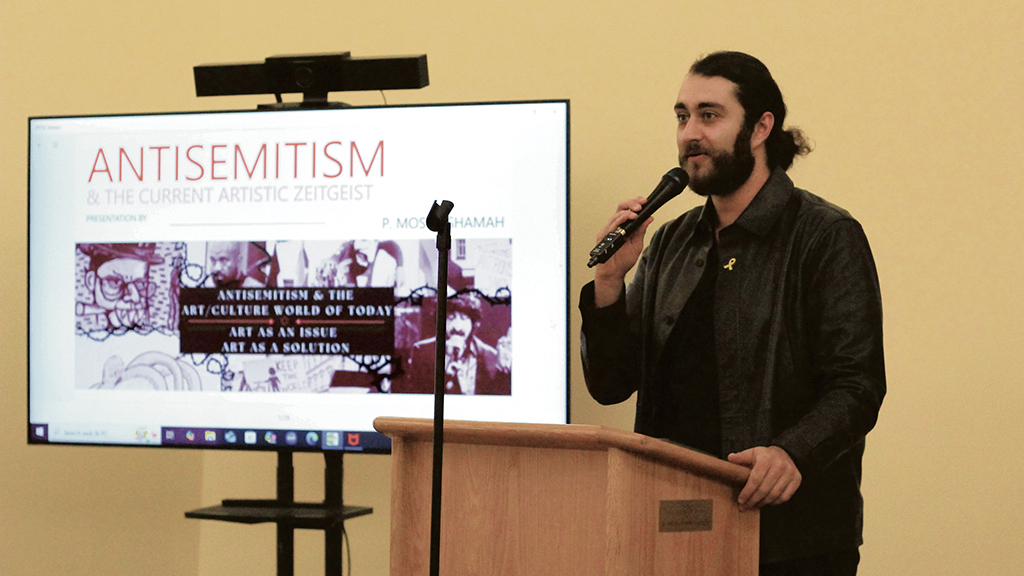
Just before the High Holidays, in a month-long series of exhibitions and educational workshops, Peter Moshe Shamah, who grew up in New Milford, graduated from Rutgers, and now lives in Jerusalem, had the opportunity to showcase his work to audiences in Tenafly, New Brunswick, Manhattan, and Brooklyn.
In a homecoming of sorts, Mr. Shamah exhibited his work at the Karmazin Gallery at the Eva and Arie Halpern Hillel House in New Brunswick on September 3. Organized by Rabbi Esther Reed, the exhibit, “Jewish Past/Jewish Future” aimed to invoke the posters and illustrations of the early Zionist movement, reframing them in a way that is relevant for today.
“We are embarking on a mission through Zionism to build a brighter future, starting with the upcoming generation of Jewish leaders — our students,” Mr. Shamah said. The exhibit was an opportunity for the artist to connect with other Rutgers Hillel alumni, donors, and current students and raise funds for America’s largest Hillel chapter. “When I was a student, Hillel offered me a second home and allowed me to engage in a Jewish reawakening and build friends and community that will last a lifetime.”
Mr. Shamah’s exhibition at the Waltuch Gallery at the Kaplen JCC on the Palisades in Tenafly this summer, “From Darkness, the Embers of Hope,” was a mixed-media collection exploring resilience, identity, and Jewish hope in the aftermath of October 7.
“I came to the United States this fall for both artistic exposure and as a call to action,” Mr. Shamah said. “Our people are at a crossroads the likes of which we haven’t seen in several generations. My work serves as a reminder that in the darkest times, even a spark can light the way.”
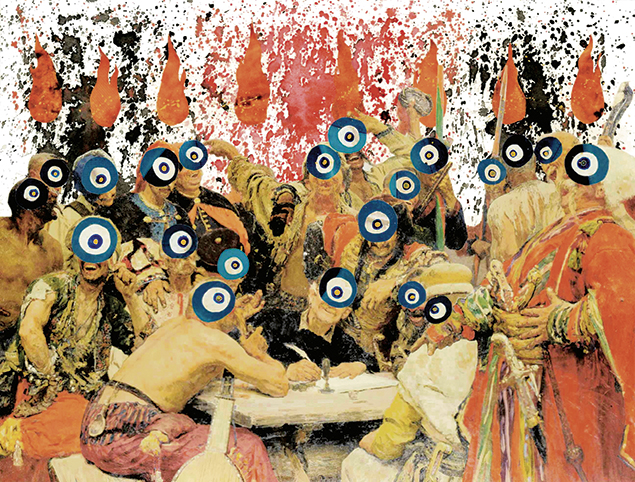
He describes growing up in New Jersey “in a functionally Israeli home. I was the kid from Israel in the class. Spiritually, musically, artistically, and culturally, home was in Israel.” In 2013, when he was a senior at New Milford High School, Mr. Shamah applied to a 14-day Holocaust study tour; he was accepted, and it took him to Poland, the Czech Republic, and Germany. The annual trip was supervised by Colleen Tambuscio, who is now the pedagogy programs administrator at Ramapo College’s Center for Holocaust and Genocide Studies but then taught a high-school course on the Holocaust and other genocides.
In 2023, on the 10th anniversary of the trip, Mr. Shamah designed a piece of artwork for each significant contributor to the trip.
“I would certainly say that Colleen’s Holocaust study tour experience was something that kick-started my journey exploring my identity, and also utilizing and integrating Jewish history, culture, and trauma into a living continuum of artworks,” he said.
Before 2015, he’d studied collage, but it was the chaos that raged around the U.S. presidential election in 2016 that made him lean into collage as a medium of choice. “Mixed media collage is the taking of chaos, destroying it, and reorienting it for the sake of expression,” he said. “The responsibility falls on artists of all mediums to pick up and reorder that chaos into human expression.”
Mr. Shamah took Jewish studies and art history at Rutgers and flourished at Hillel there. “I was awarded a scholarship from the Allen and Joan Bildner Center for the Study of Jewish Life at Rutgers and finished my senior year at Rutgers with B.A. in Art History and Jewish Studies,” he said, crediting Professor Gary Rendsburg with helping him win the award. He graduated in 2018, and then he made aliyah.
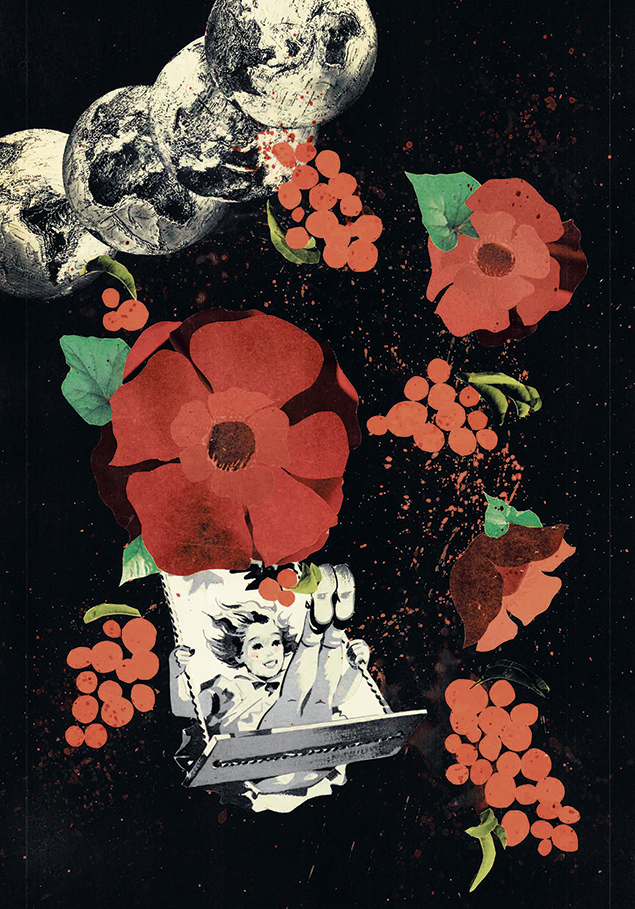
He “had a soft landing” in Israel because he already spoke Hebrew and didn’t have to deal with some of the hurdles that other olim — new immigrants — face, he said. “I got off the plane and was ready to rock and roll.” He worked on an archaeological dig at the Temple Mount sifting site in Jerusalem for a year, later writing about it in a piece called “Inspiration in Ashes and Fragments” and publishing it on his website, studioshamah.com.
That project was a turning point in shifting his attention from academia to art. In 2019, he opened his art business, Studio Shamah, from his home in Jerusalem.
Mr. Shamah describes his artwork as intentional. “I ask myself every time my brush hits the canvas how I am communicating and to whom. The creative process never stops.” He is working on two series now. One based on the legend of the golem, and the other, called “Faceless in Time” deals with contemporary Jewish and Israeli social issues, subtly through biblical calligraphy.
“I want to know that my artwork has been looked at and processed, rather than glazed over and ignored,” he said. “Artists are challenged by reactions that come in the form of posts and clicks and algorithms. We are being asked to gauge our success based on views and likes on social media.”
But that reaction changes when people view my art in person,” he said. “If someone has a visceral reaction to my work or even hates it, at least I know they’re feeling something — that I’ve provoked a human response,” he said.
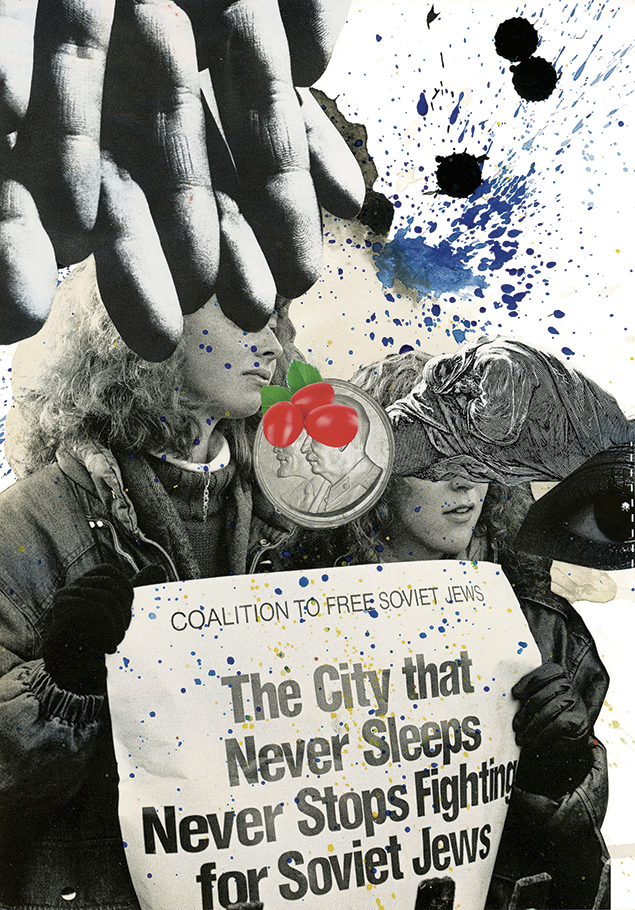
In 2022, Studio Shamah started producing the Slava Ukraini Charity Series, focused on fundraising for the refugees and the soldiers of Ukraine, who are fighting for their freedom and lives each day. The Mixed-Media and Painting Series is an ongoing project, which donates 50 to 85 percent of the proceeds to direct action causes, ensuring that the patron’s money directly helps a person in need.
“My work is a collection of everything,” Mr. Shamah said. “From custom-made ketubot for weddings and Hebrew calligraphies of different sizes and subjects, to Judaica and mixed-media collage.” While he spends 90 percent of his time creating art, he also freelances as a Jewish educator.
“In June 2025, my work was shown in Belgrade,” he said. “The title was ‘Places That Aren’t.’ The series speaks to the role of utopias in human culture.
“At the same time I was functioning as a Jewish educator for a Moishe House retreat in Serbia,” he said. “Brush Strokes of Belonging” was centered on the idea of exploration of Jewish culture, identity and tradition through art. A group of young professionals, mostly Jews and some Serb non-Jews, who were friends of the community, attended.
“I’d planned to stay eight days, but when the Israel/Iran War broke out, we stayed for a month. I was running an interactive lecture at the Sukat Shalom Synagogue, with the support of Moishe House, when my girlfriend and I got stuck. The Serbian Jewish community in Belgrade was diminished after the Holocaust. They were less than 100, but they opened their doors to us, eager for Jewish stimulation.
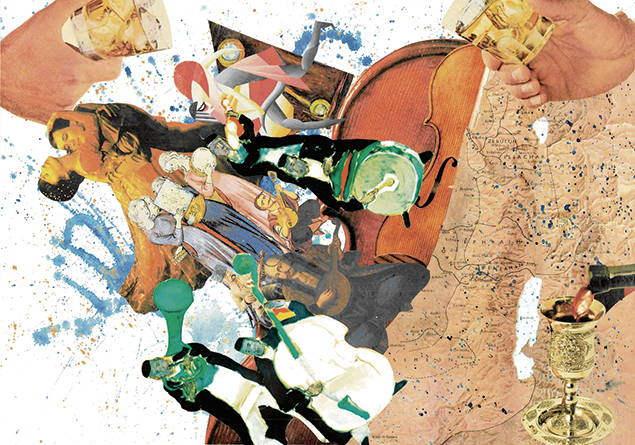
“In many ways, we stand on the shoulders of our parents’ and grandparents’ generation,” Mr. Shamah said. “They had a wellspring of Jewish creatives — Mark Chagall, Gene Wilder, Amos Oz, Debbie Friedman, Mel Brooks — who allowed them to feel spiritually and culturally fulfilled. On the other hand, my generation has so many young talented artists of all different fields, but they find themselves stymied without a platform or space to exhibit or perform their work,” he said. “In order to usher in a new Jewish renaissance, we are going to need the older generation to open their doors and fund our projects.”
“I dream of the Jewish artistic community coming together to find an avenue through which they can feel safe to express their Jewish identity and flourish.
“We are October 8th Jews,” he said. ‘We need a contemporary Jewish culture that calls on our Jewish past and expresses itself in the today and the tomorrow.”
Mr. Shamah’s art exhibits and speaking engagements in New York and New Jersey focused on the crises in Israel and Ukraine. “I try to take the frustration felt from the powerlessness, and the anger at the injustices and bloodshed that Ukraine is faced with, and channel that into a creative conduit,” he said. His art reflects both countries’ struggles in titles such as “Anti-Ukrainian & Anti-Semitic: Conspiracies, Hatred and Historical Inversion — How Soviet and Modern Russian Propaganda Ties Ukrainians and Jews,” “For Those Who Fight For Life,” “From Darkness, The Embers of Hope,” “Jewish Past/Jewish Future,” “Antisemitism and the Artistic Zeitgeist of Today,” and “Our Tomorrow is Today.”
Mr. Shamah’s website is studioshamah.com.