

One people, one camp
NJY Camps welcomes Israeli campers displaced by the war
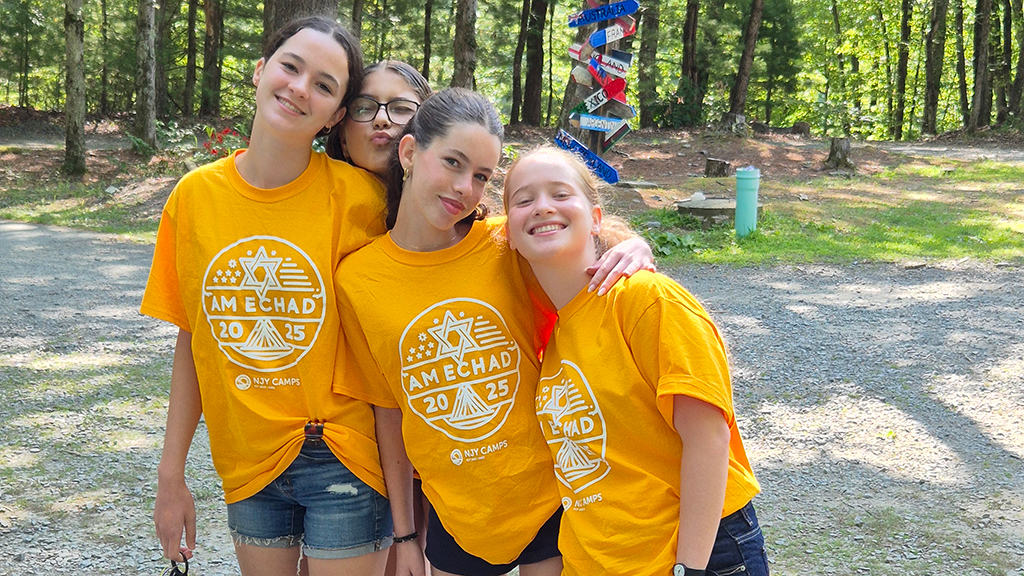
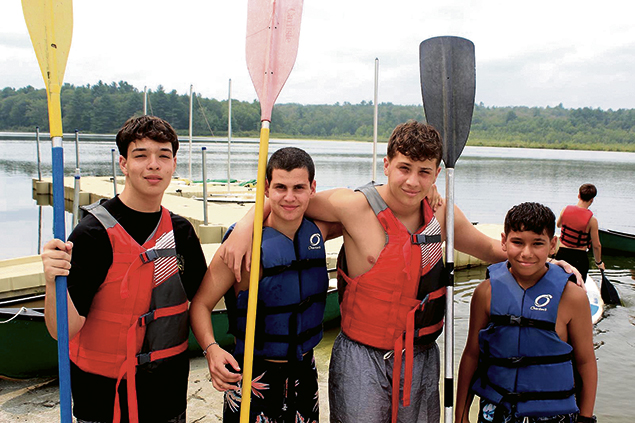
The NJY Camps have provided children, teenagers, young adults, and even some grown-ups with the chance to have a magic summer — you know, with fun things to do, some responsibilities but not too many, friends who become so much part of your life, so much part of your nervous system, that you can’t imagine living without them, even if you do live without them more than 40 weeks a year, a lake, no homework, endless giggles, some boredom but it’s sort of good boredom, no parents — yes, you miss them, a lot, but still, no parents! — and time that seems to stretch on forever until you realize that it’s ending and the summer’s over, and now you just have to wait for the next one.
The adults around you also know that you’re being enveloped in a Jewish way of living and thinking that very well might knit you into the warmth of the Jewish community for the rest of your life. No matter how observant or non-observant your family is, this will always be yours.
The NJY camps have been providing this kind of summer for children for a little more than a century now. They’ve provided scholarships so that kids whose parents couldn’t afford camp still can get to go. The camps are inclusive, nourishing campers from across the Jewish world — not only New Jersey but across the country, and from Jewish communities around the world. They also attract many Israelis, both as campers and as staffers; this year, like most years, there are about 100 Israelis on staff, and more than 300 Israeli campers. That means that all campers learn more about other Jewish communities, and the bond between the rest of the world and Israel has been strengthened effortlessly, year after year.
All this goes very well, and the camp’s administration works hard to maintain its standards and constantly looks to improve its practices. The camp has made it through the hard times this century has thrown at all of us — the economic disaster that was 2008, the ticking-up problem of the mental health issues all kids face, particularly with the growth of social media. And, of course, the pandemic — camp was closed for a summer, and bubbled for the next.
Then October 7 happened.
“Our response to October 7 was that on October 9” — the first Monday after that monstrous Shabbat and then the saddest possible Simchat Torah — “we said that we wanted to bring 100 Israeli kids to camp, free,” Will Eastman, NJY Camp’s chief development officer, said.
They decided that those campers should be kids who had been displaced from their homes by Hamas. “It was an ambitious goal and became an outstanding success,” Mr. Eastman said. “We started talking about it, and those initial conversations snowballed.” With some initial help from the Foundation for Jewish Camp, “the Jewish Agency for Israel jumped at the chance to bring campers together.” Last summer, with JAFI’s help, 1,000 Israeli campers spent two weeks at camps across North America.
This summer, the program, called Am Echad — that means One People — brought 84 eighth- and ninth-grade campers and 11 staff members from two municipalities, Golan and Katzrin in the north, and Ruchama in the south. “It was a wonderful thing to do,” Mr. Eastman said. “These are kids who have seen way too much that they should not have seen.”
Last year, the 100 Israeli kids came right after the regular season ended. “It was such a large group, and we thought it was important to have all eyes on them,” Mr. Eastman said.
“This year, we had 84 campers, 11 Israeli staff members, and three Israeli social workers. Every group of kids came with three staff members and a social worker, all from their municipality. Everyone came knowing someone. We didn’t want to dump them in a place where they didn’t know each other.
“We had several orientations in Israel, so the parents met each other. All the kids came knowing what the camp rules are and what the camp looks like.
“We also hired Gaya Mor, a longtime member of our staff, to be the rosh machane” — the head of camp for Am Echad. “She’s done 500 days of miluim service since October 7, she came to camp right out of deployment in Gaza, delivering humanitarian aid, and now she’s back in service already.
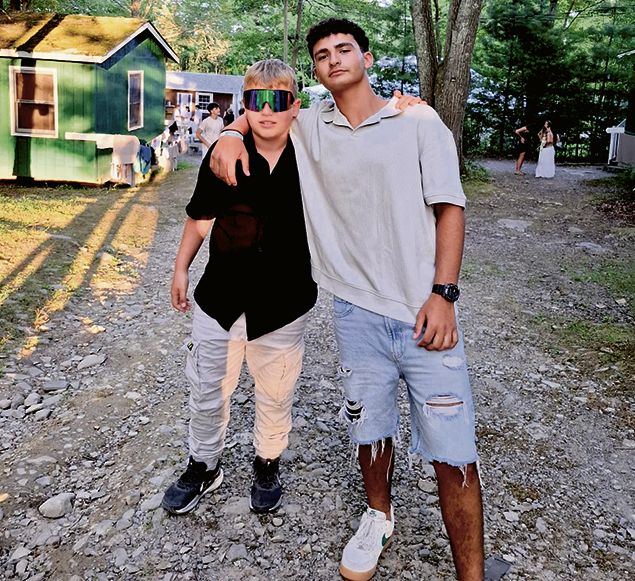
“She’s 26 years old. She’s a true heroine of Israel.”
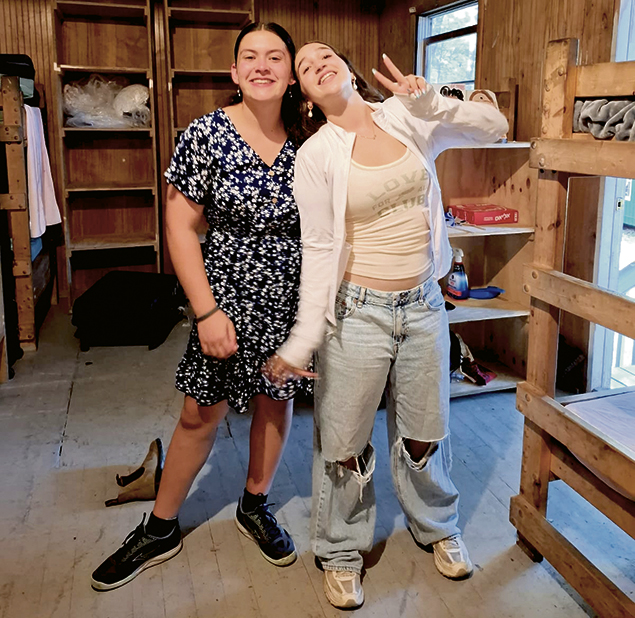
At camp, the Am Echad kids stay together. “We have such a big space,” Mr. Eastman said. “And we could be creative with it. We used our Teen Camp cabins. The teens travel that last week. It’s a little enclosed, with its own pagoda. This part worked out as really well for all of us.”
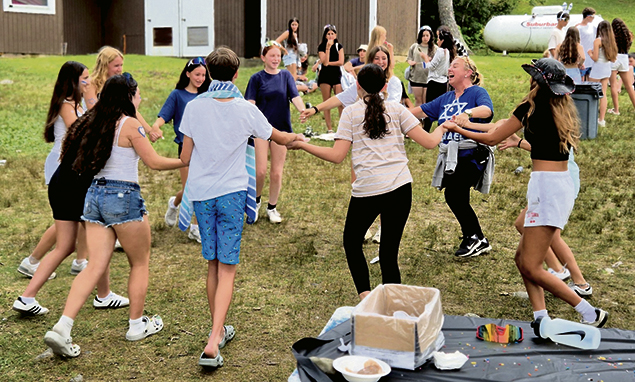
Then, when the Am Echad group left their cabins, “there was an intentional effort to integrate kids,” Mr. Eastman said. That’s not necessarily easy, because the other campers already were together all summer, and probably every summer for years, but on the other hand, some campers come for different sessions, so it’s not unusual to welcome new ones. “We were really intentional about it,” Mr. Eastman said. “We had an ice cream social, and we had our staff working as matchmakers. It had to be informal, or we’d just have the kids rolling their eyes — you know how eighth- and ninth-graders can roll their eyes — but it worked.
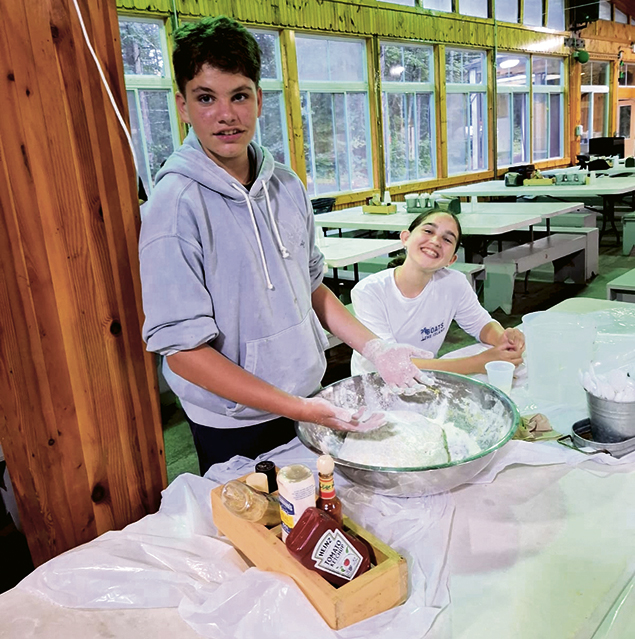
“We wanted to make sure that by the time color war happened, about three or four days after they got there, all the kids were together already.”
And it worked, Mr. Eastman added.
“One week in camp can feel like a lifetime. You can learn so much so quickly.

This year, the group’s first week was the regular campers’ last week, and they spent it at Cedar Lake together. “They came right before color war,” Mr. Eastman said. “It’s hectic then, and they loved it. The camp has a large population of Israelis and Hebrew-speakers anyway, so they weren’t alone.” Most of the campers speak some English, he continued; some speak it well, some not so well, and others not at all.
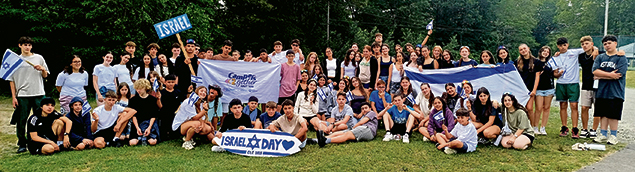
“There are two teams at color war, Tikvah and Emunah” — hope and faith — “and there were Israeli kids on both teams. They were in every element of color war — they did the dance competition, they paid tribute to the hostages.
“We also had an Israel Day for all the campers. We set up Hostage Square.”
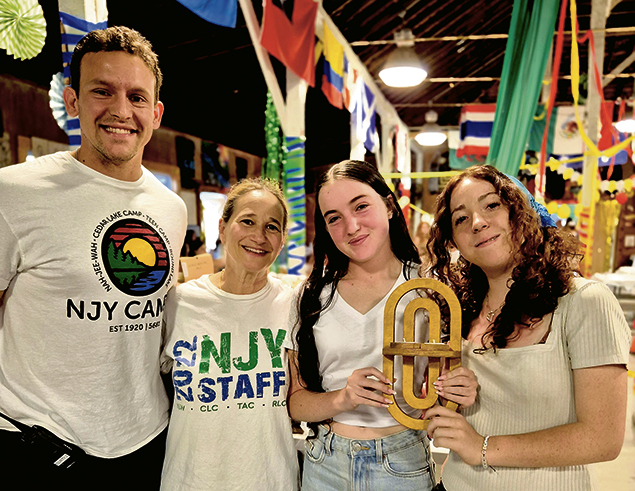
There also was a memorial for adults. “Many of the staff have come to camp during a break in reserve service,” Mr. Eastman said. “Some of them at Na-Jee-Wah and Cedar Lake put up a memorial wall for people they had known who had died — this was for adults — and they talked about it. They told personal stories. It was mind-blowing and heartbreaking. ‘My teacher,’ they’d say. ‘My cousin.’ ‘My commander.’”
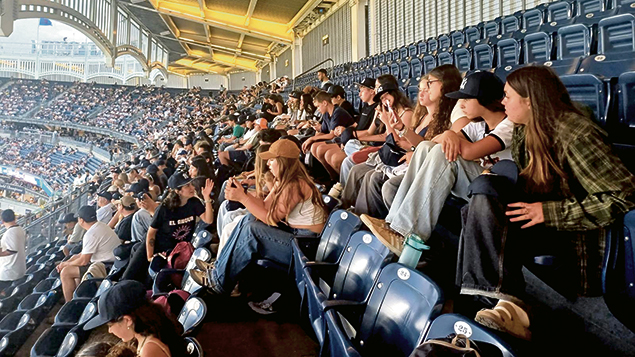
The second week was post-camp. The visitors were taken on day trips. “The Yankees hosted them for a day,” Mr. Eastman said. “That was awesome. They gave every kid a Yankee hat. The kosher booths gave 50 percent discounts. It was a really good experience.”
The campers had wanted to tour Times Square, but common sense intruded. “We reached out to the Summit at One Vanderbilt, and we went up to the extraordinary observation deck on the 90th floor. They donated tickets.” The midtown tour, even without Times Square, was exciting for the kids; perhaps it was less exciting than stressful for the adults. “When they got home from the city and got into their cabins that day, I was so thrilled,” Mr. Eastman said.
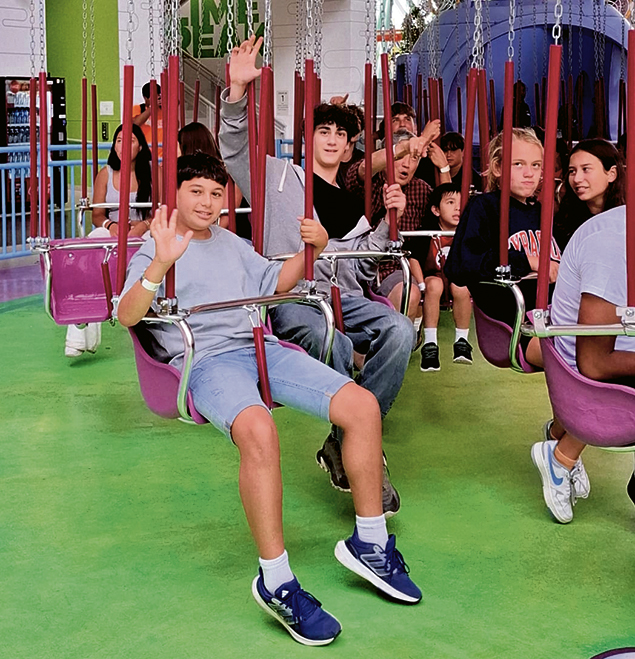
The campers also had a wonderful donated time at the American Dream mall, courtesy of Don Ghermezian.
“Both local federations, the Jewish Federation of Northern New Jersey and the Jewish Federation of Greater MetroWest, are NJY Camp’s biggest federation partners, with more than 500 campers and staff coming from each region,” Mr. Eastman said. “Our sponsors included the Russell Berrie Foundation, both this year and last, and the Wilf Family Foundation.
“It was a New Jersey labor of love.”
The camp also worked closely with JAFI. “It’s been a 50/50 funder with each camp,” Mr. Eastman said. “They recruit kids and get them to us. They organize the schedules, buy the tickets and travel insurance. We provide the campers with scholarships while they’re here. We cover those costs. So JAFI finds, recruits, orients, and sends them to us. It’s our job to take care of them once they get to the airport.”
He hopes that the program will continue next year and beyond. The specificity of the needs will change, of course, but the desire to take Israeli children who need a break and give them one at the NJY Camps will continue.
“The whole reason that it’s called Am Echad is so that they know they’re not alone. We are with them. We think about them every day. We wear our hostage necklaces. We pray for them. And now they know that there are lot of people out there who think about them and love them and can’t wait to meet them.”

The program is hard work, Mr. Eastman said. “We — Daniel Hosiassohn, who runs all of our Israel programs, and I — have been working on it since last year, working on logistics and fundraising. It has been a ton of work. I am typically not a program person, but I did it, with Daniel and Gaya. It was a huge labor of love, and also a lot of work.”
Listening to Mr. Eastman, it is clear that he is deeply moved by this program. His talk about it has absolutely nothing to do with lip service and everything to do with commitment.
“Professionally, we all feel that this is the most important thing that we have done as camp professionals,” he said. “This is living our values. This program is expensive, and we have to raise a lot of money, and there is a lot of bureaucracy to deal with. But I put all that mishigas to the side every second that I do this work.
“Honestly, I miss those kids,” he added. “When last year’s kids left, I cried. This year, I cried a little less. I’ve toughened up a little bit.
“A lot of these kids say thank you. They offered to write letters to donors. They are very mature. When they saw one of us, they’d come over and say thank you. One kid said, ‘I want you to know that this is the best camp ever.’ This was a six-foot-one ninth-grader. And it makes it all, all the work, worth it.
“It’s a real labor of love,” he said.