

Journey of a tray and a spice box
What it feels like to hand objects down from generation to generation
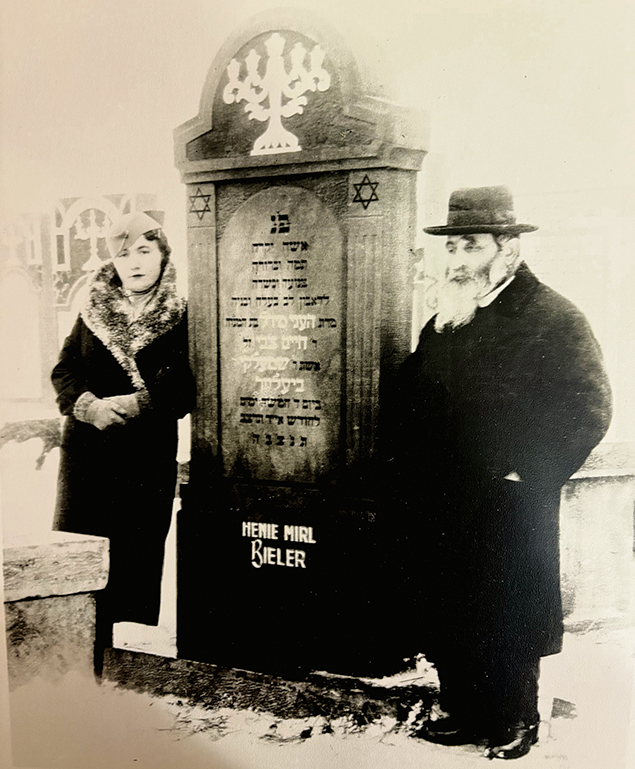
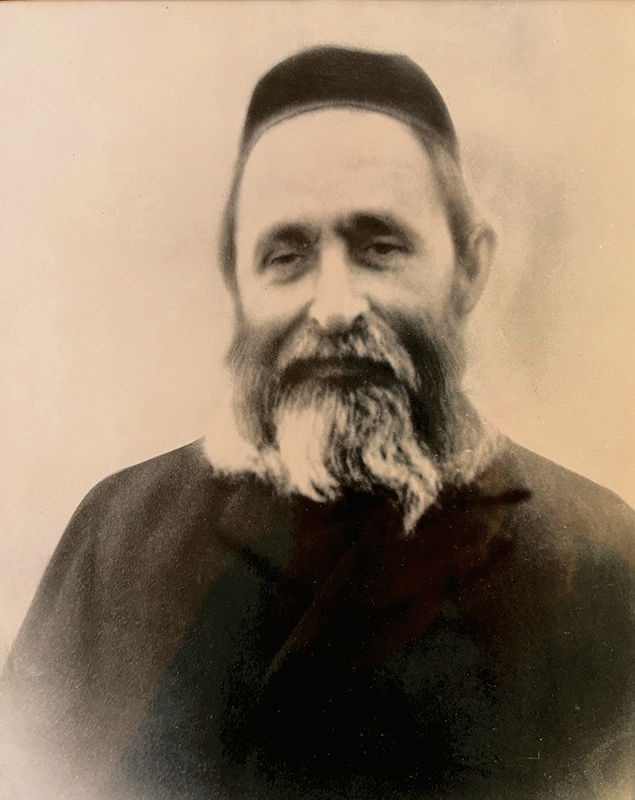
Yekutiel Schmelke Bieler was born in Poland to Moshe and Zosia (Shifra) Bieler in 1870. I am not related to him by blood; I am, however, connected to him inextricably through the gift of family. My late husband, Bruno, was Schmelke’s grandson. And the older I am, the more powerful is my awareness of our bond.
As a husband and father living in Tarnopol, Poland, Schmelke Bieler was a pious, Sabbath-observant Jew who owned a large, well-known kosher salami factory in what was then a thriving city. (People sometimes used both his first and middle names, but he was often more casually called Schmelke Bieler.) When my husband and our oldest daughter traveled to Tarnopol on a roots trip in 1995, they met an old man who was a child during the early 1900s. He remembered the factory and showed them where it once had stood. He also told them that you could smell the savory aroma of the salami from miles away. And even more importantly, Jewish Polish soldiers coming into Tarnopol always knew they could trust the kashrut of Schmelke Bieler.
Yekutiel Schmelke and his wife, Henia Mirel, who was born in 1873, were blessed with seven children, three sons and four daughters. Henia Mirel died on the 5th day of Iyar in 1932, about a year before Hitler’s rise to power began when he was appointed chancellor of Germany. She could not have imagined that an unspeakable massacre was about to occur a few years later. Surely nothing in her wildest imaginings would have foreseen the sinister days, blacker than black, when Yekutiel Schmelke, five of his seven children, all their spouses, and all their children would be murdered in the Shoah.
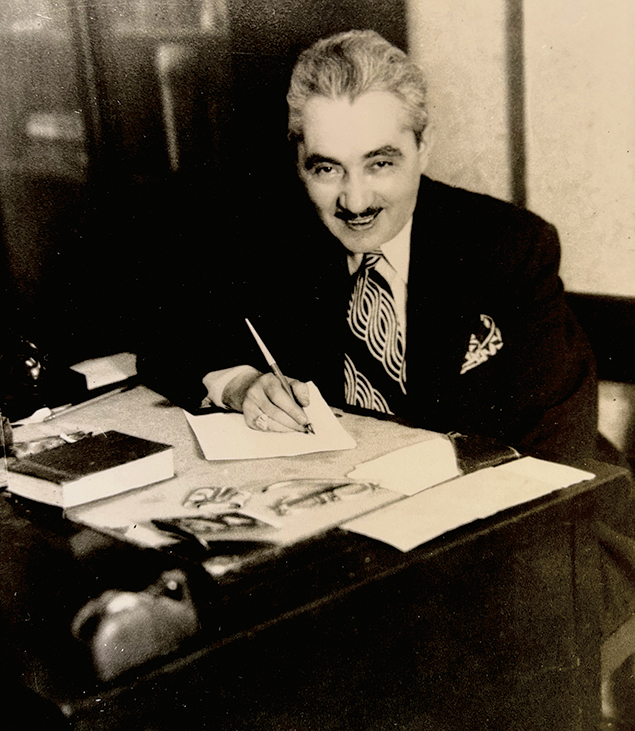
Schmelke’s oldest son, Chayim, a very adventurous young man, had left Poland years earlier, most likely in the early 1920s looking to build a new life in the Goldene Medina, the golden land of America.
Schmelke’s youngest son, Meyer, also survived the war, though quite differently. As a physician, he joined first the Polish and then the Russian armies. But my understanding is that before Meyer left home, he sensed the Holocaust that was about to befall the Jewish people. Perhaps Meyer’s father shared that dread. I was told that Meyer took a number of treasured items and photos from his parents’ home and his own home and hid them in a secret hole he built in the wall of his house. Toward the end of the war, Meyer returned to his home, likely still dressed as a Russian soldier. The house was then occupied by a Christian Polish family; I imagine that without a moment’s hesitation, Meyer boldly walked in, smashed open the wall, retrieved his possessions, and walked out of the house forever.
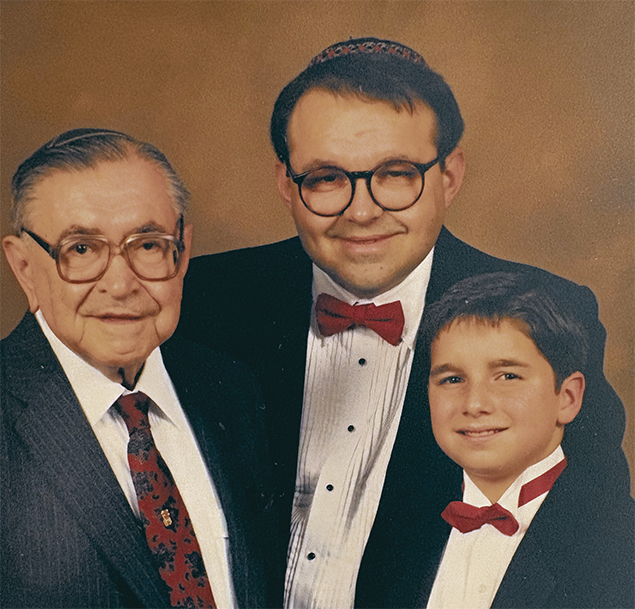
Meyer and his wife were reunited sometime in 1944. Their only son, Bruno (who was my husband), was born in April 1945, and after three years living in a displaced persons camp, Meyer’s older brother Chayim sponsored them as they closed the door of their old world and traveled in 1948 to open a new door that beckoned through Ellis Island.
I became a Bieler in name when I married Bruno in 1967. Quite naturally, it took time for the connection to his history to become deeper. Obviously, I never knew Yekutiel Schmelke, but through the years he has become very much a part of my consciousness. I own two beautiful objects belonging to him that were hidden in that wall. And when I touch those objects, I feel Yekutiel Schmelke’s soul speaking to me.
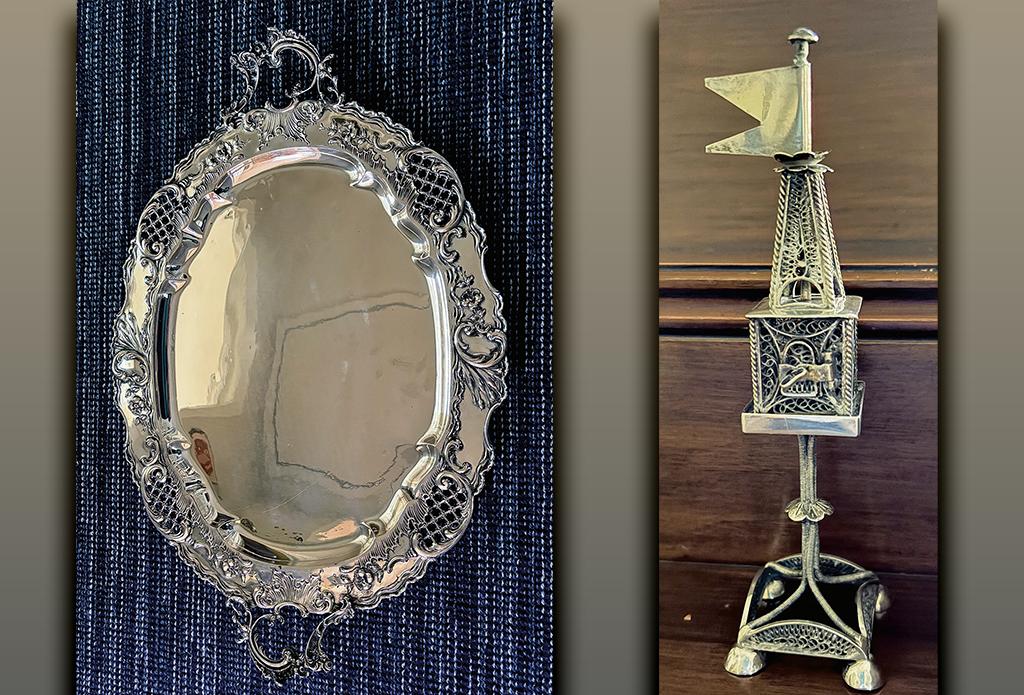
One is a large silver tray that was used in his family for every pidyon ha’ben (redeeming the firstborn son) ceremony. I have no idea how many Bieler baby boys were brought to a Kohen on that tray, but I smile when imagining how amazing it would have been if the name of each child had been engraved on that stunning piece of silver.
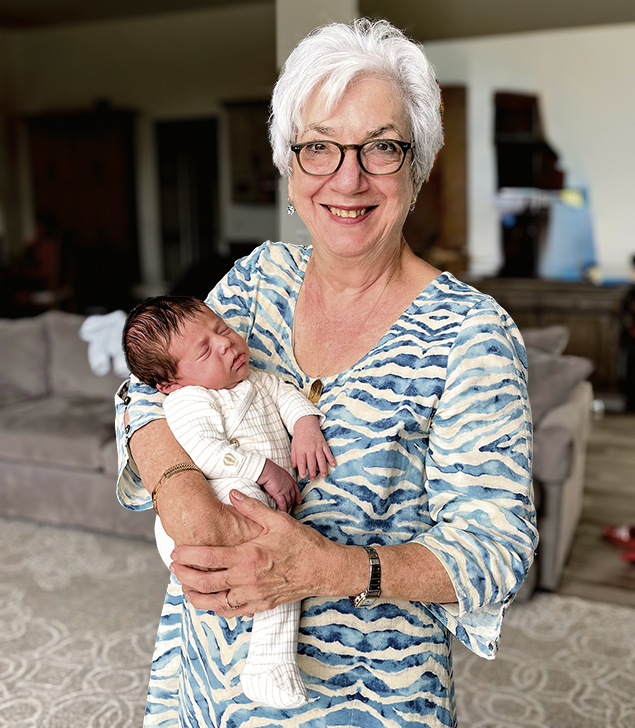
A pidyon ha’ben is not a common occurrence, and I was about 40 years old when I attended such a unique ceremony for the very first time. But I have been blessed to use Schmelke’s tray three times thus far in my own family. My oldest grandson, Gershon Avigdor, was carried on that tray first. My fourth grandson, Dov Betzalel, was carried on the tray six years later. And most recently, on the Sunday between Yom Kippur and Sukkot this year, my first great-grandson, Ben, was the lucky passenger. The first night of Sukkot was the very next night, and this celebratory ceremony was most definitely the start of my zeman simchateynu — my time of rejoicing — during the Sukkot holiday.
Of course, one-month-old Ben could not have understood the significance of resting on a pillow atop this beautiful tray that belonged to his great-great-great-grandfather. But for me, when I touched that piece of ornate silver and marveled at the baby lying upon it, I was overcome with both profound joy and sadness. I felt a powerful connection to the tray’s original owner, to the life he lived, to the family he loved, to the dreams he might have cherished, to the grief about how he and his family died. But I was also comforted in believing in the deepest part of my heart that the souls of Schmelke and his son Meyer and his grandson Bruno were with me that day. Surely they were watching and were at peace, knowing that my children and grandchildren and great-grandchild have carried their essence forward.
A second treasured item I own that had been hidden in the wall is a delicate havdalah besamim (spice) box. At some point when both my husband and his father were still alive, Meyer inexplicably decided to thank the family’s eye doctor for all his kindnesses over many years by gifting him the spice box. Meyer was quite elderly at that point and likely had a moment of not thinking clearly; he never would have simply given away his father’s treasured piece of Judaica. But I remember Bruno being quite distraught when he discovered that his father had given away a family heirloom. I have no memory of why he did nothing about it.
Years after Bruno died in November 1999, I thought about that box often. Do not ask me why. And the more I thought, the more agitated I became, until the day I decided that when I had my next yearly examination with that very same eye doctor, I was going to ask him to return the piece. Most likely the doctor had no idea that this was a family heirloom and was simply trying to make his elderly patient happy by accepting the gift.
My children, quite naturally, thought that my plan was beyond chutzpadik and were appalled that their mother would consider doing such a thing. Their disapproval did not dissuade me.
I went to my yearly appointment confident of my plan. When the eye exam was completed and results were shared, the doctor, as always, inquired about the well-being of my family. This was my moment.
“Perhaps you remember that years ago, Bruno’s father gave you a besamim box to thank you for your kindnesses,” I said. He responded a bit vaguely that yes, he thinks he remembers. “Well,” I continued more committed than ever, “Bruno was truly distraught that his father gave that family heirloom to you, which I’m sure you can understand. It actually came from the home of Meyer’s parents. In truth, that spice box doesn’t really belong to you; it actually doesn’t belong to me either. It belongs to my children, the great-grandchildren of the original owner.
“I know it’s a bit of a crazy request, but it would be wonderful if you returned it to me. Do you think you can do that?”
I most definitely threw him off balance. I was sorry I made him feel that way, but I did not regret the ask. “I’ll look where I have it,” he responded hesitantly. Two weeks later a package with the well-wrapped spice box was delivered to my door. My children were amazed; the doctor and I never spoke of it again and I have continued my annual appointments.
I brought the piece to my wonderful Jewish silver repairman to straighten the bent little feet and then joyfully placed this prized possession under glass with my other beautiful silver pieces.
A number of years ago, I was looking to sell some items that had no significance to me and invited into my house one of the antique dealers who often advertise in the Jewish Standard. Walking into my dining room, he quickly glanced at the many pieces I have under glass. He immediately focused on one piece only: Yekutiel Schmelke’s besamim box. “I’d buy that from you,” he said. I smiled politely and told him unequivocally that it was not for sale.
One day I will give that piece of Judaica to one of my children. And I have faith that the silver tray will continue to be used by Bielers long after I am no longer its caretaker. But what I have now is the deepest faith that the souls of Yekutiel Schmelke and Meyer and Bruno and all the Bielers who died al kiddush Hashem never have to worry. These treasures will remain safely in the hands of future Bieler generations. And the stories we know about how they lived and how they died will be told over and over again. Rabbi Dr. Jonathan Sacks said: “The focal point of Jewish life is the transmission of a heritage across the generations.”
L’dor v’dor. Jewish faith. Jewish history. Jewish family.