

‘Holding Liat’ holds the unexpected
Documentary records the unorthodox response by an October 7 hostage dad

Shortly after October 7, Brandon Kramer began filming Yehuda Beinin, whose daughter and son-in-law, Liat and Aviv Atzili, were kidnapped by Hamas.
The result is “Holding Liat,” a complex, occasionally heartbreaking and — depending on your politics — often unexpectedly infuriating documentary about how one family dealt with what happened.
Mr. Kramer, a documentary filmmaker, and the Beinins are distantly related by marriage. “A little over 20 years ago, when Lance and I went to Israel for the first time, we stayed with Liat’s parents, Yehuda and Chaya, on their kibbutz Shomrat,” he said. (Lance is his brother; he produced the film.)
“And we also stayed with Tal,” Liat’s younger sister, “in Tel Aviv,” Mr. Kramer continued. “So though they were distant relatives, they were our introduction to Israel, and we stayed in touch with them over the years We were close with the family before October 7.”

But the family relationship didn’t guarantee Mr. Kramer and his crew access to the Beinins. “It’s a slow and thoughtful process with any film, but especially a film dealing with relatives in a moment of crisis,” he said. “It wasn’t just one conversation, where you’re like, ‘We’re making a documentary. Are you game to participate?’ It’s a process that unfolds over days and weeks.
“But Yehuda’s daughter was a history teacher” — Liat specialized in Holocaust studies and led groups on tours of Yad Vashem — “and he felt that what they were living through was historic and his daughter would want this documented. Thankfully he had the courage to be incredibly vulnerable and open up his life.”
Much credit is due Mr. Kramer and his crew, who are seemingly everywhere with Mr. Beinin — at home in Israel, when he travels to Washington as part of a delegation intended to build support for Israel, and when he receives middle-of-the-night phone calls from the military liaison officer informing him first that Liat was alive and, days later, that Aviv was not.
He was there when Mr. Beinin learns that Liat, who, like her father, holds dual Israeli-American citizenship, is on a list of people to be released, and he’s there over the next several days when he was told not yet. And of course Mr. Kramer’s camera is there when she returns.

The most poignant scene in the film is when the family is finally reunited and Yehuda breaks down in tears. Not that that is an unexpected reaction — but it is unexpected from him. He comes across as a gruff, my-way-or-the-highway kind of guy, who, as Mr. Kramer points out, is “a very political person. He has been his entire life.”
The Washington delegation’s sponsors urged participants to focus on the pain and suffering they were going through with relatives held captive by Hamas in conversation with members of Congress.
“Yehuda was not comfortable doing that,” Mr. Kramer explained. He took “the position within days of his daughter and son-in-law being taken captive that we need to get them home, but we also need to use this moment to advocate for peace, for reconciliation, for coexistence.” In fact, he went further. He didn’t want Liat’s captivity to be used to justify violence in Gaza.
Fortunately, I watched the documentary at home on my computer, so no one heard the expletives I hurled at the screen. It’s always easy for critics to say what they don’t like. But Mr. Beinin didn’t offer a viable alternative. Did he want Israel to rely on the international community to secure his daughter’s release? That would have gone well. Or perhaps he wanted to send in troops to be slaughtered as Hamas soldiers popped out of tunnels?

I wasn’t the only one who disagreed with him. His decision “to take a more political stance caused a lot of tension amongst his own family and others, as well,” Mr. Kramer said. Consider Netta, the middle of his three grandchildren, who accompanied him to Washington. Netta barely survived the attack and was understandably traumatized. He was, Mr. Kramer notes, “deeply angry and enraged at the idea that Yehuda was going to be speaking to politicians and media about peace. Reconciliation was not something he wanted to entertain at all.”
Similarly, his daughter Tal didn’t feel the time was ripe to discuss peace and reconciliation. She felt the focus needed to be on getting her sister and brother-in-law home.
Ironically, Yehuda’s position was conservative compared to that of his brother Joel, a Stanford University professor emeritus of Holocaust history. He’s filmed addressing an unnamed group seemingly suggesting that the events of October 7 were Israel’s fault.
“There is no way to understand the events in Israel and Palestine without understanding Nakba,” Dr. Beinin said. Some 750,000 Arabs left Israel in the aftermath of the creation of the Jewish state. While some were expelled by Israelis, many were ordered out by surrounding Arab states, and many left voluntary out of fear of what was to come.

Then Joel Beinin said, “Nakba doesn’t mean the genocide of the Jewish people or driving Jewish people into the sea or even necessarily the end of the Jewish state.” In retrospect, I should have anticipated that philosophy the moment I saw Yehuda driving his decade-old Prius with the Bernie Sanders bumper sticker.
Though this was not revealed in the film, both Yehuda and Joel (who lived in Metuchen for six years) were part of the Hashomer Hatzair movement. They emigrated from the United States in the early 1970 hoping to live a socialist life on an Israeli kibbutz.
Joel, disillusioned in part when he learned that he lived on land once owned by Arabs, returned to the United States. Yehuda stayed, though he became increasingly unhappy with the direction of Israeli politics.
“It’s not my job as a filmmaker to say this political belief is right and this perspective is wrong,” Mr. Kramer said. “There are a lot of films that advance a specific agenda. That’s not this movie. We made this movie because we felt the different perspectives would be a way to have a conversation amongst families and communities — which is something not happening now…
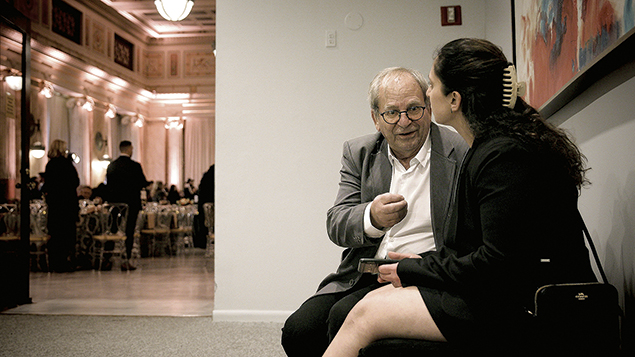
“He had a vision for Israel that was rooted, yes, in socialism, but also coexistence and humanitarian values. For Yehuda over the decades, he’s become disillusioned with the direction that Israel has moved in. With this horrific attack, with his daughter and son-in-law held captive, his grandchildren almost killed, he wanted to use this moment to speak the values he believed in his whole life.
“He needed something more than a military response. He needed something that actually shows a path toward a sustainable future for Israelis like himself and also for Palestinians. That was what he felt was missing from the equation.”
“Holding Liat” opens at the Film Forum in New York on January 9. A streaming release will follow.
Curt Schleier of River Vale covers the arts for the Jewish Standard/New Jersey Jewish News.
comments