

Grief and hope
Rachel Goldberg-Polin talks about her son Hersh
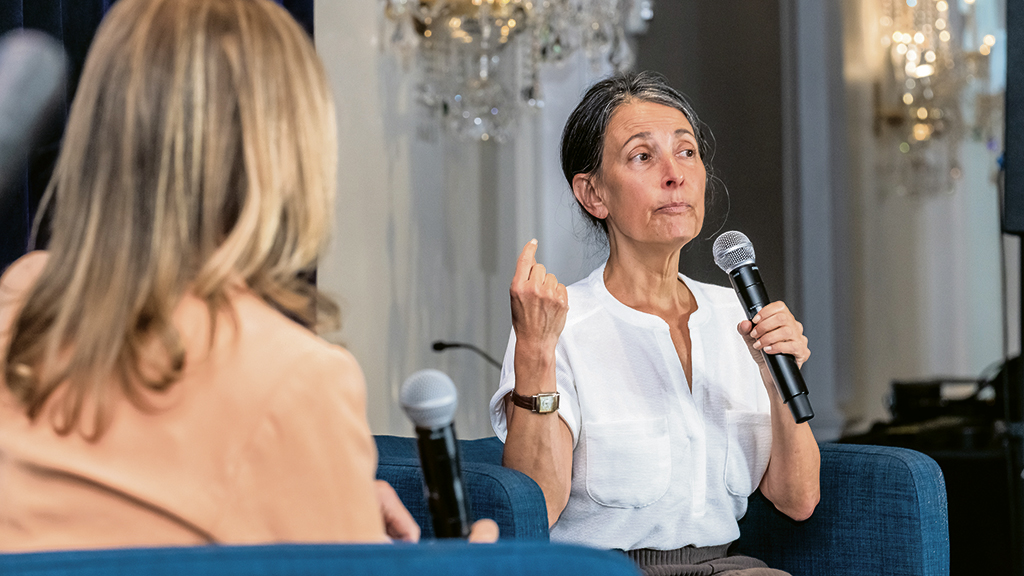
It can be hard to imagine that any discussion about the October 7 terror attacks by Hamas and its impact on the hostage families could elicit even the most minute chuckle, let alone a laugh and smile and hope.
Yet that was exactly what happened when Rachel Goldberg-Polin, who calls herself an “optimist,” spoke to more than 700 women as the keynote speaker at the Jewish Federation of Northern New Jersey’s annual women’s spring luncheon on May 6 at the Rockleigh Country Club. She spoke openly and honestly about her son, Hersh, who was abducted by Hamas and murdered in captivity when he was just 23, and about her new book, “When We See You Again,” a No. 1 New York Times bestseller.
She speaks about the before and the after, and about love and pain, humanity and grief.
Almost from the beginning, it was as if she tried to lighten the load that she knew people were carrying. Settling in for her talk, she looked around the room and said, “I like being in a room with powerful women and a few good men,” earning a chuckle from the audience.
The talk was facilitated by consumer reporter and writer Janice Lieberman, who has known the Goldberg-Polin family for many years and has spent Pesach holidays with them, when “our kids played together.” Ms. Lieberman and Ms. Goldberg-Polin even mentioned trying to set up a shidduch backstage for their children, earning another laugh from the audience.
But then it was on to the heart of the talk. In addressing what the book “is not,” Ms. Goldberg-Polin said it is not a memoir or a tell-all, nor is it a story of a phoenix rising from the ashes. What it is, she said, is “a love letter swallowed in pain.
“I was gagging, drowning in my pain, and Jon said, ‘You need to get this out,’” she said. “I feel these words are packages of pain.” (Jon is her husband, Hersh’s father Jon Polin.)
As someone who prays daily, Ms. Goldberg-Polin noted that the morning blessing “Baruch shamer v’hayah ha’olam” is about God who said words and created a world. “In some ways, I was trying to bring Hersh back in words,” she said.
The book also is an attempt to answer the most basic of questions and the one that remains complex and difficult for Ms. Goldberg-Polin to answer: “How are you?”
“Do you not see there’s a dagger sticking out of my chest?” she asked, noting that of course people don’t see it, and “I can’t be mad at them” for that. Yet through the book, she hopes people can see her pain.
Noting that she has a disorder called “grief,” she said, “many millions of people buried their children, but that feels out of order…. I realized love does not die. Love is stronger than death. Love is stronger than time.”
But that’s something she didn’t know before they lost Hersh.
Grief, she said, “is a gorgeous price we pay for having loved someone so deeply,” adding that grief is a “badge of honor.”
Calling the time that Hersh was held hostage “purgatory,” she said her family had no idea what Hersh knew or thought during his time in captivity until Or Levy was released from Gaza after 491 days. (Mr. Levy was released alongside Eli Sharabi and Ohed Ben Ami; all of them “came out looking like [it was] 1945,” Ms. Goldberg-Polin said.)
Almost immediately after he was told his wife had died on October 7 and he was reunited with his young son, Or asked his family about Hersh and how he was doing. Through video footage, the families knew that Or had been in the bomb shelter with Hersh and Aner Shapira — who tossed out seven grenades that Hamas threw into the shelter, and died when the eighth exploded in his hands. But as far as the two families knew, there had been no previous connection between Hersh and Levy.
Why then did he ask about Hersh?
Noting that the Hebrew word “or” means “light,” she said that “Or’s parents were endowed with divine inspiration” when they named their son, because he brought a “shaft of light” into their lives.
“Jon and I had been living in complete darkness,” like a “box within a box,” until they met Mr. Levy, who told them that he had been in the tunnels under Gaza with Hersh at one point. Mr. Levy recounted that Hersh would quote the Holocaust survivor, psychiatrist, and author Viktor Frankl, who wrote in his book “Man’s Search for Meaning” that “He who has a why can bear almost any how.” Mr. Levy’s “why,” Hersh had told him, was his son. He had to survive to get back to his child.
Focusing on that “why” gave Mr. Levy strength.
And Hersh’s “why,” Mr. Levy told the Goldberg-Polins, was his family. “Or said, ‘He heard your voices.’ And I said, ‘You mean he heard I was interviewed?’” Ms. Goldberg-Polin recalled. “And he said, ‘He heard you, your voice on the radio, in Gaza, speaking in English.’
“We had buried Hersh, and we never knew if he knew that we were running to the ends of the earth, doing what every parent would do. But he knew, and we never knew that he knew until that minute, and that whole conversation was a pivot for us,” she said. “When we have a goal, when we have a purpose, when we have meaning … we can get through anything.”