

Fred Lebow’s late-life religious awakening
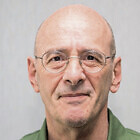
On a Tuesday night in late February 1990, Fred Lebow – president of the New York Road Runners Club and co-founder of the New York City Marathon – lay alone in Mount Sinai Medical Center in upper Manhattan. He had found out earlier in the day that he had a rare cancer of the brain, a malignant tumor growing in the left frontal lobe of his skull. Doctors had told him he likely had only three months to live, maybe six at most.
Two years later, I came to know Lebow a little. We met in his office a few times for several hours in all. He had reached age 60 but was frail, looking older than his years. He moved his angular frame haltingly around his office, taking small steps, almost shuffling. His desk was surrounded by photos of him with Pope John Paul II and presidents Reagan and Bush, along with trophies and plaques.
Fischel Leibowitz was born in western Romania, in the small Transylvanian town of Arad, the second youngest of seven children in an Orthodox Jewish family. When the Nazis occupied Arad, his father was sent to a work camp, where he was ordered to wear a yellow star stigmatizing him as a Jew. Later the boy would learn that the Nazis had murdered his grandparents, uncles, aunts, and cousins.
Get The Jewish Standard Newsletter by email and never miss our top stories Free Sign Up
Separated from his family at age 13, penniless, he lived life literally on the run all through his teenage years. He fled his homeland to Bulgaria, then migrated to Czechoslovakia, Holland, England, and Dublin, jumping freight cars to ride for free. He smuggled diamonds, packaged in prophylactics, across borders, earning hefty fees as a courier.
His brush with totalitarian regimes defined hm as an escape artist, a hustler, quick on his feet and ever ready to cut a deal with border patrols. Anything to survive. He arrived in the United States in 1951, living first in Kansas City, then in Cleveland, and finally — reincarnated as Fred Lebow — in a $69-a-month apartment shared with a friend in midtown Manhattan.
Last year, the New York City Marathon Lebow helped create was the largest in history, featuring 56,000 runners who came from 137 countries and all 50 states. Since 2006, the run has raised $520 million for charity. Lebow is widely acknowledged as a pioneer in long-distance running, bringing it into the global mainstream and elevating the ancient marathon to the status of 20th-century spectacle.
Back in his office, Lebow leaned back in his chair, his eyes sad but somehow not resigned, his voice a whisper almost impossible to hear. He confided to me that cancer had changed his life. Shortly after he was treated, he told me, he reverted to the Judaism he had all but abandoned decades earlier.
“Before, my attitude was: ‘Religion, who needs it?’” he said. “I used to belittle it. I was brought up a very religious Jew. But I hated Hebrew school, hated it terribly, and I was a bad student. In the past, Jewish people would call to invite me to banquets and functions, and usually I said no. Now I usually say yes.”
Lebow nibbled on a rugelach I had brought from a kosher bakery around the corner. A fan whirred overhead. Telephones trilled in the background, with calls from would-be race sponsors, invitations to pose for running magazines and appear in out-of-town marathons, and an offer from a book publisher to write his autobiography.
“I feel more humble and spiritual now,” he said. “I believe in God. I go to temple more often. I read more Jewish books. I’m definitely a stronger Jew than I was 10, 20 years ago. I feel more of a kinship now to other Jews.”
In 1992, with his cancer believed to be in remission, Lebow, who had competed in 68 marathons in 35 countries, ran for the first time in his own New York City Marathon. He wore number 60, emblematic of his age. He tottered along, accompanied by 25,945 runners from 91 countries and 49 states. Among the estimated two million spectators lining the race course were his beloved sister Sarah and his brothers Shlomo, Michael, Morris, and Simcha.
The thin, bearded figure, wearing a lime-yellow racing cap and neon blue running suit, approached Williamsburg, a community made up largely of Orthodox Jews, and felt a twinge of kinship. The chasidic Jews along the route shouted out “Shalom!” to him, and he returned the greeting in kind. It warmed him to be urged on by the strictest standard-bearers for the Judaism he had lost in his flight from Nazis and Communists, only to find his religion all over again when he was near death.
Lebow crossed the finish line with a time of five hours, 32 minutes, and 34 seconds, and received the longest, loudest cheers of any runner that day. New York City Mayor David Dinkins hugged him.
Two years later, Fred Lebow succumbed to brain cancer. He died on October 9, 1994. A mere month later, at the 1994 marathon, New York City Mayor Rudolph Giuliani unveiled a 600-pound life-sized bronze sculpture of Fred Lebow in Central Park. Lebow is shown in his trademark running suit, looking at his watch as if to time runners crossing the finish line. Every year, in his honor, the statue is relocated from its year-round spot at 90th Street and East Drive to the race’s finish line, all but bringing him back to life.
“Respect for religion and its traditions have calmed me and made me more aware of the need for compassion toward others,” he had told me. “It also makes me feel a bit more responsible for other people. I realize that I am not a man here by myself, but that I exist within a world community of other people.”
This year’s New York City Marathon will be run on Sunday, November 2.
Bob Brody, a consultant and essayist, grew up in Fair Lawn. He is author of “Edge Against Cancer: The Athlete’s Advantage Against Cancer And How To Gain It” and the memoir “Playing Catch with Strangers: A Family Guy (Reluctantly) Comes of Age.”