

Fair Lawn mom vs. Hezbollah drones
Operation Israel founder deploys netting system to disable enemy UAVs
Northern Israel has been targeted by rockets and missiles launched by Hezbollah terrorists from Lebanon for more than two and a half years. Israel has the technology to detect and intercept these projectiles.
But the newest menace, explosive unmanned aerial vehicles, are Hezbollah’s current weapon of choice. That’s because UAVs — aka drones — are difficult to detect and deflect.
Explosive UAVs are injuring IDF soldiers and hitting civilian areas with alarming frequency. Recently, an unexploded Hezbollah UAV was discovered on the roof of a school in Nahariya, the Jewish Federation of Northern New Jersey’s sister city on Israel’s northwest coast.
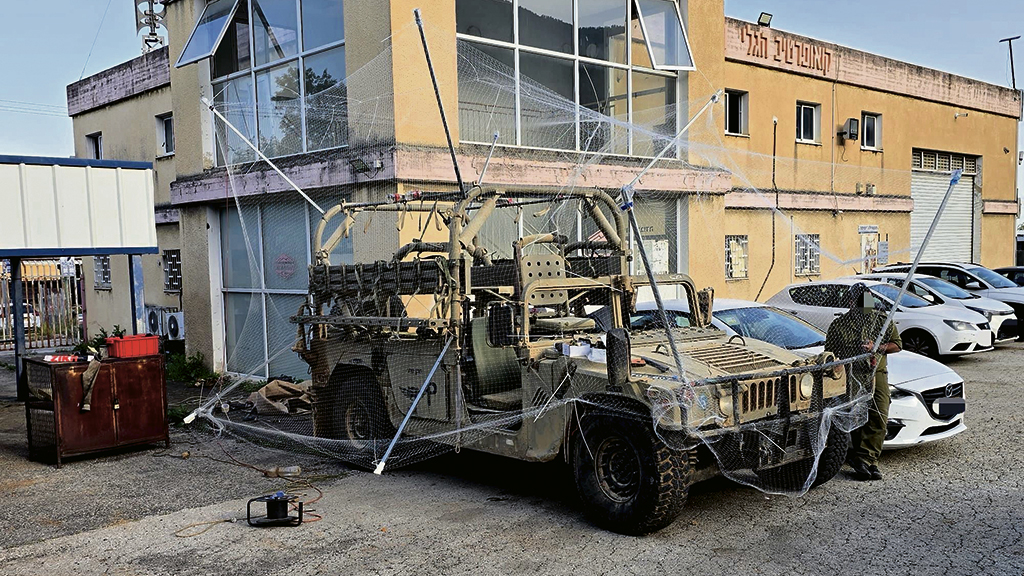
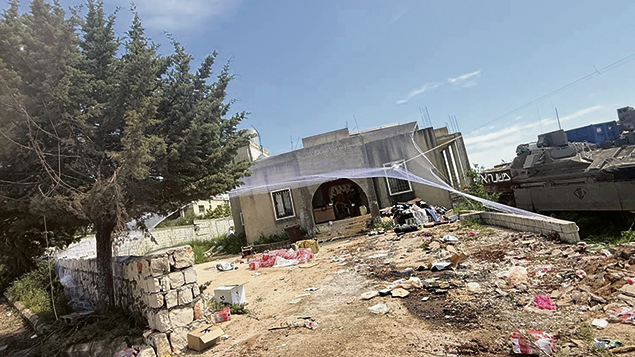
Operation Israel, a volunteer-based nonprofit established by Adi Vaxman of Fair Lawn in the wake of October 7, is putting resources into developing a potentially lifesaving yet low-tech anti-drone solution: a mesh netting that catches the propellers of incoming drones, like a spiderweb, before the attached explosive device can detonate.
Dr. Vaxman explained that this is an Israeli innovation co-developed by Operation Israel with Israeli military and engineering experts, inspired by a similar solution used in Ukraine. About 10,000 square meters of anti-drone netting — which costs $1.20 per square meter — has been deployed so far as part of a field test in northern Israel.
“Everything we do is to save soldiers’ lives,” Dr. Vaxman said. “Operation Israel does not purchase or supply weapons or offensive gear of any kind. The netting is purely defensive. At least three soldiers have personally reported they would have been killed without the netting in place.”
 Operation Israel previously has invested in technologies such as “centipede” robots that scout out deadly improvised explosive devices, and 360-degree tank camera systems to alert soldiers inside to dangers on their path. That’s in addition to tons of off-the-shelf protective gear purchased for IDF soldiers from the start of the multifront war two and a half years ago.
The all-volunteer organization, run by a handful of people in the United States and Israel, including Dr. Vaxman’s father-in-law in Israel, has raised approximately $11.4 million since its founding. About $35,000 has now been raised toward a goal of $300,000 for the anti-drone netting campaign. Dr. Vaxman said that less than 2 percent of donations go toward overhead.
“In October 2023, we really did think Operation Israel would last only a few months,” she said. “We are all volunteers, so this is a big undertaking for people who have jobs and children.”
Dr. Vaxman heads a management consulting company; she and her husband, software engineer Ronen Magid, have three children. “But we’ve realized that this is no longer just a crisis situation. It’s more an ongoing Israeli reality. And within that reality, our role has evolved into a more permanent one of filling gaps.”
She emphasized that the gaps do not represent IDF failures but rather address normally long procurement cycles of three to five years before a solution is adopted. “Operation Israel fills the window between threat identification and institutional response,” she said.
“We have also kind of grown into a role of lending expertise that we have accumulated over this period of time. The relationships that we have established with field commanders, and the trust that we have established, give our organization the opportunity to fill gaps and solve problems that come up in real time. Those explosive drones are a good example of that.”
 She added that the equipment Operation Israel strives to offer quickly does not necessarily provide permanent or ideal solutions. The goal is to put something in place that can save lives while better options are under development.
“This is the one thing that we care about,” she said. “We don’t care about politics or elections. We don’t care about the government. We want to save lives and prevent injuries.”
This mission is very personal for her. “My brother has been fighting in Gaza, and now in Lebanon, for nearly three years,” she said. “And his son had his IDF swearing-in ceremony yesterday, so now I’m going to have two to worry about.”
Operation Israel also has begun doing advocacy within the Israeli government to help remove bureaucratic obstacles from the process of getting lifesaving innovations onto the battlefield faster.
“Look, our enemies are evolving faster than we are,” Dr. Vaxman said. “They have access to more resources and are bound by less red tape than we are, so we need to keep on innovating. When we get approached about testing new ideas, we always say yes because you never know what can come out of them.
“When we take on a project, we put some budget into assembling a team of experts to test and improve the concept in a controlled environment before we implement anything in the field. After we get it to a certain place, and all the field commanders are using it, then eventually, two or three years in, the army absorbs it and it becomes standard. These things take time because of all the red tape, which is very normal. I’m not complaining or blaming; a government body has to answer to a lot of different layers and cannot simply do whatever it wants to do.”
Dr. Vaxman was raised in Israel and came to America in 1998 to pursue her master’s and Ph.D. in business at Cornell. She and her husband moved to Fair Lawn in 2002, when they were expecting their first baby.
The possibility of closing Operation Israel has never been considered. When one of the volunteers can’t get to an immediate task because of work or family obligations, another will take on that responsibility.
“It just has to get done, because if we are not there, people will die,” Dr. Vaxman said. “And I could not live with that. I can’t live with not doing everything in my power to prevent another mother from burying her child.”
How to help Operation Israel
•Donate to the counter-drone initiative (operationisrael.org/donate)
Operation Israel has set a $300,000 goal to expand the anti-drone netting program to additional IDF units and to fund R&D for mobile platforms to protect vehicles including tanks. All the funds go directly to the program.
•Help with regulatory advocacy in Israel
A Knesset finance committee is working to remove the regulatory and tax barriers that delay donated equipment from reaching IDF soldiers and civil defense squads. Readers can write directly to MK Michael Bitton’s office and to the relevant ministries — the Ministry of Finance (Misrad HaOtzar), Ministry of Economy (Misrad HaKalkala), Israeli Customs (Meches), and El Al — to support reinstating the donation pathways and tariff exemptions that expired and were never renewed. “Even a short letter from a U.S. citizen has weight in this conversation,” Dr. Vaxman said.
•March with Operation Israel in the Israel Day Parade
For the first time, Operation Israel will be marching in the Israel Day Parade in Manhattan on Sunday, May 31. To join the contingent, email contact@operationisrael.org with the subject line “Parade.”
•Volunteer
Operation Israel is looking for help with social media, marketing, PR, content, and event support. To find out more about volunteer opportunities, email contact@operationisrael.org with the subject line “Volunteer.”
•Stay connected
Website: operationisrael.org