

Evan Hochberg is new JFCS leader
His lifelong commitment to Jewish community makes him a natural for the job
How do you prepare to be the CEO of the Jewish Family and Children’s Services of Northern New Jersey?
It’s hard to say exactly how you develop the goals, or characteristics, or modes of being it calls for, but it seems that idealism, a sense of community, a deep connection to the Jewish world, and a desire to do the right thing certainly are part of it.
Without realizing what he was doing, Evan Hochberg, JFCS’s new leader, has been training for that job throughout his life.
A logical path to JFCS could be through social work or teaching. Mr. Hochberg did neither — but his mother, Thelma, is a retired social worker, and his father, Sanford, is a retired public school teacher.
Mr. Hochberg, 48, is from Mount Vernon, right across the river in southeastern Westchester County. “I grew up with a sense of the importance of community,” he said. “My parents were both very focused on service. Our synagogue was a central part of our lives.”
The family — including Evan’s sister, Ellen — belonged to a Conservative shul, Emanu-El Jewish Center of Mount Vernon; the shul later merged with another one, in Tuckahoe, and the merged group moved to Scarsdale. But during his childhood and adolescence, the shul thrived, and “everyone who was in leadership was a Holocaust survivor,” Mr. Hochberg said. That means that although he was not the descendant of survivors, the Holocaust “was the background of my childhood.
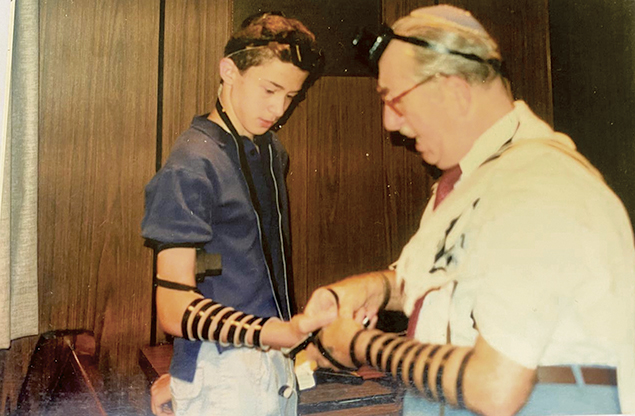
“As I became more and more interested and involved in the synagogue, they” — the synagogue leaders — “really encouraged me to take on more leadership. I used to go to a lot of services with my dad, and they would encourage me to read Torah and lead services.
“They didn’t talk a lot about their lives, but the Holocaust always was the background.”
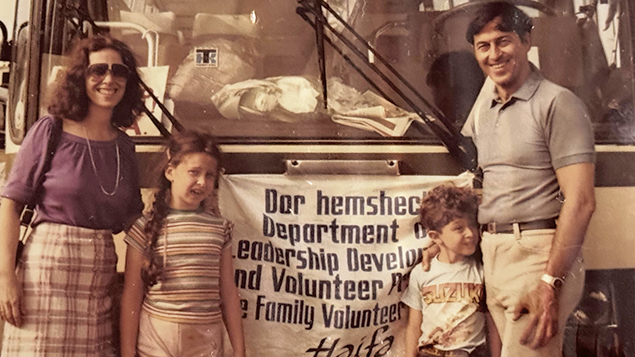
Mr. Hochberg went to an Orthodox day school, Westchester Day School in Mamaroneck, for elementary and middle school. “The school was very focused on activism, and I grew up in the final push of the Soviet Jewry movement. My parents were involved in it.
“When I was 10, my parents took me to the March on Washington for Soviet Jewry.” That huge rally, in 1987, saw about 250,000 people gather on the Mall; it was one of the largest rallies that Jews have held.
“It was a central moment of my childhood,” Mr. Hochberg said. “I had grown up on the soundtracks from the band Safam, and their freedom songs for the Jewish community. We would sing them in our school plays. The idea of being part of history, and of all Jews rallying together on behalf of our brothers and sisters around the world made a huge impact on me.”
Westchester Day School reinforced that sense of solidarity not only with Soviet Jews, but with Jews who had to be rescued from oppression and brought to freedom. “It must have been Operation Solomon in 1991, when I was in seventh or eighth grade,” he said. “I still remember the thermometer chart outside our principal’s office, raising funds to support the rescue of Ethiopian Jewry.
“This is what I grew up with.”
His own family had been in the United States since before World War I, Mr. Hochberg said, but “I felt this connection. Just a few years ago, I did some genealogical research and learned that my father’s family came from a shtetl in Poland next to Treblinka,” the notorious death camp.” Had his family not left Europe when they did, most likely they would have died there.
Mr. Hochberg went to Ramaz, on Manhattan’s Upper East Side, for high school. “At the end of every Yom HaShoah assembly — they were all beautifully organized — we would all stand up and hear a list of people’s family members who died in the Holocaust.
“There would be music playing in the background, and they would ask every person, every student who was the descendant of a survivor to leave the room first.
“I remember standing there. Half the room would leave. That was really one of the most powerful moments I’ve seen.
“All of this is what has driven me in my Jewish communal service — the notion of community and collective responsibility.”
After he graduated from Ramaz, Mr. Hochberg went to Columbia; although his family wasn’t far away, he lived on campus for the full student experience. “I was the president of what was then the Jewish Student Union — it wasn’t Hillel yet — and I was fascinated again with the idea that the Jewish community is a collection of diverse people. I had the goal of creating an environment where everyone could be Jewish in the way that they want to be Jewish, and to thrive and to care about each other.”
Mr. Hochberg majored in political science and wrote his senior thesis on the Soviet Jewry movement. “I looked at the struggle over loan guarantees for Israel to resettle Soviet immigrants as a lesson in the use of presidential power,” he said. In other words, he was interested in the pragmatic use of political power to achieve loftier goals. “It was the George W. Bush administration, and I was looking at how the Jewish community mobilized to push for loan guarantees and met resistance from the administration, and how that played out.”
After he graduated from college, Mr. Hochberg worked for the Anti-Defamation League for a year, and then went to Israel on a Dorot fellowship. (Dorot is a nonprofit Jewish organization that looks for young Jewish leaders and helps train them as they work for social justice.)
“That’s when I met my wife, Samantha Kur,” he said. Ms. Kur, who is from South Africa, is the longtime chair of the English department at Ma’ayanot Yeshiva High School for Girls in Teaneck.
Mr. Hochberg had been accepted to law school but deferred it for his year in Israel. When he got home, he began Harvard Law School, graduating in 2004.
Then, he said, “I had a legal career.” He clerked for the court of appeals in Maryland for two years, and then went to South Africa, with Ms. Kur and their oldest child, then a baby, for a yearlong clerkship at the Constitutional Court, the country’s Supreme Court equivalent. “It was amazing, and I also got to spend time with my in-laws,” he said.
When the family returned to the United States, they moved to Englewood. Mr. Hochberg worked for the white-shoe law firm Debevoise & Plimpton for a while, and then returned to public service, spending five years at the New York City law department, in a small unit, the Division of Legal Advice, that advises the mayor’s office and city agencies. “I did everything from environmental law to sanitation to Second Amendment issues,” Mr. Hochberg said. “It was really interesting.” He liked it, and he flourished.
But then, while he was working for the city, “I was chosen to be a Berrie Fellow, and that really was the turning point of my career.”
The Berrie Fellows Leadership Program — which since has changed focus — worked with young and young-ish leaders and people with clear leadership potential for two years, nurturing them as they blossomed into the leaders they seem to have been meant to be.
“That experience made me realize that what I am most passionate about is Jewish community,” Mr. Hochberg said. “It made me realize that I wanted to be a Jewish leader.
“So I worked for the Claims Conference for eight years,” he continued. He worked with Gideon Taylor, who is now its president but then was a lay leader. “I was brought on as the lead staff person to work with Gideon to revive a sister organization, the World Jewish Restitution Organization. I got really lucky. I was about to partner closely with this tremendous lay leader, and we worked to strengthen the organization, which is responsible for negotiating the return of property taken during the Holocaust from all countries outside Germany and Austria. Gideon was a tremendous mentor.”
Mr. Taylor is equally impressed by Mr. Hochberg.
“Evan is an outstanding Jewish professional who combines a sharp mind, a caring soul, and tremendous organizational ability,” he said. “He played a key role in many complicated and difficult Holocaust restitution negotiations. He is a terrific choice to deal with the great challenges that the Jewish community in general, and Jewish family services, in particular face today.”
“It was an amazing experience, the idea of pursuing justice, or what the Claims Conference calls a small measure of justice, for Holocaust survivors and their families,” Mr. Hochberg said. “When the Claims Conference representatives would press a case, “we would sit at a table, with the U.S. government, the Israeli government, Holocaust survivors and members of the local Jewish community. And on the other side of the table would be heads of state. Our job was to represent the Jewish people, on behalf of justice.
“One of the other things I saw at the Claims Conference, one of the things that I think is the most powerful about the organization, is our responsibility to Holocaust survivors.
“There are two important messages, and I think that too often we only focus on one of them.
“That first one, which we always focus on, which is super important, is the importance of memory while survivors are still around.
“But the other part, which I think is just as important, if not more important, is that we are the last generation that has the responsibility and the privilege of making sure that Holocaust survivors live out the end of their days in comfort and dignity. And to me, there’s really nothing more important that we as human beings, as Jews, can do.
“That was the focus of our work at the Claims Conference, and that is our focus here,” at JFCS, “as well,” Mr. Hochberg said. “There is a clear connection between that and what I’m doing now.
After the Claims Conference, Mr. Hochberg went to work for the Jewish Federations of North America, where he was the associate vice president and deputy director of Israel and overseas. “I was the point person for JFNA’s work outside North America,” he said.
“It’s the same through line. It’s the idea that we, as Jews living in the United States, are connected to Jews around the world, and have a responsibility to them. While I was there, I led the campaign to raise $9 million for the aliyah of 3,000 people from Ethiopia, and for humanitarian assistance for the people who stayed there.”
That was in 2021, during covid; Mr. Hochberg’s tenure at JFNA also included the wars in both Ukraine and Gaza.
And then, on July 14, Mr. Hochberg took over from Susan Greenbaum, who retired after many years at the head of JFCS, to do work that is both very similar and very different from what he’s done before, but work for which all his earlier jobs, as well as his early life, had prepared him.
“I’ve been working a lot in the international space,” he said. “There’s something special about working in my community. Our work is all around us. I don’t have to travel. I walk down the hall and I see our clients. There are people in the waiting room for mental health care. There are people buzzing downstairs for our food pantry. We have people going in and out for our older adult services. And then I go to Café Europa to see Holocaust survivors.
“So the through line is the same. It’s the notion that we have a responsibility for every person who lives in our community, and that each person matters.”
JFCS works with 400 Holocaust survivors, Mr. Hochberg said. Surprisingly, that number has gone up, not down, as 138 survivors who had not registered with JFCS before have learned about the organization as their need for support increases as they grow older. “It is an opportunity and a blessing to care for people we didn’t know about before,” Mr. Hochberg said. “Last year, even before those 138 people came in, we provided almost 250,000 hours of home care to survivors. It’s a crazy number.”
Most survivors live alone, and “each of those hours is an hour that someone gets help and is able to avoid falling and have food and walk around their house,” Mr. Hochberg said. “It’s a tremendous blessing to be able to offer this service.
“We have a unique ability as the organization in the Jewish community that is charged with caring for our neighbors, to be thinking about how we could be doing more and more to care for people. So I struggle a lot with the needs that we are not covering. Who are the people who don’t know about our services but could benefit from them? How can we reach them?”
The organization has four pillars, Mr. Hochberg said.
The first is older adults. “They may not be eligible for government benefits, and at the same time they might need guidance about how to get support. How to find a home care company, how to meet their other needs.” Their children also might need help as they try to help their parents.
The second pillar is mental health. “We serve 2000 families and individuals,” Mr. Hochberg said. “And I think a real challenge is that a lot of people think of us as a place for people who have financial needs — which is true — but at the same time, our mental health service is open for everyone. We offer the highest quality mental health care at an affordable price. So our vision is that more and more people who need mental health care know that they can come to us and they’ll be able to afford it, and also they will know that they will be getting high-quality care.”
That’s not only for older people, he added. There’s a teen health crisis; JFCS works with teens, and with families. It offers couples counseling. “And if you walk into our waiting room after school hours, you’ll see young children here as well.
“We’re here for everyone.”
The third pillar is helping people with food insecurity. “That’s been a real crisis, particularly over the last few weeks,” when the government shutdown, which since has ended, stopped SNAP benefits, Mr. Hochberg said.
“Our food pantry is unique in a few ways. It’s the only kosher food pantry in this area that has not only food but also other supplies, from toilet paper and paper towels to cooking supplies.”
The pantry is unique also in that it offers both choice and privacy, Mr. Hochberg continued. People shop online, volunteers bag their food, and then they drive in, ring a bell, and volunteers bring them the bags. “That way, we preserve people’s privacy and dignity,” he said. “I have no idea who uses the food pantry, because I don’t see them in the building.”
The fourth pillar is basic needs, “which range from career services to case management, assessing needs and helping people in different ways.
“What I think is really special is that each of these pillars and services are connected. This goes to the idea that we care about each person. So people often come to us asking for one of these services, and in assessing them we realize that they may have another need as well.”
Being a lawyer affords Mr. Hochberg a kind of overview of the organization, he said. “I’ve learned to have a collaborative approach. We have amazing professionals here, who are experts in each of the areas we cover. As a lawyer, I have a certain skill in looking outside a problem and thinking strategically. I’m looking at the community as a whole.
“And as a federation person, because of my work with JFNA, I have a real sense of the broader community. I want to develop partnerships with other organizations in the community, whether it’s schools or synagogues or other groups that are involved in different aspects of care. And I also want us to be thinking about how to go out and engage the community. How to meet people where they are and tell them about our services.”
It’s vitally important to be welcoming, Mr. Hochberg suggested; that’s not a lazy catchphrase — exactly which synagogue does not position itself as warm and welcoming? — but a truth. “People come to us at their most vulnerable moments,” he said. “When they take that tentative initial first step toward us, we need to be there to reach out to them and embrace them. We have to make them feel welcome.
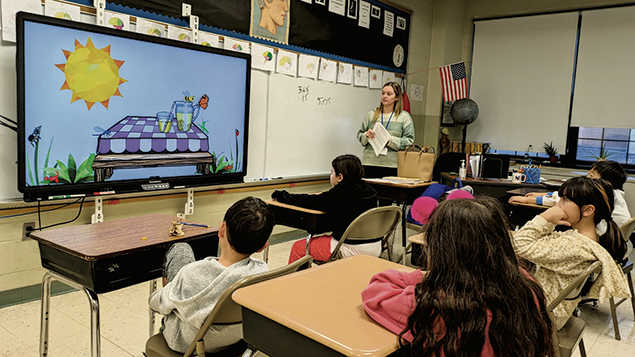
“That goes to everything in the building. I have lots of thoughts about how to make it more welcoming by doing a lot of what we’re doing already, which is making sure that every person feels valued and cared for. And a lot of this focus on excellence is from my federation background. It’s also looking at the impact of our work, assessing what’s working and what’s not working, and constantly thinking about how we can be most effective.”
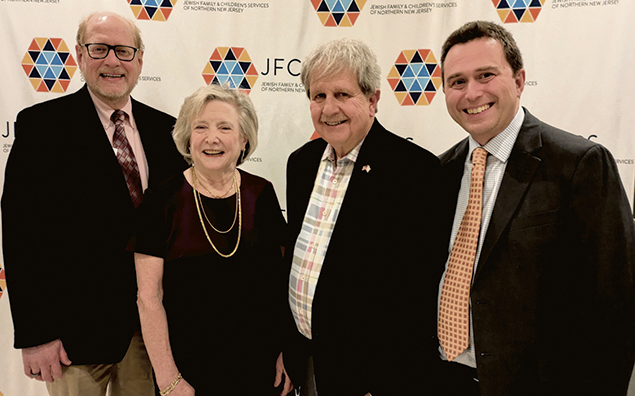
He talked about the annual meeting in the spring, where “everyone said farewell to Susan and welcomed me. My kids and my parents came too, and they immediately got the feeling that this is a family organization.”
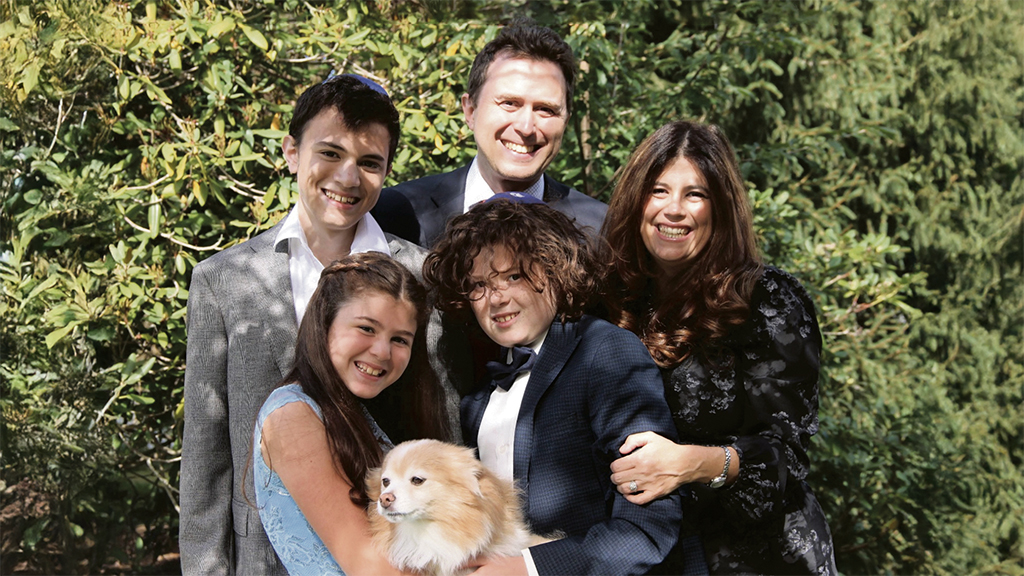
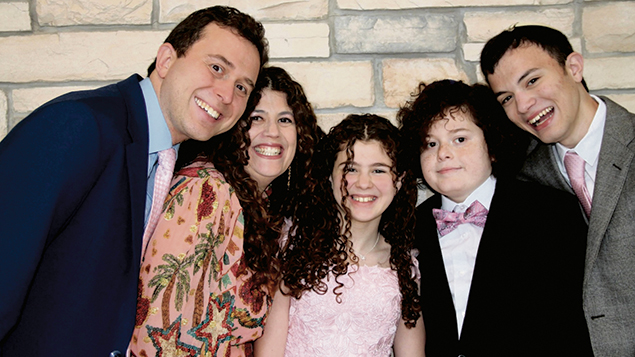
Mr. Hochberg and Ms. Kur have three children, he said proudly. “My oldest, Betzalel, is a senior at Brandeis. My middle one, Caleb, is a junior at Bi-Cultural Hebrew Academy of Connecticut in Stamford. My daughter, Sophie, is about to turn 15, and she is a freshman at Ramaz.”
Mr. Hochberg is excited about JFCS’s new strategic plan, which includes increasing its visibility, expanding its reach, and growing its professional staff, lay leaders, and fundraising.
These are ambitious goals, but if Mr. Hochberg’s combination of experience and passion continues to guide him, he — and JFCS — will meet them.
Learn more about JFCS at www.jfcsnnj.org.
comments