

Empires are ephemeral — ideas remain forever
Rabbi Chaim Seidler-Feller to speak at Davar this Shabbat
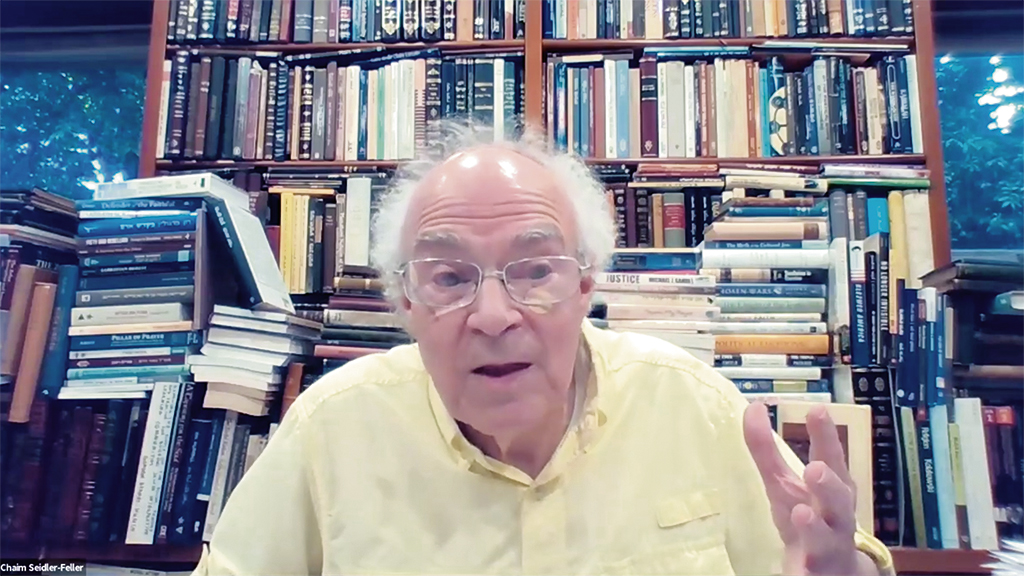
To anyone who ever has heard Chaim Seidler-Feller speak, the idea that he did so, even on a phone interview, with both great passion and great clarity would not be surprising. It’s what he does.
To add to the difficulty of the feat, he takes on explosive, important topics that demand precision and care.
Like, say, a return to the Zionism of the future.
Or to put it more straightforwardly, an examination of the relationship between the modern state of Israel, Jewish values, and power.
Rabbi Seidler-Feller, whose smicha is from Yeshiva University and whose 40-year-long career, from which he has now retired, was as head of Hillel at UCLA, and who now is a faculty member of the Shalom Hartman Institute, among other projects, will speak at Davar in Teaneck this Shabbat. (See box.)
His talk, based on a paper published last year in the journal Sources, examines a basic question. How can Israel, and the Jews who govern it, balance Jewish values and real-world political, economic, social, and cultural demands?
He quotes from a lecture by his teacher, Rabbi Joseph Soloveitchik. “The Jew has experienced persecution and brutality,” the Rav wrote. “We never had a state, we never had political power. What if we had been a state in the Middle Ages? How would we have acted — just like the feudal lords, or would we have acted differently because of Jewish values? Who knows?”
That talk was written in 1958; it was current then but seems prescient now.
What will Jews do with power, Rabbi Soloveitchik continued in that long quote. “Will we act like masters, or will we understand that Judaism doesn’t know the concept of master and slave, victor and vanquished, powerful and weak?
“This is my problem with regards to the State of Israel. The whole of Jewish history will be interpreted in terms of what the State of Israel will do in the next 50 years.”
“I’ve proposed that we need to return to the founders of religious Zionism, who were moderate and sensitive to the issues of power and nationalism,” Rabbi Seidler-Feller said. “They dealt with questions that we don’t talk about. They understood that engaging in the political enterprise required a confrontation with the elements of politics, and bringing religious teaching to bear on those elements.
“My contention is that if religion didn’t function as it does now in the state of Israel, as a manipulator of the government, it would function as a restraint on the excesses of power and nationalism. My contention is that we have to recover that spirit of religious Zionism, which understood that when we move from our diasporic experience of powerless to sovereignty, when we have power, our religious obligation is to be conscious of how power can be abusive.”
In his examination of the uses of political power, Rabbi Seidler-Feller turns to men whose ideas he cherishes; leaders whose ideas largely have been forgotten but whose power has not waned.
“One of my heroes is Moshe Avigdor Amiel, a student of Rabbi Soloveitchik’s grandfather,” who became the chief rabbi of Tel Aviv, Rabbi Seidler-Feller said. Rabbi Amiekl said that Amalek, the enemy of the Israelites, the existential enemy we are supposed to fight in every generation, “is not a people but is militarism, and that the Torah is teaching that we have to wage war against militaritarism. It’s a war against warfare.”
He quoted the founder of the Mizrachi party in Israel, Rabbi Yitzchak Yaakov Reines, “who was also a great darshan,” a great explicator and teacher of text, as taking the biblical hope, as Isaiah described it, that one day we turn swords into plowshares and spears into pruning hooks, and redefining plowshares as pens. “And you shall write books,” Rabbi Seider-Feller said. He quoted a famous midrash about the sword and the book coming down from heaven intertwined.
“Rabbi Reines said that you should smash your swords into pens, and you should write books,” he continued. “He said that the sword and the book are incompatible, and that the book will defeat the sword.”
How is that possible? “Because all the empires in the world have faded when they were defeated. In the end, their power was ephemeral. But ideas remain forever.”
A “primitive idea that we have to move away from” is the messianic vision of the land as inherently holy,” he continued. “We’re dealing with a large percentage of religious people who think that God promised us the land, the land itself is invested with divine holiness, and we have to use whatever means we have to hold onto the land.
“So how do we disabuse people of that worldview? Can we give them another worldview, that allows Israel still to be important — very important — in their lives because of the opportunities it provides, the Hebrew language, the culture. To take Rav Soloveitchik’s point, Israel provides people with meaning, with a way to apply Judaism to the full range of human experience, instead of being the end in itself.
“Instead of Judaism being only a religion that deals with pots and pans and how to pray, in the State of Israel you deal with life-and-death issues. What kind of an army do you have? How do you do social services?”
The messianic urge kills that, Rabbi Seidler-Feller said. When everything is seen in purely religious terms, then there is no room for culture, there’s no room for politics, there’s no room for technology. There’s no room for a society in which all these strands are braided like a challah; instead, it’s just monolithic.
His paper is complex, as his talk will be. But he is clear on his vision.
“I’m calling on the Orthodox community and all Jews with some religious sensibility to reclaim the ethical principles that inform Judaism and that were central to the founders of religious Zionism, so as to counter the despicable violence and the perversion of Judaism and Zionism that reigns today in the religious Zionist community and that is supported by a broad segment of modern Orthodoxy,” he said.
“Decoupling Israel and Zionism is vital to my approach. We need to understand that the nation state of Israel is not at all messianic. The messianists among us basically believe that anything is justified in the pursuit of the ultimate dream of redemption. They perpetrate evil in the name of God, acting as God’s army.
On the other hand, Rabbi Seider-Feller believes, when Israel can be seen as the place where Jews can work out how to use Jewish values and principles from of a position of real power, how to use power, how not to abuse it, how to live in a blinder-free world in truly Jewish ways, both the world and the Jews in it will flourish.
Who: Rabbi Chaim Seidler-Feller
What: Will be scholar in residence at Davar in Teaneck
When: This Shabbat, June 19-20. He’ll speak Friday night at 7 p.m., at Shabbat morning services at 8:15 and 10:45, and after mincha, which is at 5 p.m.
Where: At Davar in Teaneck
Who’s invited: Anyone who’s interested
For more information, including the address: Email Larry Krule at larrykrule@gmail.com