

Civil discourse isn’t dead, at least at TABC
Boys high school launches new curriculum modeling respectful engagement
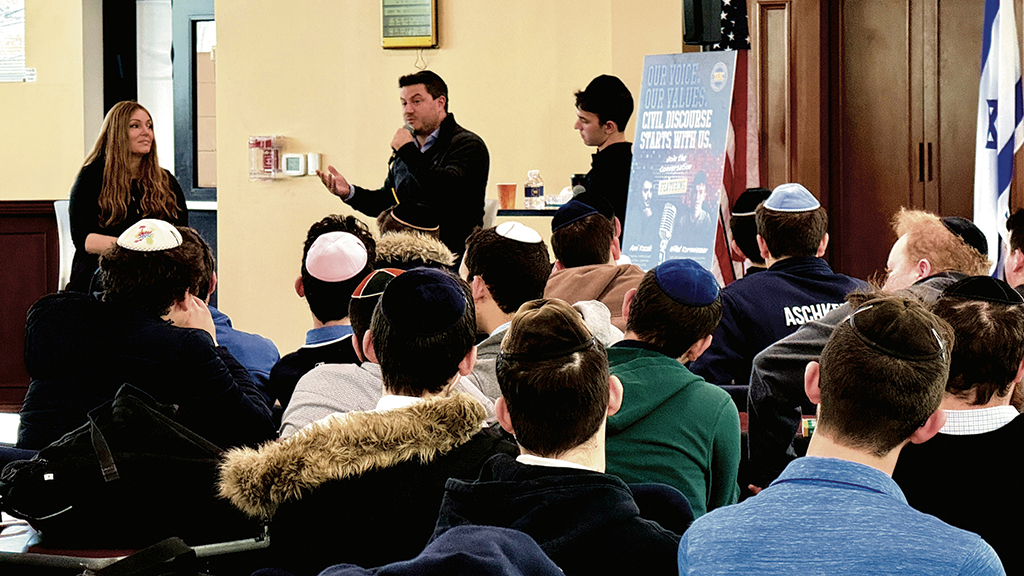
“For a number of years, there have been a lot of conversations in this country around the erosion of civil discourse and the need to do something about it,” Shoshana Schultz, dean of humanities at Torah Academy of Bergen County, said. And now, the Orthodox boys high school in Teaneck is doing something about it.
A new schoolwide multidisciplinary curriculum approaches civil discourse — defined as engaging in disagreement in public, in classrooms, and online in ways that expand knowledge and promote understanding — as a skill set that must be taught, modeled, and practiced.
“A lot of our recent alumni are facing tough conversations about Judaism and Israel on campuses and in digital spaces,” Ms. Schultz said. “Our current students are a few years away from going into college and workplaces wearing a kippah, and we want to prepare them to be engaged and capable in terms of Jewish advocacy. It’s a priority for us to guide them in navigating difficult conversations with clarity and courage, holding space for a plurality of viewpoints.”
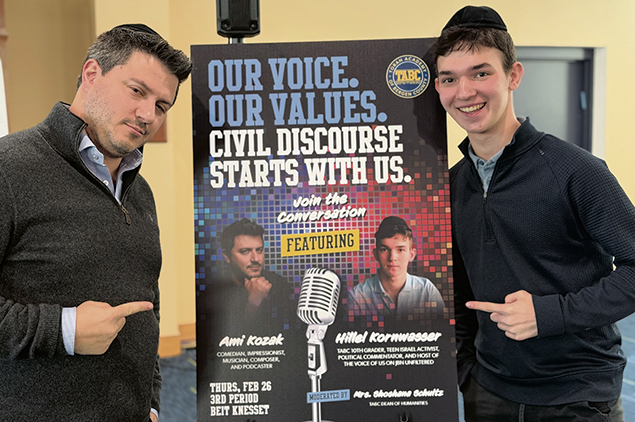
The curriculum that Ms. Schultz developed under the leadership of Rosh Yeshiva Rabbi Joshua Kahn and Head of School Rabbi Shlomo Stochel kicked off on February 26 with a presentation to all 310 students by comedian-musician Ami Kozak, TABC class of 2004, who grew up in Englewood, and Israel activist and political commentator Hillel Kornwasser of Teaneck, class of 2028 and host of “The Voice of Us” on Jewish Breaking News.
Mr. Kozak, who has more than half a million followers on his social-media channels, also hosts the “Ami’s House” podcast, which covers right-wing media, conservative politics, and Israel.
Ms. Schultz noted that Mr. Kozak exemplifies a political commentator who uses “derech eretz” — a Hebrew term for ethical behavior and common decency — in articulating his views while showing respect and consideration to guests who disagree.
“A lot of students crowded around Ami afterward to ask him what they can do to get involved,” she said. “One told him he’d engaged with an anti-Israel person and felt ill equipped to deal with what the other person said. Ami said, ‘The more you do and learn, the more capable an advocate you’ll become.’”
She said that Hillel impressed his peers “with the ability to speak about the issues with a sophistication he has gained from being in adult spaces.”
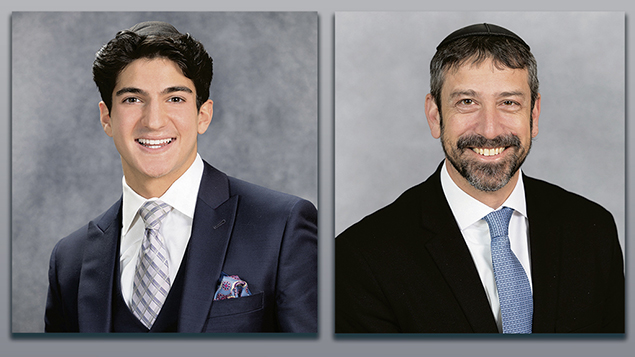
In 2024, Hillel, who is now 16, filmed a documentary, “Forces of Resilience,” about how Israelis were coping in the aftermath of the October 7 massacre. Since then, he’s branched out into high-visibility Jewish and Israel activism alongside adults such as Shai Davidai, a former Columbia Business School assistant professor.
Hillel talked about various confrontations he’s had with anti-Israel protestors. Once, one said to him, “Hitler should have killed more Jews.”
“I had a split second to decide if I would respond, and the tone I should take if I did respond,” Hillel said.
“The way I looked at it, you’re not going to change that kind of person’s mind, but if you engage him in passionate argument, you’ll have 10 or 20 people surrounding you and filming the encounter. Suddenly, you’re not talking only to him but you’re talking to the people around him and the people watching. That’s why it is crucial for high school students to have the knowledge and ability to respond. I can’t emphasize enough how important that is. We are entering a world where we will be presented with immense challenges. It’s not a matter of if, but when.”
Rabbi Kahn said that social media expose teens to “total polarization and an inability to engage in civil discourse.” In sharp contrast, as he teaches his students, the talmudic sages often disagreed with one another and yet accepted “that one person doesn’t have to be wrong for the other to be right.”
TABC’s approach to civics, he said, requires “the ability to engage in well-thought out, meaningful, and respectful dialogue without putting down the other person or their position; and bearing a civic responsibility to society at large — to Bergen County, to the United States, to our political process.”
He added that the high school was able to actualize “the vision and desire” to introduce a program on civil discourse through a donation from Pam and Ron Ennis of Teaneck, “who expressed real passion for this topic and wanted to help us make this vision into a reality.”
Created within the context of an overall “Kavod Creates Community” theme — “kavod” is Hebrew for honor or respect — the civil discourse curriculum has components of “think,” “speak,” and “act,” which are to be incorporated across disciplines from general to Jewish studies through the end of the academic year.
“Humanities teachers will teach media literacy because the starting point of civil discourse is how we consume information,” Ms. Schultz explained.
Skills to be imparted over three lessons include learning to vet sources and find those that are reliable; understanding how algorithms shape content exposure; evaluating how AI-generated content affects credibility, authorship, and persuasion; and identifying bias, misinformation, and emotional manipulation.
Judaic studies teachers will compare the ancient talmudic tradition of preserving disagreements, minority opinions, and multiple viewpoints “that are sincere even if incompatible,” Ms. Schultz said. “Democracy has the same essential elevation of discourse and disagreement that the rabbinic sages had. When discourse becomes about imposing and not engaging, you have an erosion of values that are both democratic and Jewish.”
On the other hand, she continued, “there are ideas and ideals that are not worthy of conversation, and that’s also part of the equation. If a speaker is demonizing, it’s okay not to engage.”
History teachers will train students in structured, evidence-based argumentation using a Lincoln/Douglas debate format in which debaters must argue both sides of an issue no matter which side they agree with. The Judaic studies faculty will run a study day looking at debate and civil discourse from a Torah perspective.
For the “act” component, Ms. Schultz and Rabbi Shua Katz, director of the school’s advanced Talmud program, formed a student-led Kavod Creates Community committee with representatives from each grade. The KCC decides on an actionable theme for each month; for March, the theme is Kavod Hamakom, respect for place, focusing on the school’s physical building and the people within it.
Twelfth-grader Aharon Barzideh of Bergenfield, TABC’s student council president, heads the committee.
“When Mrs. Schultz approached me about leading the KCC, I felt a sense of responsibility to step up,” Aharon said. “But to be completely honest, it wasn’t just about the role; the mission of the initiative resonated with me. The idea that a TABC student should carry himself in a way that makes people proud, that he’s not just a good student but someone who treats others and his surroundings with respect, is what sold me on the idea.”
He aims to make mutual respect “feel less like a rule and feel more like instinct” among his fellow students.
“Right now, we’re focused on things like taking care of our shared spaces, which entails cleaning up after ourselves and being mindful of the environment around us,” he said. “But the bigger picture is that we want students to internalize these values, not just perform them because they’re told to. If we can make respect and responsibility feel natural for every student, then we’ve accomplished our goal.”