

Bearing witness to brutality
Beth Sholom of Teaneck takes a civil rights trip to the Deep South
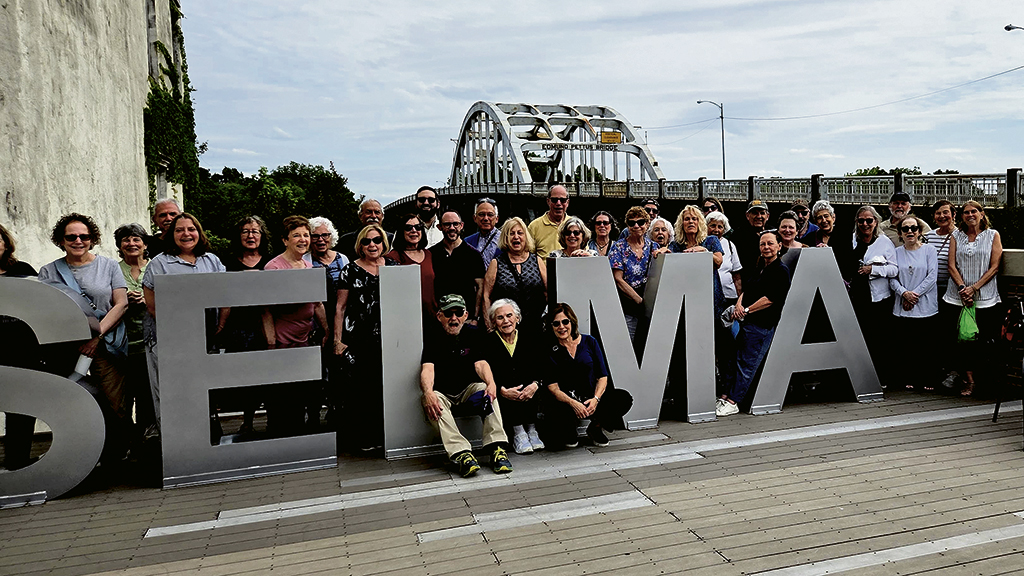
We finished the trip emotionally drained. The fact that 37 Jews sat together on a bus without talking attests to the fact that something powerful had happened, something we needed to process in silence. We had just concluded Day 3 of a civil rights trip to Alabama, coordinated by the Tzedek Tirdof Committee of Teaneck’s Congregation Beth Sholom.
Organized by Frieda Huberman and Judy Jaffe, the trip was a no-holds-barred examination of the civil rights struggle, what preceded it, and what followed. The journey, both physical and emotional, followed an itinerary laid out by Etgar 36, created by New York resident Billy Planner.
The Etgar website describes its mission as follows: “We meet with primary sources who were at the center of the Movement to hear their stories in order to learn about the strategies and lessons of the Civil Rights movement as a way of becoming empowered and inspired to get involved to create change today.” So far, more than 30,000 adults and teens have participated in Etgar trips.
Our group was led by Scott Fried, educator, author, and vast repository of knowledge about this period of history and many other human rights issues. As a Jew, he could relate to many of the special concerns we put forth — for example, the need to build time in the schedule for Mincha/Maariv so that one of us could say Kaddish, and the need to recite El Maleh Rachamim following a visit to the Lynching Museum, a brutal shorthand for the National Memorial for Peace and Justice and the Legacy Museum in Montgomery.
Why had the 37 of us come on this trip? Reasons varied. But whether driven by Jewish values, a desire to understand better an important part of American history, an interest in learning more about something we only read about as teens and young adults, or frustration because our government is undoing the very struggle we desired to know more about, we were open to finding out what actually had happened.
Ms. Jaffe said she had long desired to plan such a journey for her Hebrew high school students but had not been able to. When she retired in June, “I was determined to make it happen,” she said. “Fortunately, I belong to a very special, smart congregation.” She believes that “to be a witness to senseless brutality and ongoing bigotry is an obligation.” She cited the line by 19th-century poet Emma Lazarus, who wrote, “Until we are all free, we are none of us free.”
The Jewish content enhanced her experience, Mara Gruskin said. “Counting the Omer, a minyan for mourners to recite Kaddish, singing Jewish/Hebrew songs, reciting tehillim, our Birmingham synagogue visit, and other Jewish content, for me, added up to a more meaningful experience.”
Lyn Light Geller added that “as someone who was saying Kaddish, I can add how moving it was to be supported by our community during this experience — which my mother, for whom I am saying Kaddish, would have found so powerful.”
Mr. Fried also addressed the Jewish community’s tendency to mythologize its role in the civil rights struggle.

Carol Marcus admitted, “The truth is much more nuanced than I realized. Jews stood on both sides of the [Pettus] Bridge. Jews owned slaves. By not acknowledging those parts of the story, we are guilty of whitewashing history. The civil rights movement is not our movement. It’s not our story, not our history. We need to be careful to look at the role of the Jewish people honestly and not attempt to co-opt the story by highlighting one or two aspects of it that might make us look good.”
The word “etgar” means challenge, and Mr. Fried presented us with one almost immediately. He suggested that the much-used expression of comfort, “May his memory be for a blessing,” be replaced with “Make his memory a blessing,” committing ourselves to actualize the values of the deceased. In other words, a call to action.
Our trip took us to Birmingham — the most segregated city in the South, sometimes dubbed “Bombingham” — Montgomery, and Selma, and introduced us to people and places whose very names conjured up disturbing memories. For example, Kelly Ingram Park, where dogs and water cannons were trained on young schoolchildren protesting in place of their parents, who would lose their jobs if pegged as activists. The youngsters came back four days in a row after being injured and detained in jail, joining hands and singing to fight off their fear.
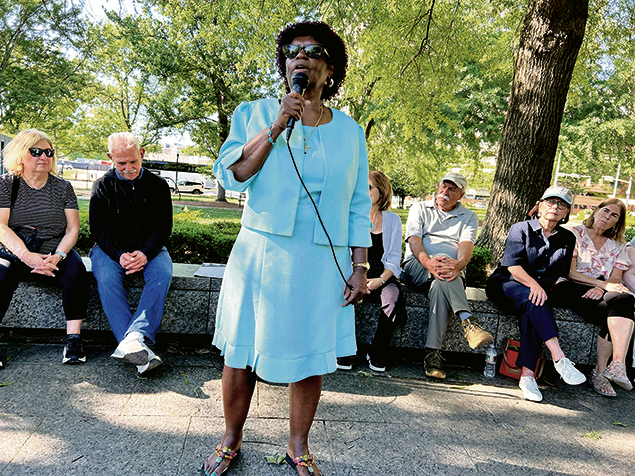
We visited the 16th Street Baptist Church, where four little girls, playing in the bathroom during a church service, became victims of a bomb placed below the church stairs. A fifth girl, Sarah Collins Rudolph, who survived the bombing that killed her sister Addie Mae and their friends, came forward only recently, when her PTSD subsided enough for her to do so. She said that she was hearing so many inaccurate stories about the tragedy that “I had to set the record straight.” Shy, partially blind from the explosion, and still startled by loud noises, she told us her story and answered our questions. Her book, “The 5th Little Girl,” recounts her experience.
CBS Associate Rabbi Louis Polisson was particularly moved by our meeting with Ms. Rudolph. “I was struck by her humility, faith, and love for her family,” he said. “She expressed no interest in vengeance or hatred. She just wanted to live her life — she wishes it had been with her sister alive. She cracked jokes, answered questions, and matter-of-factly told us the story of that terrible afternoon. But she had not a drop of hate or bitterness in her heart.”
We ate dinner at Birmingham’s Temple Beth-El, which has created a civil rights program of its own, with videos, printed information, and group activities. The synagogue, which in 1958 was itself a target — 54 sticks of dynamite, discovered by a Black janitor, were placed strategically beneath it — still stands because the dynamite did not detonate. Whether that was due to divine intervention, a faulty fuse, or a desire to scare rather than kill the congregants is still up for discussion.
A visit to the Rosa Parks Museum taught me that three young ladies had preceded Parks in refusing to give up their seats, but none were photogenic enough to represent the movement. Ms. Parks — well dressed, polite, older, lighter-skinned, and more educated — made a better symbol of resistance and was thus selected as the figurehead of that protest.
The idea of bearing witness was strongly fostered by an exhibit in the Rosa Parks Museum. One of its rooms holds a life-size replica of a bus, complete with passengers interacting with one another. Moving figures of white men challenge Ms. Parks for her seat and the befuddled robot driver who asks her to move is firmly told “No.” A robot playing a police officer comes aboard, arrests Ms. Parks, and leads her off the bus. The fact that we got to witness the entire scene made it visceral, personal, and something we will not forget.
Our subsequent trip to Selma and the march over the infamous Edmund Pettus bridge was somewhat less compelling than the stories we heard about Bloody Sunday, when marchers were trampled by horses and future civil rights icon John L. Lewis suffered a fractured skull. The fact that Jews were on both sides of the bridge — both marching and rebuffing the marchers — was a source of both surprise and shame.

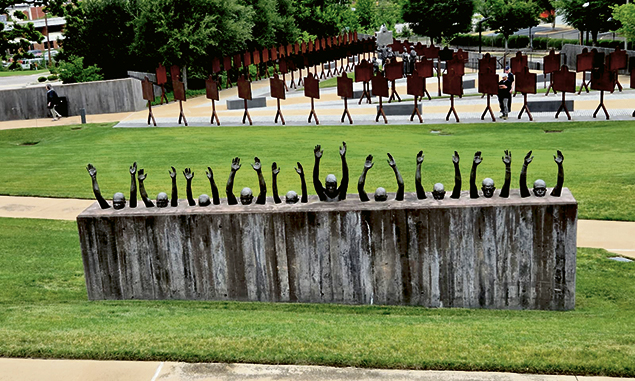
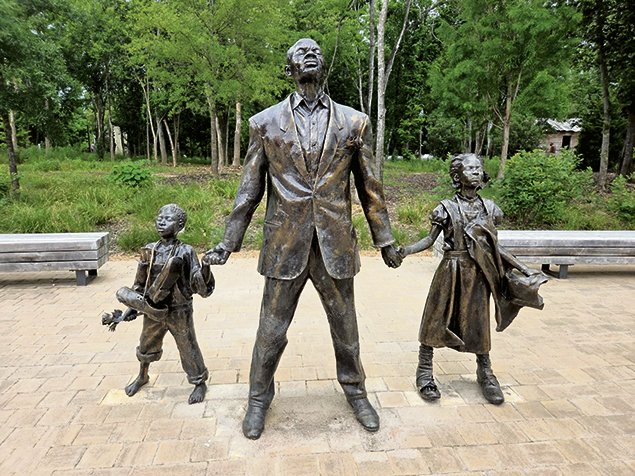
The hardest part of the trip were the museums created by Bryan Stephenson’s Equal Justice Initiative. Mr. Stephenson is an American lawyer, social justice activist, and law professor at New York University School of Law. He is also the founder and executive director of the Equal Justice Initiative. His museums are the Memorial to Peace and Justice and the Legacy Museum; he also created the sculpture garden.
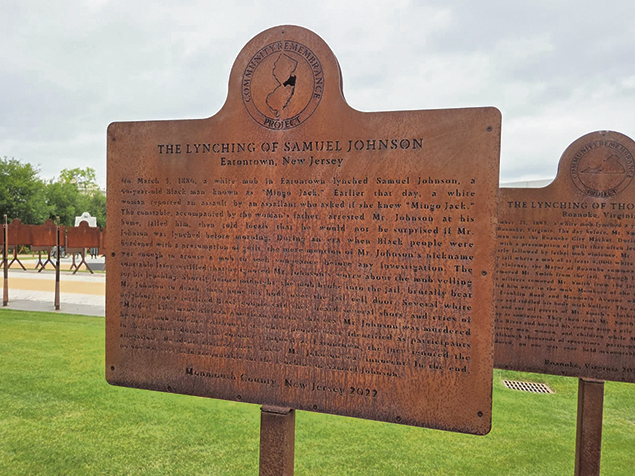
The Memorial to Peace and Justice — the first national memorial for victims of lynching — left us speechless as we walked through the vast array of pillars that carried the names of victims, categorized by the counties in which they were killed. I was particularly struck by the lynching of a schoolteacher who dared to reprimand white children who were throwing rocks at her. Lynching, we learned, did not always mean hanging. Rather, it was an instrument of racial terror, encompassing methods such as shooting, burning alive, and dismembering.
Finally, we saw from the pillars that lynchings occurred as recently as 1950, and in places as near to us as Eatontown, New Jersey, and New York City.
The artwork at the entrance to the Legacy Museum, a model of an ocean covered with small skulls, remains imprinted in my mind. Some 2 million abducted men and women died on the ocean voyage that brought them to our country. Unknown and unmourned, they speak to us from their graves. A horrifying image — though the 12 million who made it here might have wished for the same end had they known what awaited them.
Elaine Cohen, who initially proposed the trip to the committee, said, “What came to my mind as I walked silently through the museum was the haunting refrain of the well-known Hebrew song “L’chol Ish Yesh Shem” (“Every Person Has a Name”) which is often performed in Holocaust memorial remembrance ceremonies… bringing to our consciousness the awareness that every person once had a life of singular value, a unique story, a weave of connections.”
I learned that propaganda — so successfully used by Hitler in his efforts to dehumanize the Jews — was also employed here as part of the racial terror movement. Indeed, the very caricature of the black race as inferior, lazy, and criminal has helped bring about mass incarceration and the unequal administration of justice, shaping the country we live in today.
Sandra Rosenblum “was surprised and inspired by the bravery, humanity, and resilience of those who chose to lead the movement, the ability of the leaders to organize the movement, and the strength of the communities they organized.” And Susan Goldman, noting that “prior to this trip, my knowledge of the civil rights movement, as a Canadian growing up in Montreal, was purely cognitive,” said the visits “brought this cruel history alive, and I now feel it viscerally… That will remain with me forever.”
Ms. Geller said she was dismayed by all the harsh evidence of cruelty, yet simultaneously inspired by the power of bravery and faith. But she wondered why the comparisons between how the Black community was treated in this country and how the Jews were treated by the Nazis has not led to the two communities “overcoming our divisions and working together for justice.” Like several others, she marveled at the power of art “to stir emotions and tell a story.”
Recalling the horrors witnessed during the trip, Karen Kissileff asked, “Where were the ‘decent’ people in all this? Why didn’t anyone stand up to the mob? Where were the churches and church leaders?” She thought back to the Holocaust and the few people who helped the Jews, concluding, “I hope there are a lot of righteous people in our generation so that what happened in the not-so-distant past never recurs.”
On the bus ride to the airport at the conclusion of our trip, Alan Hantman wrote, “I can easily visualize our secure Bergen County world and contrast our life experiences with those we have tasted in Alabama and Atlanta.” He also paid tribute to “the meaningful artistic creations we saw both inside of formal museums and historic spaces and walking the streets of previously unknown towns and cities.”
Rozzie Hantman said she “believes we’ve moved from an intellectual understanding of the civil rights struggle to one that is more concrete, experiential, and emotional…. Perhaps we have each become a witness in ways we would not have previously imagined. But now, we’re left with the challenge of where do we go from here to begin healing our fractured nation.”
While the trip affected him in several ways, Rabbi Polisson was particularly struck “by the way the civil rights movement was built not only on the leadership of extraordinary visionary thinkers/speakers/leaders/organizers, but the power of ordinary relationships: family, friends, neighbors, and networks that extended all across the country. It took more than Dr. King alone. It took more than just the support of his wife and family. It took more than just Rosa Parks… It was people and communities all over the country… coming together to fight for equality and justice.”
The organizers expressed the hope that lessons learned on the trip would lead to further action. “I am thinking of the biblical verse, ‘Noah was a righteous person in his generation,’” Ms. Huberman said. “Why do some people step up, at great risk? The courage and commitment that everyday people displayed motivates me to continue to engage in both hands-on and advocacy work — particularly regarding voter engagement and voting rights. Our involvement can’t end with walking over the bridge — we have to do the hard work to strengthen our democracy.”