

At Yavneh, remembering with theater
Local couple endows school’s Holocaust fund
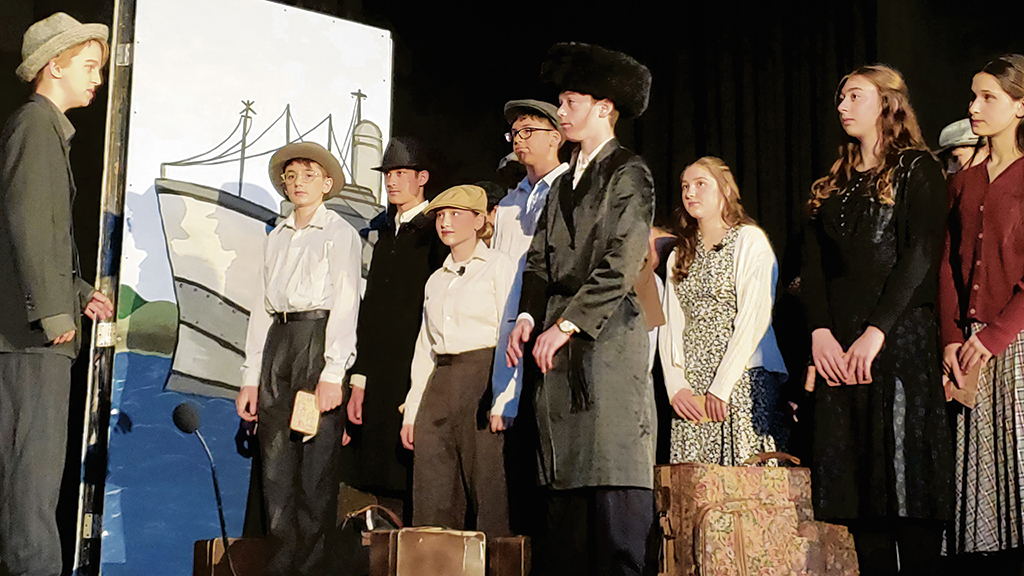
Teaching middle schoolers about the Holocaust is hard.
How do you talk to 13- and 14-year-olds about the most cataclysmically manmade evil possibly ever visited on the Jewish people without terrifying or coarsening them?
What if those eighth-graders are all Jewish, and many of them are the grandchildren of survivors? And most of them are related to victims, in ways that they’re likely never to know because all that family knowledge was lost too?
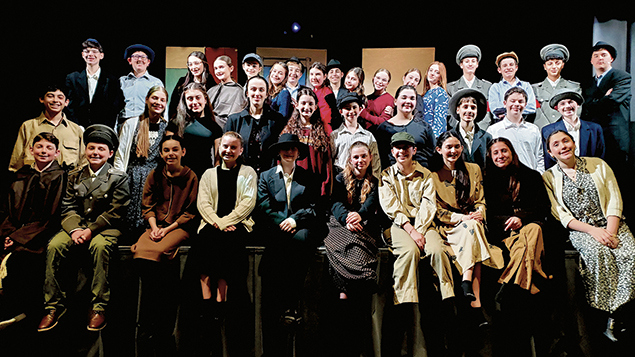
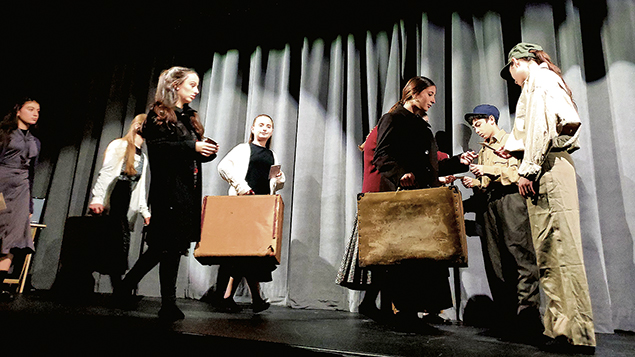
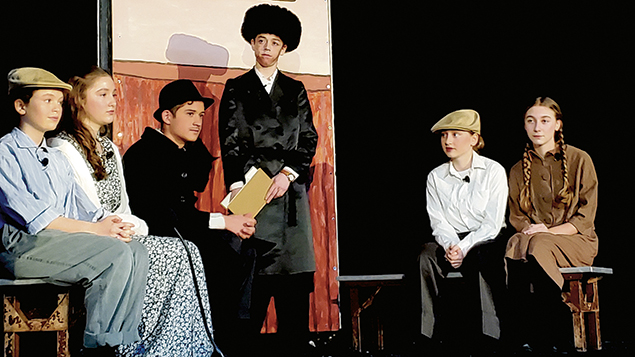
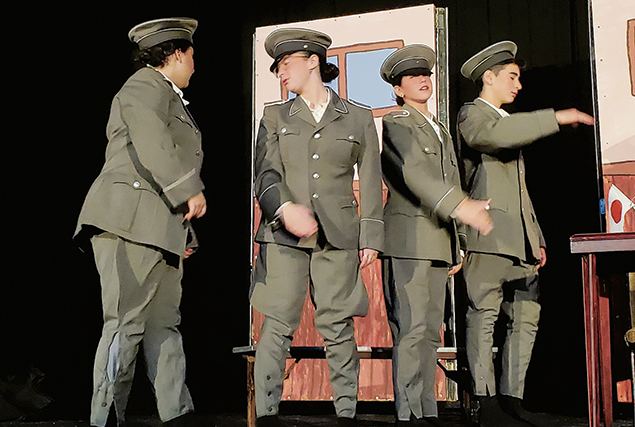
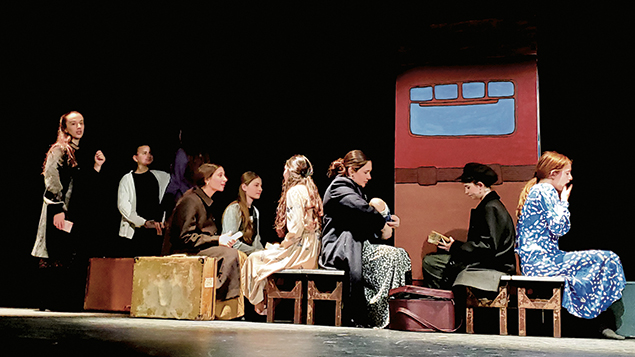
The Yavneh Academy in Paramus has taken on that monumental challenge and met it with creativity. For almost four decades now, in a program that’s been updated and refined to meet students’ needs, it has put on a student-written play about the Shoah every year.
Now, Nina Kampler and her husband, Dr. Zvi Marans, have established the Paul and Vicki Kampler Holocaust Education Program Endowment Fund.
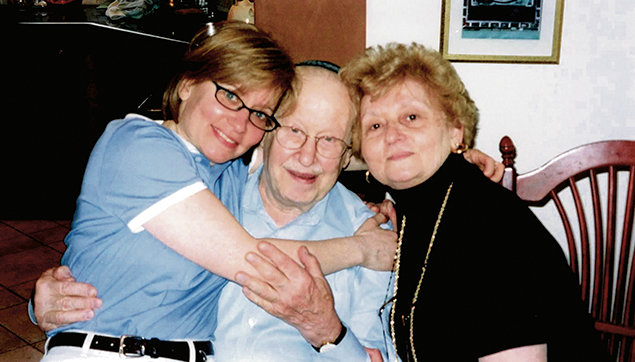
This fund accomplishes many goals at the same time. It gives both Ms. Kampler and Dr. Marans the opportunity to show their love for the school that’s educated all their children and now is teaching many of their grandchildren. It gives them a way to model generosity with not only money but also time and care that has led to this funding. It gives them the chance to honor Ms. Kampler’s parents, Shoah survivor Paul Kampler and his beloved wife and life partner, Vicki Kampler.
Ms. Kampler, a lawyer who spent many years working for Ralph Lauren — and who wore fabulous brightly colored glasses that picked up and played with the colors in the scarf around her neck — and now is a “restructuring and international broker expert,” grew up in Philadelphia. She met Dr. Marans, a pediatric cardiologist and rabbi’s son who grew up on Long Island’s South Shore, when she was in law school and he in medical school. They met on the phone, almost accidentally, they both said, and they couldn’t stop talking. They have been married for 43 years and had four children together.
Vicki Kampler was American-born, but her parents and older siblings were not; “she lost hundreds of relatives in the Holocaust,” her daughter said. “Her mother came to this country in the late 1920s. When she came, she said goodbye to 11 sisters and brothers. All her siblings and most of their children died in the Holocaust.
Paul Kampler was born in Frankfurt in 1920; he went to the premier Orthodox high school, the Samson-Raphael-Hirsch-Schule, which promoted both Torah and secular studies. “He was extremely ambitious and I daresay brilliant,” his daughter said. He studied there for an extra year, as top students did, but then his education was cut short as the Nazis tightened Jews’ lives, forbidding them more and more of life’s pleasures, and then of life’s necessities. “We have letters where they write about being exhausted by the boredom. They couldn’t go to school. They couldn’t go to work. They couldn’t even go to the movies. The were afraid. They tried to figure out how to get out, and every day they saw friends and neighbors getting visas but they were stuck. Their world shrank and shrank and shrank.”
In 1939, because he was a Jew of Polish descent born in Germany, and therefore stateless, Mr. Kampler was rounded up and sent to Sachsenhausen, a concentration camp in Germany, where somehow he survived for six years, until he was liberated in April of 1945.
“My father was able to survive through a series of fortuitous events and random divine luck, the stars somehow being aligned,” Ms. Kampler said.
She told one of those stories. He had been working in the brickmaking factory, a so-called “private enterprise” at the camp. He was “at death’s door, and he got his leg crushed, on purpose, by a railroad car. My father said he was going to die any minute, but there was a minuscule chance” that what did happen could happen.
What did happen was a miracle. There was a Red Cross infirmary there, to show visitors how humane the camp was; the brickmaking division’s fake private status meant that Mr. Kampler, as a worker there, was allowed to be treated. “So he scored that Red Cross bed, and he was nursed back to health over several months. Not only did he regain his strength, he was in the infirmary when every other Jew in the camp, including his father, was deported to Buchenwald.” Most of those Jews, including her grandfather, were murdered there.
“And during his time in the infirmary, my father learned to navigate the camp so deeply that he knew what kind of job to get to stay alive.”
When the Nazis sent the prisoners on a death march as the Allies approached, “my father hid under the barracks. He knew that he’d die on the death march, so he didn’t care if they found him and shot him there.” They didn’t. He was liberated by the Soviet army.
His mother also was murdered, but all his brothers and sisters survived. His sisters worked as domestics in Manchester, England. His parents had been married in London — because the Germans didn’t allow Jews to be married in Germany — and his sisters found their marriage certificate and sent him a copy. That allowed him to get the Russians to send him to the British sector, and eventually he made his way to the United States, where his brothers had gone before the war.
 He met Vicki Roth at the Pineview Hotel in the Catskills in 1956, they married in 1958, and they moved to Philadelphia. They had three children — Nina, Michelle Schwartz, who lives in Baltimore, and Mark Kampler, who made aliyah at 17.
“The Holocaust informed every single thing in my household when I was growing up,” Ms. Kempler said. “We dressed beautifully, and there was a great abundance of food — which was never to be wasted. And my parents lived with nonstop agency, because my parents felt that the gift of time was a blessing, to be shaped into a useful, productive existence. And it informed our commitment to Jewish life, because my father said that if Jews don’t live a full Jewish life, we will continue what Hitler began. We will wipe ourselves out by losing touch with who we are, as a unique nation.
“My father also stressed, in a way that is in my earliest memories but I didn’t begin to appreciate until I was an adult, that the most important thing that we could do is invest in Jewish education.
“We shouldn’t build museums and moments in memory of those who died, because, he said, that’s what we have as evidence of the Greek and Roman empires, which no longer exist. We have a vibrant culture and religion, which we must continue to perpetuate.
“And the only way to do that is through the vehicle of Jewish education.”
Her parents “were not wealthy people,” Ms. Kampler said, but their drive was unmistakable. Her father was a traveling salesman “for a company that was ahead of its time, selling hypoallergenic cosmetics, but by the early 1970s he taught himself to be a printer, and he opened a printing business.
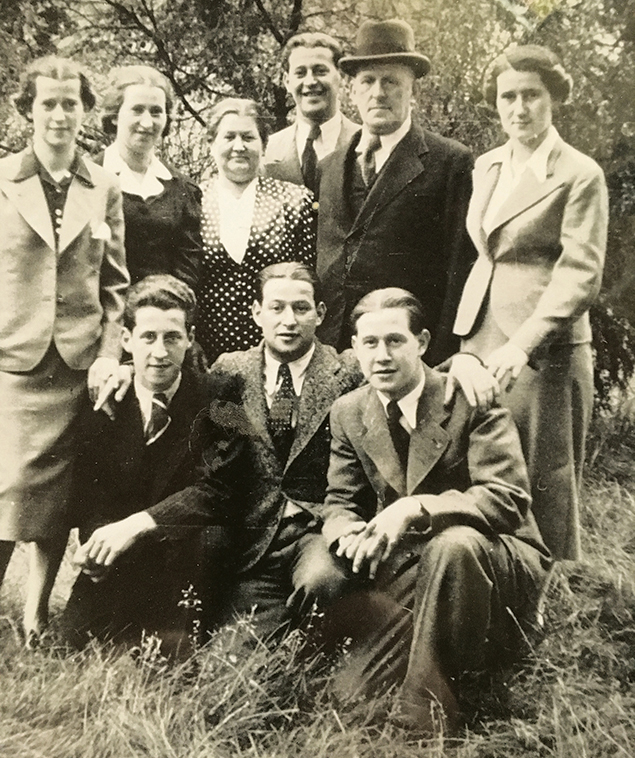
“We were not poor, but we did not take vacations. We did not go out to eat. We had a simple Holocaust-survivor household that invested in the food on the table, a Jewish education for the children, fine clothing, and tzedakah, not in frivolous joy for the moment that evaporated immediately.
“I was 17 and a first-year student at Penn before I met a Jewish person with grandparents who were born in America.”
“Another strong aspect was their strong Zionism,” Dr. Marans said. “Nina’s parents were very proud of the state of Israel, very supportive of Nina’s brother when he went to yeshiva in Israel and stayed there, and when he wanted to join the army.
“I happened to be home the day my brother, who was 17, in yeshiva, said he wanted to join the IDF. You had to get permission from your parents if you were under 18, so he called home and asked if they would say yes.
“It was the first time I saw my father weeping. He was a happy, positive, full-of-energy man. And his exact words, which I still hear in my ears till this day, were ‘I did not survive the Holocaust to say no to my son who wants my permission to join the Israeli army.’
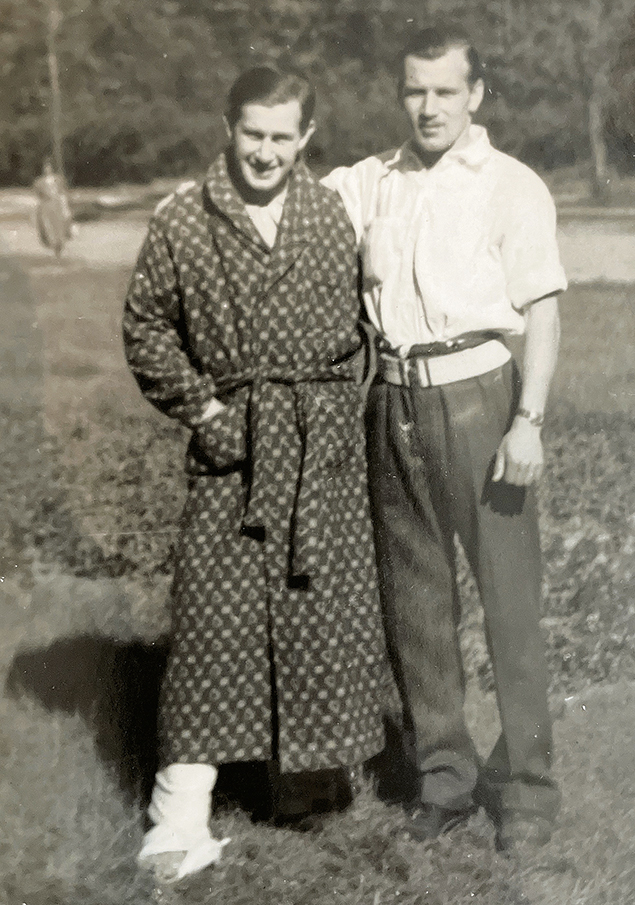
“It was complicated, because it was at a time when there was no money to travel back and forth to Israel, and he was a lone soldier before the expression ‘lone soldier’ existed, and except for a few relatives in Israel he was on his own, but my brother is like my father, independent, focused, and stubborn. He wanted to march forward, so he marched forward.
“Zvi and I both grew up in homes rich in Jewish tradition, with an emphasis on tzedakah,” Ms. Kampler summed up.
Paul Kampler died in 2005, and Vicki Kampler died in 2026. Their daughter and son-in-law thought about how to keep their names — and the lessons they taught through the lives they lived — alive.
“We are both very involved with the Jewish Federation of Northern New Jersey, and with lots of other Jewish organizations,” Ms. Kampler said. Dr. Marans is a former federation president, and both he and his wife have been on its board.
“And we are very involved with Yavneh. All our kids went there, three of our six grandchildren are there now, and the fourth will be there next year.
“So I turned to Zvi one day and said, ‘Our friends are starting to have conversations with their children about where they might want their money distributed when they die. What charities. But we have a blessing. We could control some of it in our lifetimes, and I think that we should think about taking some of the money that we want to use for charitable purposes and accelerate some of our giving, so we could be an example to our children and grandchildren in our lifetimes. We could be involved with the productive deployment of our resources in a way that reflects what is important to us.
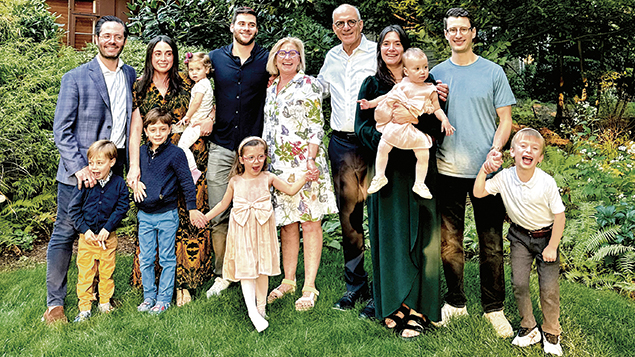
“It didn’t take us long to realize that my father was a hero, and all our kids went to Yavneh, and Yavneh has an amazing Holocaust program. We built the Judah Marans Music and Art Center there.” Dr. Marans’ and Ms. Kampler’s son Judah died in 2015, at 27.
“If my father’s whole goal, post survival, was to help ensure the continuity of the Jewish people and promote Jewish education, now we have the golden opportunity to facilitate a Holocaust education program at Yavneh, the wonderful school that our family is so invested in, is so proud of, and loves so much. We can build the Holocaust education program as a tribute not just to my father the survivor, but also his partner in life, my mother.
Dr. Marans explained why an endowment is so important.
“One of the signs of maturation in a Jewish community is its institutions’ ability to migrate from worry about annual budgets every year, and to start to think beyond long-term endowments. That includes capital campaigns. An endowment is a manifestation of a stable organization. I’ve noticed through federation that, over the past five years, organizations in our community have been starting to think about the long-term future, because they’re not struggling anymore.”
And on a personal level, that more abstract idea “dovetailed nicely with our wanting to make a nice gift to help the long-term program at Yavneh.”
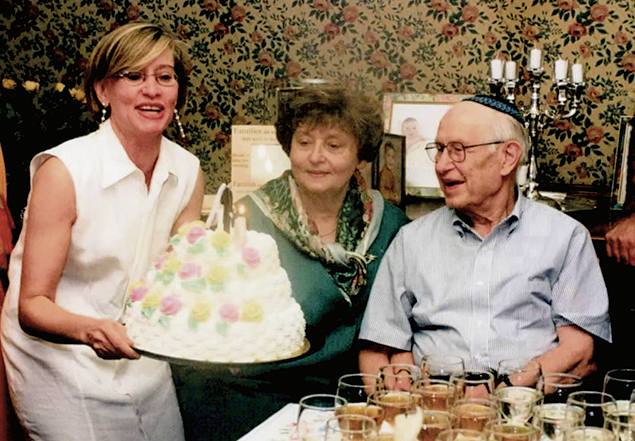
“Grandparents today are uniquely positioned to infuse capital and energy into our institutions,” Ms. Kampler said. “Young couples in their 30s and 40s are so overwhelmed building careers and lives that their resources of both time and money are much more constrained. I look back now at that time in our lives, when we got our first pre-K bill from the Yavneh Academy, and we looked at each other because we weren’t sure how we would pay it.”
They were okay. “We realized that we could pay it monthly, and therefore it was a digestible amount.” But it was a little scary.
“When we sent our kids to Yavneh, there were almost no multigenerational families there,” she continued. “But now, because of the growth of the Teaneck and Englewood community, and the proclivity of people’s children to stay in the community, you now have many people in their 30s and 40s who are Yavneh graduates sending their kids there. I know that it’s true of other local schools as well.
“So this is pregnant with possibilities for infusing resources from grandparents into the school. It’s not just an institution that we’re grateful to for educating our children, but now we have a front-row seat in watching our grandchildren continue in their parents’ footsteps. And as good as the school was then, it’s even better now.”
Both Ms. Kampler and Dr. Marans sit on Yavneh’s endowment committee, Dr. Marans said. “We have housed the endowment in the federation, so the federation manages the account and invests it. That’s very important, because it shows community participation and it also has a professional investment committee responsible, and there are guardrails.
“For Zvi and me, the marriage of federation and Yavneh is extraordinarily beautiful and comforting and meaningful,” Ms. Kampler said. “It brings together the two institutions in the community that are most important to us. They are the bedrock and the umbrella for everything that is important to Jews here and in Israel.
“Yavneh is my second home in this community,” she continued. “When I walk through its halls, I am comforted by the contextualized continuity of the Jewish community, where we can pass the baton from one generation to the next, and we are handing the Torah to the next generation and assuring our unique survival on this planet.”
It is striking how much Ms. Kampler sounds like her father. She is embodying continuity.
Robin Rocklin, the federation’s assistant executive vice president, is the managing director of the federation’s endowment foundation.
She explained that “the federation does more than manage endowment funds. As you might imagine, we have an endowment that is structured to invest assets for the long term. They are perpetual funds that will service the community, in addition to our own funds that benefit the federation.
“We also have restricted or designated funds, which the donors select, with our approval. Zvi and Nina came to us because they’re very community-minded. Zvi is a past chair of the endowment, and he sits on our investment committee. He’s very well-versed in how we operate.
 “So this is a restricted fund that we invest as part of our endowment, and annually we will make distributions to support the Paul and Vicki Kampler Holocaust program.”
The federation benefits in that it is fulfilling its mission, supporting community organizations. In this case, it’s supporting both Holocaust education and a local day school. “We feel very good to be able to provide this extra level of service to encourage and support Jewish education in northern New Jersey,” Ms. Rocklin said.
Jonathan Knapp is the head of school at Yavneh.
Even before he talked about Ms. Kampler’s and Dr. Marans’ gift to the school, Rabbi Knapp talked about them. “They are just the most remarkable, inspiring people,” he said. “They are brilliant, they are passionate, and they are so good at everything, so accomplished, so refined in everything they do.
“The family has been active in Yavneh for decades,” he continued. Their son Judah “was in eighth grade in 2002, my first year at Yavneh. He was the star of the play, and he was the student council president. So this is something that they believe in passionately.”
“The play” is the annual theatrical presentation about the Holocaust that the Kampler endowment will fund.
“This really speaks to their core beliefs,” Rabbi Knapp said. “How do we create the next generation of thoughtful, passionate, committed Jews, who understand their past and are inspired and motivated to create a beautiful Jewish legacy?”
The play “has been Yavneh’s signature for close to 40 years,” he continued. It was created by Rabbi and Yavneh Dean Emeritus Eugene Kwalwasser, who was the head of school for much of the time between 1997 and 2008, although the last few years he was a consultant; next, he made aliyah.
“Rabbi Kwalwasser was an educational visionary,” Rabbi Knapp said. “He had this idea to do something that was creative, was different, wasn’t classroom learning.” At the start, it was funded by a state grant; eventually the state’s priorities changed and the grant ended, but it had been invaluable in allowing the program to begin.
“In the ’80s, programs like these weren’t in vogue,” Rabbi Knapp continued. “People weren’t doing them. He was ahead of his time; he was a bold and creative thinker.
“Since then, we’ve grown the program, for a couple of reasons. First, the grades are so large — sometimes they have 80 to 90 students — and you want everybody to have a meaningful role. For some kids it’s being an actor, but now we also have children who learn how to write a play. A professional playwright comes in to teach them how to take a book and make it into a script, with dialogue. It’s a unique experience for eighth-graders.
“We now have an artifact museum. We have taught kids to make their own documentaries, to learn to tell personal stories, to find images, and to do research. We now also have children who design the scenery, create the set, and are stagehands.
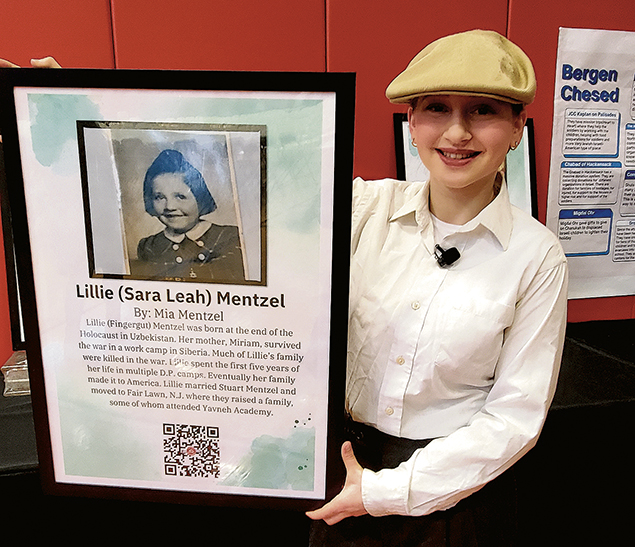
“But the play remains the anchor of the event.”
The goal is not to frighten the students but to give them some idea not only of the horrors of the Holocaust, but also of the daily realities of prewar, even pre-Nazi life in the shtetls and big cities and small villages of eastern and central Europe.
“About five or six years ago we got a gift of VR goggles and software,” Rabbi Knapp said; VR is virtual reality. “I was nervous about it, but I realized that other people are putting out content that is not historically accurate and not always complimentary.
“We had children learn how to create what prewar Jewish life looked like. We didn’t want it to be scary. We didn’t want it to be violent. We stayed away from violent images.”
He’s learned that when Yavneh graduates who haven’t known each other meet, “decades later, they ask what their story had been.” That is, what the Holocaust remembrance play had been.
“It’s a binding and bonding activity,” Rabbi Knapp said.
“What it really comes down to is what our values are. How are we communicating our values? How are we ensuring Jewish continuity?
“Of everything we do, at our core, that is what we’re about. I think that Zvi and Nina see that. They see the impact that this play has on kids, and they want to make sure that as time goes on, this signature event remains one of the pillars of our school.