

A town that remembers
Honoring the Righteous Gentiles of Tarnów
As Yom HaShoah is marked around the world — this year it begins at sundown on Monday, April 13, and ends at sundown the next day — it offers an opportunity to reflect on its meaning. It is a time to remember those who were murdered in the Shoah, as well as those who survived. The survivors’ resilience and testimonies remain enduring reminders of the capacity to persevere, even in the darkest of days.
In the decades following the war, enough survivors remained to bear firsthand witness to the horrors of the Holocaust. Today, as most of those survivors are no longer with us, the responsibility for preserving and sharing their stories has passed to the next generation.
Some survivors had positive encounters with non-Jews who played crucial roles in their survival. Recognizing the courage of non-Jews who risked their lives to rescue their Jewish neighbors, friends, and even strangers from the horrors of the Holocaust remains important.
Yad Vashem recognizes these righteous souls through the Righteous Among the Nations award, which has been bestowed upon individuals, including Poles, who demonstrated extraordinary courage in saving Jews during the Holocaust. Yet it remains uncommon for towns in Poland to extend the same recognition to their righteous citizens who saved Jews by erecting memorials and holding dedication ceremonies in their honor.
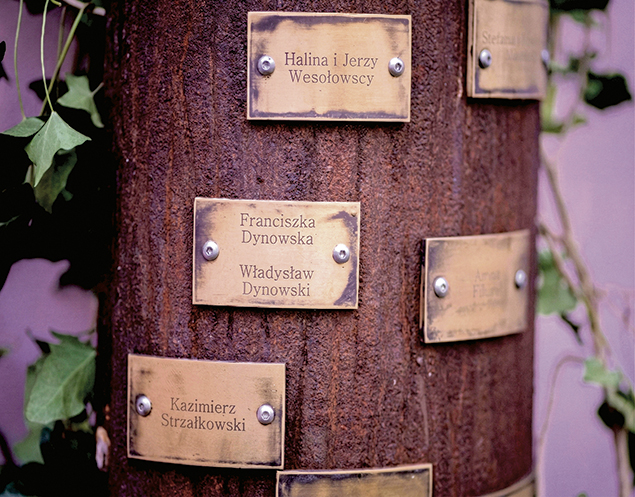
But recently, the city of Tarnów erected a public memorial to 29 righteous Christians who saved the lives of their fellow Jewish residents. The memorial is an artistic Tree of Life with the names of the Righteous Among the Nations awardees inscribed on the trunk. The mayor and local Jewish remembrance activists felt that it was important to put up this memorial in the plaza where a synagogue once stood and its bimah remains.
A dedication ceremony was held and gave the Polish city an opportunity to reflect on the extraordinary courage of the Tarnów righteous. At the dedication, speeches described some of the rescuers who courageously saved their fellow Jewish citizens. It was attended by local officials and by residents, including one whose Jewish mother was saved by a righteous gentile.
My own family experienced a brief encounter with a gentile rescuer. My mother-in-law, Frances Leder Kornmehl, worked outside the Tarnów ghetto and was able to move around outside during her work day. She managed to speak with her former apartment superintendent, who agreed to shelter her 3-year-old niece, Chaya Ricks.
With great difficulty, she brought the child to him. He kept Chaya for a few days, until the other apartment dwellers grew suspicious and made suggestive remarks to him. Fearful, he sent my mother-in-law a message that he needed to return Chaya to her family.
My mother-in-law survived the Tarnów ghetto and Auschwitz. Little Chaya did not survive; she died in Bełżec. My mother-in-law lost all her close relatives, more than 50 people, all of them murdered.
While our family’s encounter with a rescuer was limited, it prompted me to reflect on the role of rescuers who had a greater impact.
I did not have to look far. Yad Vashem had a list of Righteous Gentiles on their website. I found the testimonies of several Jews who had more favorable experiences with rescuers in Tarnów and connected with some of the families of the rescued.
The Freireich family, known in Tarnów for their hotel, had 11 daughters, including Lucia, who was born in 1918. During the war, Lucia was rescued by a non-Jewish acquaintance, Bronisław Zaczkiewicz, when her family was forced into the ghetto. In April 1942, he offered to hide her on the Aryan side — first in his parents’ apartment, and later in a basement hiding place he constructed as threats of denunciations increased. He provided her with food and other necessities at great personal risk until liberation in January 1945. After the war, Lucia married Bronisław. They remained in Poland and raised two daughters. She later served as the keeper of the Jewish cemetery key for many years.
In 1992, after he died, Lucia nominated Bronislaw for the Yad Vashem award. Lucia lived to 105, bearing witness to her husband’s extraordinary courage as one of the Righteous Among the Nations.
Cesia Weksler’s story of survival during the Holocaust is remarkable. She and her sister were hidden for two years in an attic crawl space of a mill owned by the Dagnan family in Tarnów. During that time, they were supported by the Dagnan family and by foraging at night when the mill was closed. Both sisters survived the war and later made aliya. The Dagnan family continues to honor the town’s Jewish residents today, with the son-in-law working as a stonemason restoring gravestones in the Jewish cemetery.
Cesia Honig was born in 1926 in Tarnów, Poland, and was saved by a chance encounter. Cesia worked in a saddle factory outside the Tarnów ghetto, and when a selection was rumored, her father warned her to escape and secure a hiding place. Cesia approached two brothers, Zbyszek and Lutek Mikovski, who worked at her factory. She was taken in by their family, who risked their lives to protect her. Cesia endured constant danger, including hiding in a chimney during a German search. The Mikovskis moved her to two different villages for safety, with Mr. Mikovski presenting her as his niece in attempts to protect her. She remained with the family until liberation in late 1944. Afterward, Cesia returned to Tarnów and continued her search for surviving family. She eventually reunited with distant relatives who brought her to the United States.
Cesia Honig, Lucia Freireich, and Cesia Weksler are three examples among 29 people who were rescued by individuals with moral courage during the Holocaust in a city in Poland. The dedication ceremony for the sculpted metal Tree of the Righteous recently gave Tarnów an opportunity to reflect on the courage of its Righteous Gentiles and to remember the survivors they saved. By honoring the rescuers with this memorial, the town continues to keep their stories alive and provides an enduring public reminder of their courage.
Dr. Jill Kornmehl’s interests focus on genealogy and the preservation of family memory. She administers the Tarnów Jewish Facebook page, coordinates the Tarnów yizkor books, and serves on the board of the Friends of Jewish Heritage in Poland. All her genealogical and remembrance work is dedicated to the memory of her in-laws, both Holocaust survivors from Tarnów. She lives in Teaneck.